Prurigo Nodularis Market Summary
- The prurigo nodularis market is anticipated to sustain a steady Compound Annual Growth Rate (CAGR) during the forecast period (2026–2036). The increasing recognition and diagnosis of prurigo nodularis, growing awareness of the disease, improved understanding of its underlying inflammatory and neuroimmune mechanisms, and the availability of novel targeted therapies primarily drive market growth across the 7MM.
- The approval of dupilumab (DUPIXENT) and nemolizumab-ilto (NEMLUVIO) has substantially expanded the treatment options available for patients with moderate-to-severe prurigo nodularis, shifting the market from reliance on topical and off-label systemic treatments toward approved, long-term systemic therapies. The presence of multiple approved options is expected to increase treatment rates among previously undertreated patients, support earlier initiation of systemic therapy, and drive greater market penetration over the forecast period.
- Investigational therapies are expanding the prurigo nodularis treatment landscape beyond currently approved therapies. Povorcitinib, an oral Janus kinase 1 (JAK1) selective inhibitor, is being evaluated in Phase III clinical development, while other investigational agents targeting JK pathways, type 2 inflammation, interleukin signaling, and neuroimmune mechanisms are being studied to provide additional systemic treatment options for patients with moderate-to-severe disease.
- A major unmet need in the prurigo nodularis market is the underdiagnosis and delayed recognition of the disease, driven by its overlap with other chronic pruritic dermatoses and the absence of standardized epidemiological assessment in many countries. This can result in patients remaining undiagnosed or untreated for prolonged periods, creating a substantial gap between the true disease burden and the diagnosed and treated patient population, and highlighting the need for improved disease recognition, standardized diagnosis, and systematic epidemiological surveillance.
- The future prurigo nodularis market is expected to become increasingly competitive as oral small-molecule therapies and additional biologic treatments progress through late-stage development. Competition is likely to center on magnitude and durability of itch reduction, reduction in nodule burden, speed of clinical response, convenience of oral versus injectable administration, safety with long-term treatment, and efficacy in patients inadequately controlled by existing therapies, which could influence treatment sequencing and future market share across the 7MM.
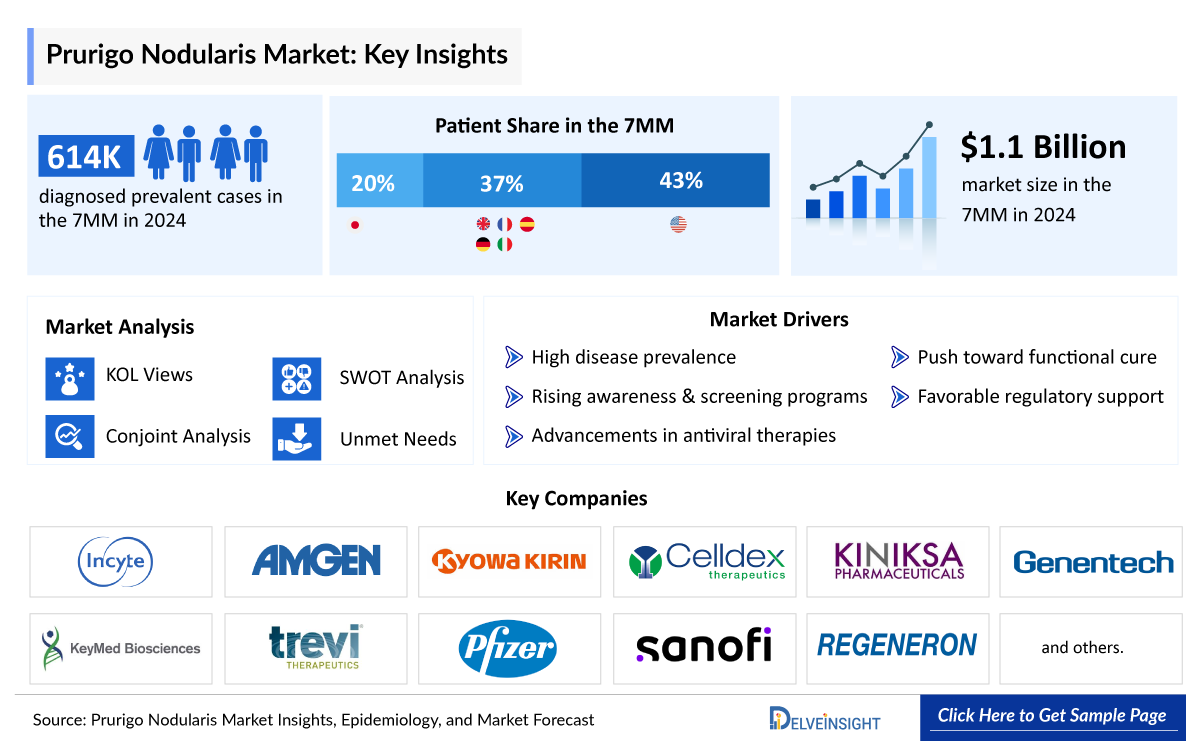
DelveInsight’s “Prurigo Nodularis Market Insights, Epidemiology, and Market Forecast – 2036” report delivers an in-depth understanding of prurigo nodularis, historical and forecasted epidemiology, as well as the prurigo nodularis market trends in the United States, EU4 (Germany, France, Italy, and Spain), the United Kingdom, and Japan.
The prurigo nodularis market report delivers a comprehensive analysis of the current treatment landscape, including standards of care, clinical practices, and evolving therapeutic algorithms. It evaluates, prurigo nodularis patient burden trends, revenue & market share dynamics, peak patient share & therapy uptake analysis, and provides an in-depth market size assessment and growth rate projections (Historical & Forecast 2022–2036) across the 7MM regions. The report highlights key unmet medical needs in prurigo nodularis and maps the competitive and clinical landscape to uncover high‑value opportunities, providing a clear outlook on future market growth potential.
Geography Covered
North America: The United States
Europe: Germany, France, Italy, Spain and the United Kingdom
Asia-Pacific: Japan
|
Study Period |
2022–2036 |
|
Historical Year |
2022–2025 |
|
Forecast Period |
2026–2036 |
|
Base Year |
2025 |
|
Geographies Covered |
|
|
Prurigo Nodularis Epidemiology Segmentation Analysis |
Patient Burden Assessment
|
|
Prurigo Nodularis Companies |
And more |
|
Prurigo Nodularis Market |
Segmented by
|
|
Analysis |
|
Prurigo Nodularis Understanding and Treatment Algorithm
Prurigo Nodularis Overview and Diagnosis
Prurigo nodularis is a chronic skin disorder characterized by the appearance of multiple, firm, itchy nodules on the skin, which are often the result of repetitive scratching or rubbing. These nodules can range in size and are typically found on areas like the arms, legs, back, and chest. The primary symptom of prurigo nodularis is intense pruritus (itching), which causes individuals to scratch, further aggravating the lesions and leading to thickened, scaly, or hyperpigmented skin. In severe cases, the nodules can ulcerate or become infected due to ongoing friction and trauma.
The diagnosis of prurigo nodularis is primarily clinical, based on the characteristic appearance of itchy, raised nodules on the skin. A healthcare provider will typically assess the patient's medical history, including any underlying conditions such as atopic dermatitis, kidney disease, or mental health issues that may contribute to the development of prurigo nodularis. A physical examination is conducted to evaluate the number, size, and location of the nodules, which are typically found on the arms, legs, and torso. In some cases, a skin biopsy may be performed to rule out other conditions, such as skin infections or malignancies, as the nodules may resemble other dermatologic disorders. Laboratory tests may also be conducted to assess for underlying systemic conditions, particularly in patients with suspected renal or hepatic disease.
Further details related to country-based variations are provided in the report…
Current Prurigo Nodularis Treatment Landscape
The treatment of prurigo nodularis focuses on relieving the intense itching and inflammation, while addressing the underlying causes if identified. First-line treatments typically include topical therapies such as potent corticosteroids to reduce inflammation and suppress the immune response. Topical calcineurin inhibitors, like tacrolimus, may also be used as an alternative to steroids, particularly for sensitive areas. Emollients and moisturizing creams are recommended to maintain skin hydration and prevent further irritation. For more severe cases, systemic treatments may be considered. Oral antihistamines can help reduce itching, while oral corticosteroids may be prescribed for short-term flare-ups. Immunosuppressive drugs like methotrexate, cyclosporine, or azathioprine are sometimes used to control inflammation in refractory cases. Phototherapy, specifically narrowband ultraviolet B (NB-UVB) light therapy, is another effective treatment option that can help improve symptoms by modulating immune function and reducing skin inflammation.
In cases where prurigo nodularis is associated with an underlying condition, such as kidney disease or psychiatric disorders, treating the primary illness may help alleviate the skin symptoms. Psychological support, including cognitive-behavioral therapy or counseling, may also benefit patients experiencing significant stress or anxiety related to the condition. Due to the chronic nature, a combination of therapies is often required to achieve symptom control and improve the patient’s quality of life.
Further details related to country-based variations are provided in the report…
Prurigo Nodularis Epidemiology
The epidemiology section of the prurigo nodularis market report offers information on the patient populations, including historical and projected trends for each of the seven major markets. Examining key opinion leader views from physicians or clinical experts can assist in identifying the reasons behind historical and projected trends. The diagnosed patient pool, their trends, and the underlying assumptions are all included in this section of the report.
This section also presents the data with relevant tables and graphs, offering a clear and concise view of the prevalence of prurigo nodularis. Additionally, the report discloses the assumptions made during the analysis, ensuring data interpretation and presentation transparency. This epidemiological data is valuable for understanding the disease burden and its impact on the patient population across various regions.
Key Findings from Prurigo Nodularis Epidemiological Analysis and Forecast
- The US contributed to the largest diagnosed prevalent population of prurigo nodularis, acquiring more than 40% of the 7MM in 2025.
- According to Kwatra et al. (2024), it is reported that the prevalence of prurigo nodularis ranges approximately 52.9 cases per 100,000 population in the US.
- The highest number of cases were found in the 65 years age group (~46%), followed by 25–44 year age group while the lowest number of cases was observed in <15 years age group.
- According to Kwatra et al. (2025), reported prevalence of prurigo nodularis was 3.32 per 10,000 (0.03%) in Germany.
- As per Igarashi et al. (2025), the prevalence of prurigo nodularis in Japan was estimated at 41 cases per 100,000 population.
Prurigo Nodularis Market Outlook
The prurigo nodularis therapeutics market is further expected to increase by the major drivers, such as the rising prevalence population, technological advancements, and upcoming therapies in the forecast period (2026–2036).
With ongoing research and continued dedication, the future holds hope for effective treatments and, ultimately, a cure for this challenging condition. According to DelveInsight, the prurigo nodularis market in the 7MM is expected to change significantly during the forecast period 2026-2036.
Prurigo Nodularis Drug Analysis & Competitive Landscape
The prurigo nodularis drug chapter provides a detailed, market-focused review of approved therapies and the emerging pipeline across Phase I-III clinical trials. It covers mechanism of action, clinical trial data, regulatory approvals, patents, collaborations, strategic partnerships upcoming key catalyst for each therapy, along with their advantages, limitations, and recent developments. This section offers critical insights into the prurigo nodularis treatment landscape, supporting market assessment, competitive analysis, and growth forecasting for the prurigo nodularis therapeutics market.
Approved Therapies for Prurigo Nodularis
Nemolizumab-ilto (NEMLUVIO/MITCHGA): Galderma /Maruho
Nemolizumab-ilto (NEMLUVIO/MITCHGA) is the first and only treatment that blocks IL-31 signalling, a key driver of itch, inflammation, and the formation of prurigo nodularis nodules, by relieving itch and reducing the urge to scratch, and allowing skin to heal. NEMLUVIO is intended for adults who have been diagnosed with prurigo nodularis.
- In 2024, nemolizumab received regulatory approvals in Japan and the US. Japan’s Ministry of Health, Labour and Welfare (MHLW) approved MITCHGA in March 2024 for patients aged 13 years and older with prurigo nodularis, while the US FDA approved NEMLUVIO in August 2024 for adults with prurigo nodularis.
- In 2025, nemolizumab received regulatory approvals in the UK and European Union. The UK Medicines and Healthcare products Regulatory Agency (MHRA) and the European Commission granted marketing authorizations in February 2025 for moderate-to-severe prurigo nodularis in adults who are candidates for systemic therapy.
|
Prurigo Nodularis Marketed/Approved Therapies | ||||||
|
Drug/Therapy |
Company |
Indication |
Molecule Type |
MoA |
RoA |
Marketed Region |
|
Nemolizumab-ilto (NEMLUVIO/ MITCHGA) |
Galderma/ Maruho |
Prurigo Nodularis |
Monoclonal antibody |
IL-31 receptor antagonists |
Subcutaneous (SC) |
US: 2024; EU: 2025; JP: 2024 |
|
Dupilumab (DUPIXENT) |
Sanofi/ Regeneron |
Prurigo Nodularis |
Monoclonal antibody |
IL-13/4 receptor antagonists |
SC |
US: 2022; EU: 2022; JP: 2023 |
Note: Detailed marketed therapies assessment will be provided in the final report…
Prurigo Nodularis Pipeline Analysis
Povorcitinib: Incyte
Povorcitinib is a small-molecule, highly selective JAK1 inhibitor being investigated by Incyte for the treatment of moderate-to-severe prurigo nodularis. Following positive Phase II results, Incyte initiated two pivotal Phase III clinical trials, STOP-PN1 and STOP-PN2, to evaluate povorcitinib in patients with prurigo nodularis. Phase III topline data are anticipated in the fourth quarter of 2026, representing the next major development milestone for the program.
|
Competitive Landscape of Pipeline Drugs | ||||||
|
Drug Name |
Company |
Highest Phase |
Indication |
RoA |
MoA |
Anticipated Launch in the US |
|
Povorcitinib |
Incyte |
Phase III |
Prurigo Nodularis |
Oral |
JAK 1 inhibitors |
Information is available in the full report |
|
Soficitinib (ICP-332) |
InnoCare |
Phase II |
Prurigo Nodularis |
Oral |
Tyrosine Kinase 2 (TYK2) Inhibitor |
Information is available in the full report |
|
XX |
XX |
XX |
XX |
XX |
XX |
XX |
Note: Detailed emerging therapies assessment will be provided in the final report…
Prurigo Nodularis Market Outlook
DelveInsight’s ‘Prurigo Nodularis – Market Insights, Epidemiology, and Market Forecast – 2036’ report provides a detailed outlook of the current and future prurigo nodularis market, segmented within countries, by therapies, and by classes. Further, the market of each region is then segmented by each therapy to provide a detailed view of the current and future market share of all therapies.
Prurigo Nodularis Market Size by Countries
The prurigo nodularis market size is assessed separately for various countries, including the US, EU4 (Germany, France, Italy, and Spain), the UK, and Japan. In 2025, the US held a significant share of the overall 7MM (Seven Major Markets) prurigo nodularis market, primarily attributed to the country’s higher prevalence of the condition and the elevated cost of the available treatments. This dominance is projected to persist, especially with the potential early introduction of new products.
Prurigo Nodularis Market Size by Therapies
Prurigo Nodularis market size by therapies is categorized into current and emerging markets for the study period 2022–2036.
Note: Detailed market segment assessment will be provided in the final report.
Prurigo Nodularis Drug Uptake
This section focuses on the sales uptake of potential of prurigo nodularis drugs that have recently been launched or are anticipated to be launched in the prurigo nodularis market between 2022 and 2036. It estimates the market penetration of prurigo nodularis drugs for a given country, examining their impact within and across classes and segments. It also touches upon the financial and regulatory decisions contributing to the probability of success (PoS) of the drugs in the prurigo nodularis market.
The emerging prurigo nodularis therapies are analyzed based on various attributes such as safety and efficacy in randomized clinical trials, order of entry and other market dynamics, and the unmet need they fulfil in the prurigo nodularis market.
Note: Detailed assessment of drug uptake and attribute analysis will be provided in the full report on Prurigo Nodularis
Prurigo Nodularis Market Access and Reimbursement
DelveInsight’s ‘Prurigo Nodularis – Market Insights, Epidemiology, and Market Forecast – 2036’ report provides a descriptive overview of the market access and reimbursement scenario of Prurigo Nodularis.
This section includes a detailed analysis of the country-wise healthcare system for each therapy, enlightening the market access, reimbursement policies, and health technology assessments.
Key Opinion Leaders (KOLs) Views
To keep up with current Prurigo Nodularis market trends and fill gaps in secondary findings, we interview KOLs and SMEs’ working in the Prurigo Nodularis domain. Their opinion helps understand and validate current and emerging therapies and treatment patterns or Prurigo Nodularis market trends. This will support the clients in potential upcoming novel treatments by identifying the overall scenario of the market and the Prurigo Nodularis unmet needs.
Prurigo Nodularis: KOL Insights
DelveInsight’s analysts connected with 30+ KOLs to gather insights; however, interviews were conducted with 15+ KOLs in the 7MM. These KOLs were from organizations, institutes, and hospitals, such as Massachusetts General Hospital, University of California San Francisco Medical Center, Institute for Health Services Research in Dermatology and Nursing, University Hospitals Cleveland Medical Center, Miller School of Medicine and Miami Itch Center and University of Maryland among others.
|
Region |
Key Opinion Leaders (KOLs) and Subject Matter Experts (SMEs) |
|
United States |
“Prurigo Nodularis is a chronic neuroimmune skin disease characterized by persistent, often severe pruritus, repeated scratching, and the development of firm pruritic nodules. The condition should be assessed beyond the visible skin lesions, with evaluation of itch intensity, disease burden, quality of life, sleep disturbance, and associated systemic or psychiatric comorbidities. Management should be individualized according to disease severity, comorbidities, and previous treatment response, while addressing both the neural and immune mechanisms underlying chronic itch.” |
|
Germany |
“Treatment of prurigo nodularis should be individualized according to disease severity, with the primary goals of controlling persistent pruritus, interrupting the itch–scratch cycle, and promoting healing of nodular lesions. Management may include topical therapies, phototherapy, and systemic antipruritic or immunomodulatory treatments, while dupilumab represents an established targeted systemic option for adults with nodular prurigo in Germany.” |
Note: Detailed assessment of KOL Views will be provided in the full report on Prurigo Nodularis
Competitive Intelligence Analysis
We conduct a Competitive and Market Intelligence analysis of the Prurigo Nodularis Market, utilizing various Competitive Intelligence tools such as SWOT analysis and Market entry strategies. The inclusion of these analyses is contingent upon data availability, ensuring a comprehensive and well-informed assessment of the market landscape and competitive dynamics.
Prurigo Nodularis Pipeline Development Activities
The report offers an analysis of therapeutic candidates in Phase II and III stages and examines companies involved in developing targeted therapeutics for prurigo nodularis. It provides valuable insights into the advancements and progress of potential treatments in clinical development for this condition.
Pipeline Development Activities
The report covers information on collaborations, acquisition and merger, licensing, patent details, and other information for emerging prurigo nodularis therapies.
Prurigo Nodularis Report Insights
- Prurigo Nodularis Patient Population
- Therapeutic Approaches
- Prurigo Nodularis Pipeline Analysis
- Prurigo Nodularis Market Size and Trends
- Prurigo Nodularis Market Opportunities
- Impact of Upcoming Therapies
Prurigo Nodularis Report Key Strengths
- 11 Years Forecast
- The 7MM Coverage
- Prurigo Nodularis Epidemiology Segmentation
- Key Cross Competition
- Highly Analyzed Prurigo Nodularis Market
- Prurigo Nodularis Drugs Uptake
Prurigo Nodularis Report Assessment
- Prurigo Nodularis Current Treatment Practices
- Unmet Needs
- Prurigo Nodularis Pipeline Product Profiles
- Prurigo Nodularis Market Attractiveness
Key Questions
- How common is prurigo nodularis?
- What are the key findings of prurigo nodularis epidemiology across the 7MM, and which country will have the highest number of patients during the study period (2022–2036)?
- What are the currently available treatments for prurigo nodularis?
- What are the disease risk, burden, and unmet needs of prurigo nodularis?
- At what CAGR is the prurigo nodularis market and its epidemiology is expected to grow in the 7MM during the forecast period (2026–2036).
- How would the unmet needs impact the prurigo nodularis market dynamics and subsequently influence the analysis of the related trends?
- What would be the forecasted patient pool of prurigo nodularis in the 7MM covering the United States, EU4 (Germany, France, Italy, and Spain), the UK, and Japan?
- Among EU4 and the UK, which country will have the highest number of patients during the forecast period (2026–2036)?
- How many companies are currently developing therapies for the treatment of prurigo nodularis?
Reasons to buy
- The report will help in developing business strategies by understanding the latest trends and changing treatment dynamics driving the prurigo nodularis market.
- Insights on patient burden/disease prevalence, evolution in diagnosis, and factors contributing to the change in the epidemiology of the disease during the forecast years.
- To understand the existing market opportunity in varying geographies and the growth potential over the coming years.
- Distribution of historical and current patient share based on real-world prescription data along with reported sales of current treatment in the US, EU4 (Germany, France, Italy, and Spain), the United Kingdom, and Japan.
- Identification of strong upcoming players in the market will help in devising strategies that will help in getting ahead of competitors.
- Detailed analysis and ranking of class-wise potential current and emerging therapies under the attribute analysis section to provide visibility around leading classes.
- Highlights of access and reimbursement policies of approved therapies, barriers to accessibility of off-label expensive therapies, and patient assistance programs.
- To understand the perspective of key opinion leaders around the accessibility, acceptability, and compliance-related challenges of existing treatment to overcome barriers in the future.
- Detailed insights on the unmet needs of the existing market so that the upcoming players can strengthen their development and launch strategy.