
Radial Artery Compression Devices Market Summary
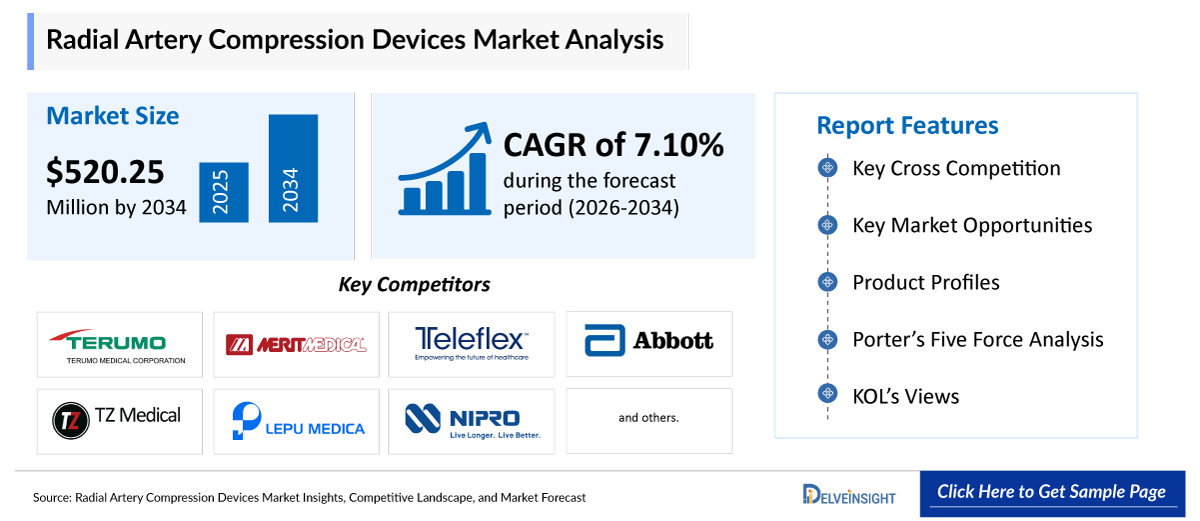
- The global radial artery compression devices market size was valued at USD 280.61 million in 2025 and is projected to reach USD 520.25 million by 2034.
- The market is expected to expand at a CAGR of 7.10% during the forecast period 2026-2034, supported by the rising prevalence of cardiovascular disorders, the increasing adoption of transradial access, and continuous technological advancement in device design.
- By product type, the band-based compression devices segment dominated the radial artery compression devices market with a 50% share in 2025.
- By usage type, the disposable devices segment dominated the radial artery compression devices market with a 70% share in 2025.
- By end-user, the hospitals segment dominated the radial artery compression devices market with a 60% share in 2025.
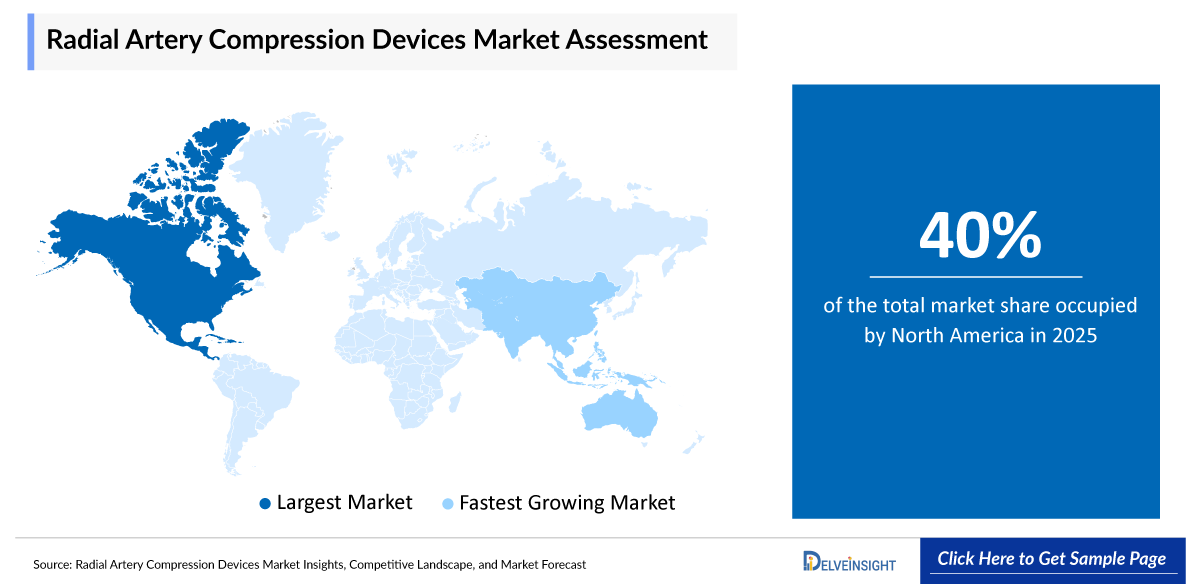
- North America accounted for the largest share of the radial artery compression devices market at 40% in 2025, while Asia-Pacific is anticipated to register the fastest growth through 2034.
Radial artery compression devices are medical tools used to achieve hemostasis after transradial procedures such as coronary angiography or percutaneous coronary intervention. They apply controlled pressure over the radial artery at the wrist to prevent bleeding or hematoma formation while maintaining arterial patency, and they are designed for safety, patient comfort, and ease of use, often incorporating adjustable pneumatic or mechanical mechanisms to optimize compression duration and reduce complications. The market is organized by the mechanism by which pressure is applied and the manner in which the device is used. Band-based systems, the largest category, encircle the wrist and apply pressure through an inflatable balloon or adjustable strap, permitting graduated pressure release and direct visualization of the puncture site through transparent materials.
Disc-based devices concentrate force through a rigid compression disc positioned over the arteriotomy, and plate-based systems distribute pressure across a flat contact surface secured by a fastening mechanism. By usage, the market divides between single-use disposable devices, which eliminate reprocessing and cross-contamination risk, and reusable systems retained for repeated application. The defining clinical objective across all designs is patent hemostasis, meaning the arrest of bleeding while antegrade flow through the radial artery is preserved, since occlusion would preclude future access. The contemporary market is defined by the continued migration from femoral to radial access, the extension into distal radial approaches, and the emergence of automated and sensor-enabled compression.
Radial Artery Compression Devices Market Key Growth Drivers
- Rising prevalence of cardiovascular disorders, with DelveInsight estimating that 314 million people worldwide were living with coronary artery disease in 2022.
- A large peripheral artery disease population, with DelveInsight estimating that some 200 million individuals globally were affected.
- A substantial United States patient base, with DelveInsight estimating some 20.45 million people living with coronary artery disease and some 47% of the population carrying at least one major cardiovascular risk factor.
- The increasing adoption of transradial access, which significantly lowers the risk of major bleeding and vascular complications relative to femoral access.
- Faster recovery and improved patient comfort, since patients can sit up and move immediately after a transradial procedure, supporting quicker ambulation and shorter hospital stays.
- Cost-effectiveness for providers, as shorter hospital stays and reduced recovery room occupancy generate substantial savings and support same-day discharge pathways.
- Continuous technological advancement in device design, including patient-friendly ergonomic bands, distal radial access compatibility, and smart compression systems with automated pressure adjustment.
Key Companies in Radial Artery Compression Devices Market
The competitive field is fragmented, comprising established interventional cardiology companies whose compression bands accompany their broader transradial access portfolios, alongside focused hemostasis specialists and a substantial tier of cost-competitive regional manufacturers. The leading participants in the radial artery compression devices market include the following:
- Terumo Corporation
- Merit Medical Systems Inc.
- Teleflex Incorporated
- Abbott Laboratories
- TZ Medical Inc.
- Lepu Medical Technology (Beijing) Co. Ltd.
- Medtronic plc
- Nipro Medical Corporation
- Meril Life Sciences Pvt. Ltd.
- Advanced Vascular Dynamics, and others
- For illustrative purposes, only the top 10 companies are listed in the Table of Contents. The report may include analysis and references to additional companies relevant to the market assessment.
Radial Artery Compression Devices Market Size
The following table summarizes the headline market metrics for the global radial artery compression devices market across the base year and the forecast horizon.
|
Report Metrics |
Details |
|
2025 Market Size |
USD 280.61 million |
|
2034 Projected Market Size |
USD 520.25 million |
|
Growth Rate (2026-2034) |
7.10% CAGR |
|
Largest Market |
North America (40% share in 2025) |
|
Fastest Growing Market |
Asia-Pacific |
|
Market Structure |
Fragmented |
All market values are expressed in USD and represent DelveInsight estimates synthesized from primary and secondary research.
Factors Contributing to the Growth of the Radial Artery Compression Devices Market
Radial Artery Compression Devices Market Drivers
- Rising Prevalence of Cardiovascular Disorders: The foundational driver of the radial artery compression devices market is the rising global prevalence of cardiovascular disease, which generates the procedural volume upon which the entire category depends. The growing incidence of cardiovascular conditions, including coronary artery disease, heart attacks, and peripheral artery disease, is leading to an increased number of transradial procedures, and this surge in procedures is driving demand for compression devices because they are essential to ensuring safe and effective post-procedural hemostasis. DelveInsight estimates that 314 million people worldwide were living with coronary artery disease in 2022, with Central Europe, Eastern Europe, and Central Asia reporting the highest age-standardized prevalence and South Asia the lowest, while peripheral artery disease affected some 200 million individuals globally. The relationship between disease burden and device demand in this market is unusually direct and mechanical: every diagnostic angiogram and every percutaneous coronary intervention performed through the wrist requires a compression device at its conclusion, and the device is consumed in the process, so procedural volume translates one-to-one into unit demand without the substitution or deferral that affects more discretionary technologies. Because the underlying disease burden is rising in every region as populations age and as hypertension, diabetes, obesity, and sedentary lifestyles become more prevalent, and because a growing proportion of that burden is managed interventionally, the cardiovascular disease base provides the most durable foundation for market growth.
- Increasing Adoption of Transradial Access: The increasing adoption of transradial access is the single most consequential driver of this market, because it determines not merely how many cardiac procedures are performed but what proportion of them require a radial compression device at all. Transradial access is a minimally invasive technique that reaches the heart through the radial artery in the wrist rather than the traditional femoral artery in the groin, and it is increasingly preferred by clinicians and patients for three reasons. It significantly lowers the risk of major bleeding and vascular complications, because the radial artery is superficial and compressible against the underlying bone, so hemorrhage can be controlled by external pressure in a way that a deep femoral puncture cannot. It permits faster recovery and greater comfort, since patients can sit up and move immediately after the procedure rather than lying flat for hours, leading to quicker ambulation and shorter hospital stays. And it is cost-effective, because shorter stays and reduced recovery room occupancy generate substantial savings for healthcare facilities. Professional guidelines in multiple regions now favor radial access as the default approach for coronary intervention, and the resulting shift in access route has converted a category that barely existed two decades ago into a standard consumable in every catheterization laboratory. Because this transition remains incomplete in many markets, continued conversion from femoral to radial access constitutes a substantial reservoir of growth independent of any increase in total procedure volume.
- Technological Advancements in Device Design: Continuous innovation in device design is a central driver of the radial artery compression devices market, raising the value delivered per unit in a category that might otherwise commoditize rapidly. Development of adjustable pneumatic and mechanical compression systems, improved ergonomics, and enhanced patient comfort features is boosting market growth, and modern devices allow precise control of pressure, reduced risk of radial artery occlusion, and shorter hemostasis times, making them more efficient and widely adopted in clinical settings. The clinical objective that governs this innovation is patent hemostasis, meaning the arrest of bleeding while antegrade flow through the radial artery is preserved, because an occluded radial artery precludes future access through that wrist in a patient population likely to require repeat procedures; devices that permit graduated pressure titration and that facilitate the patent hemostasis technique directly reduce occlusion rates. Further advances include transparent materials for site visualization, antimicrobial coatings, precision-adjustable pressure mechanisms, patient-friendly ergonomic bands, and compatibility with distal radial access at the anatomical snuffbox, an approach that further reduces occlusion risk and permits more comfortable arm positioning. Smart compression systems with automated pressure adjustment represent the current frontier. Because these improvements encourage providers to prefer advanced solutions over basic alternatives, technological advancement is accelerating market expansion in value terms as well as volume.
- Growth of Same-Day Discharge and Outpatient Intervention: The structural shift of coronary intervention toward same-day discharge and outpatient settings is an important driver of the radial artery compression devices market, because radial access and the compression devices that support it are the enabling technology for that shift. A femoral puncture requires prolonged bed rest and monitoring before a patient can safely ambulate, which makes same-day discharge difficult and constrains catheterization laboratory throughput, whereas radial access with a wrist compression band allows the patient to sit up immediately, ambulate within a short period, and be discharged the same day. This capability has made transradial intervention the foundation of ambulatory and office-based interventional programs, and the rising shift toward same-day discharge percutaneous coronary intervention is explicitly reshaping market positioning. The economics reinforce the clinical rationale, since avoiding an overnight admission represents a substantial saving per case and improves laboratory utilization, and reimbursement policies increasingly favor the outpatient setting. As ambulatory surgical centers and office-based laboratories expand their interventional capacity, and as a growing proportion of elective diagnostic and interventional procedures migrates out of the inpatient hospital environment, demand for the compression devices that make this pathway feasible grows correspondingly. Because this trend simultaneously increases device utilization and reinforces the preference for radial over femoral access, it is a self-reinforcing contributor to market growth.
- Expansion into Distal Radial and Alternative Access Routes: The emergence of distal radial access and related alternative approaches is a growing driver of the market, extending the applicability of compression technology and creating demand for purpose-designed devices. Distal radial access, in which the artery is punctured at the anatomical snuffbox on the back of the hand rather than at the conventional wrist position, offers several advantages that have driven rapid adoption: it further reduces the risk of radial artery occlusion because the puncture lies distal to the origin of the superficial palmar branch, preserving antegrade flow; it permits more comfortable arm positioning during the procedure and afterward; it simplifies access in patients with prior radial harvest or occlusion; and it allows the patient to use the hand more freely during the compression period. These benefits have generated demand for compression devices specifically configured for the distal anatomy, since a conventional wrist band does not apply pressure correctly at the snuffbox, and manufacturers have responded with distal radial access compatible designs. The same logic extends to the growing use of radial access for peripheral, neurovascular, and structural procedures beyond coronary intervention, each of which requires post-procedural compression. Because these developments expand the anatomical and procedural scope of the category rather than merely improving existing devices, they add incremental demand and support premium positioning.
- Integration of Sensors, Automation, and Artificial Intelligence: The incorporation of sensors and smart features for real-time monitoring and improved hemostasis management represents a significant emerging driver of the market, transforming these devices from purely mechanical tools into intelligent platforms. By integrating smart sensors and predictive algorithms, artificial-intelligence-enabled devices can monitor hemostatic pressure, blood flow dynamics, and vascular characteristics in real time, automatically adjusting compression levels to prevent complications such as radial artery occlusion or hematoma, which addresses the central clinical challenge of the category, namely that correct pressure is a moving target requiring periodic manual adjustment by nursing staff over a period of hours. Automation of that titration reduces both the labor burden and the variability that produces occlusion when pressure is set too high or rebleeding when set too low. Artificial intelligence further enables remote monitoring and telehealth connectivity, allowing clinicians to track post-procedural recovery and support safe same-day discharge in outpatient settings, and analytics identify trends in device performance and patient outcomes that guide refinement of practice and technology. Adjacent innovation in smart dressings and bandages with real-time hemostasis monitoring and wearable sensors detecting early signs of radial artery occlusion extends the same principle. Because these capabilities address occlusion, staffing burden, and outpatient safety simultaneously, they justify premium pricing in an otherwise cost-sensitive category.
- Expanding Interventional Capacity in Emerging Markets: The expansion of interventional cardiology capacity across emerging markets is a significant driver of the radial artery compression devices market, adding a fast-growing demand base to the mature markets. Countries across Asia-Pacific, most notably China, Japan, and India, are witnessing rapid growth driven by large patient populations, rising awareness of minimally invasive cardiovascular intervention, and increasing government investment in healthcare, and the establishment of new catheterization laboratories and the training of interventional cardiologists are converting a historically undertreated cardiovascular burden into treated procedures. The transradial approach is gaining preference over femoral access across these markets because of lower complication rates, faster recovery, and shorter hospital stays, and this preference is particularly valuable where hospital bed capacity is constrained and where post-procedural nursing resources are limited, since a wrist band requires far less monitoring infrastructure than femoral compression. The presence of capable regional manufacturers offering cost-effective devices accelerates adoption further by making compression bands affordable at price points suited to these markets, and international participants are targeting the region with cost-effective solutions. Because these markets combine very large populations, a rising cardiovascular burden, expanding procedural capacity, and a structural preference for the radial approach, they are expected to grow substantially faster than the developed markets over the forecast period.
Radial Artery Compression Devices Market Restraints
While expanding, the radial artery compression devices market faces several notable restraints. The most significant is the risk of complications associated with the devices and the access route they serve, including hematoma, bleeding, and thrombosis at the puncture site, which can limit device adoption and affect patient safety. Radial artery occlusion is the complication of greatest strategic consequence, because it eliminates that wrist as a future access site in a patient population likely to require repeat intervention, and it arises directly from compression applied at excessive pressure or for excessive duration; the resulting clinical imperative for patent hemostasis imposes a monitoring and titration burden that basic devices do not resolve. The second constraint is the stringent and time-consuming regulatory approval process for new devices, which can delay market entry and increase development costs, and delayed approvals in both European and United States jurisdictions have affected market entry timing. The third constraint is the lack of specialized training for healthcare professionals in the proper use of these devices, which may hinder widespread adoption, since correct application and graduated pressure release require techniques that are not intuitive and that vary by device design; inconsistent practice produces both occlusion and rebleeding, and the resulting variability in outcomes tempers clinician confidence. The market also faces competition from alternative hemostasis solutions and post-procedural care methods, including manual compression, simple pressure dressings, and the vascular closure devices used in femoral procedures, which can affect the share captured by traditional compression devices. Additional constraints include severe pricing pressure arising from the fragmented and commoditized nature of the category and from reimbursement challenges in emerging markets, product recalls linked to material durability and patient comfort, and tariff-driven cost escalation affecting devices that incorporate specialized polymers, plastics, and precision components sourced internationally, which raises the manufacturing cost base and elevates procurement costs for providers. Collectively, these clinical, regulatory, and economic factors ensure that growth, while robust, proceeds under persistent margin pressure.
Radial Artery Compression Devices Market Segment Analysis
The global radial artery compression devices market is segmented by product type into band-based compression devices, disc-based compression devices, and plate-based compression devices; by usage type into disposable devices and reusable devices; by end-user into hospitals, ambulatory surgical centers, specialty clinics, and others; and by geography into North America, Europe, Asia-Pacific, and the Rest of the World.
By Product Type
Dominant Subsegment: Band-Based Compression Devices.
Dominant: Band-Based Compression Devices ~ 50%
The band-based compression devices segment accounted for a 50% share of the radial artery compression devices market in 2025. Band-based compression devices dominate the product-type structure because of their clinical efficacy, ease of use, and patient-centric design. These devices are widely employed to achieve effective hemostasis following transradial procedures such as coronary angiography and percutaneous intervention, where controlling bleeding while maintaining arterial patency is critical, and band-based systems offer adjustable and consistent compression that reduces the risk of complications such as hematoma or radial artery occlusion, while their ergonomic design ensures patient comfort during the compression period. The decisive advantage is graduated pressure control, since a band encircling the wrist with an inflatable balloon or adjustable strap permits pressure to be titrated downward in stages over the compression period, which is the technique required to achieve patent hemostasis and avoid occlusion, and no alternative geometry supports this as readily. Technological advancements including transparent materials for site visualization, antimicrobial coatings, and precision-adjustable pressure mechanisms have further enhanced adoption in modern catheterization laboratories. Several leading products dominate this category and are recognized for reliability, ease of use, and compatibility with diverse patient needs, spanning the established inflatable wrist bands offered by the major interventional manufacturers. Disc-based compression devices constitute the second category, concentrating force through a rigid disc positioned over the arteriotomy, and plate-based systems distribute pressure across a flat contact surface. The combination of growing transradial procedure volumes, increasing focus on patient safety, and continuous device innovation positions band-based devices as the leading category throughout the forecast period.
By Usage Type
Dominant Subsegment: Disposable Devices.
Dominant: Disposable Devices ~ 70%
The disposable devices segment accounted for a 70% share of the radial artery compression devices market in 2025. Disposable devices dominate the usage-type structure, driven by their convenience, enhanced safety, and superior infection-control benefits. These single-use devices eliminate the risk of cross-contamination, a critical consideration in hospital and catheterization laboratory settings and particularly for high-volume transradial procedures such as coronary angiography and percutaneous intervention, where a device remains in contact with an arterial puncture site for a period of hours. Disposable compression devices also offer consistent performance without the need for sterilization, reducing procedural preparation time and operational costs, and the avoidance of reprocessing removes both the capital and labor associated with sterile services and the risk that a reprocessed device performs unpredictably after repeated inflation cycles. Their lightweight and compact design, combined with ease of application and removal, enhances workflow efficiency for healthcare providers and improves patient comfort, and the low unit cost of a compression band relative to the procedure it supports means the economic case for reuse is weak even before infection risk is considered. The increasing emphasis on infection prevention, streamlined procedural protocols, and cost-effective high-turnover solutions is driving rapid adoption globally. Reusable devices constitute the second usage category, retained principally in cost-sensitive settings and in certain mechanical and plate-based designs where the compression element can be reliably cleaned, though their share continues to decline as disposable pricing falls and infection-control expectations tighten. Disposable devices are expected to retain their dominant share throughout the forecast period.
By End-User
Dominant Subsegment: Hospitals.
Dominant: Hospitals ~ 60%
The hospitals segment accounted for a 60% share of the radial artery compression devices market in 2025. Hospitals are expected to remain the leading end-users of radial artery compression devices, supported by their high volume of cardiovascular and interventional procedures. As the primary setting for transradial interventions such as coronary angiography and percutaneous procedures, hospitals require reliable hemostasis solutions to manage patient safety and procedural efficiency, and their capability to handle complex cardiovascular cases, combined with the availability of skilled staff and advanced infrastructure, enables the adoption of innovative compression devices. Hospitals perform the emergent and higher-acuity work, including primary percutaneous intervention for acute myocardial infarction and intervention in patients with significant comorbidity, which cannot be delivered elsewhere, and they retain the great majority of catheterization laboratory capacity worldwide. Additionally, hospitals have the financial resources to invest in the latest technologies, including ergonomic, band-based, and disposable compression systems, reinforcing their position as the dominant end-user segment. Ambulatory surgical centers form the fastest-growing end-user category, as the rapid ambulation and same-day discharge that radial access with a wrist compression band permits make an expanding range of elective diagnostic and interventional procedures feasible in the outpatient setting, supported by favorable reimbursement and by the cost and convenience advantages of ambulatory care. Specialty clinics and office-based laboratories serve diagnostic angiography and lower-complexity work, and other settings complete the structure. Hospitals are expected to retain their leading share throughout the forecast period, even as ambulatory settings grow faster.
Radial Artery Compression Devices Market Region Analysis
Dominant Region: North America
Dominant: North America ~ 40% (Largest)
North America accounted for a 40% share of the global radial artery compression devices market in 2025. The region is expected to capture the largest portion of the global market, driven by the rising prevalence of cardiovascular diseases including coronary artery disease and peripheral artery disease, along with an increasing number of transradial procedures. According to DelveInsight analysis, some 20.45 million people in the United States were living with coronary artery disease, representing a substantial patient population requiring interventional procedures such as angioplasty and stenting, and transradial access is increasingly preferred in these procedures because of its lower complication rates and faster patient recovery compared with the traditional femoral approach. DelveInsight further highlights the growing prevalence of conditions such as acute coronary syndrome, atherosclerosis, and congestive heart failure, and with some 47% of the United States population carrying at least one major cardiovascular risk factor, including high cholesterol, hypertension, or smoking, demand for diagnostic and interventional cardiovascular procedures continues to rise. In this context, radial artery compression devices play a critical role by ensuring safe and effective post-procedural hemostasis, providing a less invasive and more patient-centric alternative to conventional access methods. A similar trend is observed across the region, with some 2.39 million individuals in Canada living with heart disease in 2022. The region also benefits from widespread adoption of technologically advanced compression devices that improve patient comfort and reduce post-procedural complications, alongside strong healthcare infrastructure, robust research investment, frequent product launches and approvals, and the presence of the key market participants. The region is expected to retain its leading position throughout the forecast period.
Fastest Growing Region: Asia-Pacific
Asia-Pacific is projected to register the fastest compound annual growth rate in the radial artery compression devices market through 2034. The region is experiencing significant growth, driven by the rising prevalence of cardiovascular diseases, increasing adoption of transradial procedures, and expanding healthcare infrastructure across the region. Countries such as China, Japan, and India are witnessing rapid growth owing to large patient populations, rising awareness of minimally invasive cardiovascular intervention, and increasing government investment in healthcare. The establishment of new catheterization laboratories together with the training of interventional cardiologists is converting a historically undertreated cardiovascular burden into treated procedures. The transradial approach is gaining preference over femoral access because of lower complication rates, faster patient recovery, and shorter hospital stays, which is boosting demand for reliable compression devices, and this preference carries particular weight in settings where hospital bed capacity is constrained and post-procedural nursing resources are limited, since a wrist band requires substantially less monitoring infrastructure than femoral compression. The growing adoption of advanced band-based and disposable devices, along with innovations focused on patient comfort and procedural efficiency, is further propelling expansion. Increasing access to advanced medical technologies, rising procedural volumes, and the presence of both key international and capable domestic participants offering cost-effective devices are collectively contributing to robust growth, and international manufacturers are explicitly targeting the region with cost-effective solutions. Regional growth is expected to exceed the global average across every segment.
Radial Artery Compression Devices Market Regional Commentary
North America
North America leads on value and adoption, holding a 40% share in 2025. The region combines a high cardiovascular burden, with DelveInsight estimating some 20.45 million people in the United States living with coronary artery disease and some 47% of the population carrying at least one major risk factor, with advanced catheterization infrastructure, strong research investment, frequent product launches and approvals, and the presence of the key manufacturers. Canada adds some 2.39 million individuals living with heart disease. Near-term dynamics are shaped by the continued conversion from femoral to radial access, the growth of same-day discharge intervention, distal radial adoption, sensor-enabled and automated compression, and tariff-driven supply reconfiguration.
Europe
Europe is witnessing steady growth, driven by the rising prevalence of cardiovascular disease, increasing adoption of transradial procedures, and ongoing technological advancement in device design. Germany, France, and the United Kingdom lead the regional market owing to well-established healthcare infrastructure, high procedural volumes, and growing awareness of minimally invasive cardiovascular intervention, and the transradial approach is increasingly preferred over femoral access across the region because it offers lower complication rates, faster recovery, and shorter hospital stays, directly boosting demand for reliable compression devices. Advancements in band-based and disposable systems, coupled with ergonomic and patient-friendly designs, are encouraging adoption in hospitals and specialized cardiac centers, while supportive regulatory frameworks and rising healthcare expenditure contribute further.
Asia-Pacific
Asia-Pacific is the fastest-growing region, driven by the rising prevalence of cardiovascular disease, increasing adoption of transradial procedures, and expanding healthcare infrastructure. China, Japan, and India are witnessing rapid growth owing to large patient populations, rising awareness of minimally invasive intervention, and increasing government investment. The transradial approach is gaining preference over femoral access for its lower complication rates and shorter stays, which carries particular weight where bed capacity and nursing resources are constrained. Growing adoption of advanced band-based and disposable devices, rising procedural volumes, and the presence of both international and cost-competitive domestic manufacturers are collectively driving robust expansion above the global average.
Rest of World
The Rest of the World comprises the Middle East, Africa, and South America. Access is highly stratified. The Gulf Cooperation Council states have invested substantially in catheterization capacity and contemporary interventional practice, and the larger South American markets, particularly Brazil, support established interventional cardiology programs with growing radial adoption, together representing steady growth. Much of Africa lacks the catheterization laboratories, trained interventional workforce, and financing required, so a large share of coronary disease is never treated interventionally, and the compression device market remains correspondingly small. Regional growth will be driven by investment in cardiac catheterization capacity, the rising cardiovascular burden, and the availability of low-cost compression bands from regional and Asian manufacturers, which suit the price sensitivity of these markets.
Radial Artery Compression Devices Market Competitive Landscape
The global radial artery compression devices market is classified as Fragmented, characterized by the presence of several established participants alongside a growing number of regional manufacturers and emerging medical technology entrants. Global leaders compete by leveraging wide product portfolios, strong distribution networks, and ongoing innovation in patient-friendly and safety-enhanced compression systems, while regional participants drive differentiation through cost-effective offerings tailored for local markets. The competitive landscape is further shaped by mergers and acquisitions, collaborations with digital health and artificial intelligence companies, and the steady rollout of advanced devices with features such as automated pressure adjustment and remote monitoring.
The competitive landscape is evaluated across the following dimensions:
- Market concentration: Fragmented, with several established interventional companies competing alongside focused hemostasis specialists and a substantial tier of regional manufacturers, and with no participant holding a dominant global share given the low unit price and modest technical barriers of basic compression bands.
- Leading players: Terumo leads through the category-defining inflatable wrist band that established transradial hemostasis as a standard practice, Merit Medical, Teleflex, and Abbott compete through compression portfolios integrated with their broader transradial access offerings, and TZ Medical, Lepu Medical, Nipro, and Meril contest defined product and regional segments.
- Geographic reach: The leading participants maintain global commercial organizations and distribute compression bands alongside sheaths, catheters, and guidewires as part of complete transradial kits, while regional manufacturers leverage cost advantages to serve large domestic and price-sensitive markets, with international participants explicitly targeting Asia-Pacific with cost-effective solutions.
- Product portfolio strength: Competitive advantage rests less on the compression band in isolation than on the completeness of the transradial access portfolio, since operators and purchasing departments increasingly procure integrated kits spanning sheath, catheter, and hemostasis, and a supplier able to furnish the entire pathway captures the compression device by default.
- Pipeline strength: Development is concentrated in artificial-intelligence-enabled compression with automated pressure adjustment, smart dressings and bandages with real-time hemostasis monitoring, wearable sensors detecting early signs of radial artery occlusion, distal radial access compatible designs, and remote monitoring platforms supporting outpatient intervention.
- Strategic partnerships: Collaboration spans clinical studies with hospitals on post-procedural patient safety, alliances with digital health and artificial intelligence companies to embed monitoring capability, and distribution agreements extending regional manufacturers into new geographies.
- M&A activity: Acquisition activity has focused upon strengthening radial and vascular access portfolios, including the acquisition of vascular closure technology assets to reinforce radial offerings, alongside portfolio restructuring by participants optimizing their vascular divisions.
- Innovation focus: Innovation is shifting toward automated and sensor-enabled pressure control that reduces the nursing burden of manual titration, designs that minimize radial artery occlusion and preserve future access, distal radial compatibility, and remote monitoring enabling safe same-day discharge.
- Regulatory standing: United States clearance and European Union Medical Device Regulation certification are the operative credentials, and although the regulatory burden is lower than for implantable devices, stringent and time-consuming approval processes have delayed market entry, while product recalls linked to material durability and patient comfort represent a material competitive risk.
Radial Artery Compression Devices Market Recent Developmental Activities
- In August 2025, Merit Medical Systems Inc. announced the United States commercial release of the Prelude Wave Hydrophilic Sheath Introducer with SnapFix Securement Technology, extending its transradial access portfolio. Strategic significance: reinforcing the access sheath alongside an established compression portfolio reflected the competitive logic of the category, in which purchasing increasingly favors integrated transradial kits spanning sheath, catheter, and hemostasis, so that strength across the pathway secures the compression device by default.
- In 2023 and 2024, Terumo Corporation introduced enhanced radial compression bands with improved hemostasis control, building upon the inflatable wrist band platform that established transradial hemostasis as standard practice. Strategic significance: continued refinement of the category-defining product by its originator sustained the technical benchmark for graduated pressure release and patent hemostasis, and it defended a leading position in a market where clinician familiarity with a specific band design carries substantial switching inertia.
- In 2023 and 2024, Abbott Laboratories launched closure devices compatible with radial interventions and emphasized development of devices reducing radial artery occlusion rates. Strategic significance: the explicit focus upon occlusion reduction addressed the complication of greatest strategic consequence in transradial practice, since an occluded radial artery eliminates that wrist for future access in a population likely to require repeat intervention, making occlusion avoidance the principal axis of clinical differentiation.
- In 2023 and 2024, Terumo Corporation collaborated with hospitals on post-percutaneous coronary intervention patient safety studies and focused upon expanding radial access adoption in outpatient intervention. Strategic significance: clinical collaboration aimed at outpatient adoption aligned commercial strategy with the structural shift toward same-day discharge, in which the compression band is the enabling technology, and it generated the evidence required to support protocol change within health systems.
- In 2023 and 2024, Merit Medical Systems Inc. acquired vascular closure technology assets to strengthen its radial portfolio. Strategic significance: consolidating closure and compression capability within a single transradial franchise reflected the strategy of competing on portfolio completeness rather than on the individual device, and it positioned the company across both the radial and femoral hemostasis pathways.
- In 2023 and 2024, Teleflex Incorporated targeted emerging markets in Asia-Pacific with cost-effective solutions across its vascular access portfolio. Strategic significance: the pursuit of price-appropriate offerings for Asia-Pacific acknowledged that the fastest-growing regional demand is concentrated in markets where premium pricing is not sustainable, and it positioned an established participant to compete against capable domestic manufacturers on their own terms.
- In 2023 and 2024, Lepu Medical Technology (Beijing) Co. Ltd. advanced its radial compression band portfolio and expanded its presence across emerging markets. Strategic significance: the expansion of a capable Chinese manufacturer illustrated the structural shift of unit volume toward domestic suppliers in the largest emerging market and the pricing pressure this exerts globally in a category where the technical barrier to entry is modest.
- In 2023 and 2024, TZ Medical Inc. and Nipro Medical Corporation extended their radial hemostasis offerings, competing on band design, comfort, and price across hospital and ambulatory settings. Strategic significance: the continued participation of focused hemostasis specialists alongside the diversified interventional companies sustained the fragmented structure of the market and maintained competitive pressure upon pricing in a category with low unit values.
- In 2023 and 2024, manufacturers across the field advanced distal radial access-compatible compression designs, addressing the anatomical snuffbox approach that further reduces radial artery occlusion risk and permits more comfortable arm positioning. Strategic significance: purpose-designed distal radial devices addressed a genuine gap, since a conventional wrist band does not apply pressure correctly at the snuffbox, and they extended the category into a rapidly adopted access route rather than merely improving existing products.
- In 2024 and 2025, development of artificial-intelligence-powered compression devices with automated pressure adjustment advanced across the industry, alongside smart dressings and bandages providing real-time monitoring of hemostasis. Strategic significance: automating the graduated pressure titration that nursing staff otherwise perform manually over several hours addressed the labor burden simultaneously, the variability that produces occlusion or rebleeding, and the safety requirements of outpatient discharge, justifying premium positioning in an otherwise cost-sensitive category.
- In 2024 and 2025, integration of wearable sensors and remote monitoring platforms advanced to detect early signs of radial artery occlusion and to enable outpatient percutaneous intervention safety. Strategic significance: extending monitoring beyond the hospital addressed the principal clinical objection to same-day discharge, namely that a patient leaves before the compression period is complete, and it positioned connected devices as enablers of the outpatient migration rather than as incremental product features.
- In 2023 and 2025, the market experienced setbacks including product recalls linked to material durability and patient comfort issues, delayed regulatory approvals in European and United States jurisdictions affecting market entry, and cost pressures arising from reimbursement challenges in emerging markets. Strategic significance: these events underscored that a low-cost consumable applied to an arterial puncture carries reputational and clinical risk disproportionate to its price, and that quality consistency and regulatory execution remain material determinants of competitive standing.
Radial Artery Compression Devices Market Segmentation
- Radial Artery Compression Devices Market Assessment by Product Type
- Band-Based Compression Devices
- Disc-Based Compression Devices
- Plate-Based Compression Devices
- Radial Artery Compression Devices Market Assessment by Usage Type
- Disposable Devices
- Reusable Devices
- Radial Artery Compression Devices Market Assessment by End-User
- Hospitals
- Ambulatory Surgical Centers
- Specialty Clinics
- Others
Radial Artery Compression Devices Market Assessment by Geography
- North America Radial Artery Compression Devices Market Assessment
- United States Radial Artery Compression Devices Market Size in USD million (2023-2034)
- Canada Radial Artery Compression Devices Market Size in USD million (2023-2034)
- Mexico Radial Artery Compression Devices Market Size in USD million (2023-2034)
- Europe Radial Artery Compression Devices Market Assessment
- France Radial Artery Compression Devices Market Size in USD million (2023-2034)
- Germany Radial Artery Compression Devices Market Size in USD million (2023-2034)
- United Kingdom Radial Artery Compression Devices Market Size in USD million (2023-2034)
- Italy Radial Artery Compression Devices Market Size in USD million (2023-2034)
- Spain Radial Artery Compression Devices Market Size in USD million (2023-2034)
- Rest of Europe Radial Artery Compression Devices Market Size in USD million (2023-2034)
- Asia-Pacific Radial Artery Compression Devices Market Assessment
- China Radial Artery Compression Devices Market Size in USD million (2023-2034)
- Japan Radial Artery Compression Devices Market Size in USD million (2023-2034)
- India Radial Artery Compression Devices Market Size in USD million (2023-2034)
- Australia Radial Artery Compression Devices Market Size in USD million (2023-2034)
- South Korea Radial Artery Compression Devices Market Size in USD million (2023-2034)
- Rest of Asia-Pacific Radial Artery Compression Devices Market Size in USD million (2023-2034)
- Rest of the World Radial Artery Compression Devices Market Assessment
- Middle East Radial Artery Compression Devices Market Size in USD million (2023-2034)
- Africa Radial Artery Compression Devices Market Size in USD million (2023-2034)
- South America Radial Artery Compression Devices Market Size in USD million (2023-2034)
Radial Artery Compression Devices Market Recent Industry Trends and Milestones (2023-2026):
|
Category |
Key Developments |
|
Radial Artery Compression Devices Market Product Approval |
Regulatory activity in this category proceeds principally through clearance rather than premarket approval, given that compression devices are external and non-implantable, and the period was characterized by steady product introductions alongside notable delays. Merit Medical announced the United States commercial release of its Prelude Wave Hydrophilic Sheath Introducer with SnapFix Securement Technology in August 2025, extending the transradial access portfolio upon which compression device purchasing depends. Terumo introduced enhanced radial compression bands with improved hemostasis control, and Abbott launched closure devices compatible with radial interventions. Offsetting these, delayed regulatory approvals in both the European Union and the United States jurisdictions affected market entry timing for several participants, and product recalls linked to material durability and patient comfort issues affected confidence in specific offerings. |
|
Radial Artery Compression Devices Market Product Expansion |
Product expansion advanced along three axes. The first is pressure control, as adjustable pneumatic and mechanical systems with precision-adjustable mechanisms replaced simpler fixed designs, allowing the graduated release required to achieve patent hemostasis and reduce radial artery occlusion. The second is anatomy and access route, as manufacturers introduced distal radial access compatible designs configured for the anatomical snuffbox, where a conventional wrist band cannot apply pressure correctly, extending the category into a rapidly adopted approach. The third is intelligence and connectivity, as artificial-intelligence-powered devices with automated pressure adjustment, smart dressings and bandages with real-time hemostasis monitoring, and wearable sensors detecting early signs of occlusion advanced toward clinical use. Ergonomic refinement, transparent materials for site visualization, and antimicrobial coatings continued across portfolios. |
|
Radial Artery Compression Devices Market Investment |
Investment reflected the fragmented and cost-sensitive nature of the category, concentrating upon portfolio consolidation and upon the technologies that justify premium pricing. Merit Medical acquired vascular closure technology assets to strengthen its radial portfolio, consolidating compression and closure capability within a single transradial franchise. Terumo invested in expanding radial access adoption in outpatient intervention and in clinical collaboration with hospitals on post-procedural safety; Abbott directed development toward devices reducing radial artery occlusion rates; and Teleflex targeted emerging markets in Asia-Pacific with cost-effective solutions, while participants including Smith & Nephew implemented restructuring to optimize vascular divisions. Venture capital in the field remains modest and early-stage, exemplified by seed-stage funding of specialist compression band developers. Manufacturers also responded to United States tariff measures by shifting production to tariff-exempt regions, leveraging trade agreement benefits, and exploring domestic assembly. |
|
Company Strategy |
The unifying strategic theme is competition on the completeness of the transradial access portfolio rather than upon the compression band in isolation, since purchasing increasingly favors integrated kits. Terumo is defending the category-defining band platform while expanding radial adoption in outpatient intervention. Merit Medical is consolidating compression, closure, and access capability into a single franchise. Abbott is differentiating on occlusion reduction, the complication of greatest clinical consequence. Teleflex is pursuing emerging markets with cost-effective offerings, and Medtronic competes through its broader interventional portfolio. Regional participants including Lepu Medical, Nipro, and Meril compete on cost-effective offerings tailored for local markets, while focused specialists such as TZ Medical and Advanced Vascular Dynamics contest defined product niches, and niche entrants push innovation in smart bandages, wearable-integrated systems, and bioresorbable technologies. |
|
Emerging Technologies |
The defining emerging technologies are artificial-intelligence-powered compression devices with automated pressure adjustment, which integrate smart sensors and predictive algorithms to monitor hemostatic pressure, blood flow dynamics, and vascular characteristics in real time and automatically titrate compression to prevent radial artery occlusion or hematoma, addressing the manual titration burden that nursing staff otherwise carry over several hours; smart dressings and bandages providing real-time monitoring of hemostasis; and wearable sensors detecting early signs of radial artery occlusion. Complementing these are remote monitoring platforms enabling outpatient intervention safety and supporting same-day discharge, distal radial access compatible designs configured for the anatomical snuffbox, antimicrobial and transparent materials, and bioresorbable technologies under early development. Across these, the trajectory is toward compression that is automated rather than manually managed, monitored rather than assumed, and connected beyond the hospital, aligning the category with the migration of intervention into outpatient settings. |
Radial Artery Compression Devices Market Startup Funding and Investment Trends
Investment in the radial artery compression devices field is modest in absolute terms relative to other interventional categories, reflecting the low unit price of the devices and the limited technical barrier to producing a basic compression band, and capital has therefore concentrated upon the narrow set of propositions capable of commanding a premium: automated pressure control that removes the manual titration burden, sensing that detects radial artery occlusion before it becomes irreversible, and designs configured for distal radial access. Because established interventional companies distribute compression bands alongside complete transradial kits, standalone entrants face a distribution disadvantage that channels most toward acquisition or licensing. The table below summarizes representative companies advancing the next generation of radial compression technology.
|
Company |
Total Funding |
Funding Stage |
Main Product/Offering |
Core Technology |
|
Transradial Technologies |
Over USD 350 thousand |
Seed stage |
Radial compression solutions |
Innovative compression band design |
|
Advanced Vascular Dynamics |
Privately held |
Commercial stage |
Radial compression systems |
Mechanical compression technology |
|
Request for unlocking the report of the @ Radial Artery Compression Devices Market Insights | ||||
Capital formation in this field is constrained by economics rather than by technical difficulty, since a compression band is inexpensive, non-implantable, and clears regulatory review more readily than an implanted device, yet those same characteristics mean the revenue available to a successful entrant is modest and the pricing environment unforgiving. Investors have consequently favored propositions that convert the device from a commodity consumable into a monitored system, principally automated pressure titration and occlusion sensing, because these address genuine clinical problems, namely the nursing burden of manual adjustment and the loss of a future access site through occlusion, that a conventional band cannot solve at any price. Distal radial access compatibility constitutes a second and narrower opportunity, and connected platforms supporting outpatient discharge a third. The structural obstacle facing any entrant is distribution, since the established interventional companies supply compression bands bundled within complete transradial kits comprising sheath, catheter, and guidewire, so a standalone band competes against a product the purchaser effectively receives as part of a larger contract. The archetypal outcome is therefore acquisition or licensing by one of the established access companies seeking to add sensing or automation to an existing band, rather than independent scale. The principal risks are pricing pressure, the modest absolute market size, reimbursement challenges in emerging markets, and the difficulty of demonstrating that a premium device improves outcomes sufficiently to justify its cost. Source: company disclosures.
Key Takeaways from the Radial Artery Compression Devices Market Report Study
- Market size analysis for the current radial artery compression devices market size (2025) and market forecast for 9 years (2026 to 2034).
- Top key product/technology developments, mergers, acquisitions, partnerships, and joint ventures that happened over the last 3 years.
- Key companies dominating the global radial artery compression devices market.
- Various opportunities available for competitors in the radial artery compression devices market space.
- What are the top-performing segments in 2025? How will these segments perform in 2034?
- Which are the top-performing regions and countries in the current radial artery compression devices market scenario?
- Which are the regions and countries where companies should concentrate their opportunities for radial artery compression devices market growth in the future?
Target audience who can benefit from this radial artery compression devices market report study
- Radiofrequency ablation devices product providers
- Research organizations and consulting companies
- Radiofrequency ablation devices-related organizations, associations, forums, and other alliances.
- Government and corporate offices
- Start-up companies, venture capitalists, and private equity firms
- Distributors and traders dealing in radial artery compression devices
- Various end-users who want to know more about the radial artery compression devices market and the latest technological developments in the radial artery compression devices market.

