RIPK1 inhibitor Market Summary
-
The RIPK1 Inhibitor market in the 7MM is projected to grow at a significant CAGR by 2034 in leading countries (US, EU4, UK and Japan).
RIPK1 Inhibitor Market and Epidemiology Analysis
- The RIPK1 inhibitor market holds potential in addressing unmet needs across inflammatory and neurodegenerative diseases, but current setbacks in early-stage trials highlight the importance of strategic pipeline development and patient stratification to unlock commercial viability.
- Receptor-interacting Protein Kinase 1 (RIPK1) regulates inflammatory signaling and induces apoptosis and necroptosis. Pharmacological inhibition of RIPK1 kinase activity has demonstrated efficacy in animal models of neurodegenerative, autoimmune and inflammatory diseases.
- RIPK1 inhibitors are effective treatments for rheumatoid arthritis, ulcerative colitis, and other indications.
- As of the current date, there are no RIPK1 inhibitors that have received regulatory approval for commercial use by major health authorities, including the US Food and Drug Administration (FDA), the European Medicines Agency (EMA).
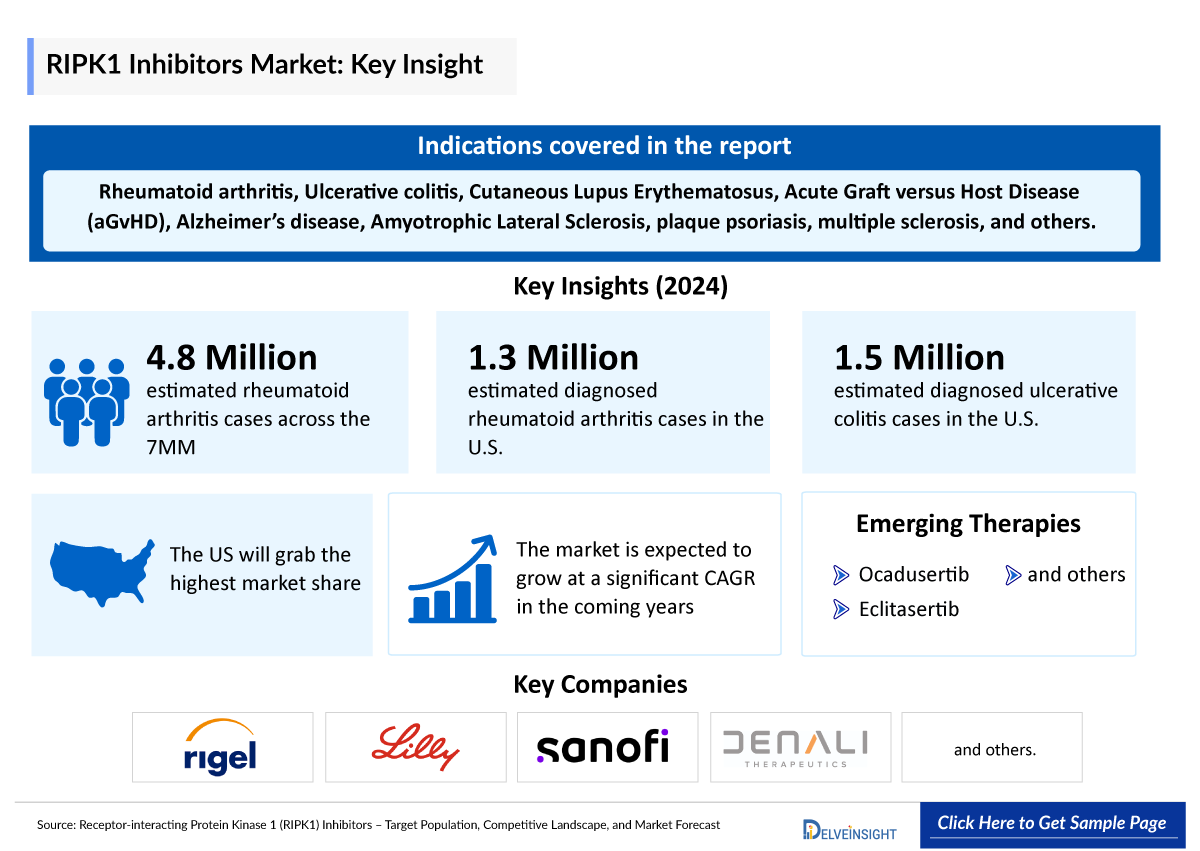
- Several RIPK1 Inhibitor companies, including Rigel Pharmaceuticals and Eli Lilly (ocadusertib), Sanofi and Denali Therapeutics (eclitasertib), and others, are engaged in the development of RIPK1 inhibitors.
- Overall, this is an exciting class that holds great potential for the development of treatment for autoimmune disorders and other indications. The maturation of current studies over the next few years will lead to a better understanding of RIPK1 Inhibitors and define their role in the therapy of autoimmune indications, neurodegenerative diseases, and others.
DelveInsight’s “Receptor-interacting Protein Kinase 1 (RIPK1) Inhibitors Market Size, Target Population, Competitive Landscape, and Market Forecast – 2034” report delivers an in-depth understanding of the RIPK1 inhibitors, historical and competitive landscape as well as its market trends in the United States, EU4 (Germany, France, Italy, and Spain) and the United Kingdom, and Japan.
The RIPK1 inhibitors’ market report provides current treatment practices, emerging drugs, market share of individual therapies, and current and forecasted 7MM RIPK1 inhibitors’ market size from 2020 to 2034. The RIPK1 Inhibitors market report also covers current RIPK1 inhibitors’ treatment practices/algorithms and unmet medical needs to curate the best opportunities and assess the RIPK1 Inhibitors market’s potential.
|
Study Period |
2020–2034 |
|
Forecast Period |
2025–2034 |
|
Geographies Covered |
US, EU4 (Germany, France, Italy, and Spain) the UK, and Japan |
|
RIPK1 Inhibitors Epidemiology |
Segmented by:
|
|
RIPK1 Inhibitors Key Companies |
|
|
RIPK1 Inhibitors Key Therapies |
|
|
RIPK1 Inhibitors Market |
Segmented by:
|
|
RIPK1 Inhibitors Market Analysis |
|
Receptor-interacting Protein Kinase 1 (RIPK1) Inhibitor Understanding
Receptor-interacting Protein Kinase 1 (RIPK1) Inhibitors Overview
Receptor-Interacting Protein Kinase 1 (RIPK1), a key member of the RIPK protein family, serves as a central mediator of both cell death and inflammatory responses, thereby playing a vital role in sustaining cellular and tissue equilibrium. RIPK1's kinase activity is particularly important in orchestrating necroptosis—a programmed form of necrotic cell death—as well as Tumor Necrosis Factor (TNF)-induced necrosis. Consequently, RIPK1 has gained recognition as a pivotal upstream regulator involved in several signaling pathways that govern inflammation and cell survival. Notably, RIPK1 is expressed across all major cell types within the Central Nervous System (CNS). Targeted inhibition of RIPK1 has demonstrated the ability to protect neurons from cell death, offering potential therapeutic benefits by reducing both neurodegeneration and neuroinflammation. Moreover, the structural characteristics of RIPK1’s kinase domain make it an attractive target for the development of selective small-molecule inhibitors.
Further details related to country-based variations are provided in the report.
Receptor-interacting Protein Kinase 1 (RIPK1) Inhibitors Market Overview
In recent years, there has been a growing interest in the exploration of RIPK1 inhibitors for a variety disorders, encompassing rheumatoid arthritis, ulcerative colitis, and other indications.
Further details related to country-based variations are provided in the report…
RIPK1 Inhibitors Epidemiology
The epidemiology chapter RIPK1 inhibitors in the report provides historical as well as forecasted epidemiology segmented as total cases in selected indications for RIPK1 inhibitors, total eligible patient pool in selected indications for RIPK1 inhibitors, and total treated cases in selected indications for RIPK1 inhibitors in the 7MM covering the United States, EU4 (Germany, France, Italy, and Spain) and the United Kingdom, and Japan from 2020 to 2034.
- The prevalent cases of rheumatoid arthritis in 7MM in 2024 were nearly 4,834,450.
- Among the EU4 and the UK, Germany accounted for the highest number of cases of ulcerative colitis, followed by the UK and the lowest number of cases were reported in Italy in 2024.
- Japan accounted for nearly 328,500 diagnosed prevalent cases of ulcerative colitis in 2024.
Target Pool Assessment of RIPK1 Inhibitors | |
|
Indication |
Estimated Cases in the US (2024) |
|
Rheumatoid arthritis |
~1,307,750 (Diagnosed prevalence) |
|
Ulcerative colitis |
~1,546,100 (Diagnosed prevalence) |
The list is indicative and not exhaustive…
RIPK1 Inhibitors Drug Chapters
The drug chapter segment of the RIPK1 inhibitors market report encloses a detailed analysis of early and mid-stage RIPK1 inhibitors. It also helps understand the RIPK1 inhibitors clinical trial details, expressive pharmacological action, agreements and collaborations, approval, and patent details, advantages and disadvantages of each included drug, and the latest news and press releases.
Emerging RIPK1 Inhibitor
Ocadusertib (R552/LY3871801): Rigel Pharmaceuticals and Eli Lilly
Ocadusertib, a small molecule being developed for the treatment of autoimmune and inflammatory disorders, and brain penetrating RIPK1 inhibitors for CNS diseases. In preclinical studies, R552 demonstrated prevention of joint and skin inflammation in a RIPK1-mediated murine model of inflammation and tissue damage. The comapny had initiated a Phase IIa clinical trial (NCT05848258) studying ocadusertib in adult patients with moderately to severely active rheumatoid arthritis. Pursuant to the collaboration, Eli Lilly will also lead all clinical development of brain penetrating RIPK1 inhibitors in CNS diseases (Alzheimer’s disease and amyotrophic lateral sclerosis [ALS]). RIPK1 inhibitors play key role in TNF signaling and induction of pro-inflammatory necroptosis, which could support broad potential in rheumatoid arthritis, psoriasis and IBD, and with their experience, Lilly is the ideal partner for Rigel Pharmaceuticals.
In its 2024 annual presentation, the company stated that enrollment for the Phase IIa trial involving approximately 100 patients is ongoing and preliminary results are expected in the first half of 2025.
Eclitasertib (SAR443122/DNL758): Sanofi and Denali Therapeutics
Eclitasertib (SAR443122), a small-molecule inhibitor of RIPK1, is being co-developed in partnership with Denali Therapeutics. The ongoing Phase II RESOLUTE study is currently evaluating its efficacy in patients with moderate to severe ulcerative colitis.
Comparison of Key Emerging Receptor-interacting Protein Kinase 1 (RIPK1) Inhibitors Inhibitors | ||||
|
Product |
Company |
RoA |
Phase |
Indication |
|
Ocadusertib (R552/LY3871801) |
Rigel Pharmaceuticals and Eli Lilly |
Oral |
II |
Moderately-to-severely active rheumatoid arthritis |
|
Eclitasertib (SAR443122/DNL758) |
Sanofi and Denali Therapeutics |
Oral |
II |
Ulcerative colitis |
Note: Detailed emerging therapies assessment will be provided in the final report.
RIPK1 Inhibitors Market Outlook
The global RIPK1 inhibitor market is expected to witness substantial growth in the coming years, driven by the increasing prevalence of autoimmune diseases, robust clinical pipeline activity, and expanding regulatory approvals.
Several leading RIPK1 Inhibitors companies, including Rigel Pharmaceuticals, Eli Lilly, Sanofi, and Denali Therapeutics, are actively involved in the development of RIPK1 inhibitors for a range of indications such as rheumatoid arthritis, ulcerative colitis, and others. Early-stage clinical trials have also explored RIPK1 inhibitors for conditions like Cutaneous Lupus Erythematosus, Acute Graft versus Host Disease (aGvHD), Alzheimer’s disease, Amyotrophic Lateral Sclerosis, plaque psoriasis, and multiple sclerosis. However, many of these programs were discontinued and kept on hold in early phases due to safety issues, limited efficacy, or shifting strategic priorities.
ABBV-668, AbbVie's small molecule RIPK1 inhibitor, was under investigation for ulcerative colitis. As per the clinicaltrials.gov ABBV-668 has completed its Phase II trial in ulcerative colitis as of December 2024, while there is no update regarding its clinical development since then and the product is not present in the pipeline.
In addition, several studies on RIPK1 inhibitors have been conducted outside the 7MM. For instance, AC-003 by Accro Biosciences is currently in a Phase Ib clinical trial for patients with aGvHD and is also under investigation for Idiopathic Pulmonary Fibrosis in China. Furthermore, SIRONAX is developing SIR9900 and SIR2446 for the treatment of neurodegenerative, immune, and inflammatory disorders. First-in-human, Phase I study to evaluate SIR9900 was conducted in Australia (Nucleus Network Pty Ltd. Melbourne, Australia) to evaluate the safety and tolerability of single ascending doses (SAD) and multiple ascending doses (MAD) of oral SIR9900 in healthy adult and elderly participants.
Overall, this is an exciting new class with great potential for development. The maturation of current studies over the next few years will lead to a better understanding of RIPK1 inhibitors and define their role in autoimmune indications.
RIPK1 Inhibitors Drugs Uptake
This section focuses on the uptake rate of potential approved and emerging RIPK1 inhibitors expected to be launched in the RIPK1 market during 2025–2034.
Receptor-interacting Protein Kinase 1 (RIPK1) Inhibitors Pipeline Development Activities
The RIPK1 market report provides insights into different therapeutic candidates in Phase II and Phase I. It also analyzes key players involved in developing targeted therapeutics.
The presence of numerous drugs under different stages is expected to generate immense opportunity for RIPK1 inhibitors market growth over the forecast period.
RIPK1 Pipeline Development Activities
The RIPK1 market report covers information on collaborations, acquisitions and mergers, licensing, and patent details for RIPK1 inhibitor therapies.
Latest KOL Views on RIPK1 Inhibitors
To keep up with current and future RIPK1 market trends, we take Industry Experts’ opinions working in the domain through primary research to fill the data gaps and validate our secondary research. Industry experts were contacted for insights on RIPK1 inhibitors' evolving treatment landscape, patient reliance on conventional therapies, patient therapy switching acceptability, drug uptake, along challenges related to accessibility.
DelveInsight’s analysts connected with 10+ KOLs to gather insights; however, interviews were conducted with 5+ KOLs in the 7MM. Centers such as Duke University School of Medicine, and others. Their opinion helps understand and validate current and emerging therapy treatment patterns or RIPK1 inhibitors’ market trends. This will support the clients in potential upcoming novel treatments by identifying the overall scenario of the RIPK1 Inhibitors market and the unmet needs.
|
KOL Views |
|
“Recent research has revealed the complex regulation of RIPK1, controlled by post-translational modifications including ubiquitination, phosphorylation, and proteolytic processing. Additionally, environmental factors such as pH shifts and hypoxia influence its function, further supporting RIPK1 as a compelling therapeutic target in inflammatory and neurodegenerative disorders.” Researcher, Duke University School of Medicine, US |
Qualitative Analysis of RIPK1 Inhibitor Market
We perform Qualitative and market Intelligence analysis using various approaches, such as SWOT analysis. In the SWOT analysis, strengths, weaknesses, opportunities, and threats in terms of disease diagnosis, patient awareness, patient burden, competitive landscape, cost-effectiveness, and geographical accessibility of therapies are provided. These pointers are based on the analyst’s discretion and assessment of the patient burden, cost analysis, and existing and evolving treatment landscape.
RIPK1 Inhibitors Market Access and Reimbursement
Reimbursement may be referred to as the negotiation of a price between a manufacturer and payer that allows the manufacturer access to the market. It is provided to reduce the high costs and make the essential drugs affordable. Health Technology Assessment (HTA) plays an important role in reimbursement decision-making and recommending the use of a drug. These recommendations vary widely throughout the seven major markets, even for the same drug.
In the US healthcare system, both Public and Private health insurance coverage are included. Also, Medicare and Medicaid are the largest government-funded programs in the US. The major healthcare programs including Medicare, Continuing Medical Education (CME) program, the Children's Health Insurance Program (CHIP), and the state and federal health insurance marketplaces are overseen by the Centers for Medicare & Medicaid Services (CMS). Other than these, Pharmacy Benefit Managers (PBMs), and third-party organizations that provide services, and educational programs to aid patients are also present.
The RIPK1 Inhibitors market report further provides detailed insights on the country-wise accessibility and reimbursement scenarios, cost-effectiveness scenario of approved therapies, programs making accessibility easier and out-of-pocket costs more affordable, insights on patients insured under federal or state government prescription drug programs, etc.
The abstract list is not exhaustive, will be provided in the final report
Scope of the RIPK1 Inhibitors Market Report
- The RIPK1 Inhibitors market report covers a segment of key events, an executive summary, and a descriptive overview of the RIPK1 inhibitors, explaining its mechanism, and therapies.
- Comprehensive insight into the competitive landscape, and forecasts, the future growth potential of treatment rate, drug uptake, and drug information have been provided.
- Additionally, an all-inclusive account of the emerging therapies and the elaborative profiles of late-stage and prominent RIPK1 Inhibitors therapies will impact the current landscape.
- A detailed review of the RIPK1 inhibitors market, historical and forecasted market size, market share by therapies, detailed assumptions, and rationale behind our approach is included in the report, covering the 7MM drug outreach.
- The RIPK1 Inhibitors market report provides an edge while developing business strategies, by understanding trends, through SWOT analysis, expert insights/KOL views, and treatment preferences that help shape and drive the 7MM RIPK1 inhibitors market.
Receptor-interacting Protein Kinase 1 (RIPK1) Inhibitors Market Report Insights
- RIPK1 Inhibitors Targeted Patient Pool
- Therapeutic Approaches
- RIPK1 Inhibitors Pipeline Analysis
- RIPK1 Inhibitors Market Size
- RIPK1 Inhibitors Market Trends
- Existing and future RIPK1 Inhibitors Market Opportunities
RIPK1 Inhibitors Market Report Key Strengths
- Ten years Forecast
- The 7MM Coverage
- Key Cross Competition
- RIPK1 Inhibitors Drugs Uptake
- Key RIPK1 Inhibitors Market Forecast Assumptions
RIPK1 Inhibitors Market Report Assessment
- Current RIPK1 Inhibitors Treatment Practices
- RIPK1 Inhibitors Unmet Needs
- RIPK1 Inhibitors Pipeline Product Profiles
- RIPK1 Inhibitors Market Attractiveness
- Qualitative Analysis (SWOT)
Key Questions Answered in the RIPK1 Inhibitor Market Report
- What was the total RIPK1 Inhibitors market size, the market size by therapies, market share (%) distribution, and what would it look like in 2034? What are the contributing factors for this growth?
- Which RIPK1 Inhibitors drug is going to be the largest contributor in 2034?
- Which is the most lucrative RIPK1 Inhibitors market?
- What are the pricing variations among different geographies for approved RIPK1 Inhibitors therapies?
- What are the risks, burdens, and unmet needs of treatment with RIPK1 inhibitors? What will be the growth opportunities across the 7MM for the patient population of RIPK1 inhibitors?
- What are the key factors hampering the growth of the RIPK1 Inhibitors market?
- What are the indications for which recent novel therapies and technologies have been developed to overcome the limitations of existing treatments?
- What key designations have been granted to the therapies for RIPK1 inhibitors?
- What is the cost burden of approved therapies on the patient?
- Patient acceptability in terms of preferred therapy options as per real-world scenarios?
- What are the country-specific accessibility issues of expensive, recently approved RIPK1 Inhibitors therapies?
Reasons to buy RIPK1 Inhibitor Market report
- The RIPK1 Inhibitors market report will help develop business strategies by understanding the latest trends and changing dynamics driving the RIPK1 inhibitors market.
- Understand the existing RIPK1 Inhibitors market opportunities in varying geographies and the growth potential over the coming years.
- Distribution of historical and current patient share based on real-world prescription data along with reported sales of approved products in the US, EU4 (Germany, France, Italy, and Spain) the United Kingdom, and Japan.
- Identifying strong upcoming RIPK1 Inhibitors companies in the RIPK1 Inhibitors market will help devise strategies to help get ahead of competitors.
- Detailed analysis and ranking of indication-wise emerging therapies under the conjoint analysis section to provide visibility around leading indications.
- Highlights of access and reimbursement policies of approved therapies, barriers to accessibility of expensive off-label therapies, and patient assistance programs.
- To understand Key Opinion Leaders’ perspectives around the accessibility, acceptability, and compliance-related challenges of existing treatment to overcome barriers in the future.
- Detailed insights on the unmet needs of the existing RIPK1 Inhibitors market so that the upcoming RIPK1 Inhibitors companies can strengthen their development and launch strategy.