Sjogren's Syndrome Market Summary
Sjögren's Disease Insights and Trends
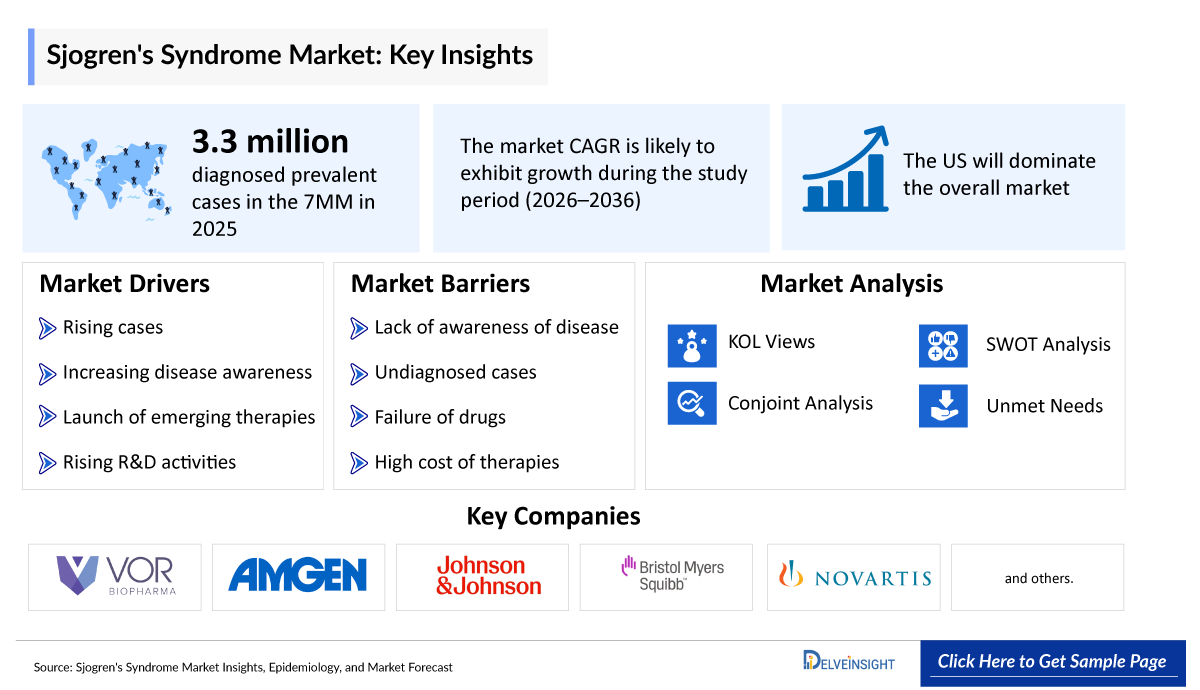
- According to DelveInsight’s analysis, Sjögren's disease market size was around USD 1 billion in the leading markets (the United States, EU4 (Germany, France, Italy, and Spain), the United Kingdom, and Japan) in 2025.
- In 2025, the total number of diagnosed prevalent cases of Sjögren's disease in the 7MM was more than 1 million. Among the 7MM countries, the US accounted for the highest number of diagnosed prevalent cases
- Sjögren’s disease represents a major unmet opportunity in immunology, with no approved disease-modifying therapies and current care largely limited to symptomatic relief. Generic pilocarpine (SALAGEN) and cevimeline (EVOXAC) primarily alleviate dry-mouth symptoms but do not modify disease progression, leaving significant gap for therapies.
- The Sjögren’s disease treatment pipeline is increasingly diversified, encompassing B-cell depletion, BAFF/APRIL modulation, FcRn blockade, and T-cell–B-cell interaction inhibition, with investigational therapies such as ianalumab (VAY736), telitacicept (RC18), nipocalimab, and dazodalibep targeting distinct mechanisms of immune dysregulation. These approaches aim to address the underlying autoimmune pathology beyond symptomatic relief, potentially expanding treatment options for patients with systemic and refractory disease.
- EULAR Sjögren’s Syndrome Disease Activity Index (ESSDAI) and EULAR Sjögren’s Syndrome Patient Reported Index (ESSPRI) remain the gold-standard endpoints for approval, KOLs highlighted limitations in their ability to reflect routine clinical practice and patient experience, favoring composite measures such as Composite of Relevant Endpoints for Sjögren’s Syndrome (CRESS) and Sjögren’s Tool for Assessing Response (STAR). B-cell depletion and salivary flow were also viewed as useful indicators of treatment activity.
- Despite Sjögren’s syndrome being a systemic autoimmune disease, treatment remains heavily focused on managing individual manifestations such as ocular and oral dryness, while systemic immunomodulators are largely used off-label. This creates a fundamental gap between the systemic nature of the disease and the predominantly symptomatic nature of available treatment. Importantly, recent clinical development has begun to demonstrate that disease modifying approaches may be feasible, increasing the competitive importance of establishing a clearly differentiated mechanism and clinically meaningful benefit.
Sjögren's Disease Market size and forecast
- 2025 Sjögren's disease Market Size in the 7MM: ~USD 1 billion
- 2036 Projected Sjögren's disease Market Size in the 7MM: ~USD 10 billion
- Sjögren's disease Growth Rate (2026-2036): 26.2% CAGR
DelveInsight’s “Sjögren's Disease – Market Insights, Epidemiology, and Market Forecast – 2036” report delivers an in-depth understanding of Sjögren's disease, historical and forecasted epidemiology, as well as the Sjögren's disease market trends in the United States, EU4 (Germany, France, Italy, and Spain), the United Kingdom, and Japan.
The Sjögren's disease market report delivers a comprehensive analysis of the current treatment landscape, including standards of care, clinical practices, and evolving therapeutic algorithms. It evaluates, Sjögren's disease patient burden trends, revenue & market share dynamics, peak patient share & therapy uptake analysis, and provides an in-depth market size assessment and growth rate projections (Historical & Forecast 2022–2036) across the 7MM regions. The report highlights key unmet medical needs in Sjögren's disease and maps the competitive and clinical landscape to uncover high-value opportunities, providing a clear outlook on future market growth potential.
|
Study Period |
2022–2036 |
|
Historical Year |
2022–2025 |
|
Forecast Period |
2026–2036 |
|
Base Year |
2025 |
|
Geographies Covered |
|
|
Sjögren's Disease Market CAGR (Forecast period) |
26.2% (2026-2036) |
|
Sjögren's Disease Epidemiology Segmentation Analysis |
Patient Burden Assessment
|
|
Sjögren's Disease Companies |
And more |
|
Sjögren's Disease Therapies |
And more |
|
Sjögren's Disease Market |
Segmented by
|
|
Analysis |
|
Geography Covered
- North America: The United States
- Europe: Germany, France, Italy, Spain and the United Kingdom
- Asia-Pacific: Japan
Sjögren's Disease Understanding and Treatment Algorithm
Sjögren's Disease Overview and Diagnosis
Sjögren's disease, previously referred to as Sjögren's syndrome, is a chronic, systemic autoimmune disorder in which the body's immune system mistakenly targets its own exocrine glands, particularly the lacrimal (tear) glands and salivary glands. This immune-mediated attack results in lymphocytic infiltration and progressive damage to glandular tissue, impairing the glands' ability to produce adequate moisture.
The diagnosis of Sjögren’s disease remains challenging due to its heterogeneous presentation, overlapping autoimmune symptoms, and absence of a single definitive diagnostic test. Persistent sicca symptoms, anti-Ro/SSA antibody testing, Schirmer’s test, ocular staining, and salivary gland biopsy support disease identification under the 2016 ACR/EULAR classification criteria. Improved physician awareness and serological testing may enhance diagnosis, while seronegative and systemic cases continue to contribute to diagnostic delays and an unmet need for timely treatment.
Further details related to country-based variations are provided in the report…
Current Sjögren's Disease Treatment Landscape
The Sjögren’s disease treatment landscape is primarily supported by local symptomatic therapies, including pilocarpine, cevimeline, and topical ocular treatments, alongside systemic therapies such as corticosteroids, hydroxychloroquine, and conventional immunosuppressants. In the absence of an FDA-approved disease-specific treatment, management remains individualized according to symptom burden, disease severity, and extra-glandular involvement.
Treatment selection is further influenced by the heterogeneous clinical presentation of Sjögren’s disease, with systemic therapies reserved for patients experiencing inflammatory musculoskeletal symptoms or clinically significant organ involvement. Although off-label biologics such as rituximab are used in selected refractory cases, variable clinical outcomes and limited disease-specific evidence continue to constrain treatment standardization and highlight the reliance on symptom- and organ-directed management.
Further details related to country-based variations are provided in the report…
Sjögren's Disease Infections Unmet Needs
The section “unmet needs of Sjögren's disease” outlines the critical gaps between the current state of patient care, diagnosis, and the ideal & effective management of the disease. It highlights the obstacles experienced by patients, clinicians, and researchers and identifies potential solutions for future progress.
- Lack of an approved systemic disease-modifying therapy
- High-burden population that remains inadequately served
- Severe systemic and extraglandular manifestations are insufficiently addressed
- Epidemiological evidence remains fragmented, limiting confidence in the true addressable Sjögren syndrome population and others…
Note: Comprehensive unmet needs insights in Sjögren's disease and their strategic implications are provided in the full report…
Sjögren's Disease Epidemiology
Key Findings from Sjögren's Disease Epidemiological Analysis and Forecast
- In the US, total diagnosed prevalent cases of Sjögren’s disease were approximately 730,000 in 2025, supported by improved recognition of patients presenting with persistent sicca symptoms and the increasing adoption of serological testing, which facilitates disease identification and diagnosis.
- According to DelveInsight analysis, gender-specific diagnosed prevalent cases of Sjögren’s disease in the US in 2025 were predominantly female, accounting for more than 650,000 cases, compared with around 75,000 male cases, reflecting the disease’s established female predominance.
- In 2025, Anti-Ro/SSA-positive cases represented the largest antibody-specific segment of diagnosed prevalent Sjögren’s disease cases across EU4 and the UK, totaling to approximately 410,000 cases, followed by Anti-La/SSB-positive cases at around 290,000.
- According to DelveInsight analysis, Japan recorded approximately 120,000 diagnosed prevalent cases of Sjögren’s disease in 2025, of which nearly 82,000 were mild cases, while around 35,000 were moderate-to-severe cases, indicating a substantial diagnosed patient pool with varying disease severity.
Sjögren's Disease Drug Analysis & Competitive Landscape
The Sjögren's disease drug chapter provides a detailed, market-focused review of approved therapies and the emerging pipeline across Phase I-III clinical trials. It covers mechanism of action, clinical trial data, regulatory approvals, patents, collaborations, strategic partnerships upcoming key catalyst for each therapy, along with their advantages, limitations, and recent developments. This section offers critical insights into the Sjögren's disease treatment landscape, supporting market assessment, competitive analysis, and growth forecasting for the Sjögren's disease therapeutics market.
Sjögren's Disease Pipeline Analysis
Ianalumab (VAY736): Novartis
Ianalumab (VAY736) is a novel, fully human monoclonal antibody of the IgG1/?-class, directed against B cells and binding to the B-cell activating factor receptor (BAFF-R). It is designed with a dual mechanism of action, combining B-cell depletion via antibody-dependent cellular cytotoxicity (ADCC) with interruption of BAFF-R-mediated signals that support B-cell function and survival.
In July 2026, Novartis reported that longer-term data from NEPTUNUS-1 and NEPTUNUS-2 showed durable ESSDAI improvement and a favorable safety profile with no increase in TEAE rates through Week 108.
|
Competitive Landscape of Pipeline Drugs | ||||||
|
Drug Name |
Company |
Highest Phase |
Indication |
RoA |
MoA |
Anticipated Launch in the US |
|
Ianalumab (VAY736) |
Novartis |
III |
Sjögren’s disease |
SC |
BAFF-R inhibitor and ADCC-mediated B-cell depletion |
2027 |
|
Nipocalimab (IMAAVY) |
Johnson & Johnson |
III |
Sjögren's disease |
IV infusion/SC |
FcRn antagonist |
Information is available in the full report |
Sjögren's Disease Key Players, Market Leaders and Emerging Companies
- Vor Biopharma/ RemeGen
- Argenx
- Amgen
- Johnson & Johnson
- Novartis
- Resolve Therapeutics
- And more
Sjögren's Disease Drug Updates
- In June 2026, Johnson & Johnson reported new biomarker exploratory analyses from the Phase II DAHLIAS study evaluating nipocalimab in adults with moderate-to-severe Sjögren's disease, a showing that participants with elevated autoantibody and immunoglobulin G (IgG) levels, who are often those who experience more substantial disease burden, showed greater clinical response rates.
- In April 2026, Novartis reported that ianalumab had received FDA Priority Review, while regulatory submissions had been completed in the US, Europe, and Japan, marking the transition of the program into global regulatory review.
Sjögren's Disease Market Outlook
At present, the therapeutic market size of Sjogren’s disease is mainly accounted for by local therapies, systemic therapy, and biological therapies. The local therapies mainly include pilocarpine, cevimeline, topical fluoride, topical cyclosporine, autologous serum eye drops, and others. Systemic therapy mainly uses corticosteroids, hydroxychloroquine, and immunosuppressants. In the absence of an approved disease-specific treatment, current Sjögren’s disease management primarily relies on individualized symptom control and organ-directed immunosuppression. Local therapies remain the foundation for dryness, while systemic treatment is reserved for inflammatory musculoskeletal manifestations, clinically significant extra-glandular involvement, or organ-threatening disease.
- In 2025, the Sjögren's disease market size in the US was nearly USD 700 million. This figure is expected to grow significantly with the introduction of emerging therapies.
- The total market size of EU4 and the UK was estimated to approximately USD 300 million in 2025.
- Among EU4 and the UK, Germany accounted for the highest market share with approximately USD 150 million in 2025, followed by the UK with approximately USD 60 million in the respective year, and France capturing the least market with nearly USD 10 million in 2025.
- In 2025, the total market size of Sjögren's disease was more than USD 30 million in Japan, which is anticipated to increase during the forecast period (2026–2036).
Drug Class/Insights into Leading Emerging Therapies in Sjögren's Disease (2022–2036 Forecast)
Biologics: Biologics are emerging as a key therapeutic class in the Sjögren’s disease treatment landscape, driven by the need for targeted disease-modifying therapies that address underlying B-cell hyperactivity, autoantibody production, and immune dysregulation beyond symptomatic management. Agents such as ianalumab (VAY736), a B-cell-depleting anti-B-cell activating factor receptor (BAFF-R) monoclonal antibody, and dazodalibep, a CD40 ligand (CD40L) antagonist, represent distinct approaches to modulating pathogenic immune pathways. The advancement of these therapies may expand treatment options for patients with moderate-to-severe or systemic disease, particularly those inadequately controlled by conventional symptomatic treatments.
Sjögren's Disease Drug Uptake
This section focuses on the uptake rate of potential drugs expected to be launched in the market during the forecast period (2026–2036). The analysis covers the Sjögren's disease drug’s uptake, performance at peak, factors affecting performance during prime years of growth, patient uptake by therapy, and anticipated sales generated by each drug.
Among the emerging therapies, VAY736 (ianalumab), a BAFF-R–targeted monoclonal antibody with B-cell–depleting activity, has emerged as a key late-stage candidate after meeting primary endpoints in the Phase III NEPTUNUS-1 and NEPTUNUS-2 studies. Nipocalimab, an FcRn inhibitor, has also demonstrated reductions in clinical systemic disease activity and dose-dependent decreases in total IgG and Sjögren’s disease -associated autoantibodies in clinical development. In addition, B-cell–focused therapies, as well as CD40/CD40L-directed approaches, kinase inhibitors, and other immune modulators, are expanding the range of potential mechanisms available for systemic Sjögren’s disease.
Detailed insights of emerging therapies' drug uptake is included in the report…
Sjögren's Disease Therapies Price Scenario & Trends
Pricing and analogue assessment of Sjögren's disease therapies highlights evolving price dynamics structures. This section summarizes the cost of approved treatments, closest and most appropriate analogue selection for emerging therapies, and understanding of how pricing influences market access, adherence, and long-term uptake.
Pricing of Sjögren's Disease Drugs
The treatment course cost of disease modifying anti-rheumatic drugs (DMARDs) in the US is around USD 112,000 in 2025.
Industry Experts and Physician Views for Sjögren's Disease
To keep up with Sjögren's disease market trends, we take Key Opinion Leaders (KOLs) and Subject Matter Experts (SMEs) opinions working in the domain through primary research to fill the data gaps and validate our secondary research. Industry Experts were contacted for insights on the Sjögren's disease emerging therapies, evolving treatment landscape, patient adherence to conventional therapies, therapy switching trends, drug adoption and uptake, accessibility challenges, and epidemiology and real-world prescription patterns in Sjögren's disease, including MD, PhD, Instructor, Postdoctoral Researcher, Professor, Researcher, and others.
DelveInsight’s analysts connected with 30+ KOLs to gather insights at country level. Centers such as the John Hopkins University, Akiruno Medical Center, Grünenthal Foundation-University of Cadiz, Université Paris-Saclay, and Columbia University etc. were contacted.
Their opinion helps understand and validate current and emerging Sjögren's disease therapies, highlight unmet medical needs, provide epidemiological context, and support strategic decisions for market access, therapy adoption, and pipeline prioritization in Sjögren's disease.
|
Region |
Key Opinion Leaders (KOLs) and Subject Matter Experts (SMEs) |
|
United States |
“Sjögren’s disease remains difficult to diagnose because its hallmark symptoms have multiple potential causes and may develop gradually. There is no single diagnostic test, requiring clinicians to integrate findings from multiple assessments; consequently, some patients may take years to receive a diagnosis.” |
|
United Kingdom |
“Hydroxychloroquine helps with fatigue and joint pain. In some patients, it takes 6-12 months for the benefit to be felt, so treatment should not be stopped earlier than this. If hydroxychloroquine is difficult to tolerate, a lower dose can be used and increased slowly. Some people report problems with certain brands, with abdominal pain and an upset stomach occurring in some patients.” |
Qualitative Analysis: SWOT and Attribute Analysis
We perform qualitative and market Intelligence analysis using various approaches, such as SWOT analysis and attribute analysis.
In the SWOT analysis of Sjögren's disease, strengths, weaknesses, opportunities, and threats in terms of disease diagnosis, patient awareness, patient burden, competitive landscape, cost-effectiveness, and geographical accessibility of therapies are provide attribute analysis analyzes emerging therapies based on relevant attributes such as safety, efficacy, frequency of administration, route of administration, and order of entry. Scoring is given based on these parameters to analyze the effectiveness of therapy.
The team of analysts analyzes promising emerging therapies based on relevant attributes such as safety, efficacy, frequency of administration, route of administration, and order of entry. In efficacy, the trial’s primary and secondary outcome measures are evaluated, whereas the therapies’ safety is evaluated, wherein the acceptability, tolerability, and adverse events are majorly observed. In addition, the scoring is also based on the route of administration, order of entry, probability of success, and the addressable patient pool for each therapy. According to these parameters, the final weightage score and the ranking of the emerging therapies are decided.
Scope of the Report
- The report covers a segment of key events, an executive summary, a descriptive overview of Sjögren’s disease, explaining their causes, signs and symptoms, pathogenesis, and currently available treatments.
- Comprehensive insight has been provided into the epidemiology segments and forecasts, the future growth potential of the diagnosis rate, and disease progression along treatment guidelines.
- Additionally, an all-inclusive account of both the current and emerging treatments, along with the elaborative profiles of late-stage and prominent therapies, will have an impact on the current treatment landscape.
- A detailed review of the Sjögren’s disease market, historical and forecasted market size, market share by therapies, detailed assumptions, and rationale behind our approach is included in the report, covering the 7MM drug outreach.
- The report provides an edge while developing business strategies by understanding trends through SWOT analysis and expert insights/KOL views, patient journey, and treatment preferences that help in shaping and driving the 7MM Sjögren’s disease market.
Report Insights
- Sjögren’s Disease Patient Population Forecast
- Sjögren’s Disease Therapeutics Market Size
- Sjögren’s Disease Pipeline Analysis
- Sjögren’s Disease Market Size and Trends
- Sjögren’s Disease Market Opportunity (Current and Forecasted)
Report Key Strengths
- Epidemiology-based (Epi-based) Bottom-up Forecasting
- Artificial Intelligence (AI) - enabled Market Research Report
- 11-year forecast
- Sjögren’s Disease Market Outlook (North America, Europe, Asia-Pacific)
- Patient Burden Trends (by geography)
- Sjögren’s Disease Treatment Addressable Market (TAM)
- Sjögren’s Disease Competitive Landscape
- Sjögren’s Disease Major Companies Insights
- Sjögren’s Disease Price Trends and Analogue Assessment
- Sjögren’s Disease Therapies Drug Adoption/Uptake
- Sjögren’s Disease Therapies Peak Patient Share analysis
Report Assessment
- Sjögren’s Disease Current Treatment Practices
- Sjögren’s Disease Unmet Needs
- Sjögren’s Disease Clinical Development Analysis
- Sjögren’s Disease Emerging Drugs Product Profiles
- Sjögren’s Disease Market Attractiveness
- Sjögren’s Disease Qualitative Analysis (SWOT and Attribute analysis)
FAQs
Market Insights
- What was the Sjögren’s disease market size, the market size by therapies, market share (%) distribution in 2025, and what would it look like by 2036? What are the contributing factors for this growth?
- What are the anticipated pricing variations among different geographies for the emerging therapies in the future?
- What can be the future treatment paradigm of Sjögren’s disease?
- What are the disease risks, burdens, and unmet needs of Sjögren’s disease? What will be the growth opportunities across the 7MM concerning the patient population with Sjögren’s disease?
- Who is the major future competitor in the market, and how will the competitors affect their market share?
- What are the current options for the treatment of Sjögren’s disease? What are the current guidelines for treating Sjögren’s disease in the US, Europe, and Japan?
Reasons to Buy
- The report will help in developing business strategies by understanding the latest trends and changing treatment dynamics driving the Sjögren’s disease market.
- Bottom up forecasting builds from the affected population to product forecasts, delivering a robust, data driven approach ideal for new therapies and novel classes.
- Insights on patient burden/disease prevalence, evolution in diagnosis, and factors contributing to the change in the epidemiology of the disease during the forecast years.
- Understand the existing market opportunities in varying geographies and the growth potential over the coming years.
- Identifying strong upcoming players in the market will help devise strategies to help get ahead of competitors.
- Detailed analysis, ranking of class-wise potential current, and emerging therapies under the attribute analysis section to provide visibility around leading classes.
- To understand KOLs’ perspectives on the accessibility, acceptability, and compliance-related challenges of existing treatment to overcome barriers in the future.
- Detailed insights on the unmet needs of the existing market so that the upcoming players can strengthen their development and launch strategy.
- This Artificial Intelligence (AI) enabled report summarize and simplify complex datasets with in the report into clear, actionable insights for stakeholders, investors, and healthcare providers, enabling faster, data driven decisions.