Brain Monitoring Devices Market Summary
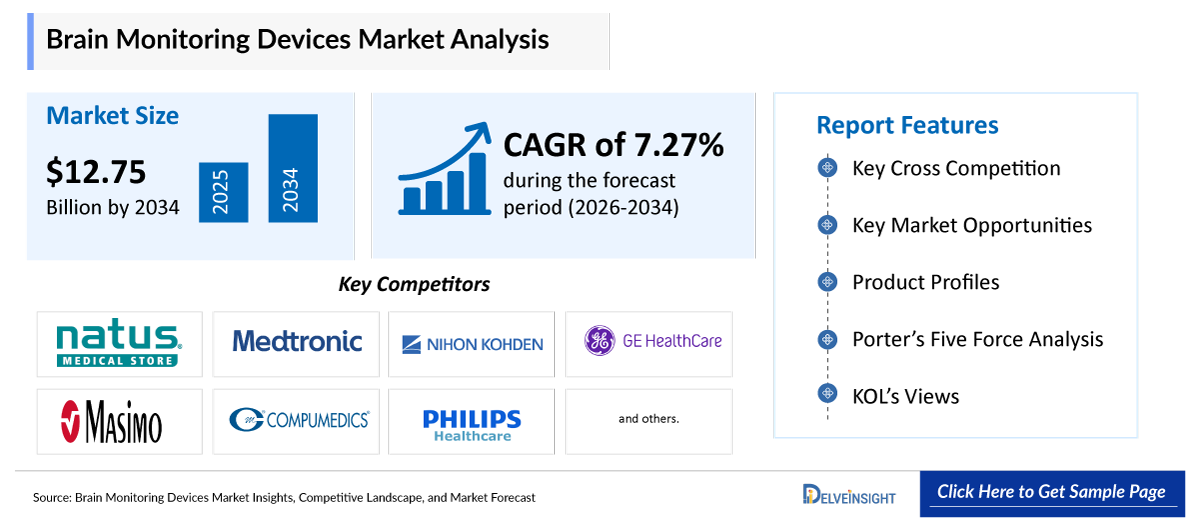
- The global brain monitoring devices market was valued at USD 6.78 billion in 2025 and is projected to reach USD 12.75 billion by 2034.
- The market is expected to expand at a CAGR of 7.27% during the forecast period 2026-2034, supported by rising prevalence of neurological disorders such as multiple sclerosis, epilepsy, and dementia, rising incidence of traumatic brain injury and stroke, growing awareness of these disorders, and continuous product development.
- By product, the electroencephalography devices segment dominated the brain monitoring devices market with a 34% share in 2025.
- By type, the non-invasive segment dominated the brain monitoring devices market with a 78% share in 2025.
- By application, the traumatic brain injury segment dominated the brain monitoring devices market with a 24% share in 2025.
- By end-user, the hospitals segment dominated the brain monitoring devices market with a 52% share in 2025.
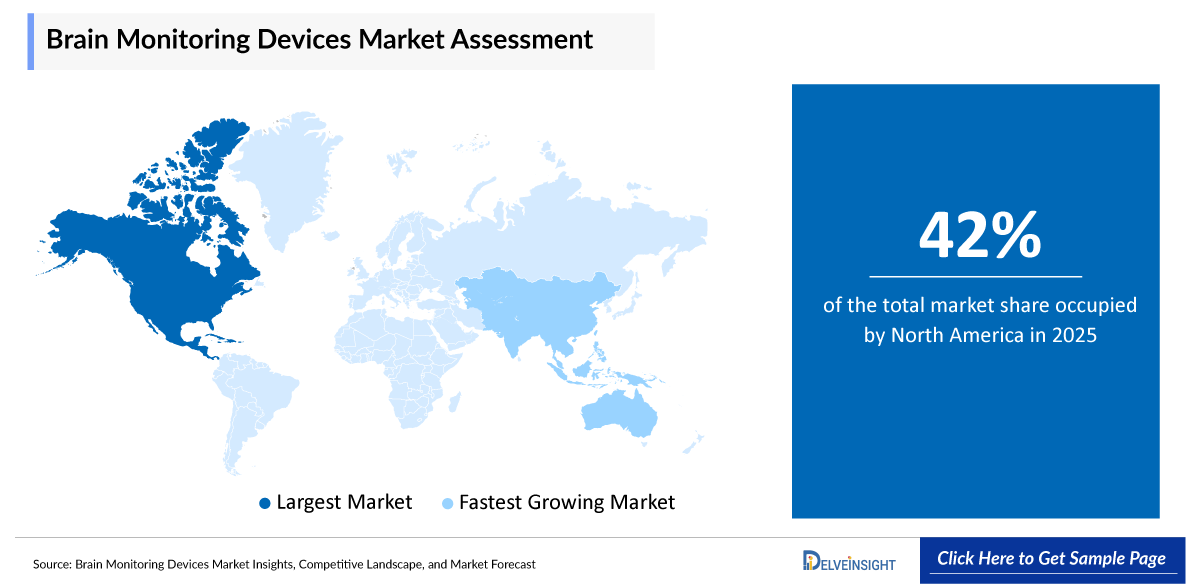
- North America accounted for the largest share of the brain monitoring devices market at 42% in 2025, while Asia-Pacific is anticipated to register the fastest growth through 2034.
Brain monitoring devices are instruments used in the assessment and monitoring of brain function, measuring electrical, metabolic, hemodynamic, and pressure parameters that reflect the state of the brain in order to diagnose, monitor, and manage neurological conditions and critically ill and surgical patients. The market is organized by product, type, application, and setting of care. By product, it spans electroencephalography devices that record electrical activity of the brain, magnetoencephalography devices that record magnetic fields, cerebral oximeters that monitor oxygenation, intracranial pressure monitors, transcranial Doppler systems that monitor cerebral blood flow, sleep monitoring devices, and others. By type, it divides into non-invasive devices that monitor the brain without breaching the skull, which dominate the market, and invasive devices, principally intracranial pressure monitors. By application, it spans traumatic brain injury, stroke, dementia, epilepsy, sleep disorders, and other conditions. By end-user, it spans hospitals, neurology and diagnostic centers, ambulatory surgical centers, and home care settings. The market is driven by rising prevalence of neurological disorders, rising incidence of traumatic brain injury and stroke, growing geriatric population, rising intensive care admissions requiring continuous brain monitoring, and advances in artificial-intelligence-enabled, wearable, and connected monitoring.
Brain Monitoring Devices Market Key Growth Drivers
- The rising global prevalence of neurological disorders, including epilepsy, multiple sclerosis, dementia, Parkinson’s disease, and stroke, which drives demand for devices that diagnose and monitor function of brain.
- The rising incidence of traumatic brain injury and stroke, which require intracranial pressure, electroencephalography, and cerebral oximetry monitoring in acute and critical care settings.
- The growing geriatric population, which increases the incidence of neurodegenerative and cerebrovascular conditions that brain monitoring is used to diagnose and manage.
- The rising intensive care admissions requiring continuous brain monitoring, which drives adoption of continuous electroencephalography and multimodal monitoring in intensive care units.
- Continuous technological advancement, including artificial-intelligence-enabled electroencephalography interpretation, wearable and wireless brain sensors, and cloud-based and integrated platforms that enable real-time and remote monitoring.
- The growing awareness of neurological disorders and rising product development activity by leading manufacturers, which expand the range and adoption of devices.
- The rising prevalence of sleep disorders and growing demand for sleep monitoring that electroencephalography and polysomnography devices provide.
Key Companies in Brain Monitoring Devices Market
The competitive landscape is led by the following active manufacturers:
- Medtronic plc
- Natus Medical Incorporated
- Nihon Kohden Corporation
- GE HealthCare Technologies Inc.
- Masimo Corporation
- Compumedics Limited
- Integra LifeSciences Holdings Corporation
- Drägerwerk AG & Co. KGaA
- Cadwell Industries, Inc.
- Koninklijke Philips N.V.
For illustrative purposes, only the top 10 companies are listed in the Table of Contents. The report may include analysis and references to additional companies relevant to market assessment.
Brain Monitoring Devices Market Size
The following table summarizes headline market metrics for the global brain monitoring devices market across the base year and forecast horizon.
|
Report Metrics |
Details |
|
2025 Market Size |
USD 6.78 billion |
|
2034 Projected Market Size |
USD 12.75 billion |
|
Growth Rate (2026-2034) |
7.27% CAGR |
|
Largest Market |
North America (42% share in 2025) |
|
Fastest Growing Market |
Asia-Pacific |
|
Market Structure |
Moderately Fragmented |
All market values are expressed in USD and represent DelveInsight estimates synthesized from primary and secondary research.
Factors Contributing to Growth of Brain Monitoring Devices Market
Market Drivers
Rising Prevalence of Neurological Disorders
The foundational driver of the brain monitoring devices market is the rising global prevalence of neurological disorders, because brain monitoring devices are used to diagnose, monitor, and manage these disorders, and the burden of neurological disease directly determines demand for them. The rising prevalence of neurological disorders, including epilepsy, multiple sclerosis, dementia, Parkinson’s disease, and stroke, drives demand for devices that assess and monitor brain function, and increasing instances of these disorders, coupled with increasing awareness of them, are recognized as major factors contributing to growth of the market. Epilepsy, one of the most common neurological disorders, is diagnosed and monitored principally through electroencephalography, which records electrical activity of the brain; dementia and neurodegenerative disorders are increasingly assessed through brain monitoring, and a full range of neurological conditions, from acute to chronic, depends upon brain monitoring for diagnosis and management. The chronic and progressive nature of many of these disorders, which require repeated and continuous monitoring over the course of disease, and a large and rising number of patients, generate a great and enduring demand. Because neurological disease burden is large, rising, and dependent upon brain monitoring for its diagnosis and management, this driver provides the most durable foundation for market growth.
Rising Incidence of Traumatic Brain Injury and Stroke
The rising incidence of traumatic brain injury and stroke is a powerful driver of the brain monitoring devices market, because these acute conditions require intensive brain monitoring in acute and critical care settings, and their large and rising burden drives demand for devices. Traumatic brain injury, caused by road accidents, falls, violence, and other causes, and stroke, one of the leading causes of death and disability worldwide, cause acute injury to the brain that requires monitoring of intracranial pressure, electrical activity, and oxygenation of the brain to guide management and to detect deterioration, and the rising incidence of these conditions drives a great and growing demand for brain monitoring devices. Intracranial pressure monitors that guide management of raised pressure after traumatic brain injury, continuous electroencephalography that detects seizures and ischemia, and cerebral oximetry that monitors oxygenation are central to acute and critical care of these patients, and the growth of trauma and stroke burden, together with recognition of the value of monitoring in improving outcomes, drives demand. Traumatic brain injury is the largest application of brain monitoring devices. Because traumatic brain injury and stroke are large, rising, and monitoring-intensive burdens, this driver is a powerful contributor to market growth.
Growing Geriatric Population
The growing geriatric population is a significant driver of the brain monitoring devices market because neurodegenerative and cerebrovascular conditions that brain monitoring is used to diagnose and manage are concentrated in older adults, and growth of the elderly population expands the population requiring monitoring. The incidence of dementia, Parkinson’s disease, stroke, and other neurological and cerebrovascular conditions rises markedly with age, and an expanding elderly demographic heightens the risk of neurodegenerative disease, so an aging population increases the burden of conditions that drive demand for brain monitoring. The global geriatric population is growing rapidly, and the concentration of neurodegenerative and cerebrovascular disease in this growing group expands demand for brain monitoring devices correspondingly, while increasing life expectancy of the population extends the period over which patients require monitoring. The growth of the older population drives demand for electroencephalography, brain monitoring, and diagnostic devices used in the assessment of dementia and neurodegenerative disease, and rising healthcare expenditure and improving access in aging societies further expand demand. Because demographic aging is slow, predictable, and effectively irreversible, and because it concentrates neurological disease burden in a growing older population, it provides a stable and durable foundation for long-term market growth.
Rising Intensive Care Admissions and Continuous Monitoring
The rising intensive care admissions requiring continuous brain monitoring are an important driver of the brain monitoring devices market, because continuous electroencephalography and multimodal brain monitoring are increasingly central to the care of critically ill patients, and growth of intensive care and recognition of the value of monitoring drive demand. The intensive care unit is a principal setting for brain monitoring, where continuous electroencephalography detects seizures, ischemia, and changes in the state of the brain in critically ill patients, and multimodal monitoring of pressure, oxygenation, and electrical activity guides management of acute brain injury; rising intensive care admissions, driven by aging of population, rising burden of critical illness, and expansion of critical care capacity, drive a growing demand for continuous brain monitoring. The growing recognition of the value of continuous electroencephalography in detecting non-convulsive seizures and electrographic status epilepticus that would otherwise be missed, and incorporation of continuous monitoring into critical care of acute brain injury, drive adoption of monitoring, and the advance of artificial-intelligence-enabled interpretation that makes continuous monitoring feasible at scale further supports it. Because continuous brain monitoring is increasingly central to growing critical care, this driver is a meaningful contributor to market growth.
Technological Advancement
Continuous technological advancement is a central driver of the brain monitoring devices market, because each advance improves capability, accessibility, or intelligence of monitoring and thereby extends its applications and drives adoption of newer systems. The application of artificial intelligence to the interpretation of electroencephalography is a defining advance, providing automated interpretation, predictive analytics, and early detection of neurological conditions, improving the speed and accuracy of diagnosis and addressing the shortage of neurophysiologists who read studies; modern electroencephalography systems have become integrated platforms that combine hardware, software, and cloud-based analytics, enabling real-time monitoring and remote neurophysiology workflows. The advance of wearable and wireless brain sensors, which extend brain monitoring beyond hospitals toward continuous, remote, and ambulatory monitoring, and miniaturization of sensor technology, extend reach of monitoring, and advance of non-invasive and brain-computer-interface technologies open new applications. The integration of electroencephalography, oximetry, pressure, and other parameters into multimodal monitoring, and advances in magnetoencephalography and other modalities, further extend capability. Because innovation is rapid, improves the capability and intelligence of monitoring, and extends its applications, technological advancement is a principal engine of market growth.
Growing Awareness and Product Development
The growing awareness of neurological disorders and rising product development activity are important drivers of the brain monitoring devices market, because they increase diagnosis and monitoring of neurological conditions and expand the range and adoption of devices. The growing awareness among the public and clinicians of neurological disorders, and of the value of early diagnosis and monitoring, increases detection and monitoring of these conditions, and increasing awareness of disorders such as multiple sclerosis, epilepsy, and dementia is a recognized driver of the market. The rising product development activity by leading manufacturers, which continuously introduce new and improved brain monitoring devices, artificial-intelligence-enabled platforms, and wearable and connected systems, expands the range, capability, and adoption of devices, and rising product development activities are recognized as a major factor contributing to growth of the market. The continuous introduction of new devices and securing of regulatory clearances for expanded diagnostic capabilities and new platforms drive adoption, and growth of awareness and product development, together with improving access to neurological care, expand the market. Because awareness and product development increase diagnosis and expand devices, this driver is a meaningful contributor to market growth.
Rising Prevalence of Sleep Disorders
The rising prevalence of sleep disorders is a significant driver of the brain monitoring devices market because diagnosis and monitoring of sleep disorders depend upon electroencephalography and polysomnography that record brain activity during sleep, and the growing burden of sleep disorders drives demand. Sleep disorders, including sleep apnea, insomnia, and other conditions, are highly prevalent and rising, driven by the aging of the population, obesity, and lifestyle factors, and their diagnosis and monitoring depend upon sleep monitoring that records electroencephalography and other parameters during sleep, so rising prevalence of sleep disorders drives a growing demand for sleep monitoring devices. The growth of recognition and diagnosis of sleep disorders, expansion of sleep laboratories and home sleep testing, and advances in wearable and home-based sleep monitoring drive demand, and the extension of sleep monitoring toward home and ambulatory settings, enabled by wearable devices, expands accessibility and volume. Sleep monitoring is an important and growing application of brain monitoring devices. Because sleep disorders are prevalent, rising, and dependent upon brain monitoring for their diagnosis, this driver is a meaningful contributor to market growth.
Market Restraints
Despite a rising neurological disease burden and rapid technological advances, the brain monitoring devices market faces several material constraints. The most significant is the high cost of advanced brain monitoring systems, since advanced electroencephalography, magnetoencephalography, and multimodal monitoring systems represent a substantial capital investment, and magnetoencephalography in particular is highly costly and requires specialized shielded facilities. The high cost of systems restricts adoption, particularly among smaller hospitals and in emerging markets where the burden of neurological disease is rising, and pressure upon hospital budgets and reimbursement constrains investment in advanced systems. A second constraint is the shortage of trained neurophysiologists, neurologists, and technologists who perform and interpret brain monitoring, since electroencephalography and other studies require specialized expertise to acquire and to read, and limited availability of trained personnel constrains both capacity and effective use of monitoring, particularly continuous and complex monitoring, although artificial-intelligence-enabled interpretation is increasingly addressing the interpretation bottleneck. A third constraint is the complexity of acquisition and interpretation of brain monitoring, since acquisition of high-quality signals and interpretation of complex data require training and experience, and variability of signals and interpretation adds difficulty. A fourth constraint is the risk of invasive monitoring, particularly intracranial pressure monitoring, which carries risks of invasive access and tempers its use. Additional constraints include the reimbursement environment, competition among manufacturers, and regulatory requirements governing devices. Together, these cost, workforce, complexity, and safety factors ensure that growth, while steady, proceeds against genuine constraints.
Brain Monitoring Devices Market Segment Analysis
The global brain monitoring devices market is segmented by product (electroencephalography devices, magnetoencephalography devices, cerebral oximeters, intracranial pressure monitors, transcranial Doppler systems, sleep monitoring devices, and others), by type (non-invasive and invasive), by application (traumatic brain injury, stroke, dementia, epilepsy, sleep disorders, and others), by end-user (hospitals, neurology and diagnostic centers, ambulatory surgical centers, and home care settings), and by geography (North America, Europe, Asia-Pacific, and Rest of World).
By Product
Dominant Subsegment: Electroencephalography Devices.
The electroencephalography devices segment accounted for a 34% share of the brain monitoring devices market in 2025. Electroencephalography devices dominate the product structure because recording the electrical activity of the brain is the most widely used and most versatile form of brain monitoring, applied across diagnosis and monitoring of the widest range of neurological conditions, and the breadth of its use sustains its leading position. The electroencephalography devices, which record electrical activity of the brain through electrodes placed upon the scalp, are the most common and most widely used brain monitoring devices, applied across diagnosis and monitoring of epilepsy, assessment of coma and encephalopathy, detection of seizures and ischemia in intensive care units, sleep monitoring, and assessment of dementia and other neurological conditions, and this breadth of application, together with modern integrated platforms that combine hardware, software, and cloud-based analytics, sustains the leading position of the segment. The ubiquity and versatility of electroencephalography, the advance of artificial-intelligence-enabled interpretation, and growth of continuous and ambulatory electroencephalography reinforce dominance of the segment. The cerebral oximeters, which monitor oxygenation of the brain, and intracranial pressure monitors, used in acute brain injury, constitute substantial product categories, and transcranial Doppler systems, which monitor cerebral blood flow, sleep monitoring devices, magnetoencephalography devices, which record magnetic fields of the brain, and others complete the structure. The electroencephalography devices segment is expected to retain its leading share throughout the forecast period.
By Type
Dominant Subsegment: Non-Invasive.
The non-invasive segment accounted for a 78% share of the brain monitoring devices market in 2025. The non-invasive type dominates the type structure because the great majority of brain monitoring is performed without breaching the skull, through electroencephalography, cerebral oximetry, transcranial Doppler, and other non-invasive modalities, and safety, accessibility, and breadth of non-invasive monitoring sustain its leading position. The non-invasive brain monitoring devices, which monitor the function of the brain through electrodes, sensors, and probes placed upon or near the head without penetrating the skull, including electroencephalography, magnetoencephalography, cerebral oximetry, and transcranial Doppler, constitute the great majority of the market, and their safety, their accessibility, their applicability across a wide range of patients and settings, and their suitability for repeated and continuous monitoring sustain the leading position of the segment. The safety and broad applicability of non-invasive monitoring, ubiquity of non-invasive electroencephalography, and growth of wearable and ambulatory non-invasive monitoring reinforce the dominance of the segment. The invasive type constitutes the second category, principally intracranial pressure monitors that are placed within the skull to monitor pressure in acute brain injury, together with other invasive monitoring, and it is essential in the management of severe acute brain injury, providing direct and accurate monitoring that non-invasive methods cannot fully replace, though it carries risks of invasive access. The non-invasive segment is expected to retain its dominant share throughout the forecast period.
By Application
Dominant Subsegment: Traumatic Brain Injury.
The traumatic brain injury segment accounted for a 24% share of the brain monitoring devices market in 2025. Traumatic brain injury dominates the application structure because acute brain injury requires intensive and multimodal brain monitoring in acute and critical care settings, and the large burden of traumatic brain injury anchors the market. Traumatic brain injury, caused by road accidents, falls, violence, and other causes, produces acute injury to the brain that requires monitoring of intracranial pressure, electrical activity, and oxygenation of the brain to guide management, to detect deterioration and secondary injury, and to inform treatment decisions that determine outcome; this intensive and multimodal monitoring, together with the large burden of traumatic brain injury, sustains the leading position of application. Intracranial pressure monitoring, continuous electroencephalography, and cerebral oximetry that are central to management of traumatic brain injury, and the large and rising burden of injury, reinforce dominance of application. The stroke application constitutes a substantial and growing application, encompassing monitoring of the brain in acute stroke and neurocritical care, and the epilepsy application constitutes a large application, encompassing electroencephalography-based diagnosis and monitoring of seizures. The dementia application and sleep disorders application, encompassing sleep monitoring, and other applications complete the structure, several of them growing rapidly. The traumatic brain injury segment is expected to retain its leading share throughout the forecast period, while stroke and dementia applications grow.
By End-User
Dominant Subsegment: Hospitals.
The hospitals segment accounted for a 52% share of the brain monitoring devices market in 2025. Hospitals dominate the end-user structure because the great majority of brain monitoring, particularly acute, critical care, and surgical monitoring, is performed in hospitals, and the scale and concentration of neurological and critical care in hospitals make it the leading end-user. Hospitals, through their neurology departments, intensive care units, operating rooms, and emergency departments, perform a great volume of brain monitoring, diagnosing and managing epilepsy, acute brain injury, stroke, and other neurological conditions, and monitoring critically ill and surgical patients; the concentration of neurological care, critical care, and surgery in hospitals, together with the infrastructure, specialist staff, and resources that brain monitoring requires, makes hospitals the leading end-user. The scale of hospital neurological and critical care, concentration of acute and complex cases in hospitals, and resources to invest in advanced monitoring systems reinforce the dominant position of the segment. Neurology and diagnostic centers constitute a substantial end-user, performing electroencephalography and diagnostic brain monitoring on an outpatient and a referral basis, and ambulatory surgical centers constitute a further end-user, as selected procedures that use brain monitoring migrate toward outpatient settings. Home care settings constitute a distinct and growing end-user, reflecting migration of ambulatory electroencephalography and sleep monitoring toward home, enabled by wearable and connected devices. The hospitals segment is expected to retain its leading share throughout the forecast period, while home care settings grow.
Brain Monitoring Devices Market Region Analysis
Dominant Region: North America
North America accounted for a 42% share of the global brain monitoring devices market in 2025. The region is expected to remain the leading region in the global market, driven by the high prevalence of neurological disorders, advanced healthcare infrastructure, and high adoption of advanced monitoring, well-developed reimbursement, strong research and development, and the presence and commercial strength of leading manufacturers. The United States hosts a large and technologically advanced neurology and critical care infrastructure, with a high density of hospitals, neurology and diagnostic centers, and sleep laboratories that perform a high volume of brain monitoring and are early adopters of most advanced systems, and strong reimbursement and advanced infrastructure support adoption of advanced electroencephalography, multimodal monitoring, and artificial-intelligence-enabled systems. The region carries a high and rising burden of epilepsy, dementia, stroke, traumatic brain injury, and sleep disorders that drive demand for monitoring, and it leads in adoption of the newest technologies, including artificial-intelligence-enabled electroencephalography interpretation, wearable and wireless brain sensors, and cloud-based platforms, and in product development and regulatory clearances that drive the market. The strong manufacturer and research presence, advanced infrastructure, favorable reimbursement, and high adoption reinforce its position. The region is expected to retain its leading position throughout the forecast period.
Fastest Growing Region: Asia-Pacific
Asia-Pacific is projected to register the fastest compound annual growth rate in the brain monitoring devices market through 2034. The region is emerging as the principal growth engine of the market, propelled by very large and aging populations, a rising burden of neurological disorders, traumatic brain injury, and stroke, expanding neurology and critical care infrastructure, rising healthcare expenditure, and growing awareness of neurological disorders across China, Japan, India, and South Korea. The region combines the largest populations in the world with a rapidly rising burden of neurological and cerebrovascular disorders that drive demand for brain monitoring, driven by aging, urbanization, and rising incidence of stroke and trauma, and expansion and modernization of neurology and critical care infrastructure, together with rising healthcare expenditure and growing awareness, is converting this rising burden into demand for monitoring. The growth of hospitals, neurology centers, and critical care capacity, increasing adoption of advanced monitoring, and rising awareness and diagnosis of neurological disorders all support the market, and very large and underserved populations create substantial headroom for growth. China combines a very large and aging population and a high neurological and stroke burden with a rapidly developing neurology and critical care sector and a growing domestic industry; India combines a very large population with a rising burden and expanding access, and Japan and South Korea combine advanced neurology and critical care infrastructure with high adoption of advanced monitoring. Regional growth is expected to exceed the global average across every segment.
Regional Commentary
North America
North America leads on value and adoption, holding a 42% share in 2025. The region combines a high prevalence of neurological disorders, advanced healthcare infrastructure, high adoption of advanced monitoring, well-developed reimbursement, strong research and development, and commercial strength of leading manufacturers. It leads in adoption of artificial-intelligence-enabled electroencephalography interpretation, wearable and wireless brain sensors, and cloud-based platforms, and in product development and regulatory clearances. Near-term dynamics are shaped by the advance of artificial-intelligence-enabled and wearable monitoring, growth of continuous intensive care monitoring, and extension of monitoring toward home and ambulatory settings.
Europe
Europe is a large and advanced market, supported by well-developed healthcare systems, strong neurology and neurophysiology traditions, and high adoption of advanced monitoring, with Germany, France, and the United Kingdom among principal markets. The region combines a substantial burden of neurological and cerebrovascular disorders with generally supportive public healthcare and strong neurology and critical care practice, and it hosts distinctive electroencephalography, magnetoencephalography, and monitoring manufacturers. Reimbursement and public capital budgets vary by country and shape the pace of adoption, and the region sustains a competitive and advanced market served by both global and regional participants.
Asia-Pacific
Asia-Pacific is the fastest-growing region, propelled by very large and aging populations, a rising burden of neurological disorders, traumatic brain injury, and stroke, expanding neurology and critical care infrastructure, rising healthcare expenditure, and growing awareness across China, Japan, India, and South Korea. China combines a very large and aging population and a high neurological burden with a developing neurology sector; India combines a very large population with a rising burden and expanding access, and Japan and South Korea combine advanced infrastructure with high adoption. Growth exceeds the global average across every segment.
Rest of World
The Rest of World comprises the Middle East, Africa, and South America. The burden of neurological disorders, traumatic brain injury, and stroke is high and rising across all three. The Gulf states combine high healthcare investment with advanced neurology and critical care infrastructure and high adoption of advanced monitoring, and larger Latin American markets, particularly Brazil, support established neurology sectors and growing adoption, together representing steady growth. Much of Africa faces constrained neurology and critical care infrastructure and access, so brain monitoring is concentrated in larger urban and private hospitals, with substantial unmet need. Regional growth will be driven by rising neurological and cerebrovascular burden, expanding neurology and critical care infrastructure, and increasing adoption of advanced monitoring.
Brain Monitoring Devices Market Competitive Landscape
The global brain monitoring devices market is classified as Moderately Fragmented. The market comprises large patient-monitoring and neurotechnology companies, specialized electroencephalography and magnetoencephalography manufacturers, and intracranial pressure and cerebral oximetry specialists, and it is characterized by a diversity of participants across electroencephalography, oximetry, pressure, and other modalities. Competition centers upon breadth and capability of monitoring portfolio, advance of artificial-intelligence-enabled interpretation and integrated platforms, wearable and connected monitoring, clinical evidence, and regulatory clearances. The competitive landscape is evaluated across the following dimensions:
- Market concentration: Moderately fragmented, with a diversity of participants across electroencephalography, cerebral oximetry, intracranial pressure, and other modalities, comprising large patient-monitoring and neurotechnology companies, specialized electroencephalography and magnetoencephalography manufacturers, and pressure and oximetry specialists, and with technology, clinical evidence, and regulatory clearances of leaders constituting a barrier to entry.
- Leading players: Medtronic and GE HealthCare are strong in brain function and cerebral oximetry monitoring and patient monitoring; Natus Medical, Nihon Kohden, Cadwell, and Compumedics are strong in electroencephalography and neurodiagnostic systems; Masimo is strong in brain function and regional oximetry monitoring; Integra LifeSciences is strong in intracranial pressure monitoring; and Drägerwerk and Philips are strong in patient and integrated monitoring.
- Geographic reach: The leading patient-monitoring and neurotechnology companies maintain global commercial, distribution, and service organizations and broad installed bases, decisive because brain monitoring devices require installation, service, and specialized support, while specialized manufacturers reach broad geographies through distribution, and growth of domestic industry in Asia-Pacific is a notable dynamic.
- Product portfolio strength: Competitive advantage rests upon breadth and capability of monitoring portfolio across electroencephalography, oximetry, pressure, and other modalities, advances in artificial-intelligence-enabled interpretation and integrated hardware, software, and analytics platforms, wearable and connected monitoring, and clinical evidence, with leaders competing on comprehensive and integrated platforms and specialists on a distinctive modality such as electroencephalography, magnetoencephalography, or intracranial pressure monitoring.
- Pipeline strength: Development is concentrated in artificial-intelligence-enabled electroencephalography interpretation and predictive analytics, integrated hardware, software, and cloud-based platforms, wearable and wireless brain sensors, multimodal monitoring, continuous intensive care monitoring, and brain-computer-interface technologies.
- Strategic partnerships: Collaboration spans integration of artificial intelligence and cloud analytics into electroencephalography platforms, partnerships that advance wearable and connected monitoring and brain-computer interfaces, and collaborations with clinical and research centers that generate evidence and advance technology.
- M&A activity: Acquisition and consolidation have shaped the field, including the acquisition of electroencephalography and neurodiagnostic companies, exemplified by the consolidation of neurodiagnostic businesses, and the acquisition of specialized monitoring and technology capabilities by diversified companies, as leaders assemble brain monitoring and neurodiagnostic portfolios.
- Innovation focus: Innovation is shifting toward artificial-intelligence-enabled interpretation and automated electroencephalography analysis, integrated and cloud-based platforms, wearable and wireless brain sensors, continuous and remote monitoring, multimodal monitoring, and brain-computer-interface technologies that extend the reach and intelligence of brain monitoring.
- Regulatory standing: Regulatory clearance and approval for brain monitoring devices and artificial-intelligence-enabled software in major jurisdictions is a decisive credential, exemplified by clearances for expanded diagnostic capabilities and artificial-intelligence-based electroencephalography analysis tools, and securing regulatory clearances is a significant competitive factor, alongside stringent requirements governing neurological and critical care devices.
Brain Monitoring Devices Market Recent Developmental Activities
In March 2026, Natus Medical expanded its NeuroWorks ecosystem with the global launch of the autoSCORE artificial-intelligence-based electroencephalography analysis tool, which provides automated clinical interpretation of electroencephalography studies at an expert level of accuracy, reducing dependence upon manual reading and addressing the shortage of neurologists. Strategic significance: launch of an artificial-intelligence-based electroencephalography analysis tool that interprets studies at an expert level addressed the interpretation bottleneck and shortage of neurophysiologists and reinforced the central role of artificial intelligence in the future of electroencephalography and brain monitoring.
In December 2025, Natus Medical received United States Food and Drug Administration 510(k) clearance for expanded diagnostic capabilities within its BrainWatch platform for detection of electrographic status epilepticus, strengthening its clinical utility in acute neurological care. Strategic significance: clearance for detection of electrographic status epilepticus reinforced the value of continuous electroencephalography monitoring in acute and critical care settings and the advancement of automated detection of dangerous seizure activity.
In May 2024, Neurable secured USD 13 million in funding to enhance its non-invasive brain-computer-interface technology, which integrates electroencephalography and artificial intelligence in a compact design to capture and analyze brain activity data. Strategic significance: funding of a non-invasive brain-computer-interface technology illustrated investment in wearable and consumer-oriented brain monitoring and convergence of electroencephalography, artificial intelligence, and compact wearable design.
In April 2021, Integra LifeSciences obtained United States Food and Drug Administration 510(k) clearance for its CereLink intracranial pressure monitor, a device that connects standard physiological pressure monitoring systems with compatible strain-gauge pressure sensors for monitoring of intracranial pressure. Strategic significance: clearance of an advanced intracranial pressure monitor reinforced the role of intracranial pressure monitoring in the management of acute brain injury and the strength of specialists in invasive brain monitoring.
From 2023 through 2025, artificial-intelligence-enabled electroencephalography interpretation advanced across the field for automated interpretation, predictive analytics, and early detection of neurological conditions, improving speed and accuracy of diagnosis. Strategic significance: the advance of artificial-intelligence-enabled interpretation transformed electroencephalography from a manually read study into automated and predictive analysis, addressing the interpretation bottleneck and extending accessibility of brain monitoring.
From 2023 through 2025, Masimo advanced its SedLine brain function monitoring and its O3 regional cerebral oximetry for monitoring of depth of anesthesia and cerebral oxygenation. Strategic significance: the advancement of brain function and cerebral oximetry monitoring by a patient-monitoring leader reinforced integration of brain monitoring into perioperative and critical care monitoring and competition in cerebral oximetry.
From 2023 through 2025, Medtronic advanced its brain function and its cerebral and somatic oximetry monitoring for perioperative and critical care settings. Strategic significance: the advance of brain function and oximetry monitoring by a diversified medical device leader reinforced the role of brain monitoring in perioperative and critical care and competition among large companies.
From 2023 through 2025, Compumedics advanced its magnetoencephalography and its electroencephalography portfolio, including its advanced magnetoencephalography systems for functional brain mapping. Strategic significance: the advance of the magnetoencephalography and electroencephalography portfolio reinforced the role of specialized modalities in functional brain mapping and research and clinical assessment of the brain.
From 2023 through 2025, Nihon Kohden and Cadwell advanced their electroencephalography and their long-term monitoring systems for diagnosis and monitoring of epilepsy and other neurological conditions. Strategic significance: the advance of electroencephalography and long-term monitoring systems by specialized neurodiagnostic manufacturers reinforced competition in electroencephalography that dominates the market.
From 2023 through 2025, wearable and wireless electroencephalography and brain-sensor technologies advanced for continuous and remote brain monitoring, extending monitoring beyond the hospital. Strategic significance: the advance of wearable and wireless brain monitoring extended the reach of brain monitoring toward continuous, remote, and ambulatory settings and opened new applications in home and consumer monitoring.
From 2023 through 2025, cloud-based and integrated electroencephalography platforms, combining hardware, software, and analytics, advanced, enabling real-time monitoring and remote neurophysiology workflows. Strategic significance: the advance of integrated and cloud-based platforms transformed electroencephalography from a standalone device into a connected platform, enabling real-time and remote monitoring and scalable neurophysiology workflows.
From 2023 through 2025, continuous electroencephalography monitoring in intensive care units expanded, driven by rising intensive care admissions requiring brain monitoring and recognition of the value of continuous monitoring. Strategic significance: expansion of continuous intensive care electroencephalography monitoring reinforced growth of brain monitoring in critical care and detection of non-convulsive seizures and changes in state of brain that would otherwise be missed.
Brain Monitoring Devices Market Segmentation
Brain Monitoring Devices Market Assessment by Product
- Electroencephalography Devices
- Magnetoencephalography Devices
- Cerebral Oximeters
- Intracranial Pressure Monitors
- Transcranial Doppler Systems
- Sleep Monitoring Devices
- Others
Brain Monitoring Devices Market Assessment by Type
- Non-Invasive
- Invasive
Brain Monitoring Devices Market Assessment by Application
- Traumatic Brain Injury
- Stroke
- Dementia
- Epilepsy
- Sleep Disorders
- Others
Brain Monitoring Devices Market Assessment by End-User
- Hospitals
- Neurology and Diagnostic Centers
- Ambulatory Surgical Centers
- Home Care Settings
Brain Monitoring Devices Market Assessment by Geography
- North America
- United States Brain Monitoring Devices Market Size in USD million (2023-2034)
- Canada Brain Monitoring Devices Market Size in USD million (2023-2034)
- Mexico Brain Monitoring Devices Market Size in USD million (2023-2034)
- Europe
- France Brain Monitoring Devices Market Size in USD million (2023-2034)
- Germany Brain Monitoring Devices Market Size in USD million (2023-2034)
- United Kingdom Brain Monitoring Devices Market Size in USD million (2023-2034)
- Italy Brain Monitoring Devices Market Size in USD million (2023-2034)
- Spain Brain Monitoring Devices Market Size in USD million (2023-2034)
- Rest of Europe Brain Monitoring Devices Market Size in USD million (2023-2034)
- Asia-Pacific
- China Brain Monitoring Devices Market Size in USD million (2023-2034)
- Japan Brain Monitoring Devices Market Size in USD million (2023-2034)
- India Brain Monitoring Devices Market Size in USD million (2023-2034)
- Australia Brain Monitoring Devices Market Size in USD million (2023-2034)
- South Korea Brain Monitoring Devices Market Size in USD million (2023-2034)
- Rest of Asia-Pacific Brain Monitoring Devices Market Size in USD million (2023-2034)
- Rest of World
- Middle East Brain Monitoring Devices Market Size in USD million (2023-2034)
- Africa Brain Monitoring Devices Market Size in USD million (2023-2034)
- South America Brain Monitoring Devices Market Size in USD million (2023-2034)
Brain Monitoring Devices Market Recent Industry Trends and Milestones (2021-2026)
|
Category |
Key Developments |
|
Product Launches and Clearances |
Product and regulatory activity centered upon artificial-intelligence-enabled electroencephalography, continuous monitoring, and intracranial pressure monitoring. Natus Medical launched the autoSCORE artificial-intelligence electroencephalography analysis tool in March 2026 and received clearance for electrographic status epilepticus detection within BrainWatch in December 2025; Integra LifeSciences received clearance for its CereLink intracranial pressure monitor in April 2021; and Masimo, Medtronic, Compumedics, Nihon Kohden, and Cadwell advanced their brain function, oximetry, magnetoencephalography, and electroencephalography portfolios. Across these, activity emphasized artificial-intelligence-enabled electroencephalography, continuous and automated seizure detection, and advanced modalities. |
|
Artificial Intelligence and Automation |
The advance of artificial intelligence and automation was a defining trend. The artificial-intelligence-enabled electroencephalography interpretation advanced across the field for automated interpretation, predictive analytics, and early detection, exemplified by the launch of an artificial-intelligence electroencephalography analysis tool that interprets studies at an expert level, addressing the shortage of neurologists and the interpretation bottleneck. Across these, artificial intelligence transformed electroencephalography from manually read studies into automated and predictive analysis, a central axis of innovation and competition. |
|
Wearable and Connected Monitoring |
Wearable and connected monitoring advanced. Wearable and wireless electroencephalography and brain-sensor technologies advanced for continuous and remote monitoring; brain-computer-interface technologies that integrate electroencephalography and artificial intelligence in a compact design advanced, exemplified by funding of a non-invasive brain-computer-interface company, and cloud-based and integrated platforms combining hardware, software, and analytics advanced. Across these, brain monitoring extended beyond hospitals toward continuous, remote, ambulatory, and consumer monitoring. |
|
Continuous Critical Care Monitoring |
Continuous critical care monitoring expanded. Continuous electroencephalography monitoring in intensive care units expanded, driven by rising intensive care admissions requiring brain monitoring and recognition of the value of continuous monitoring in detecting non-convulsive seizures and electrographic status epilepticus, and multimodal monitoring of pressure, oxygenation, and electrical activity advanced in management of acute brain injury. Across these, continuous and multimodal brain monitoring became increasingly central to growing critical care. |
|
Company Strategy |
The unifying strategic theme is competition on breadth and capability of monitoring portfolio and advance of artificial-intelligence-enabled and connected monitoring. Natus Medical, Nihon Kohden, Cadwell, and Compumedics are advancing their electroencephalography and neurodiagnostic systems and artificial-intelligence interpretation; Medtronic, GE HealthCare, and Masimo are advancing brain function and cerebral oximetry monitoring; Integra LifeSciences is advancing intracranial pressure monitoring, and emerging companies are advancing wearable and brain-computer-interface technologies. Across the field, participants are competing on portfolio breadth, artificial intelligence, wearable and connected monitoring, and clinical evidence. |
|
Emerging Trends |
The defining trends are the advance of artificial-intelligence-enabled electroencephalography interpretation that addresses the interpretation bottleneck and neurologist shortage; growth of wearable, wireless, and connected brain monitoring that extends monitoring beyond the hospital; expansion of continuous and multimodal monitoring in critical care; and advance of cloud-based and integrated platforms enabling real-time and remote neurophysiology workflows. Complementing these are growth of sleep monitoring and home testing, advance of brain-computer-interface technologies, continued advance of magnetoencephalography and specialized modalities, and rapid growth of monitoring in Asia-Pacific. Across these, the trajectory is toward a more intelligent, more connected, more continuous, and more accessible brain monitoring market. |
Brain Monitoring Devices Market Startup Funding and Investment Trends
Investment in the brain monitoring field concentrates upon technologies that make monitoring more intelligent, more wearable, and more connected, principally artificial-intelligence-enabled electroencephalography interpretation, wearable and wireless brain sensors, and brain-computer-interface technologies. Because established leaders hold electroencephalography, oximetry, pressure, and patient-monitoring portfolios, installed base, and clinical relationships that a new entrant cannot readily match, innovators typically enter through a differentiated artificial-intelligence, wearable, or brain-computer-interface technology, suited to partnership with or acquisition by a leader. The table below summarizes representative companies and platforms in the brain monitoring field.
|
Company |
Backing / Status |
Position |
Main Product |
Core Technology |
|
Natus Medical |
ArchiMed |
Market leader |
NeuroWorks, autoSCORE |
EEG and AI interpretation |
|
Neurable |
Venture-backed |
Development stage |
BCI headphones |
Non-invasive BCI |
|
Request for unlocking report of @ Brain Monitoring Devices Market | ||||
Capital formation in this field is shaped by a moderately fragmented structure of the market and by portfolios, installed base, and clinical relationships of established electroencephalography, oximetry, pressure, and patient-monitoring companies, which together mean that a new entrant competes most effectively through a differentiated artificial-intelligence, wearable, or brain-computer-interface technology rather than by contesting established portfolios directly. The artificial-intelligence-enabled electroencephalography interpretation, which addresses the interpretation bottleneck and neurologist shortage, is the most prominent investment thesis, and wearable and wireless brain sensors, which extend monitoring beyond the hospital, and brain-computer-interface technologies, which integrate electroencephalography and artificial intelligence in a compact design, constitute related and heavily invested theses, exemplified by funding of non-invasive brain-computer-interface companies. The cloud-based and integrated platforms complete principal categories, and consolidation through which leaders acquire neurodiagnostic and technology capability is a notable capital dynamic. The archetypal outcome for an innovator is partnership with or acquisition by an established leader. The principal risks are portfolios, installed base, and clinical relationships of incumbents; length and cost of regulatory clearance and clinical validation; accuracy and reliability requirements; and ability of leaders to develop or acquire competing technology.
Key Takeaways from Brain Monitoring Devices Market Report Study
- Market size analysis for current Brain Monitoring Devices market size (2025), and market forecast for 9 years (2026 to 2034).
- Top key product/technology developments, mergers, acquisitions, partnerships, and joint ventures that have happened over the last 3 years.
- Key companies dominating the global Brain Monitoring Devices market.
- Various opportunities available for competitors in the Brain Monitoring Devices market space.
- What are the top-performing segments in 2025? How will these segments perform in 2034?
- Which are the top-performing regions and countries in the current Brain Monitoring Devices market scenario?
- Which regions and countries should companies concentrate their opportunities for Brain Monitoring Devices market growth in the future?
Target audience that can benefit from this Brain Monitoring Devices market report study
- Brain Monitoring Devices product providers
- Research organizations and consulting companies
- Brain Monitoring Devices -related organizations, associations, forums, and other alliances
- Government and corporate offices
- Start-up companies, venture capitalists, and private equity firms
- Distributors and traders dealing in Brain Monitoring Devices
- Various end-users who want to know more about the Brain Monitoring Devices market and the latest technological developments in the Brain Monitoring Devices market.