Liver Cancer Diagnostics Market Summary
- The Liver Cancer Diagnostics Market Size is estimated at USD 10.55 billion in 2025 and is projected to reach USD 19.80 billion by 2034. Growth is anchored in the rising global burden of hepatocellular carcinoma, the shift toward non-invasive blood-based biomarker surveillance, and rapid adoption of AI-assisted imaging and molecular diagnostics.
- The Global Liver Cancer Diagnostics Market Size is growing at a CAGR of 7.2% during the forecast period from 2026 to 2034.
Liver Cancer Diagnostics Market Trends & Insights
- By test type, the imaging-based test segment dominated the Liver Cancer Diagnostics market with a 42% share in 2025.
- By sample type, the blood segment dominated the Liver Cancer Diagnostics market with a 46% share in 2025.
- By disease stage, the early-stage liver cancer segment dominated the Liver Cancer Diagnostics market with a 41% share in 2025.
- By liver cancer type, the hepatocellular carcinoma (HCC) segment dominated the Liver Cancer Diagnostics market with a 78% share in 2025.
- By end-users, the hospitals segment dominated the Liver Cancer Diagnostics market with a 47% share in 2025.
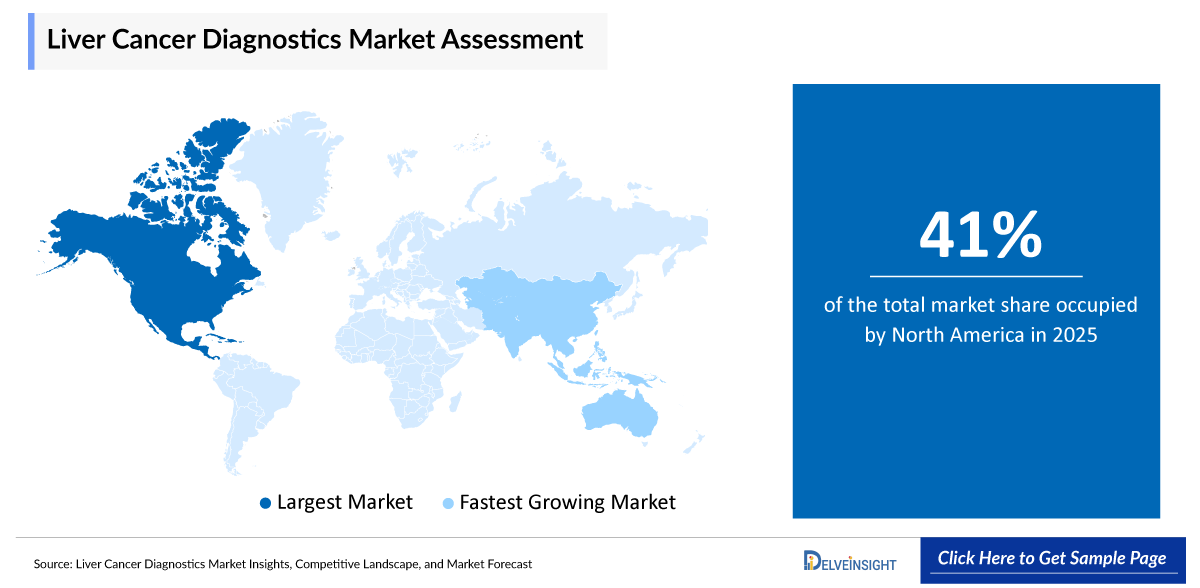
- North America dominated the global liver cancer diagnostics market revenue with a 41% share in 2025, representing the highest regional market share globally.
Request to unlock the Sample Page of the "Liver Cancer Diagnostics Market"
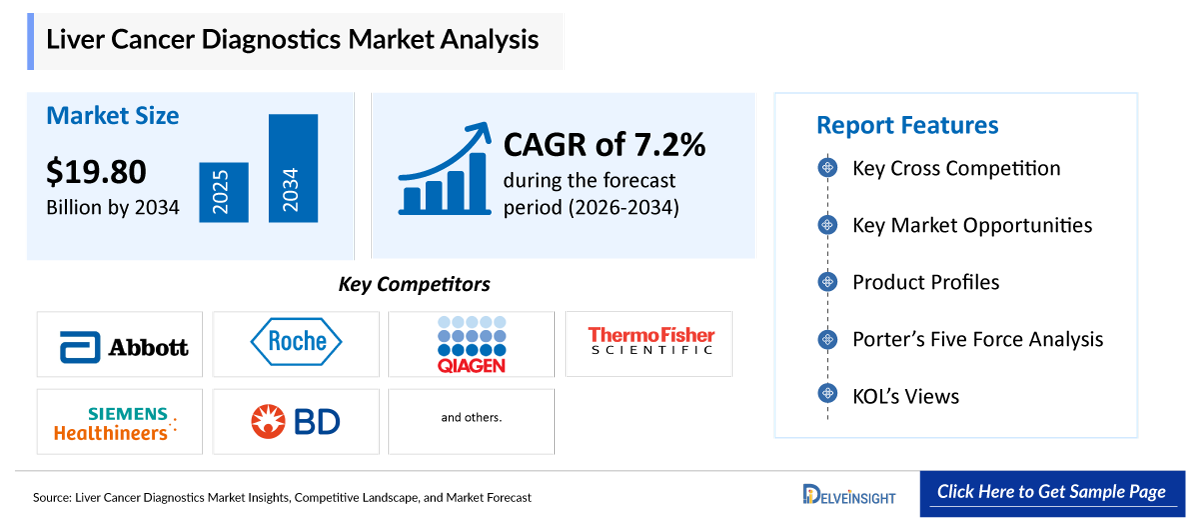
| Report Metrics | Details |
| 2025 Liver Cancer Diagnostics Market Size | USD 10.55 billion |
| 2034 Projected Liver Cancer Diagnostics Market Size | USD 19.80 billion |
| Growth Rate (2026-2034) | CAGR of 7.2% |
| Largest Liver Cancer Diagnostics Market | North America |
| Fastest Growing Liver Cancer Diagnostics Market | Asia-Pacific |
| Liver Cancer Diagnostics Market Structure | Fragmented |
Factors Contributing to the Growth of the Liver Cancer Diagnostics Market
Liver Cancer Diagnostics Market Drivers
-
Rising Global Burden of Liver Cancer
The most fundamental driver of the Liver Cancer Diagnostics market is the rising global burden of liver cancer. GLOBOCAN 2026 recorded approximately 861,000 new liver cancer cases in 2025, and the International Agency for Research on Cancer projects that the annual number of people diagnosed with or dying from primary liver cancer could rise by more than 55% by 2040, reaching an estimated 1.4 million new cases per year.
Liver cancer remains among the top three causes of cancer death in dozens of countries, concentrated disproportionately in regions with high chronic hepatitis B and C prevalence. As the population of patients requiring surveillance, diagnosis, staging, and post-treatment monitoring expands, demand for imaging procedures, biomarker assays, biopsy services, and molecular testing rises in direct proportion, anchoring sustained market growth through 2034.
-
Expanding At-Risk Population from Chronic Liver Disease
A structurally expanding at-risk population is a central growth engine for the market. Chronic hepatitis B and C infection remain leading causes of cirrhosis and hepatocellular carcinoma globally, while alcohol-related liver disease and the rapidly growing prevalence of non-alcoholic fatty liver disease and non-alcoholic steatohepatitis (NAFLD/NASH), linked to rising obesity and metabolic syndrome, are driving a new wave of liver cancer risk in Western and increasingly Asian populations.
Clinical guidelines from bodies such as AASLD and EASL recommend twice-yearly ultrasound and AFP surveillance for cirrhotic and other high-risk patients, meaning every additional at-risk patient translates into recurring, guideline-mandated diagnostic testing volume across the surveillance interval, sustaining durable long-term demand for diagnostic services.
Liver Cancer Diagnostics Overview
Liver cancer diagnostics encompass the imaging procedures, blood-based biomarker assays, biopsy techniques, and molecular tests used to detect, confirm, stage, and monitor primary liver malignancies, principally hepatocellular carcinoma (HCC) and intrahepatic cholangiocarcinoma (ICC).
Because liver cancer typically develops silently against a backdrop of chronic liver disease, chronic hepatitis B and C infection, alcohol-related liver disease, and increasingly non-alcoholic fatty liver disease (NAFLD) and non-alcoholic steatohepatitis (NASH), clinical guidelines recommend periodic surveillance of at-risk cirrhotic and high-risk populations using ultrasound and serum alpha-fetoprotein (AFP), supplemented by cross-sectional imaging (multiphase CT and MRI applying LI-RADS criteria), blood-based biomarker panels (AFP-L3, des-gamma-carboxy prothrombin/PIVKA-II, and composite algorithms such as GALAD and GAAD), tissue biopsy, and molecular and next-generation sequencing assays for tumor subtyping and treatment selection.
The Liver Cancer Diagnostics Market is organized by test type across imaging-based, biomarker-based, biopsy-based, and molecular diagnostics testing; by sample type across blood, urine, tissue, and other biological samples; by disease stage from early-stage through recurrent disease; by liver cancer type, led by hepatocellular carcinoma; and by end-users across hospitals, diagnostic centers, and research laboratories.
Driven by the rising global burden of liver cancer, growing clinical adoption of non-invasive blood-based surveillance algorithms, advances in AI-assisted imaging, and expanding molecular diagnostics capabilities among major in-vitro diagnostics companies, liver cancer diagnostics has become a critical and fast-evolving component of the global precision oncology and hepatology care continuum.
Liver Cancer Diagnostics Market Key Growth Drivers
- The rising global burden of liver cancer is expanding demand for diagnostic testing, with GLOBOCAN recording approximately 866,000 new liver cancer cases worldwide in 2022, and the International Agency for Research on Cancer projecting that annual cases and deaths could rise by more than 55% by 2040.
- Growing prevalence of chronic hepatitis B and C, alcohol-related liver disease, and non-alcoholic fatty liver disease/steatohepatitis (NAFLD/NASH) is expanding the at-risk population requiring routine surveillance and diagnostic testing.
- Increasing clinical adoption of non-invasive, blood-based biomarker panels, including AFP, AFP-L3, and des-gamma-carboxy prothrombin combined into composite algorithms such as GALAD and GAAD, is improving early-detection sensitivity relative to ultrasound alone.
- Advances in AI-assisted multiphase CT and MRI imaging, applying standardized reporting frameworks such as LI-RADS, are improving non-invasive diagnostic accuracy and reducing reliance on biopsy.
- Expansion of molecular diagnostics and next-generation sequencing-based liquid biopsy is supporting tumor subtyping, prognosis, and treatment selection for hepatocellular carcinoma and intrahepatic cholangiocarcinoma.
- Major in-vitro diagnostics and imaging companies are broadening liver cancer test menus and platforms through new product launches, regulatory clearances, and strategic partnerships, expanding access to advanced diagnostics.
- Rising government and health-system investment in cancer screening infrastructure, particularly across Asia-Pacific, where chronic hepatitis-driven liver cancer burden is concentrated, is accelerating diagnostic adoption.
Key Liver Cancer Diagnostics Companies
The Liver Cancer Diagnostics Competitive Landscape is led by the following active manufacturers:
- Abbott Laboratories
- F. Hoffmann-La Roche Ltd.
- QIAGEN N.V.
- Thermo Fisher Scientific Inc.
- Siemens Healthineers
- Becton Dickinson and Company (BD)
- Illumina Inc.
- Epigenomics AG
- Fujifilm Corporation
- Fujirebio Holdings Inc.
Liver Cancer Diagnostics Market Restraints
Despite strong momentum, the Liver Cancer Diagnostics market faces material constraints. Real-world adherence to guideline-recommended, twice-yearly ultrasound and AFP surveillance among eligible cirrhotic and high-risk patients remains inconsistent across health systems, limiting the early-detection benefit that diagnostic innovation can deliver. Ultrasound sensitivity is reduced in patients with obesity or NASH-related hepatic steatosis, a growing share of the at-risk population, which can necessitate reliance on costlier cross-sectional imaging or biomarker testing.
High cost and uneven reimbursement for advanced molecular and NGS-based tests constrain adoption in cost-sensitive and lower-resource markets, while invasive tissue biopsy carries procedural risks, including bleeding and tumor seeding, that limit its use as a first-line diagnostic tool. A shortage of trained radiologists, hepatologists, and pathologists in many low- and middle-income countries constrains diagnostic throughput and interpretation quality, and fragmented, inconsistent adoption of clinical guidelines across regions creates variability in test selection and diagnostic pathways.
Regulatory and clinical-validation hurdles for novel biomarker and liquid biopsy assays also lengthen the time to clinical adoption. Together, these access, cost, workforce, and regulatory barriers temper the pace of growth, even as the underlying drivers of rising disease burden, biomarker innovation, and imaging advancement remain firmly intact.
Liver Cancer Diagnostics Market Segment Analysis
The liver cancer diagnostics market by test type (imaging-based test, biomarker-based test, biopsy-based test, molecular diagnostics test, others), sample type (blood, urine, tissue, other biological samples), disease stage (early-stage liver cancer, intermediate-stage liver cancer, advanced-stage liver cancer, recurrent liver cancer), liver cancer type (hepatocellular carcinoma (hcc), intrahepatic cholangiocarcinoma (icc), hepatoblastoma, other liver cancers), end-users (hospitals, diagnostic centers, research laboratories, others), and geography (North America, Europe, Asia-Pacific, and Rest of World).
-
Liver Cancer Diagnostics Market Segmentation By Test Type
- Dominant Subsegment: Imaging-Based Test.
The imaging-based test segment accounted for 42% of the Liver Cancer Diagnostics Market in 2025. Imaging is the clinical cornerstone of hepatocellular carcinoma diagnosis because multiphase contrast-enhanced CT and MRI, interpreted under standardized frameworks such as LI-RADS, can establish a definitive, non-invasive diagnosis in cirrhotic patients meeting specific imaging criteria, without requiring biopsy. Ultrasound with or without contrast remains the backbone of guideline-recommended surveillance for at-risk populations, generating very high, recurring procedure volumes across hospitals and diagnostic centers.
While biomarker-based testing is the fastest-growing test type, propelled by the clinical adoption of composite algorithms such as GALAD and GAAD that improve early-stage detection sensitivity relative to ultrasound alone, and molecular diagnostics testing is expanding quickly on the back of NGS-based tumor subtyping, the breadth, established clinical role, and sheer surveillance and diagnostic volume of imaging secure its leadership across the forecast period.
-
Liver Cancer Diagnostics Market Segmentation By Sample Type
- Dominant Subsegment: Blood.
The blood segment accounted for 46% of the Liver Cancer Diagnostics market in 2025. Blood is the leading sample type because nearly all biomarker-based surveillance and diagnostic tests, including AFP, AFP-L3, des-gamma-carboxy prothrombin, and composite algorithms such as GALAD and GAAD, as well as emerging liquid biopsy assays, rely on blood or serum specimens. Blood-based testing is minimally invasive, straightforward to collect at scale through standard venipuncture, and well suited to the repeat, semiannual surveillance testing recommended for cirrhotic and other high-risk populations under long-term follow-up.
Tissue sample testing is the fastest-growing sample type, driven by expanding use of biopsy-derived tissue for molecular and next-generation sequencing-based tumor subtyping and treatment-selection profiling, while urine and other biological samples remain a smaller, emerging area of biomarker research. Nonetheless, the scale, convenience, and central role of blood specimens in both surveillance and diagnosis secure the segment's leadership across the forecast period.
Liver Cancer Diagnostics Market Region Analysis
- Dominant Region: North America
North America accounted for 41% of the global liver cancer diagnostics market revenue in 2025, representing the highest regional market share globally. The region's dominance reflects a mature hepatology and oncology care infrastructure, well-established AASLD guideline-driven surveillance programs, broad reimbursement coverage for AFP, AFP-L3, and DCP biomarker testing, advanced cross-sectional imaging, and a high concentration of leading in-vitro diagnostics and imaging companies headquartered in the region.
Rising incidence of NAFLD/NASH-related hepatocellular carcinoma, alongside continued chronic hepatitis-driven cirrhosis burden, sustains strong demand for both surveillance and confirmatory diagnostic testing. Continued investment in AI-assisted imaging platforms and expanding adoption of composite blood-based biomarker algorithms reinforce the region's leadership across the forecast period.
- Fastest Growing Region: Asia-Pacific
Asia-Pacific is the fastest-growing region in the Liver Cancer Diagnostics market. The region's elevated CAGR is driven by the world's highest burden of chronic hepatitis B and C-related liver cancer, concentrated particularly in China, alongside rapid expansion of hospital and diagnostic-center imaging infrastructure and rising healthcare investment across China, Japan, India, South Korea, and Australia.
China's large and growing hepatitis B carrier population continues to drive substantial surveillance and diagnostic testing volume; Japan is scaling adoption of AI-assisted imaging and advanced biomarker panels, India is expanding low-cost diagnostic-center capacity, and South Korea and Australia are broadening reimbursed access to biomarker and molecular testing.
The combination of high disease burden, infrastructure build-out, and rising diagnostic technology adoption positions Asia-Pacific as the principal source of incremental growth over the forecast period.
Liver Cancer Diagnostics Regional Commentary
- North America
North America accounted for 41% of the global liver cancer diagnostics market revenue in 2025. The United States dominates on the strength of its hepatology and oncology infrastructure, established surveillance guidelines, broad reimbursement, and concentration of leading diagnostics companies, while rising NAFLD/NASH-driven HCC incidence and continued investment in AI-assisted imaging reinforce its leadership.
- Europe
Europe is a large and advanced regional market, supported by established EMA and national regulatory frameworks, strong hepatology research networks, and growing adoption of composite biomarker algorithms such as GALAD and GAAD across Germany, France, the United Kingdom, Italy, and Spain. Expanding NAFLD/NASH prevalence and continued investment in AI-enabled imaging platforms support diagnostic testing growth across the region.
- Asia-Pacific
Asia-Pacific is the fastest-growing region, propelled by the world's highest chronic hepatitis B and C-related liver cancer burden, rapid diagnostic and hospital infrastructure build-out, and growing healthcare investment across China, Japan, India, South Korea, and Australia. China's hepatitis B-driven disease burden, Japan's advanced imaging and biomarker adoption, and India's expanding low-cost diagnostic-center capacity are accelerating regional testing volumes.
- Rest of World
The Rest of World region, spanning Latin America, the Middle East, and Africa, is an emerging growth frontier. Expanding hospital and diagnostic-imaging infrastructure, rising awareness of liver cancer risk associated with chronic hepatitis and alcohol-related liver disease, and gradually improving access to biomarker and molecular testing are broadening diagnostic capacity, while international partnerships support continued build-out of regional testing infrastructure.
Liver Cancer Diagnostics Market Competitive Landscape
The Liver Cancer Diagnostics Market is classified as Moderately Fragmented. Large, diversified in-vitro diagnostics and imaging conglomerates, including F. Hoffmann-La Roche Ltd., Abbott Laboratories, Siemens Healthineers, and Thermo Fisher Scientific Inc., compete alongside specialized molecular diagnostics and biomarker-focused providers such as QIAGEN N.V., Illumina Inc., Becton Dickinson and Company, Fujirebio Holdings Inc., Fujifilm Corporation, and Epigenomics AG, creating a competitive landscape spanning automated immunoassay platforms, advanced imaging systems, and next-generation molecular diagnostics.
The Liver Cancer Diagnostics Competitive Landscape can be evaluated across the following dimensions:
- Market concentration: Moderately fragmented, with diversified diagnostics conglomerates competing alongside specialized biomarker and molecular diagnostics providers.
- Leading players: F. Hoffmann-La Roche Ltd., Abbott Laboratories, Siemens Healthineers, and Thermo Fisher Scientific Inc. anchor the top tier through broad immunoassay, imaging, and molecular diagnostics portfolios.
- Geographic reach: Leaders operate global commercial and manufacturing networks, supplying automated immunoassay and imaging platforms to hospitals and reference laboratories across North America, Europe, and Asia-Pacific.
- Portfolio strength: Top players offer integrated pathways spanning imaging systems, AFP/AFP-L3/DCP biomarker assays, biopsy support, and NGS-based molecular diagnostics.
- Technology and platform access: Ownership of automated chemiluminescence immunoassay platforms (such as Elecsys and Lumipulse), AI-enabled imaging systems, and NGS sequencing infrastructure is a decisive competitive advantage.
- Strategic partnerships: Collaborations spanning molecular diagnostics, companion diagnostics, and oncology genomic profiling extend the reach of leading providers into liver cancer subtyping and treatment-selection testing.
- Innovation focus: Composite blood-based biomarker algorithms, AI-assisted multiphase imaging, and NGS-based liquid biopsy for tumor subtyping represent the leading edges of competitive innovation.
- Manufacturing and testing capabilities: Automated, high-throughput immunoassay analyzers, advanced CT/MRI and interventional imaging systems, and validated NGS workflows are key competitive moats.
Liver Cancer Diagnostics Market Recent Developmental Activities
- In 2026, Siemens Healthineers introduced new Artis angiography platforms, including Artis genio and Artis icono. Artis Genio and Artis Icono. vision, incorporating AI-based imaging tools such as automated cone-beam CT motion correction to support precise embolization treatment planning for liver cancer. Strategic significance: Strengthens Siemens Healthineers' integrated liver-disease imaging and interventional portfolio.
- In 2025-2026, F. Hoffmann-La Roche Ltd. continued clinical adoption and validation of its Elecsys GAAD and GALAD blood-based algorithmic scores for hepatocellular carcinoma surveillance, combining AFP, AFP-L3, and des-gamma-carboxy prothrombin into a single composite risk score run on its automated immunoassay platform. Strategic significance: Reinforces Roche's leadership in non-invasive, blood-based HCC surveillance biomarkers.
Liver Cancer Diagnostics Market Segmentation
Liver Cancer Diagnostics Market by Test Type
- Imaging-Based Test
- Biomarker-Based Test
- Biopsy-Based Test
- Molecular Diagnostics Test
- Others
Liver Cancer Diagnostics Market by Sample Type
- Blood
- Urine
- Tissue
- Other Biological Samples
Liver Cancer Diagnostics Market by Disease Stage
- Early-Stage Liver Cancer
- Intermediate-Stage Liver Cancer
- Advanced-Stage Liver Cancer
- Recurrent Liver Cancer
Liver Cancer Diagnostics Market by Liver Cancer Type
- Hepatocellular Carcinoma (HCC)
- Intrahepatic Cholangiocarcinoma (ICC)
- Hepatoblastoma
- Other Liver Cancers
Liver Cancer Diagnostics Market by End-Users
- Hospitals
- Diagnostic Centers
- Research Laboratories
- Others
Liver Cancer Diagnostics Market by Geography
-
North America Liver Cancer Diagnostics Market
- United States Liver Cancer Diagnostics Market Size in USD million (2023-2034)
- Canada Liver Cancer Diagnostics Market Size in USD million (2023-2034)
- Mexico Liver Cancer Diagnostics Market Size in USD million (2023-2034)
-
Europe Liver Cancer Diagnostics Market
- Germany Liver Cancer Diagnostics Market Size in USD million (2023-2034)
- United Kingdom Liver Cancer Diagnostics Market Size in USD million (2023-2034)
- France Liver Cancer Diagnostics Market Size in USD million (2023-2034)
- Italy Liver Cancer Diagnostics Market Size in USD million (2023-2034)
- Spain Liver Cancer Diagnostics Market Size in USD million (2023-2034)
- Rest of Europe Liver Cancer Diagnostics Market Size in USD million (2023-2034)
-
Asia-Pacific Liver Cancer Diagnostics Market
- China Liver Cancer Diagnostics Market Size in USD million (2023-2034)
- Japan Liver Cancer Diagnostics Market Size in USD million (2023-2034)
- India Liver Cancer Diagnostics Market Size in USD million (2023-2034)
- Australia Liver Cancer Diagnostics Market Size in USD million (2023-2034)
- South Korea Liver Cancer Diagnostics Market Size in USD million (2023-2034)
- Rest of Asia-Pacific Liver Cancer Diagnostics Market Size in USD million (2023-2034)
-
Rest of the World (RoW) Liver Cancer Diagnostics Market
- Middle East Liver Cancer Diagnostics Market Size in USD million (2023-2034)
- Africa Liver Cancer Diagnostics Market Size in USD million (2023-2034)
- South America Liver Cancer Diagnostics Market Size in USD million (2023-2034)
Key Takeaways from the Liver Cancer Diagnostics Market Report Study
- Market size analysis for the current liver cancer diagnostics market size (2025), and market forecast for 9 years (2026 to 2034).
- Top key product/technology developments, mergers, acquisitions, partnerships, and joint ventures that happened over the last 3 years.
- Key companies dominating the global liver cancer diagnostics market.
- Various opportunities available for competitors in the liver cancer diagnostics market space.
- What are the top-performing segments in 2025? How will these segments perform in 2034?
- Which are the top-performing regions and countries in the current liver cancer diagnostics market scenario?
- Which are the regions and countries where companies should concentrate their opportunities for liver cancer diagnostics market growth in the future?
Target audience who can benefit from this liver cancer diagnostics market report study
- Liver cancer diagnostics product providers
- Research organizations and consulting companies
- Neurodegenerative disease therapeutics-related organizations, associations, forums, and other alliances
- Government and corporate offices
- Start-up companies, venture capitalists, and private equity firms
- Distributors and traders dealing in liver cancer diagnostics
- Various end-users who want to know more about the liver cancer diagnostics market and the latest technological developments in the liver cancer diagnostics market.
Stay updated with us for Recent Articles @ New DelveInsight Blogs

