
PRA-023 Market Summary
Key Factors Driving PRA-023 Growth
1. Strong efficacy signals in ulcerative colitis and Crohn’s disease
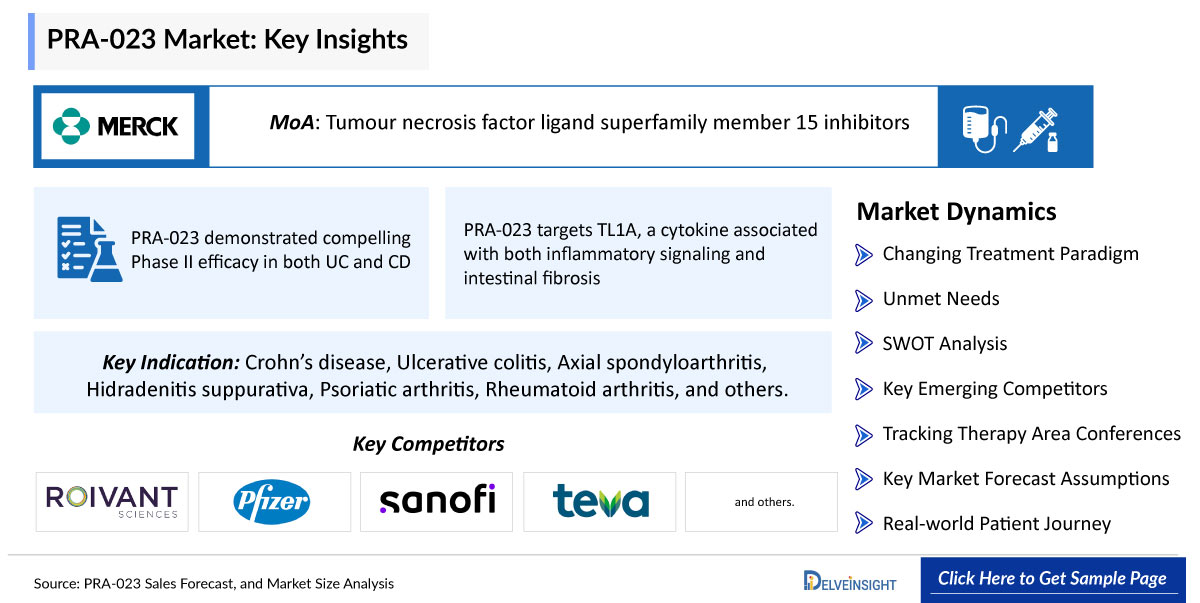
PRA-023 demonstrated compelling Phase II efficacy in both UC and CD, including biologic-experienced populations with difficult-to-treat disease. In the ARTEMIS-UC study, approximately 26.5% of patients achieved clinical remission at Week 12 versus 1.5% with placebo. In the APOLLO-CD study, the drug achieved 49% clinical remission and 26% endoscopic response rates, outperforming historical placebo benchmarks. These outcomes positioned TL1A inhibition as a potentially transformative mechanism in IBD.
2. Novel mechanism targeting both inflammation and fibrosis
Unlike many currently approved biologics that primarily suppress inflammation, PRA-023 targets TL1A, a cytokine associated with both inflammatory signaling and intestinal fibrosis. Fibrosis and stricturing remain major unmet needs in Crohn’s disease, often leading to surgery despite biologic therapy. The dual anti-inflammatory and anti-fibrotic potential significantly differentiates PRA-023 from anti-TNF agents, JAK inhibitors, and IL-23 inhibitors. This mechanism has generated strong scientific and commercial interest across the gastroenterology community.
3. Large and expanding IBD market opportunity
The global IBD market continues to expand rapidly due to increasing prevalence, earlier diagnosis, and longer treatment duration. Ulcerative colitis and Crohn’s disease collectively affect millions globally, with biologics representing multi-billion-dollar therapeutic segments. Leading IBD drugs such as HUMIRA and STELARA historically generated annual sales exceeding US$5-20 billion. Given PRA-023’s differentiated efficacy profile and potential use in earlier lines of therapy, analysts and industry observers widely expect blockbuster potential exceeding US$1 billion annually if Phase III studies are successful. Merck’s willingness to pay approximately US$10.8 billion for Prometheus underscores the commercial confidence in the asset.
4. Merck’s global commercialization capabilities
A major growth catalyst is the acquisition of Prometheus Biosciences by Merck & Co. for approximately US$10.8 billion in 2023. Merck’s extensive immunology infrastructure, clinical development expertise, and global commercial reach substantially de-risk PRA-023’s future launch trajectory. The acquisition also signaled that Merck views immunology as a strategic post-Keytruda growth pillar. Merck has since renamed the asset MK-7240 and continues advancing late-stage development.
5. Precision medicine and companion diagnostic strategy
Prometheus developed PRA-023 alongside a genetics-based companion diagnostic platform designed to identify patients with elevated TL1A pathway activity. This biomarker-driven approach could improve response rates, reduce trial failures, and support premium pricing strategies. Precision medicine remains relatively underdeveloped in IBD compared with oncology, giving PRA-023 a potential competitive advantage in payer negotiations and physician adoption. Early APOLLO-CD data suggested enhanced responses in genetically selected patient subsets.
PRA-023 Recent Developments
In October 2025, Merck announced the initiation of three new Phase IIb trials for tulisokibart in three additional immune-mediated inflammatory diseases:
- Hidradenitis suppurativa (HS) – NCT06956235
- Radiographic axial spondyloarthritis (r-axSpA/ankylosing spondylitis) – NCT07133633
- Rheumatoid arthritis (RA) – NCT07176390
These global trials are recruiting over 640 patients across the 7MM (US, EU4+UK, Japan), bringing tulisokibart's total clinical footprint to six diseases. The drug is already in Phase III for ulcerative colitis (ATLAS-UC, NCT06052059) and Crohn's disease (ARES-CD, NCT06430801), plus Phase II for systemic sclerosis-associated interstitial lung disease.
“PRA-023 Sales Forecast, and Market Size Analysis – 2034” report provides comprehensive insights of PRA-023 for potential indication like Crohn’s disease, Ulcerative colitis, Axial spondyloarthritis, Hidradenitis suppurativa, Psoriatic arthritis, Rheumatoid arthritis, and Systemic scleroderma in the 7MM. A detailed picture of PRA-023’s existing usage in anticipated entry and performance in potential indications in the 7MM, i.e., the United States, EU4 (Germany, France, Italy, and Spain) and the United Kingdom, and Japan for the study period 2020 –2034 is provided in this report along with a detailed description of the PRA-023 for potential indications. The PRA-023 market report provides insights about PRA-023’s sales forecast, mechanism of action (MoA), dosage and administration, as well as research and development including regulatory milestones, along with other developmental activities. Further, it also consists of historical and current PRA-023 performance, future market assessments inclusive of the PRA-023 market forecast analysis for potential indications in the 7MM, SWOT, analysts’ views, comprehensive overview of market competitors, and brief about other emerging therapies in respective indications. It also provides analysis of PRA-023 sales forecasts, along with factors driving its market.
PRA-023 Drug Summary
PRA-023 is an investigational humanized IgG1 monoclonal antibody developed by Prometheus Biosciences, later acquired by Merck & Co., that targets tumor necrosis factor-like ligand 1A (TL1A), a cytokine involved in intestinal inflammation and fibrosis. The drug is being developed primarily for immune-mediated diseases including ulcerative colitis, Crohn’s disease, and systemic sclerosis-associated interstitial lung disease (SSc-ILD). PRA-023 binds both soluble and membrane-bound TL1A with high specificity, aiming to reduce inflammatory signaling and fibrotic progression, making it a potentially disease-modifying therapy. Clinical studies have demonstrated favorable safety, tolerability, target engagement, and promising efficacy signals in inflammatory bowel disease patients, particularly in genetically selected populations with elevated TL1A expression, supporting its precision medicine approach alongside companion diagnostic development. The report provides PRA-023’s sales, growth barriers and drivers, post usage and approvals in multiple indications.
Scope of the PRA-023 Market Report
The report provides insights into:
- A comprehensive product overview including the PRA-023 MoA, description, dosage and administration, research and development activities in potential indication like Crohn’s disease, Ulcerative colitis, Axial spondyloarthritis, Hidradenitis suppurativa, Psoriatic arthritis, Rheumatoid arthritis, and Systemic scleroderma.
- Elaborated details on PRA-023 regulatory milestones and other development activities have been provided in PRA-023 market report.
- The report also highlights PRA-023‘s cost estimates and regional variations, reported and estimated sales performance, research and development activities in potential indications across the United States, Europe, and Japan.
- The PRA-023 market report also covers the patents information, generic entry and impact on cost cut.
- The PRA-023 market report contains current and forecasted PRA-023 sales for potential indications till 2034.
- Comprehensive coverage of the late-stage emerging therapies for respective indications.
- The PRA-023 market report also features the SWOT analysis with analyst views for PRA-023 in potential indications.
Methodology
The PRA-023 market report is built using data and information sourced primarily from internal databases, primary and secondary research and in-house analysis by DelveInsight’s team of industry experts. Information and data from the secondary sources have been obtained from various printable and nonprintable sources like search engines, news websites, global regulatory authorities websites, trade journals, white papers, magazines, books, trade associations, industry associations, industry portals and access to available databases.
PRA-023 Analytical Perspective by DelveInsight
- In-depth PRA-023 Market Assessment
This PRA-023 sales market forecast report provides a detailed market assessment of PRA-023 for potential indication like Crohn’s disease, Ulcerative colitis, Axial spondyloarthritis, Hidradenitis suppurativa, Psoriatic arthritis, Rheumatoid arthritis, and Systemic scleroderma in the seven major markets, i.e., the United States, EU4 (Germany, France, Italy, and Spain) and the United Kingdom, and Japan. This segment of the report provides current and forecasted PRA-023 sales data uptil 2034.
- PRA-023 Clinical Assessment
The PRA-023 market report provides the clinical trials information of PRA-023 for potential indications covering trial interventions, trial conditions, trial status, start and completion dates.
PRA-023 Competitive Landscape
The report provides Insights on competitors and marketed products within the domain, along with a summary of emerging products and their respective launch dates, posing significant competition in the market.
PRA-023 Market Potential & Revenue Forecast
- Projected market size for the PRA-023 and its key indications
- Estimated PRA-023 sales potential (PRA-023 peak sales forecasts)
- PRA-023 Pricing strategies and reimbursement landscape
PRA-023 Competitive Intelligence
- Number of competing drugs in development (pipeline analysis)
- PRA-023 Market positioning compared to existing treatments
- PRA-023 Strengths & weaknesses relative to competitors
PRA-023 Regulatory & Commercial Milestones
- PRA-023 Key regulatory approvals & expected launch timelines
- Commercial partnerships, licensing deals, and M&A activity
PRA-023 Clinical Differentiation
- PRA-023 Efficacy & safety advantages over existing drugs
- PRA-023 Unique selling points
PRA-023 Market Report Highlights
- In the coming years, the PRA-023 market scenario is set to change due to strong adoption, increased prescriptions and broader uptake in multiple immunological indications; which would expand the size of the market.
- The PRA-023 companies are developing therapies that focus on novel approaches to treat/improve the disease condition, assess challenges, and seek opportunities that could influence PRA-023’s dominance.
- Other emerging products for Crohn’s disease, Ulcerative colitis, Axial spondyloarthritis, Hidradenitis suppurativa, Psoriatic arthritis, Rheumatoid arthritis, and Systemic scleroderma are expected to give tough market competition to PRA-023 and launch of late-stage emerging therapies in the near future will significantly impact the market.
- A detailed description of regulatory milestones, and developmental activities, provide the current development scenario of PRA-023 in potential indications.
- Analyse PRA-023 cost, pricing trends and market positioning to support strategic decision-making in the immunology landscape.
- Our in-depth analysis of the forecasted PRA-023 sales data uptil 2034 will support the clients in decision-making process regarding their therapeutic portfolio by identifying the overall scenario of PRA-023 in potential indications.
Key Questions
- What is the class of therapy, route of administration and mechanism of action of PRA-023? How strong is PRA-023’s clinical and commercial performance?
- What is PRA-023’s clinical trial status in each individual indications such as Crohn’s disease, Ulcerative colitis, Axial spondyloarthritis, Hidradenitis suppurativa, Psoriatic arthritis, Rheumatoid arthritis, and Systemic scleroderma and study completion date?
- What are the key collaborations, mergers and acquisitions, licensing and other activities related to the PRA-023 Manufacturers?
- What are the key designations that have been granted to PRA-023 for potential indications? How are they going to impact PRA-023’s penetration in various geographies?
- What is the current and forecasted PRA-023 market scenario for potential indications? What are the key assumptions behind the forecast?
- What are the current and forecasted sales of PRA-023 in the seven major countries, including the United States, Europe (Germany, France, Italy, Spain) and the United Kingdom, and Japan?
- What are the other emerging products available and how are these giving competition to PRA-023 for potential indications?
- Which are the late-stage emerging therapies under development for the treatment of potential indications?
- How cost-effective is PRA-023? What is the duration of therapy and what are the geographical variations in cost per patient?

