Venous Thromboembolism Market Summary
- The burden of venous thromboembolism (VTE) is expected to increase substantially over the coming decades, with projections indicating that the number of affected adults in the United States could nearly double.
- The concerns regarding bleeding complications contribute to the underutilization of anticoagulant therapy in clinical practice, leaving some high-risk patients vulnerable to potentially life-threatening thrombotic events.
- The pharmaceutical companies involved in the venous thromboembolism market are Bristol Myers Squibb (apixaban (ELIQUIS)), Boehringer Ingelheim (dabigatran etexilate (PRADAXA)), Pfizer (dalteparin sodium (FRAGMIN), and others.
- ELIQUIS has emerged as the leading therapy in the venous thromboembolism market, supported by strong efficacy, a favorable safety profile, and extensive physician adoption.
- The widespread adoption of oral anticoagulants has expanded the treated venous thromboembolism population, with ELIQUIS becoming the most prescribed oral anticoagulant in the United States.
- The venous thromboembolism pipeline is increasingly focused on next-generation anticoagulants that target factor XI and aim to reduce bleeding risk while maintaining antithrombotic efficacy.
- The pipeline of venous thromboembolism is not robust and includes REGN7508 (Regeneron Pharmaceuticals), BAY3018250 (Bayer), and others.
- Despite advances in treatment, recurrent venous thromboembolism remains a significant clinical challenge. highlighting the need for effective long-term anticoagulation strategies and improved risk stratification.
Venous Thromboembolism Market Size and Forecast in the 7MM
- 2025 Venous Thromboembolism Market Size: XX million
- 2036 Projected Venous Thromboembolism Market Size: XX million
- Venous Thromboembolism Growth Rate (2026–2036): XX% CAGR
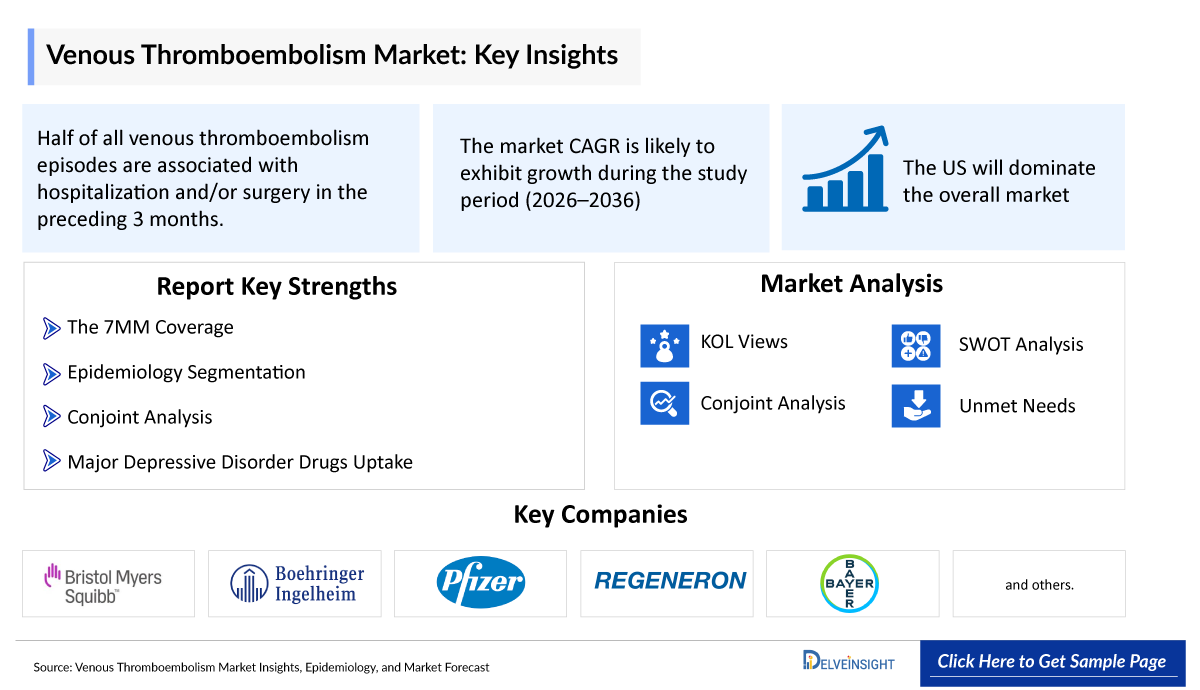
DelveInsight's ‘Venous Thromboembolism Market Insights, Epidemiology and Market Forecast 2036’ report delivers an in-depth understanding of venous thromboembolism, historical and forecasted epidemiology, as well as the venous thromboembolism market trends in the United States, EU4 (Germany, Spain, Italy, and France) and the United Kingdom, and Japan.
The venous thromboembolism market report delivers a comprehensive analysis of the current treatment landscape, including standards of care, clinical practices, and evolving therapeutic algorithms. It evaluates venous thromboembolism patient burden trends, revenue & market share dynamics, peak patient share & therapy uptake analysis, and provides an in-depth market size assessment, and growth rate projections (Historical & Forecast 2022–2036) across global regions. The report highlights key unmet medical needs in venous thromboembolism and maps the competitive and clinical landscape to uncover high‑value opportunities, providing a clear outlook on future market growth potential.
|
Study Period |
2022–2036 |
|
Historical Year |
2022–2025 |
|
Forecast Period |
2026–2036 |
|
Base Year |
2026 |
|
Geographies Covered |
|
|
Venous Thromboembolism Market CAGR (Forecast period) |
XX% (2026–2036) |
|
Venous Thromboembolism Epidemiology Segmentation Analysis |
Patient Burden Assessment
|
|
Venous Thromboembolism Companies |
|
|
Venous Thromboembolism Therapies |
|
|
Venous Thromboembolism Market |
Segmented by
|
|
Analysis |
|
|
|
Key Factors Driving the Venous Thromboembolism Market
Increasing Incidence of Venous Thromboembolism
The global burden of venous thromboembolism, including deep vein thrombosis (DVT) and pulmonary embolism, continues to rise due to aging populations, increasing obesity rates, sedentary lifestyles, and the growing prevalence of chronic diseases such as cancer and cardiovascular disorders. This expanding patient pool is driving demand for effective anticoagulant therapies and long-term disease management.
Widespread Adoption of Direct Oral Anticoagulants (DOACs)
The availability of DOACs such as apixaban, rivaroxaban, edoxaban, and dabigatran has transformed venous thromboembolism management. These therapies offer fixed dosing, fewer drug interactions, and reduced monitoring requirements compared with traditional anticoagulants, improving patient convenience and supporting broader treatment uptake.
Rising Number of Surgical Procedures and Hospitalizations
Major orthopedic surgeries, cancer treatments, prolonged hospital stays, and critical care admissions are significant risk factors for venous thromboembolism. The increasing volume of these procedures worldwide is boosting demand for prophylactic anticoagulation and thrombosis prevention strategies.
Venous Thromboembolism Understanding and Treatment Algorithm
Venous Thromboembolism Overview and Diagnosis
Venous thromboembolism is a vascular disorder that encompasses DVT and pulmonary embolism. DVT occurs when a blood clot forms in the deep veins, most commonly in the lower extremities, while pulmonary embolism develops when part of the clot dislodges and travels to the lungs, potentially causing life-threatening complications. Venous thromboembolism is a major cause of morbidity and mortality worldwide and is associated with risk factors such as advanced age, prolonged immobility, surgery, hospitalization, cancer, obesity, pregnancy, inherited thrombophilia, and certain chronic medical conditions. The disease imposes a substantial healthcare burden due to recurrent events, long-term complications, and the need for ongoing anticoagulation therapy.
Diagnosis of venous thromboembolism involves a combination of clinical assessment, laboratory testing, and imaging studies. Patients with DVT may present with symptoms such as unilateral leg swelling, pain, tenderness, and redness, whereas pulmonary embolism commonly manifests as shortness of breath, chest pain, tachycardia, and, in severe cases, hemodynamic instability. Diagnostic evaluation often includes clinical prediction tools, such as the Wells score, along with D-dimer testing to assess the likelihood of thrombosis. Confirmatory imaging studies include compression ultrasonography for DVT and computed tomography pulmonary angiography (CTPA) for pulmonary embolism, which remain the standard diagnostic modalities in clinical practice.
Further details are provided in the report.
Current Venous Thromboembolism Treatment Landscape
Treatment of venous thromboembolism is primarily centered on anticoagulation to prevent clot extension, recurrence, and embolization. DOACs, including apixaban, rivaroxaban, dabigatran, and edoxaban, are widely used due to their efficacy and ease of administration. In selected patients, low-molecular-weight heparins and vitamin K antagonists may also be employed, particularly in specific clinical settings such as cancer-associated thrombosis. Severe or high-risk cases may require thrombolytic therapy, catheter-directed interventions, or surgical thrombectomy. Long-term management focuses on reducing recurrence risk through extended anticoagulation, risk-factor modification, and appropriate prophylaxis in high-risk populations.
Further details related to country-based variations are provided in the report.
Venous Thromboembolism Unmet Needs
The section “unmet needs of venous thromboembolism” outlines the critical gaps between the current state of patient care, diagnosis, and the ideal & effective management of the disease. It highlights the obstacles experienced by patients, clinicians, and researchers and identifies potential solutions for future progress.
-
Need for safer anticoagulants with lower bleeding risk
-
Prevention of recurrent venous thromboembolism
-
Persistent long-term complications
-
Limited options for high-bleeding-risk patients, and others…..
Note: Comprehensive unmet needs insights in Venous Thromboembolism and their strategic implications are provided in the full report.
Venous Thromboembolism Epidemiology
Key Findings from Venous Thromboembolism Epidemiological Analysis and Forecast
- In the United States, up to 900,000 people develop venous thromboembolism annually, resulting in an estimated 60,000–100,000 deaths each year and substantial long-term complications among survivors.
- According to secondary analysis, increasing age is associated with a significant increase in risk, with an annual incidence of 1 per 100, in those over 80 years of age.
- Half of all venous thromboembolism episodes are associated with hospitalization and/or surgery in the preceding 3 months.
- Women are at a higher risk of venous thromboembolism during younger adulthood due to factors such as the use of combined hormonal contraceptives and pregnancy.
- As per Thrombosis UK, 1 in 4 deaths are related to blood clots.
Venous Thromboembolism Drug Analysis
The venous thromboembolism drug chapter provides a detailed, market-focused review of the emerging pipeline across Phase III/II clinical trials and preclinical trials. It covers the mechanism of action, clinical trial data, regulatory approvals, patents, collaborations, and strategic partnerships for each therapy, along with their advantages, limitations, and recent developments. This section offers critical insights into the venous thromboembolism treatment landscape, supporting market assessment, competitive analysis, and growth forecasting for the venous thromboembolism therapeutics market.
Approved Therapies for Venous Thromboembolism
Apixaban (ELIQUIS): Bristol Myers Squibb
It is a direct oral factor Xa inhibitor widely used for the treatment and prevention of venous thromboembolism, including DVT and pulmonary embolism. Its oral administration, predictable pharmacokinetic profile, and lack of routine coagulation monitoring requirements have contributed to its widespread adoption in clinical practice. Apixaban has minimum marker exclusivity till 2028 in the US and 2026 in Japan. BMS in its SEC filing stated that apixaban’s US revenues increased 6% in 2025, primarily due to higher demand.
Dabigatran etexilate (PRADAXA): Boehringer Ingelheim
It is an oral direct thrombin inhibitor approved for the treatment and prevention of recurrent venous thromboembolism. As the first DOAC approved in this class, dabigatran etexilate represents a significant advancement over traditional vitamin K antagonists by offering fixed dosing and reduced monitoring requirements.
|
Competitive Landscape of Venous Thromboembolism Marketed/Approved Therapies | ||||||
|
Drug/Therapy |
Company |
Indication |
Molecule Type |
MoA |
RoA |
Marketed Region |
|
Apixaban (ELIQUIS) |
Bristol Myers Squibb |
Venous thromboembolism |
Small molecule |
Factor Xa inhibitor |
Oral |
US: 2012 |
|
Dabigatran etexilate (PRADAXA) |
Boehringer Ingelheim |
Venous thromboembolism |
Small molecule |
Thrombin inhibitors |
Oral |
US: 2010 |
|
Dalteparin sodium (FRAGMIN) |
Pfizer |
Venous thromboembolism |
Oligosaccharide |
Antithrombotic |
SC |
US: 1994 |
Note: Detailed marketed therapies assessment of therapies will be provided in the final report.
Venous Thromboembolism Pipeline Analysis
REGN7508: Regeneron Pharmaceuticals
REGN7508 is currently in Phase III clinical development for the prevention of venous thromboembolism. Following positive results from the Phase II ROXI-VTE studies, in which REGN7508 demonstrated superiority to enoxaparin and non-inferiority to apixaban for postoperative VTE prevention after total knee arthroplasty, Regeneron initiated a broad Phase III program in 2025. No major bleeding events were observed in Phase I or Phase II studies due to REGN7508. The pivotal ROXI-APEX Phase III trial is evaluating REGN7508 against apixaban and enoxaparin for thromboprophylaxis following elective total knee arthroplasty.
BAY3018250: Bayer
It is an investigational thrombolytic agent being evaluated for the treatment of symptomatic proximal DVT. Unlike traditional anticoagulants that primarily prevent clot extension, BAY3018250 is designed to actively dissolve existing thrombi, potentially enabling faster restoration of venous blood flow and reducing the risk of long-term complications such as post-thrombotic syndrome.
|
Competitive Landscape of Pipeline Drugs | ||||||
|
Drug Name |
Company |
Highest Phase |
Indication |
RoA |
MoA |
Anticipated Launch in the US |
|
REGN7508 |
Regeneron Pharmaceuticals |
III |
Venous Thromboembolism |
IV infusion |
Factor XI inhibitor |
Information is available in the full report |
|
BAY3018250 |
Bayer |
II |
DVT |
IV infusion |
Factor XI inhibitor |
Information is available in the full report |
|
Note: Launch insights are provisional and may change with future report updates or the occurrence of major key catalysts. | ||||||
Note: Detailed emerging therapies assessment will be provided in the final report.
Venous Thromboembolism Key Players, Market Leaders, and Emerging Companies
- Bristol Myers Squibb
- Boehringer Ingelheim
- Pfizer
- Regeneron Pharmaceuticals
- Bayer, and others
Venous Thromboembolism Drug Updates
- Regeneron Pharmaceuticals, in its corporate presentation, anticipated initial pivotal data of REGN7508 starting in 2027.
Venous Thromboembolism Market Outlook
The treatment landscape for venous thromboembolism has evolved over time, driven by the adoption of DOACs that have largely replaced traditional vitamin K antagonists and parenteral anticoagulants in many clinical settings.
Among approved therapies, ELIQUIS has emerged as the market leader due to its strong efficacy, favorable bleeding profile, convenient oral administration, and broad physician acceptance. ELIQUIS continues to maintain a dominant competitive position in the anticoagulation market, supported by its broad clinical adoption, extensive evidence base, and established role across multiple thromboembolic indications. Dabigatran etexilate was the first DOAC approved for venous thromboembolism treatment and prevention. However, its market share has declined over time because of increasing competition from newer DOACs with more favorable clinical and dosing profiles. Dalteparin sodium continues to play an important role, particularly in select patients with cancer-associated thrombosis and in situations where parenteral anticoagulation is preferred, although its use has been challenged by the growing adoption of oral anticoagulants.
The emerging candidates include, REGN7508, a Phase III factor XI monoclonal antibody that has demonstrated promising efficacy in preventing postoperative venous thromboembolism and represents one of the most advanced next-generation anticoagulants in development. It selectively targets factor XI and aims to preserve antithrombotic activity while potentially improving safety outcomes. BAY3018250 is being evaluated for the treatment of DVT and differs from conventional anticoagulants by actively promoting clot dissolution rather than solely preventing clot propagation. If successful, these pipeline candidates could address important unmet needs in venous thromboembolism management and intensify competition within a market currently dominated by established anticoagulants such as apixaban.
Overall, the venous thromboembolism market is expected to witness continued growth across the 7MM, supported by increasing disease incidence, aging populations, and greater awareness of thromboembolic disorders. The advancements are anticipated to create significant commercial opportunities for both established products and emerging pipeline therapies through 2036.
- The United States represented the largest share of the 7MM market in 2025 and is expected to experience robust growth through 2036, driven by continued therapeutic adoption and expanding patient populations.
- Apixaban is expected to remain the leading therapy during the forecast period.
- The introduction of novel factor XI-targeted therapies and innovative thrombolytic approaches could reshape the competitive landscape by offering differentiated efficacy and safety profiles.
Further details will be provided in the report….
Drug Class/Insights into Leading Emerging and Marketed Therapies in Venous Thromboembolism (2026–2036 Forecast)
The venous thromboembolism market (2022–2036 forecast) is evolving toward anticoagulant therapies that provide effective thrombosis prevention while minimizing bleeding risk, a key limitation of current treatment options.
- DOACs: This class includes apixaban and dabigatran etexilate, a direct thrombin inhibitor. These small-molecule therapies prevent thrombus formation by selectively inhibiting key coagulation factors within the clotting cascade. Their favorable efficacy, convenience, and established safety profiles have made them the standard of care for many patients with VTE, contributing significantly to market growth.
- Low-Molecular-Weight Heparins (LMWHs): Dalteparin sodium belongs to the LMWH class and exerts its anticoagulant effect primarily through inhibition of Factor Xa via antithrombin. Although the use of LMWHs has declined with the increasing adoption of DOACs, they remain important in specific patient populations, particularly those with cancer-associated thrombosis and in hospital settings requiring parenteral anticoagulation.
- Thrombolytic/Fibrinolytic Agents: BAY3018250 represents an investigational thrombolytic approach aimed at actively dissolving established blood clots rather than simply preventing clot progression.
Overall, innovation in venous thromboembolism is increasingly centered on next-generation anticoagulants and targeted thrombolytic therapies. While DOACs currently dominate the market, emerging classes such as factor XI inhibitors and novel clot-dissolving agents are expected to expand therapeutic options. As these pipeline candidates progress, they are expected to expand the therapeutic landscape beyond Metoclopramide, addressing significant unmet needs and supporting steady market growth across major regions.
Venous Thromboembolism Drug Uptake
This section focuses on the uptake rate of potential drugs expected to be launched in the market during the forecast period (2026–2036). The analysis covers the venous thromboembolism drug’s uptake, performance at peak, factors affecting performance during prime years of growth, patient uptake by therapy, and anticipated sales generated by each drug.
During the forecast period, apixaban is expected to maintain its position as the leading therapy in the venous thromboembolism market. Dabigatran etexilate is expected to experience relatively stable but modest utilization, as competition from factor Xa inhibitors has limited its market expansion despite its proven efficacy. Dalteparin sodium is likely to retain a niche role, particularly in hospitalized patients and select cases of cancer-associated thrombosis, although its uptake may gradually decline due to the convenience and increasing use of oral anticoagulants.
Among emerging therapies, REGN7508 is expected to achieve meaningful uptake following potential approval, driven by its novel factor XI inhibition mechanism and the prospect of reducing bleeding risk while maintaining antithrombotic efficacy. Its adoption is likely to be strongest among patients at elevated bleeding risk and in clinical settings where safety concerns limit the use of conventional anticoagulants. BAY3018250 is anticipated to see more targeted uptake in patients with acute DVT, particularly if clinical studies demonstrate superior clot resolution and improved long-term outcomes compared with standard anticoagulation alone. While its use may initially be limited to specialized treatment centers, positive efficacy and safety data could support broader adoption over time.
Detailed insights into emerging therapies' drug uptake is included in the report
Market Access and Reimbursement of Approved Therapies in Venous Thromboembolism
The United States
|
US Reimbursement of Therapies Approved for Venous Thromboembolism | |
|
Drug/Therapy |
Access Program |
|
ELIQUIS |
Eliquis 360 Support |
Reimbursement is a crucial factor that affects the drug’s access to the market. Often, the decision to reimburse comes down to the price of the drug relative to the benefit it produces in treated patients. To reduce the healthcare burden of these high-cost therapies, many payment models are being considered by payers and other industry insiders.
NOTE: Further Details are provided in the final report….
Venous Thromboembolism Therapies Price Scenario & Trends
Pricing and analogue assessment of venous thromboembolism therapies highlights evolving price dynamics structures. This section summarizes the cost of approved treatments, the closest and most appropriate analogue selection for emerging therapies, and understanding of how pricing influences market access, adherence, and long-term uptake.
Industry Experts and Physician Views for Venous Thromboembolism
To keep up with venous thromboembolism market trends, we take Key Opinion Leaders (KOLs) and Subject Matter Experts (SMEs) opinions working in the domain through primary research to fill the data gaps and validate our secondary research. Industry experts were contacted for insights on the venous thromboembolism emerging therapies, evolving treatment landscape, patient adherence to conventional therapies, therapy switching trends, drug adoption and uptake, accessibility challenges, and epidemiology and real-world prescription patterns in venous thromboembolism, including MD, PhD, Instructor, Postdoctoral Researcher, Professor, Researcher, and others.
DelveInsight’s analysts connected with 15+ KOLs to gather insights at the country level. Centers such as the American Society of Hematology, the University of Edinburgh, and Aichi Medical University, etc. were contacted. Their opinion helps understand and validate current and emerging venous thromboembolism therapies, highlight unmet medical needs, provide epidemiological context, and support strategic decisions for market access, therapy adoption, and pipeline prioritization in venous thromboembolism.
|
Region |
Key Opinion Leaders (KOLs) and Subject Matter Experts (SMEs) |
|
United States |
“Pregnant women face an increased risk of venous thromboembolism, but routine thromboprophylaxis may not be warranted except for those with specific risk factors like prior VTE. Diagnosing pregnancy-associated venous thromboembolism (PA-VTE) is challenging due to its nonspecific symptoms and potential complications for both mother and fetus, compounded by limited research in this area.” |
|
Germany |
“The burden of venous thromboembolism includes impaired quality of life (QoL), additional costs of treatment, and potentially indirect costs due to days lost from work. In Europe, there are approximately 544,000 venous thromboembolism-related deaths every year.” |
Qualitative Analysis: SWOT and Conjoint Analysis
We perform qualitative and market Intelligence analysis using various approaches, such as SWOT analysis and conjoint analysis.
In the SWOT analysis of venous thromboembolism, strengths, weaknesses, opportunities, and threats in terms of disease diagnosis, patient awareness, patient burden, competitive landscape, cost-effectiveness, and geographical venous thromboembolismessibility of therapies are provided.
Conjoint analysis analyzes emerging therapies based on relevant attributes such as safety, efficacy, frequency of administration, route of administration, and order of entry. Scoring is given based on these parameters to analyze the effectiveness of therapy.
The team of analysts analyzes promising emerging therapies based on relevant attributes such as safety, efficacy, frequency of administration, route of administration, and order of entry. In efficacy, the trial’s primary and secondary outcome measures are evaluated, whereas the therapies’ safety is evaluated, wherein the acceptability, tolerability, and adverse events are mainly observed. In addition, the scoring is also based on the route of administration, order of entry, probability of success, and the addressable patient pool for each therapy. According to these parameters, the final weightage score and the ranking of the emerging therapies are decided.
Scope of the Report
- The report covers a segment of key events, an executive summary, a descriptive overview of venous thromboembolism, explaining their causes, signs and symptoms, pathogenesis, and currently available treatments.
- Comprehensive insight has been provided into the epidemiology segments and forecasts, the future growth potential of the diagnosis rate, and disease progression along treatment guidelines.
- Additionally, an all-inclusive account of both the current and emerging treatments, along with the elaborative profiles of late-stage and prominent therapies, will have an impact on the current treatment landscape.
- A detailed review of the venous thromboembolism market, historical and forecasted market size, market share by therapies, detailed assumptions, and rationale behind our approach is included in the report, covering the 7MM drug outreach.
- The report provides an edge while developing business strategies by understanding trends through SWOT analysis and expert insights/KOL views, patient journey, and treatment preferences that help in shaping and driving the 7MM venous thromboembolism market.
Report Insights
- Venous Thromboembolism Patient Population Forecast
- Venous Thromboembolism Therapeutics Market Size
- Venous Thromboembolism Pipeline Analysis
- Venous Thromboembolism Market Size and Trends
- Venous Thromboembolism Market Opportunity (Current and forecasted)
Report Key Strengths
- Epidemiology‑based (Epi‑based) Bottom‑up Forecasting
- Artificial Intelligence (AI)-Enabled Market Research Report
- 11-Year Forecast
- Venous Thromboembolism Market Outlook (North America, Europe, Asia-Pacific)
- Patient Burden Trends (By Geography)
- Venous Thromboembolism Treatment Addressable Market (TAM)
- Venous Thromboembolism Competitive Landscape
- Venous Thromboembolism) Major Companies Insights
- Venous Thromboembolism Price Trends and Analogue Assessment
- Venous Thromboembolism Therapies Drug Adoption/Uptake
- Venous Thromboembolism Therapies Peak Patient Share Analysis
Report Assessment
- Venous Thromboembolism Current Treatment Practices
- Venous Thromboembolism Unmet Needs
- Venous Thromboembolism Clinical Development Analysis
- Venous Thromboembolism Emerging Drugs Product Profiles
- Venous Thromboembolism Market Attractiveness
- Venous Thromboembolism Qualitative Analysis (SWOT and conjoint analysis)
FAQs
Market Insights
- What was the venous thromboembolism market size, the market size by therapies, market share (%) distribution in 2025, and what would it look like by 2036? What are the contributing factors for this growth?
- What are the anticipated pricing variations among different geographies for the emerging therapies in the future?
- What can be the future treatment paradigm of venous thromboembolism?
- What are the disease risks, burdens, and unmet needs of venous thromboembolism? What will be the growth opportunities across the 7MM concerning the patient population with venous thromboembolism?
- Who is the major future competitor in the market, and how will the competitors affect their market share?
- What are the current options for the treatment of venous thromboembolism? What are the current guidelines for treating venous thromboembolism in the US, Europe, and Japan?
Reasons to Buy
- The report will help in developing business strategies by understanding the latest trends and changing treatment dynamics driving the venous thromboembolism market.
- Bottom-up forecasting builds from the affected population to product forecasts, delivering a robust, data-driven approach ideal for new therapies and novel classes.
- Insights on patient burden/disease incidence, evolution in diagnosis, and factors contributing to the change in the epidemiology of the disease during the forecast years.
- Understand the existing market opportunities in varying geographies and the growth potential over the coming years.
- Identifying strong upcoming players in the market will help devise strategies to help get ahead of competitors.
- Detailed analysis and ranking of class-wise potential emerging therapies under the conjoint analysis section to provide visibility around leading classes.
- To understand KOLs’ perspectives on the accessibility, acceptability, and compliance-related challenges of existing treatment to overcome barriers in the future.
- Detailed insights into the unmet needs of the existing market so that the upcoming players can strengthen their development and launch strategy.
- This Artificial Intelligence (AI)-enabled report summarize and simplify complex datasets within the report into clear, actionable insights for stakeholders, investors, and healthcare providers, enabling faster, data-driven decisions.