Age-Related Vision Dysfunction Insights and Trends
- According to DelveInsight estimates, the United States represented a major market for Age-Related Vision Dysfunction in 2025, and recent analyses suggest further growth potential owing to the increasing adoption of novel and targeted therapies.
-
Market dynamics are expected to strengthen over the forecast period due to improved diagnostic technologies, growing age-related macular degeneration (AMD) awareness, and the emergence of gene- and complement-targeted therapies.
-
VEGF inhibitors remain the primary treatment for age-related vision dysfunction, particularly in wet AMD and diabetic retinal diseases, while complement inhibitors, gene therapies, retinal implants, and neuroprotective approaches are emerging as promising next-generation options for dry AMD and geographic atrophy.
-
Age-related retinal disorders, particularly AMD, are a leading cause of vision impairment and blindness worldwide, with prevalence expected to rise significantly due to population aging and increased life expectancy.
-
Among different forms of age-related retinal dysfunction, dry AMD accounts for the majority of diagnosed cases, while wet AMD contributes disproportionately to severe vision loss due to rapid disease progression and retinal neovascularization.
-
The treatment landscape for Age-Related Vision Dysfunction is evolving from conventional anti-VEGF monoclonal antibodies toward longer-acting biologics, complement inhibitors, gene therapies, and sustained-delivery approaches aimed at reducing injection frequency and improving durability of response.
-
The Age-Related Vision Dysfunction treatment landscape is shifting from conventional anti-VEGF therapies toward biologics, complement inhibitors, gene therapies, and sustained-delivery platforms designed to enhance treatment durability and reduce injection burden.
-
In July 2025, Annexon completed enrollment in the Phase III ARCHER-2 trial of vonaprument for geographic atrophy secondary to dry AMD, with topline results expected in H2 2026.
-
In July 2025, Sanofi received FDA Fast Track Designation for SAR446597, a one-time intravitreal gene therapy targeting complement pathways for geographic atrophy associated with AMD.
-
In March 2026, Ocugen reported positive 12-month Phase II ArMaDa results for OCU410, demonstrating a significant reduction in geographic atrophy lesion growth in dry AMD patients.
Age-Related Vision Dysfunction Market Size and Forecast in the 7MM
-
2025 Age-Related Vision Dysfunction Market Size: ~USD XXXX
-
2036 Projected Age-Related Vision Dysfunction Market Size: ~USD XXXX
-
Age-Related Vision Dysfunction Growth Rate (2026–2036): XX CAGR
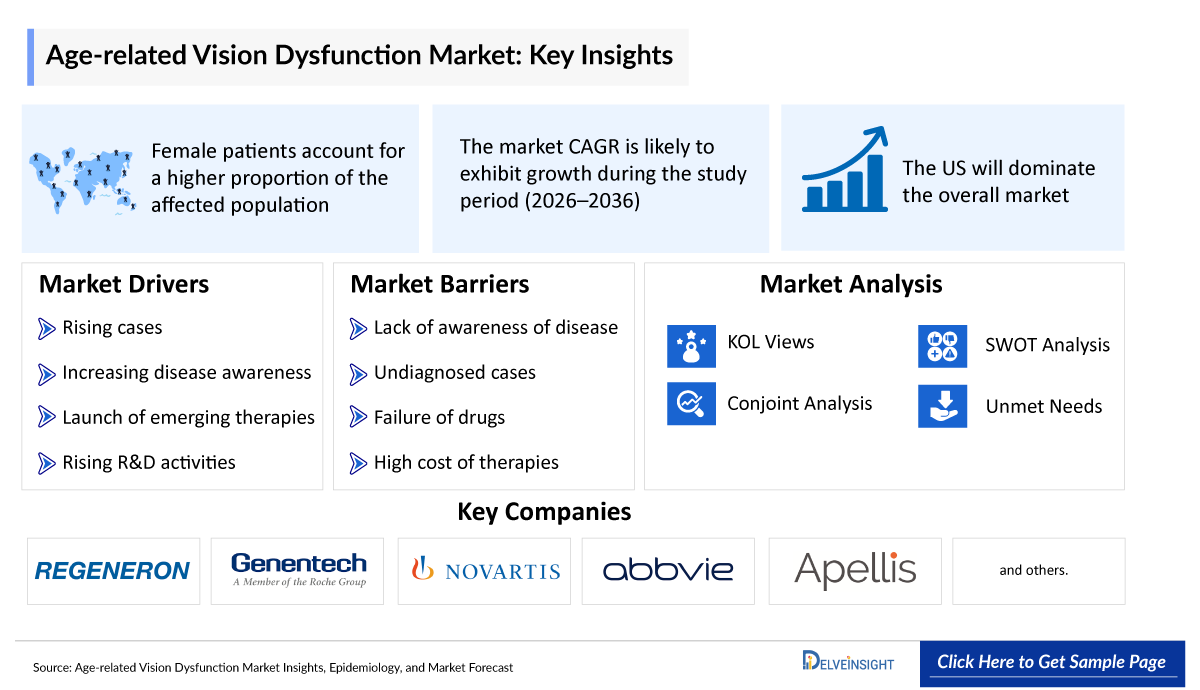
DelveInsight's ‘Age-Related Vision Dysfunction Market Insights, Epidemiology and Market Forecast – 2036’ report delivers an in-depth understanding of the Age-Related Vision Dysfunction, historical and forecasted epidemiology, as well as Age-Related Vision Dysfunction market trends in the United States, EU4 (Germany, Spain, Italy, and France) and the United Kingdom, and Japan.
The Age-Related Vision Dysfunction market report delivers a comprehensive analysis of the current treatment landscape, including standards of care, clinical practices, and evolving therapeutic algorithms. It evaluates Age-Related Vision Dysfunction patient burden trends, revenue & market share dynamics, peak patient share & therapy uptake analysis, and provides an in-depth market size assessment and growth rate projections (Historical & Forecast 2022–2036) across global regions. The report highlights key unmet medical needs in Age-Related Vision Dysfunction and maps the competitive and clinical landscape to uncover high‑value opportunities, providing a clear outlook on future market growth potential.
|
Study Period |
2022–2036 |
|
Historical Year |
2022–2025 |
|
Forecast Period |
2026–2036 |
|
Base Year |
2026 |
|
Geographies Covered |
|
|
Age-Related Vision Dysfunction Market CAGR (Forecast period) |
XX% (2026 ̶ 2036) |
|
Age-Related Vision Dysfunction Epidemiology Segmentation Analysis |
Patient Burden Assessment
|
|
Age-Related Vision Dysfunction Companies |
|
|
Age-Related Vision Dysfunction Therapies |
|
|
Age-Related Vision Dysfunction Market |
Segmented by
|
|
Analysis |
|
Key Factors Driving the Age-Related Vision Dysfunction Market
Age-Related Vision Dysfunction Patient Pool and Rising Disease Burden
Age-related vision dysfunction is a leading cause of visual impairment and blindness worldwide. The diagnosed patient population is increasing across the 7MM due to aging populations, longer life expectancy, improved retinal imaging, and greater disease awareness. The United States represents the largest market, followed by EU4, the UK, and Japan, driven by higher diagnosis rates, advanced ophthalmic care, and strong adoption of innovative retinal therapies.
Age-Related Vision Dysfunction Market Growth and Emerging Treatment Landscape
The Age-Related Vision Dysfunction market is expected to grow significantly through 2036, driven by the rising adoption of anti-VEGF therapies, complement inhibitors, and long-acting retinal treatments. While current management is dominated by agents such as aflibercept, ranibizumab, and faricimab, the treatment landscape is evolving toward solutions that reduce injection burden, improve durability, and address dry AMD. Emerging therapies targeting complement pathways, inflammation, oxidative stress, and cellular degeneration include gene therapies, sustained-release implants, bispecific antibodies, neuroprotective agents, and regenerative approaches. Complement inhibitors and modifier gene therapies are expected to play an increasingly important role in improving long-term outcomes in dry AMD and geographic atrophy.
Age-Related Vision Dysfunction Understanding
Age-Related Vision Dysfunction Overview
Age-related vision dysfunction is a progressive ocular condition marked by a gradual decline in visual function with aging, leading to reduced visual acuity, contrast sensitivity, dark adaptation, and overall vision quality. It includes a range of age-associated disorders such as presbyopia, cataracts, AMD, diabetic retinopathy, glaucoma, and other retinal or optic nerve diseases that contribute to functional vision loss in older adults. The condition affects central and peripheral vision, depth perception, and low-light performance, significantly impacting daily activities such as reading, driving, mobility, and facial recognition.
The condition arises from cumulative structural and physiological changes in ocular tissues, including lens stiffening, retinal degeneration, oxidative stress, mitochondrial dysfunction, vascular impairment, and progressive loss of photoreceptor and retinal pigment epithelial function. Risk factors such as advanced age, diabetes, smoking, hypertension, obesity, genetic predisposition, and prolonged ultraviolet exposure further accelerate disease progression. If left untreated or poorly managed, age-related vision dysfunction can result in significant visual disability, increased risk of falls, loss of independence, and reduced quality of life in older adults.
Age-Related Vision Dysfunction Diagnosis
Diagnosis of age-related vision dysfunction involves a comprehensive ophthalmic evaluation to identify the cause and extent of visual impairment. It typically includes patient history, symptom assessment, visual acuity testing, refraction, contrast sensitivity evaluation, and visual field examination. Additional tools such as slit-lamp examination, fundoscopy, intraocular pressure measurement, optical coherence tomography (OCT), fluorescein angiography, retinal imaging, and dark adaptation testing help assess retinal, lens, optic nerve, and vascular changes associated with age-related ocular disorders.
The diagnostic approach varies by condition, including cataracts, AMD, glaucoma, diabetic retinopathy, and other retinal degenerations. Early detection through routine eye exams is essential, as many conditions progress slowly and remain asymptomatic in early stages. Timely diagnosis enables earlier intervention, better disease management, and preservation of long-term visual function and quality of life.
Further details are provided in the report.
Age-Related Vision Dysfunction Treatment
Treatment of age-related vision dysfunction depends on the underlying condition and severity of visual impairment, with goals focused on slowing progression, preserving vision, and improving quality of life. Management includes pharmacological and non-pharmacological approaches such as corrective lenses, lifestyle modification, nutritional support, low-vision rehabilitation, laser procedures, surgery, and targeted retinal therapies.
For AMD, treatment is centered on anti-VEGF therapies, including LUCENTIS, EYLEA, VABYSMO, and biosimilars such as BYOOVIZ, to inhibit abnormal blood vessel growth and fluid leakage. Select cases may also be managed with laser photocoagulation or photodynamic therapy.
For diabetic macular edema and other retinal vascular disorders, treatment includes intravitreal anti-VEGF agents and corticosteroid implants such as ILUVIEN and OZURDEX, which reduce retinal swelling and help stabilize vision. Advances in sustained-release delivery systems and longer-acting biologics are improving durability and reducing treatment burden.
Cataracts are primarily managed through surgical lens replacement, while glaucoma treatment involves intraocular pressure-lowering medications, laser therapy, and minimally invasive surgical techniques. Overall, the treatment landscape is shifting toward earlier intervention, personalized approaches, and longer-acting therapies aimed at preserving visual function in the aging population.
Further details related to country-based variations are provided in the report.
Age-Related Vision Dysfunction Unmet Needs
The section “unmet needs of Age-Related Vision Dysfunction” outlines the critical gaps between the current state of patient care, diagnosis, and the ideal & effective management of the disease. It highlights the obstacles experienced by patients, clinicians, and researchers and identifies potential solutions for future progress.
-
Lack of curative therapies capable of preventing or reversing progressive retinal degeneration and long-term vision loss
-
High treatment burden associated with frequent intravitreal injections, continuous monitoring, and long-term patient follow-up
-
Delayed diagnosis and disease progression due to gradual symptom onset and inadequate routine screening in aging populations
-
Limited treatment options for advanced-stage, refractory, or treatment-resistant retinal and optic nerve disorders…..
Comprehensive unmet needs insights in Age-Related Vision Dysfunction and their strategic implications are provided in the full report.
Age-Related Vision Dysfunction Epidemiology
Key Findings from Age-Related Vision Dysfunction Epidemiological Analysis and Forecast
-
Age-related vision dysfunction is a major global public health concern, with prevalence increasing significantly with age. It rises sharply after 60 and becomes even more common and severe after 75.
-
Female patients account for a higher proportion of the affected population, largely due to longer life expectancy and greater age-related disease burden compared with males.
-
The epidemiological burden of diabetic retinal disorders and wet AMD is expected to increase steadily during the forecast period, supported by rising diabetes prevalence, increasing smoking rates, obesity, and other retinal degeneration risk factors.
-
As per DelveInsight estimates, presbyopia accounted for the highest prevalent patient population among all considered age-related vision dysfunction etiologies across the 7MM.
-
The United States accounted for more than 35% of wet AMD cases and represented the highest prevalent glaucoma population within the 7MM in 2025, primarily due to high diagnosis rates and a large aging population.
-
Japan accounted for nearly 50% of the total diagnosed prevalent cases of presbyopia in 2025, reflecting the country’s large elderly demographic and high healthcare screening penetration.
Age-Related Vision Dysfunction Drug Chapters & Competitive Analysis
The Age-Related Vision Dysfunction drug chapter provides a detailed, market-focused review of approved therapies and the emerging pipeline across Phase I–III clinical trials. It covers the mechanism of action, clinical trial data, regulatory approvals, patents, collaborations, and strategic partnerships for each therapy, along with their advantages, limitations, and recent developments. This section offers critical insights into the Age-Related Vision Dysfunction treatment landscape, supporting market assessment, competitive analysis, and growth forecasting for the Age-Related Vision Dysfunction therapeutics market.
Approved Therapies for Age-Related Vision Dysfunction
Faricimab-svoa (VABYSMO): Genentech
VABYSMO, developed by Genentech, is a prescription intravitreal injection used to treat wet AMD, DME, and macular edema following retinal vein occlusion (RVO). It was first approved in the US by the FDA in January 2022 and targets two key disease pathways involved in retinal vascular conditions. The therapy is also approved in multiple regions, including Europe. In October 2023, the FDA expanded its approval to include the treatment of macular edema following RVO.
Ranibizumab (LUCENTIS): Genentech
LUCENTIS, developed by Genentech, is a prescription intravitreal therapy used to treat wet AMD, macular edema following RVO, DME, diabetic retinopathy (DR), and myopic choroidal neovascularization. In April 2017, the FDA approved LUCENTIS for the treatment of diabetic retinopathy, a leading cause of blindness among working-age adults in the United States. It became the first therapy approved to treat all forms of diabetic retinopathy and received Priority Review designation from the FDA based on data from a National Institutes of Health (NIH)-funded collaborative study.
|
Age-Related Vision Dysfunction Marketed/Approved Therapies | ||||||
|
Drug/Therapy |
Company |
Indication |
Molecule Type |
RoA |
MoA |
Marketed Region |
|
LUCENTIS |
Genentech |
Wet AMD |
Monoclonal antibody |
Intravitreal injection |
VEGF-A inhibitor |
US: 2006 EU: 2007 |
|
VABYSMO |
Genentech |
Wet AMD |
Bispecific antibody |
Intravitreal injection |
Dual Ang-2 and VEGF-A inhibition |
US: 2022 EU: 2022 |
Age-Related Vision Dysfunction Pipeline Analysis
KSI-301 (tarcocimab tedromer): Kodiak Sciences Inc.
Kodiak Science’s KSI-301 is a novel anti-VEGF biologic designed to provide rapid VEGF inhibition with extended durability, to reduce the need for frequent intravitreal injections. Its long-acting profile is intended to improve treatment adherence, sustain efficacy, and support better visual outcomes. The therapy has completed a Phase III study and is also being evaluated in Phase III trials for diabetic macular edema, diabetic retinopathy, and retinal vein occlusion.
ONS-5010/LYTENAVA: Outlook Therapeutics
ONS-5010/LYTENAVA is an investigational intravitreal formulation of bevacizumab being developed for wet AMD and other retinal diseases. It is a full-length, humanized anti-VEGF monoclonal antibody designed to inhibit VEGF-driven angiogenesis. The FDA accepted the Biologics License Application for review in October 2022, with a PDUFA target action date of August 2023.
|
Comparison of Emerging Drugs Under Development | |||||||
|
Drug Name |
Company |
Highest Phase |
Indication |
RoA |
MoA |
Molecule Type |
Anticipated Launch in the US |
|
KSI-301 |
Kodiak Sciences |
III |
Wet AMD |
Intravitreal injection |
Anti-VEGF inhibition |
Antibody biopolymer conjugate |
2027 |
|
ONS-5010/ LYTENAVA |
Outlook Therapeutics |
III |
Wet AMD |
Intravitreal injection |
Anti-VEGF inhibiting |
Monoclonal antibody |
Information is available in the full report |
|
Note: Launch insights are provisional and may change with future report updates or the occurrence of major key catalysts. | |||||||
Note: A detailed emerging therapies assessment will be provided in the final report
Age-Related Vision Dysfunction Key Players, Market Leaders, and Emerging Companies
-
Regeneron Pharmaceuticals
-
Genentech/Roche
-
Novartis
-
AbbVie
-
Apellis Pharmaceuticals
-
Bayer AG
-
Kodiak Sciences Inc
-
Outlook Therapeutics
-
Ocugen
-
Ocular Therapeutix
-
EyePoint Pharmaceuticals, and others
Age-Related Vision Dysfunction Key Players Drug Updates
-
In March 2026, Roche/Genentech reported strong global uptake of VABYSMO across wet AMD, DME, and RVO, driven by physician preference for extended dosing intervals and dual Ang-2/VEGF-A inhibition, with long-term studies supporting sustained efficacy and durability.
-
In January 2026, Roche reported real-world evidence showing that many wet AMD patients on VABYSMO maintained dosing intervals of up to 16 weeks while preserving visual acuity, supporting reduced treatment burden versus conventional anti-VEGF therapies.
-
In November 2025, Kodiak Sciences reported continued progress in late-stage development of KSI-301 across retinal diseases, including wet AMD, diabetic retinopathy, and retinal vein occlusion, highlighting its extended durability and potential to reduce injection frequency in chronic conditions.
-
In September 2025, Outlook Therapeutics reported continued engagement with the US FDA regarding LYTENAVA for wet AMD following prior Complete Response Letters, while advancing commercialization in Europe and the UK after regulatory approvals for ophthalmic bevacizumab in retinal diseases.
Age-Related Vision Dysfunction Market Outlook
The age-related vision dysfunction market is expected to grow significantly over the forecast period, driven by an aging global population, rising prevalence of chronic ocular and retinal diseases, and increasing adoption of advanced diagnostics and biologic therapies. Growth is largely supported by increasing cases of wet AMD, diabetic retinopathy, glaucoma, cataracts, and presbyopia, particularly in developed regions such as the United States, Europe, and Japan.
The retinal therapeutics segment remains dominant, led by strong uptake of anti-VEGF agents such as VABYSMO, LUCENTIS, and EYLEA HD. The market is increasingly shifting toward longer-acting, high-durability therapies designed to reduce injection frequency and treatment burden. Dual-pathway biologics, sustained-release formulations, gene therapies, and biosimilars are expected to reshape the competitive landscape.
The United States is projected to remain the largest market due to high diagnosis rates, advanced imaging infrastructure, strong reimbursement systems, and rapid adoption of innovative therapies. Europe’s growth will be supported by an expanding elderly population and improved access to retinal care, though pricing and reimbursement pressures may limit uptake of premium biologics. Japan also represents a key market, driven by a highly aged population, although adoption of newer therapies may be comparatively slower.
The market is witnessing increased focus on early diagnosis and preventive care through OCT imaging, AI-based retinal screening, and tele-ophthalmology. At the same time, biosimilars and cost-effective anti-VEGF alternatives are intensifying competition and improving accessibility.
Despite therapeutic progress, key unmet needs persist, including limited durable treatment options, high injection burden, under-treatment in early disease, and uneven access to specialized care. As a result, companies developing long-acting biologics, gene therapies, and disease-modifying treatments are expected to gain a strong competitive advantage.
-
According to the estimates, the United States accounted for the largest share of the age-related vision dysfunction in 2025 among the 7MM during the study period.
Further details will be provided in the report….
Drug Class/Insights into Leading Emerging and Marketed Therapies in Age-Related Vision Dysfunction (2022–2036 Forecast)
The age-related vision dysfunction market is primarily driven by anti-VEGF biologics, which remain the standard of care for retinal diseases such as wet AMD, DME, diabetic retinopathy, and RVO. Marketed therapies, including LUCENTIS, VABYSMO, and EYLEA HD, work by inhibiting VEGF-mediated angiogenesis and vascular leakage, helping preserve vision and slow disease progression.
The market is gradually shifting toward longer-acting, high-durability therapies aimed at reducing injection frequency and improving adherence. Among available options, VABYSMO stands out due to its dual Ang-2/VEGF-A inhibition, enabling extended dosing intervals and improved vascular stability. High-dose aflibercept formulations and other sustained-delivery approaches are also gaining adoption as clinicians prioritize longer-lasting disease control. The competitive landscape is further evolving with the entry of biosimilars and lower-cost anti-VEGF alternatives, which are expected to improve access and intensify pricing competition. Ophthalmic bevacizumab formulations such as LYTENAVA are being developed as cost-effective options within the anti-VEGF space.
Emerging therapies are increasingly focused on gene therapy, sustained-release implants, complement inhibition, and regenerative approaches aimed at improving durability, reducing treatment burden, and offering potential disease modification. Pipeline assets such as KSI-301 are designed for extended VEGF suppression with fewer injections, while complement inhibitors are gaining momentum in dry AMD and geographic atrophy. Overall, the market is shifting from short-acting biologics toward durable, mechanism-based therapies that are expected to reshape long-term treatment paradigms in age-related vision dysfunction.
Further details will be provided in the report….
Age-Related Vision Dysfunction Drug Uptake
This section focuses on the uptake rate of potential drugs expected to be launched in the market during the forecast period (2026–2036). The analysis covers the Age-Related Vision Dysfunction market's uptake by drugs, patient uptake by therapy, and sales of each drug.
Therapy uptake in age-related vision dysfunction is expected to vary across anti-VEGF biologics, biosimilars, sustained-delivery treatments, and emerging gene and regenerative therapies over the forecast period. Conventional anti-VEGF agents such as LUCENTIS and bevacizumab are likely to retain a strong baseline share due to established efficacy, physician familiarity, and broad reimbursement, although their dominance may gradually decline as longer-acting options gain preference.
Among branded biologics, VABYSMO is expected to see strong uptake driven by its dual Ang-2/VEGF-A mechanism, extended dosing intervals, and durable efficacy in wet AMD and diabetic retinal diseases. Similarly, EYLEA HD is anticipated to gain traction as clinicians increasingly adopt higher-dose therapies that reduce injection frequency and improve adherence.
Biosimilars are expected to play a growing role by improving affordability and intensifying price competition within the anti-VEGF segment. Meanwhile, emerging modalities such as gene therapies, sustained-release implants, complement inhibitors, and regenerative approaches are expected to gradually increase uptake, particularly in chronic retinal conditions and dry AMD, where significant unmet needs persist.
Further detailed analysis of emerging therapies' drug uptake in the report…
Market Access and Reimbursement of Age-Related Vision Dysfunction
-
The United States
|
The US Reimbursement for Age-Related Vision Dysfunction | |
|
Drug |
Access Program |
|
LUCENTIS |
|
Reimbursement is a crucial factor that affects the drug’s access to the market. Often, the decision to reimburse comes down to the price of the drug relative to the benefit it produces in treated patients. To reduce the healthcare burden of these high-cost therapies, many payment models are being considered by payers and other industry insiders.
Further details are provided in the final report….
Age-Related Vision Dysfunction Therapies Price Scenario & Trends
Pricing and analogue assessment of Age-Related Vision Dysfunction therapies highlights evolving price dynamics structures. This section summarizes the cost of approved treatments, the closest and most appropriate analogue selection for emerging therapies, and understanding of how pricing influences market access, adherence, and long-term uptake.
Further details are provided in the final report….
Industry Experts and Physician Views for Age-Related Vision Dysfunction
To keep up with Age-Related Vision Dysfunction market trends, we take Key Opinion Leaders (KOLs) and Subject Matter Experts (SMEs) opinions working in the domain through primary research to fill the data gaps and validate our secondary research. Industry experts were contacted for insights on the Age-Related Vision Dysfunction emerging therapies, evolving treatment landscape, patient adherence to conventional therapies, therapy switching trends, drug adoption and uptake, accessibility challenges, and epidemiology and real-world prescription patterns in Age-Related Vision Dysfunction, including MD, PhD, Instructor, Postdoctoral Researcher, Professor, Researcher, and others.
DelveInsight’s analysts connected with 10+ KOLs to gather insights; however, interviews were conducted with 6+ KOLs in the 7MM. Centers such as the Harvard Medical School Department of Ophthalmology, the American Optometric Association, etc., were contacted. Their opinion helps understand and validate current and emerging Age-Related Vision Dysfunction therapies, highlight unmet medical needs, provide epidemiological context, and support strategic decisions for market access, therapy adoption, and pipeline prioritization in Age-Related Vision Dysfunction.
|
Region |
Key Opinion Leaders (KOLs) and Subject Matter Experts (SMEs) |
|
United States |
“Diastolic blood pressures and mean arterial blood pressures positively correlated with an increased risk of early AMD even after controlling for age. Although the relationship between blood pressure and AMD is not always consistent, several studies have demonstrated an association.” |
|
Japan |
“The dry form of age-related macular degeneration (AMD) is common, affecting approximately 80% of people with AMD; there is a huge unmet need for treatment for these patients.” |
Qualitative Analysis: SWOT and Conjoint Analysis
We perform qualitative and market Intelligence analysis using various approaches, such as SWOT analysis and conjoint analysis.
In the SWOT analysis of Age-Related Vision Dysfunction, strengths, weaknesses, opportunities, and threats in terms of disease diagnosis, patient awareness, patient burden, competitive landscape, cost-effectiveness, and geographical accessibility of therapies are provided.
Conjoint analysis analyzes emerging therapies based on relevant attributes such as safety, efficacy, frequency of administration, route of administration, and order of entry. Scoring is given based on these parameters to analyze the effectiveness of therapy.
The team of analysts analyzes promising emerging therapies based on relevant attributes such as safety, efficacy, frequency of administration, route of administration, and order of entry. In efficacy, the trial’s primary and secondary outcome measures are evaluated, whereas the therapies’ safety is evaluated, wherein the acceptability, tolerability, and adverse events are mainly observed. In addition, the scoring is also based on the route of administration, order of entry, probability of success, and the addressable patient pool for each therapy. According to these parameters, the final weightage score and the ranking of the emerging therapies are decided.
Scope of the Report
- The report covers a segment of key events, an executive summary, a descriptive overview of Age-Related Vision Dysfunction, explaining its causes, signs and symptoms, pathogenesis, and currently available treatments.
- Comprehensive insight has been provided into the epidemiology segments and forecasts, the future growth potential of the diagnosis rate, and disease progression along treatment guidelines.
- Additionally, an all-inclusive account of both the current and emerging treatments, along with the elaborative profiles of late-stage and prominent therapies, will have an impact on the current treatment landscape.
- A detailed review of the Age-Related Vision Dysfunction market, historical and forecasted market size, market share by therapies, detailed assumptions, and rationale behind our approach is included in the report, covering the 7MM drug outreach.
- The report provides an edge while developing business strategies by understanding trends through SWOT analysis and expert insights/KOL views, patient journey, and treatment preferences that help in shaping and driving the 7MM Age-Related Vision Dysfunction market.
Report Insights
- Age-Related Vision Dysfunction Patient Population Forecast
- Age-Related Vision Dysfunction Therapeutics Market Size
- Age-Related Vision Dysfunction Pipeline Analysis
- Age-Related Vision Dysfunction Market Size and Trends
- Age-Related Vision Dysfunction Market Opportunity (Current and forecasted)
Report Key Strengths
- Epidemiology‑based (Epi‑based) Bottom‑up Forecasting
- Artificial Intelligence (AI)-enabled Market Research Report
- 11-year forecast
- Age-Related Vision Dysfunction Market Outlook (North America, Europe, Asia-Pacific)
- Patient Burden Trends (by geography)
- Age-Related Vision Dysfunction Treatment Addressable Market (TAM)
- Age-Related Vision Dysfunction Competitive Landscape
- Age-Related Vision Dysfunction Major Companies Insights
- Age-Related Vision Dysfunction Price Trends and Analogue Assessment
- Age-Related Vision Dysfunction Therapies Drug Adoption/Uptake
- Age-Related Vision Dysfunction Therapies Peak Patient Share Analysis
Report Assessment
- Age-Related Vision Dysfunction Current Treatment Practices
- Age-Related Vision Dysfunction Unmet Needs
- Age-Related Vision Dysfunction Clinical Development Analysis
- Age-Related Vision Dysfunction Emerging Drugs Product Profiles
- Age-Related Vision Dysfunction Market Attractiveness
- Age-Related Vision Dysfunction Qualitative Analysis (SWOT and Conjoint Analysis)
FAQs
Market Insights
- What was the Age-Related Vision Dysfunction market size, the market size by therapies, market share (%) distribution in 2025, and what would it look like by 2036? What are the contributing factors for this growth?
- What are the anticipated pricing variations among different geographies for the emerging therapies in the future?
- What can be the future treatment paradigm of Age-Related Vision Dysfunction?
- What are the disease risks, burdens, and unmet needs of Age-Related Vision Dysfunction? What will be the growth opportunities across the 7MM concerning the patient population with Age-Related Vision Dysfunction?
- Who is the major future competitor in the market, and how will the competitors affect their market share?
- What are the current options for the treatment of Age-Related Vision Dysfunction? What are the current guidelines for treating Age-Related Vision Dysfunction in the US, Europe, and Japan?
Reasons to Buy
- The report will help in developing business strategies by understanding the latest trends and changing treatment dynamics driving the Age-Related Vision Dysfunction market.
- Bottom-up forecasting builds from the affected population to product forecasts, delivering a robust, data-driven approach ideal for new therapies and novel classes.
- Insights on patient burden/disease incidence, evolution in diagnosis, and factors contributing to the change in the epidemiology of the disease during the forecast years.
- Understand the existing market opportunities in varying geographies and the growth potential over the coming years.
- Identifying strong upcoming players in the market will help devise strategies to help get ahead of competitors.
- Detailed analysis and ranking of class-wise potential current and emerging therapies under the conjoint analysis section to provide visibility around leading classes.
- To understand KOLs’ perspectives on the accessibility, acceptability, and compliance-related challenges of existing treatment to overcome barriers in the future.
- Detailed insights into the unmet needs of the existing market so that the upcoming players can strengthen their development and launch strategy.
- This Artificial Intelligence (AI)-enabled report summarizes and simplifies complex datasets within the report into clear, actionable insights for stakeholders, investors, and healthcare providers, enabling faster, data-driven decisions.