
cardiac resynchronization therapy market
Cardiac Resynchronization (CRT) Therapy Market By Product Type (CRT-Defibrillators And CRT-Pacemakers), By End User (Hospitals, Specialty Clinics, And Others), and by geography is expected to register appreciable CAGR growth till 2034 owing to increasing prevalence of cardiovascular diseases such as heart failure due to growing prevalence of lifestyle disorders such as hypertension and diabetes
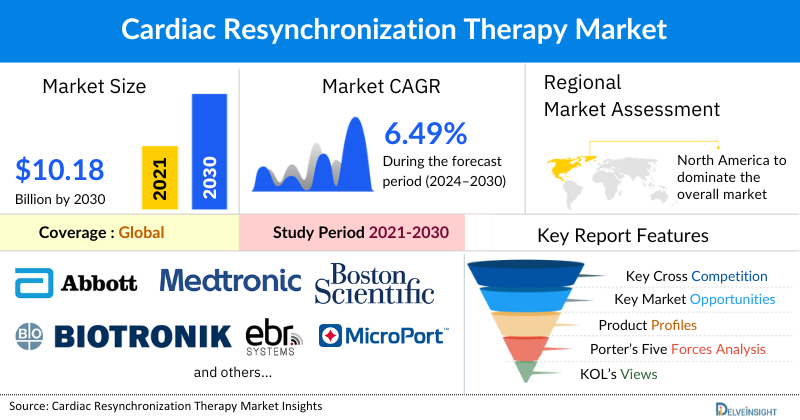
The global cardiac resynchronization (CRT) therapy market was valued at USD 7 billion in 2025, growing at a CAGR of 6.49% during the forecast period from 2026 to 2034 to reach USD 10.18 billion by 2034. The demand for cardiac resynchronization therapy devices is majorly being driven by an increase in the geriatric population who form the susceptible at-risk population group for heart failure, rising prevalence of cardiovascular diseases such as coronary artery disease which may further act as a risk factor leading to heart failure, growing prevalence of lifestyle disorders such as hypertension and diabetes that may impact the health of the heart over a long period of time, innovations in product design which are expected to play a key role in establishing an upward growth trend in the cardiac resynchronization therapy market during the forecast period from 2026-2034.
Cardiac Resynchronization (CRT) Therapy Market Dynamics:
The cardiac resynchronization therapy market is witnessing a growth in product demand owing to various factors, one of the key factors being the increase in the prevalence of cardiovascular diseases. Cardiovascular diseases (CVD) are the world's leading cause of death, killing an estimated 17.9 million people each year, according to data from the World Health Organization (2023). Some of the CVDs include myocardial infarction, congestive heart failure, acute coronary syndrome, and other conditions. Some of the CVDS such as arrhythmias, and coronary artery disease further present themselves are risk factors for heart failure. Cardiac resynchronization therapy (CRT) has revolutionized the cardiovascular treatment arena as it is recommended as a standard of care for patients with heart failure with reduced ejection fraction and electrical dyssynchrony. Therefore, the increase in the prevalence of heart failure cases due to potential exacerbations of other CVDs is projected to result in the growing need for cardiac resynchronization therapy devices, thereby propelling the growth of the CRT market during the forecast period from 2026 to 2034.
Another key aspect that is contributing to the demand for cardiac resynchronization therapy is the increasing prevalence of lifestyle disorders that may lead to heart failure in long term. According to World Health Organization (2023), there has been a drastic increase in the number of people suffering from hypertension which increased from 650 million in 1990 to 1.28 million by 2019. The factsheet further stated that nearly 46% of adults with hypertension are unaware that they have hypertension. High blood pressure is linked with numerous diseases as a major risk factor including heart failure. High blood pressure is associated with the narrowing of blood vessels and makes them less elastic. This leads to increased pressure on heart muscles which may lead to an enlarged heart and further puts pressure on the heart thereby increasing the chances of heart failure. Therefore, the increasing prevalence of lifestyle diseases such as hypertension is expected to drive the cardiac resynchronization therapy market forward during the forecast period (2026-2034).
However, product recalls and device-related complications may act as restraining factors of the cardiac resynchronization therapy market growth.
The cardiac resynchronization therapy market experienced a period of a temporary setback as lockdown restrictions were enforced as a necessary step to curb the spread of COVID-19. It was observed that the COVID-19 pandemic significantly impacted cardiovascular procedures as a majority of cardiac patients usually suffer from various comorbidities such as hypertension and diabetes. These comorbidities were further linked with increased chances of COVID-19 infection and fatality. Therefore, the suspension of elective cardiovascular procedures led to a drastic reduction in product demand in the CRT market. However, the cardiac resynchronization therapy market resumed the appreciable pace in product demand as healthcare activities returned to normal pace towards the end of 2020 with the approval and administration of COVID-19 vaccines across the globe, thereby offering better growth prospects for the cardiac resynchronization therapy market during the forecast period.
Cardiac Resynchronization (CRT) Therapy Market Segment Analysis:
Cardiac Resynchronization (CRT) Therapy Market by Product Type (CRT-Defibrillators and CRT-Pacemakers), By End User (Hospitals, Specialty Clinics, and Others), and by Geography (North America, Europe, Asia-Pacific, and Rest of the World)
In the product segment of the cardiac resynchronization therapy market, the CRT- defibrillators category is expected to amass significant revenue share during the forecast period. This can be ascribed to their ability to work in multiple indications such as heart failure, arrhythmias as well as sudden cardiac arrest. CRT-D devices are also equipped with an in-built implantable cardioverter-defibrillator besides the biventricular pacemaker component. Thus, the combined CRT-D device functions as a pacemaker in establishing normal heart rhythm along with delivering short electrical impulses to the heart ventricles to establish synchronous contraction. Moreover, CRT-D devices can deliver defibrillation signals in order to disrupt arrhythmias that may lead to sudden cardiac arrest. Therefore, the factors stated above would lead to increased product demand in the CRT market, ultimately positively influencing the overall cardiac resynchronization therapy market during the forecast period.
North America is expected to dominate the overall Cardiac Resynchronization (CRT) Therapy Market:
Among all the regions, North America is estimated to account for the largest share of the cardiac resynchronization therapy market. Owing to the significance of key growth factors such as the rising prevalence of hypertension, obesity, and diabetes, the aging population, and extensive coverage of CRT devices by insurance in the North American countries, specifically Canada and the United States, the North America cardiac resynchronization therapy market is expected to register appreciable growth.
One of the key reasons positively influencing the growth of the United States cardiac resynchronization therapy market is the rising prevalence of cardiovascular diseases in the US population. As per the latest data provided by the American Heart Association (2023), over 868,662 deaths in the country in 2017 listed cardiovascular deaths as the underlying cause. In addition to that, as per the data provided by the Centers for Disease Control and Prevention (CDC), in 2020, approximately 6.2 million adults in the country suffered from heart failure. The source further mentioned that in 2018, 379,800 death certificates mentioned heart failure as the cause of death in the nation. The above-mentioned factors point toward the growing patient population of heart failure in the country which further indicates the potential for increased uptake of CRT devices, thereby resulting in more revenue generation in the United States cardiac resynchronization therapy market.
Moreover, the rising prevalence of lifestyle disorders such as diabetes and hypertension is also considered as a key factor in the growing number of heart failure cases. As per the data provided by the Centers for Disease Control and Prevention (2023) in their National Diabetes Statistics Report, in 2020, about 10.5% of the total US population or 34.2 million people had diabetes and approximately 88 million over the age of 18 years were found to exhibit prediabetes levels. Diabetes, specifically type 2 diabetes is suspected to damage cardiomyocytes as well as blood vessels throughout the body which may put more pressure on the heart leading to progressive heart failure. Therefore, the presence of a large patient population suffering from hypertension and diabetes correlates to the presence of a high patient population suffering from heart diseases such as heart failure which would indicate the growing need for cardiac resynchronization therapy, thereby resulting in an increase in product demand supporting the growth of the United States cardiac resynchronization therapy market as well as the overall North America cardiac resynchronization therapy market during the forecast period.
Cardiac Resynchronization (CRT) Therapy Market Key Players:
Some of the key market players operating in the cardiac resynchronization therapy market include Abbott, Medtronic, Boston Scientific Corporation, BIOTRONIK, EBR Systems, Inc., Microport Scientific Corporation, MEDICO S.p.A. and others.
Recent Developmental Activities in Cardiac Resynchronization (CRT) Therapy Market:
- In October 2026, BIOTRONIK announced the first US clinical implantation of its Acticor Sky CRT-DX system at Cleveland Clinic, following FDA approval of its Acticor Sky and Rivacor Sky device family. The system incorporates left bundle branch area pacing capabilities, DX technology for atrial sensing and HeartInsight alerts for early identification of worsening heart failure.
- In October 2026, Medtronic received CE Mark approval for its next-generation Vitalis portfolio, including the ReSyncra CSP pacemaker. The ReSyncra CSP system is designed for patients who cannot achieve effective cardiac resynchronization through conventional biventricular pacing and uses conduction system pacing to activate the heart's natural electrical pathways and improve ventricular synchronization.
- In August 2026, results from the DANISH-CRT trial presented at the ESC Congress 2026 demonstrated that targeted left ventricular lead placement at the site of latest electrical activation did not improve clinical outcomes compared with standard lead placement. The primary outcome of death or first unplanned hospitalization for heart failure occurred in 27.9% of patients in the targeted-placement group compared with 25.5% in the standard-placement group.
- In June 2026, EBR Systems received a National Coverage Analysis initiation under the CMS Transitional Coverage for Emerging Technologies (TCET) pathway for its WiSE System. The evaluation will assess Medicare coverage for leadless left ventricular endocardial pacing used in cardiac resynchronization therapy, potentially supporting broader adoption of leadless CRT technology in the United States.
- In June 2026, Boston Scientific's SYNCHRONICITY clinical trial enrolled its first patient to evaluate left bundle branch area pacing (LBBAP) against conventional biventricular cardiac resynchronization therapy in patients with heart failure and cardiomyopathy. The international trial plans to enrol approximately 850–1,110 participants across multiple countries to assess the safety and effectiveness of the two approaches.
- In April 2026, results from the randomized LECART trial presented at the EHRA 2026 congress demonstrated the potential of left bundle branch area pacing (LBBAP) as an alternative to conventional biventricular CRT. The primary composite outcome occurred in 13% of patients receiving LBBAP compared with 25% receiving conventional biventricular pacing. Device-related complications requiring surgical intervention were also lower with LBBAP.
- In April 2026, BIOTRONIK received FDA approval for its next-generation Acticor Sky and Rivacor Sky ICD and CRT-D systems. The devices incorporate left bundle branch area pacing capabilities, advanced anti-tachycardia pacing (ATP), DX technology for atrial sensing and HeartInsight technology for early identification of worsening heart failure.
- In March 2026, BIOTRONIK announced the first US commercial implantation of its Solia CSP S pacing lead at Montefiore Medical Center in New York, following FDA approval. The development represents an advancement in the commercial adoption of left bundle branch area pacing technology.
- In March 2026, BIOTRONIK announced positive results from its CRT-NEXT clinical trial, evaluating its two-lead CRT-DX system against conventional three-lead CRT-D therapy. The study included 636 patients across 23 centres in Italy and demonstrated non-inferior clinical outcomes, with fewer atrial lead-related complications and shorter implantation procedures using the two-lead system.
- In March 2026, Medtronic received FDA approval for an expanded indication for its OmniaSecure defibrillation lead, allowing placement in the left bundle branch area for conduction system pacing (CSP). The technology also offers potential application in left bundle branch optimized cardiac resynchronization therapy (LOT-CRT), combining conduction system pacing with left ventricular pacing.
- In February 2026, BIOTRONIK received FDA approval for its Solia CSP S pacing lead, specifically designed for left bundle branch area pacing (LBBAP). The development expands the company's conduction system pacing portfolio and supports the adoption of physiological pacing approaches relevant to cardiac resynchronization therapy.
- In February 2026, BIOTRONIK launched its Acticor Sky and Rivacor Sky ICD and CRT-D device family in Europe, featuring support for left bundle branch area pacing (LBBAP). The systems incorporate advanced arrhythmia management and physiological pacing capabilities, expanding treatment options for patients requiring cardiac resynchronization therapy and defibrillation.
- In January 2026, EBR Systems announced the first patient enrolment in its Totally Leadless CRT (TLC-AU) feasibility study, evaluating a leadless cardiac resynchronization therapy approach combining the WiSE System with Abbott's Aveir DR leadless pacemaker. The development aims to expand leadless CRT treatment options and reduce dependence on conventional transvenous pacing leads.
- In July 2020, Abbott received the product approval from the US Food and Drug Administration for their cardiac resynchronization therapy defibrillator (CRT-D) devices equipped with bluetooth features.
- In February 2020, Medtronic received the CE mark approval for their cardiac resynchronization therapy-defibrillators (CRT-Ds) laced with smart features such as EffectivCRT and AdaptivCRT algorithms.
Key Takeaways from the Cardiac Resynchronization (CRT) Therapy Market Report Study
- Market size analysis for current cardiac resynchronization therapy market size (2025), and market forecast for 5 years (2026-2034)
- The effect of the COVID-19 pandemic on this market is significant. To capture and analyze suitable indicators, our experts are closely watching the cardiac resynchronization therapy market.
- Top key product/services/technology developments, mergers, acquisitions, partnerships, joint ventures happened for the last 3 years
- Key companies dominating the Global Cardiac Resynchronization Therapy Market.
- Various opportunities are available for the other competitor in the Cardiac Resynchronization Therapy Market space.
- What are the top-performing segments in 2025? How these segments will perform in 2034.
- Which are the top-performing regions and countries in the current cardiac resynchronization therapy market scenario?
- Which are the regions and countries where companies should have concentrated on opportunities for cardiac resynchronization therapy market growth in the coming future?
Target Audience who can be benefited from this Cardiac Resynchronization (CRT) Therapy Market Report Study
- Cardiac Resynchronization Therapy products providers
- Research organizations and consulting companies
- Cardiac Resynchronization Therapy-related organizations, associations, forums, and other alliances
- Government and corporate offices
- Start-up companies, venture capitalists, and private equity firms
- Distributors and Traders dealing in cardiac resynchronization therapy
- Various End-users want to know more about the Cardiac Resynchronization Therapy market and the latest technological developments in the Cardiac Resynchronization Therapy market.
Frequently Asked Questions For Cardiac Resynchronization (CRT) Therapy Market:
1. What is a Cardiac Resynchronization Therapy Device?
A cardiac resynchronization therapy (CRT) device is also known as a biventricular pacemaker and is used to stimulate both the lower chambers of the heart in order to restore the heart rhythm synchronously.
2. What is the market for Global Cardiac Resynchronization Therapy?
The Global cardiac resynchronization (CRT) therapy market was valued at USD 7 billion in 2025, growing at a CAGR of 6.49% during the forecast period from 2026 to 2034 to reach USD 10.18 billion by 2034.
3. What are the drivers for Global Cardiac Resynchronization Therapy Market?
The demand for cardiac resynchronization therapy devices is majorly being driven by an increase in the geriatric population who form the susceptible at-risk population group for heart failure, rising prevalence of cardiovascular diseases such as coronary artery disease which may further act as a risk factor leading to heart failure, growing prevalence of lifestyle disorders such as hypertension and diabetes that may impact the health of the heart over a long period of time, innovations in product design which are expected to play a key role in establishing an upward growth trend in the cardiac resynchronization therapy market during the forecast period from 2026-2034.
4. Who are the key players operating in the Global Cardiac Resynchronization Therapy Market?
Some of the key market players operating in the cardiac resynchronization therapy market include Abbott, Medtronic, Boston Scientific Corporation, BIOTRONIK, EBR Systems, Inc., Microport Scientific Corporation, MEDICO S.p.A., and others.
5. Which region has the highest share in the Cardiac Resynchronization Therapy market?
North America is expected to dominate the overall Cardiac Resynchronization Therapy market during the forecast period, 2026 to 2034. Owing to the significance of key growth factors such as the rising prevalence of hypertension, obesity, and diabetes, the aging population, and extensive coverage of CRT devices by insurance in the North American countries, specifically Canada and the United States, the North America cardiac resynchronization therapy market is expected to register appreciable growth.