
Deep Brain Stimulation Devices Market Summary
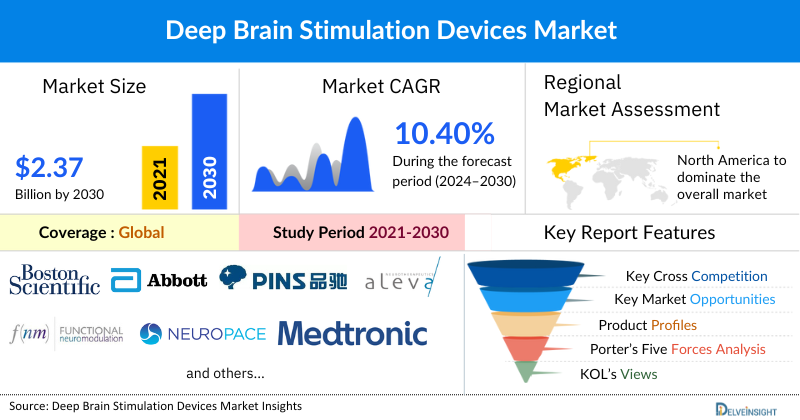
- The Deep Brain Stimulation (DBS) devices market size was estimated at USD 1.31 billion in 2023 and is projected to grow at a CAGR of 10.40% during the forecast period from 2026 to 2034, reaching approximately USD 2.37 billion by 2034.
- The leading Deep Brain Stimulation (DBS) devices companies in the market include - Abbott Laboratories, Medtronic, Boston Scientific Corporation, Aleva Neurotherapeutics, Renishaw plc, NeuroPace, Inc., NeuroSigma, Inc., Elekta, LivaNova PLC, SceneRay Co., Ltd., Synapse Biomedical, BrainsWay, Magstim, Newronika S.p.A., Brainlab AG, Functional Neuromodulation, Ltd., Theranica Bio-Electronics Ltd., Precisis GmbH, Neuros Medical, Magnus Medical, Inc., and others.
Deep Brain Stimulation Devices Market Insights & Analysis
- North America held the largest share of the deep brain stimulation (DBS) devices market in 2023, driven by the growing prevalence of neurological disorders such as Alzheimer’s disease, tremors, and OCD. Rising geriatric population, supportive government initiatives, and ongoing technological advancements in DBS devices are further contributing to regional market growth.
- The deep brain stimulation (DBS) devices market is witnessing significant growth owing to the increasing prevalence of neurological disorders, including Parkinson’s disease and epilepsy. The expanding elderly population, which is at a higher risk of developing such conditions, is further supporting market demand. Moreover, rising investments in research and development activities, along with continuous technological innovations in DBS products, are expected to drive market growth throughout the forecast period from 2026 to 2034.
Request for unlocking the report of the @ Deep Brain Stimulation Devices Market Insights
Factors Contributing to the Growth of the Deep Brain Stimulation Devices Market:
- Rising Prevalence of Neurological Disorders: The increasing incidence of Parkinson’s disease, essential tremor, epilepsy, dystonia, and other movement disorders is significantly driving the demand for Deep Brain Stimulation (DBS) devices worldwide.
- Growing Adoption of Deep Brain Stimulation Devices: Healthcare providers and patients are increasingly adopting DBS therapies due to their long-term effectiveness in managing symptoms that are resistant to conventional medications.
- Deep Brain Stimulation Devices Technological Advancements & Product Launches: Continuous innovations such as rechargeable neurostimulators, MRI-compatible systems, AI-enabled programming, and minimally invasive surgical techniques are improving treatment outcomes and fueling market expansion.
- Government Awareness Initiatives for Deep Brain Stimulation Devices: Supportive government programs, neurological disease awareness campaigns, and favorable reimbursement policies are encouraging early diagnosis and greater acceptance of DBS therapies.
- Expanding Access in Emerging Markets: Improving healthcare infrastructure, rising healthcare expenditure, and increasing availability of advanced neurology treatments in emerging economies are creating new growth opportunities for the DBS devices market.
- Increasing Geriatric Population: The aging global population is contributing to higher rates of neurodegenerative disorders, thereby boosting the need for advanced treatment solutions such as Deep Brain Stimulation devices.
Deep Brain Stimulation Devices Market by Product Type (Single Channel and Dual Channel), Battery Type (Rechargeable and Non-Rechargeable), Application (Parkinson’s Disease, Epilepsy, Obsessive Compulsive Disorder, Dystonia, and Others), End-User (Hospitals and Specialty Clinics), and Geography (North America, Europe, Asia-Pacific, and Rest of the World) is expected to grow at a steady CAGR forecast till 2034 owing to the rising prevalence of neurological disorders and technological advancements in DBS devices
The deep brain stimulation devices (DBS) Market was valued at USD 1.31 billion in 2023, growing at a CAGR of 10.40% during the forecast period from 2026 to 2034 to reach USD 2.37 billion by 2034. The demand for deep brain stimulation (DBS) devices is experiencing growth due to the increasing prevalence of neurological disorders, such as Parkinson’s disease and epilepsy. The rising geriatric population, which is more susceptible to these disorders, is a major factor driving this trend. Additionally, the growing focus on research and development (R&D) and technological advancements in product innovation are contributing significantly to the positive growth of the deep brain stimulation devices market during the forecast period from 2026 to 2034.
These advancements in DBS technology are aimed at improving the precision, safety, and efficacy of treatments for neurological conditions. As a result, more patients are turning to DBS as a therapeutic option, boosting market expansion.
What are the latest Deep Brain Stimulation Devices market dynamics and trends?
The deep brain stimulation (DBS) devices market is experiencing growth due to the rising prevalence of various movement disorders such as Parkinson’s disease, dystonia, and tremors. According to data from the UK Parliament in February 2021, approximately 145,000 adults in the United Kingdom were living with Parkinson’s disease, with this number expected to reach 172,000 by 2034. Similarly, the Parkinson’s Foundation reported in 2022 that around 90,000 individuals are diagnosed with Parkinson’s disease (PD) annually in the United States, and projections suggest that the number of people affected by PD will reach 1.2 million by 2034. As a result, the demand for DBS devices, which provide targeted neural stimulation to alleviate PD symptoms, is expected to increase significantly, driving market growth.
In addition to Parkinson’s disease, the growing prevalence of epilepsy is also fueling global demand for DBS devices. According to the World Health Organization (WHO), approximately 50 million people worldwide were affected by epilepsy in 2023. The WHO estimates that around 5 million new cases of epilepsy are diagnosed annually, making it the most common neurological disorder globally. DBS devices have proven to be effective in controlling seizure occurrences, further propelling growth in the DBS market.
Key market players are actively developing innovative devices to address the increasing prevalence of movement disorders, contributing to substantial market expansion. For example, in January 2026, Abbott Laboratories received FDA approval for its Liberta RC™ DBS system. Notably, Liberta is the smallest rechargeable DBS device available, featuring remote programming capabilities, and designed specifically for treating conditions such as Parkinson’s disease and essential tremors. The rise in research and development activities focused on DBS devices is expected to positively influence the market's growth during the forecast period.
However, the high cost of these devices and the risk of device-associated complications remain key challenges that could limit the growth of the deep brain stimulation devices market.
Get More Insights into the Report @ Deep Brain Stimulation Devices Market Trends
Deep Brain Stimulation Devices Market Segment Analysis:
Deep Brain Stimulation Devices Market by Product Type (Single Channel and Dual Channel), Battery Type (Rechargeable and Non-Rechargeable), Application (Parkinson’s disease, Epilepsy, Obsessive Compulsive Disorder, Dystonia, and Others), End-User (Hospitals and Specialty Clinics), and Geography (North America, Europe, Asia-Pacific, and Rest of the World)
In the product type segment of the deep brain stimulation (DBS) devices market, dual-channel DBS systems are expected to account for a prominent market share during the forecast period. This growth is driven by the rising number of patients affected by neurological conditions such as essential tremors and obsessive-compulsive disorders. According to the National Tremor Foundation, over one million individuals in the United Kingdom and 10 million in the United States were diagnosed with essential tremors in 2021. Dual-channel DBS systems, which effectively stimulate the ventral intermediate nucleus (VIM) of the thalamus, play a crucial role in significantly reducing tremors in both upper and lower limbs. The increasing prevalence of neurological conditions is fueling demand for dual-channel DBS devices, thereby driving market growth.
One of the key advantages of dual-channel neurostimulators is their ability to provide bilateral therapy through two separate stimulation channels. This innovative design allows for fewer incisions and minimizes the need for extensive tunneling of extensions compared to single-channel DBS systems, leading to a less invasive surgical procedure. These benefits are anticipated to increase the demand for dual-channel DBS devices throughout the forecast period, contributing significantly to the overall expansion of the DBS devices market.
Key market players are heavily focused on research and development to create advanced dual-channel DBS devices, aiming to strengthen their competitive position. For example, in January 2026, Medtronic received FDA approval for its Percept™ RC DBS system. This innovative device features sensing technology that enables physicians to tailor treatments more precisely for patients with movement disorders such as Parkinson's disease, essential tremor, dystonia, and epilepsy. Such advancements in product development are expected to drive significant growth in the dual-channel DBS segment, further boosting the overall deep brain stimulation devices market.
Deep Brain Stimulation Devices Market Regional Analysis
North Amercia is expected to dominate the overall Deep Brain Stimulation Devices Market:
North America is expected to account for the largest market share in the deep brain stimulation (DBS) devices market in 2023. This growth is driven by the rising prevalence of movement disorders such as Alzheimer’s disease, tremors, and obsessive-compulsive disorder (OCD). The increasing geriatric population, along with favorable government support and initiatives focused on brain health, are key factors contributing to the expansion of the DBS devices market in the region. Additionally, technological advancements in product development are further accelerating market growth.
The growing prevalence of neurological disorders is a significant factor driving the demand for DBS devices in North America. According to a report from the Centers for Disease Control and Prevention (CDC) published in September 2023, approximately 6.7 million individuals aged 65 and older were living with Alzheimer’s disease in the United States, with this number projected to reach 13.9 million by 2060. DBS devices regulate neuronal activity in specific areas of the brain, helping improve neural function and alleviate cognitive decline. As the number of neurological disorder cases continues to rise, the demand for DBS devices is expected to increase, further driving market growth in the region.
The expanding geriatric population is another factor contributing to the growth of the DBS market. Older adults are particularly vulnerable to neurological disorders due to age-related nerve degeneration. According to the Population Reference Bureau, approximately 58 million individuals aged 65 and older were living in the United States in 2022, and this number is projected to reach 82 million by 2050. Movement disorders like Parkinson’s disease are more common among this age group due to irregular brain activity, making the growing elderly population a key driver for DBS device demand.
Epilepsy also represents a significant driver of demand for DBS devices. According to the CDC, approximately 3 million people in the United States were living with epilepsy in 2021. The increasing number of epilepsy cases has encouraged key players in the industry to develop DBS devices specifically for treating epilepsy. For instance, in February 2022, Precisis GmbH received FDA Breakthrough Device Designation for its EASEE system, which delivers precise electrical currents to targeted areas of the brain to control seizures. Designed for individualized brain stimulation, the system is placed above the origin of epileptic seizures, significantly improving treatment outcomes. These developments are contributing to the growth of the DBS devices market in the region.
Government support is another critical factor boosting market growth. In March 2023, the Government of Canada announced an investment of CAD 38.3 million for the Brain Health Research Initiative, aimed at advancing research on aging brains and reducing the risks of dementia and cognitive impairment. This initiative also focuses on improving care and services for individuals affected by cognitive decline. Such government-backed initiatives are expected to further foster market growth in North America.
In summary, the rising prevalence of movement disorders, increasing government support, and technological innovations in product development are key factors driving the growth of the deep brain stimulation devices market in North America.
Key Deep Brain Stimulation Devices companies in the Market Landscape:
Some of the key market players operating in the deep brain stimulation devices market include
- Abbott Laboratories
- Medtronic
- Boston Scientific Corporation
- Aleva Neurotherapeutics
- Renishaw plc
- NeuroPace, Inc.
- NeuroSigma, Inc.
- Elekta
- LivaNova PLC
- SceneRay Co., Ltd.
- Synapse Biomedical
- BrainsWay
- Magstim
- Newronika S.p.A.
- Brainlab AG
- Functional Neuromodulation, Ltd.
- Theranica Bio-Electronics Ltd.
- Precisis GmbH
- Neuros Medical
- Magnus Medical, Inc., and others
Recent Developmental Activities in Deep Brain Stimulation Devices Market:
- In March 2025, Medtronic plc, a global leader in healthcare technology, announced the U.S. Food and Drug Administration (FDA) approval of BrainSense™ Adaptive deep brain stimulation (aDBS) and BrainSense™ Electrode Identifier (EI). While there is no cure for debilitating neurological conditions like Parkinson's, deep brain stimulation (DBS) has been transforming the lives of patients with Parkinson's and other neurological disorders for over 30 years.
- In April 2022, Boston Scientific Corporation announced FDA approval for STIMVIEWTM XT, developed in collaboration with BrainLab. It allows clinicians to visualize lead placement and stimulation modeling in real-time, providing a detailed view of the brain anatomy of patients with Parkinson’s disease or essential tremor.
- In June 2021, Medtronic received product approval from the US Food and Drug Administration for the First-of-its-Kind SenSight™ Directional Lead System for DBS Therapy.
- In January 2021, Boston Scientific received product approval from the US FDA for their fourth-generation Vercise Genus Deep Brain Stimulation (DBS) System used in the treatment of symptoms associated with advanced Parkinson’s disease.
|
Report Metrics |
Details |
|
Study Period |
2023 to 2034 |
|
Base Year |
2025 |
|
Forecast Period |
2026 to 2034 |
|
CAGR | |
|
Market Size |
~USD 2.37 Billion by 2034 |
|
Key Deep Brain Stimulation Devices Companies |
Medtronic PLC, Boston Scientific Corporation, Abbott Laboratories, Beijing PINS Medical Co., Ltd., Aleva Neurotherapeutics SA, SceneRay Corporation, SceneRay (Suzhou) Medical Technology Co., Ltd., Functional Neuromodulation Ltd., NeuroPace, Inc., Sapiens Neuro, Aleva Neurosurgery, St. Jude Medical, Inc. (now part of Abbott Laboratories), Fisher Wallace Laboratories, Brainsway Ltd., Aleva Neurotherapeutics (USA) Inc., Zynex Medical Inc., MagVenture A/S, SceneRay-Explant, SceneRay-US, SceneRay-EU, and Many Others. |
Deep Brain Stimulation Devices Market Segmentation
- Deep Brain Stimulation Devices Market by Product Type
- Single Channel
- Dual Channel
- Deep Brain Stimulation Devices Market by Battery Type
- Rechargeable
- Non-Rechargeable
- Deep Brain Stimulation Devices Market by Application
- Parkinson’s disease
- Epilepsy
- Obsessive Compulsive Disorder
- Dystonia
- Deep Brain Stimulation Devices Market by End-User
- Hospitals
- Specialty Clinics
Peripheral Nerve Stimulators Geography Exposure
- North America Peripheral Nerve Stimulators Market
- United States Peripheral Nerve Stimulators Market
- Canada Peripheral Nerve Stimulators Market
- Mexico Peripheral Nerve Stimulators Market
- Europe Peripheral Nerve Stimulators Market
- United Kingdom Peripheral Nerve Stimulators Market
- Germany Peripheral Nerve Stimulators Market
- France Peripheral Nerve Stimulators Market
- Italy Peripheral Nerve Stimulators Market
- Spain Peripheral Nerve Stimulators Market
- Rest of Europe Peripheral Nerve Stimulators Market
- Asia-Pacific Peripheral Nerve Stimulators Market
- China Peripheral Nerve Stimulators Market
- Japan Peripheral Nerve Stimulators Market
- India Peripheral Nerve Stimulators Market
- Australia Peripheral Nerve Stimulators Market
- South Korea Peripheral Nerve Stimulators Market
- Rest of Asia-Pacific Peripheral Nerve Stimulators Market
- Rest of the World Peripheral Nerve Stimulators Market
- South America Peripheral Nerve Stimulators Market
- Middle East Peripheral Nerve Stimulators Market
- Africa Peripheral Nerve Stimulators Market
Deep Brain Stimulation Devices Market Recent Industry Trends and Milestones (2022-2026):
| Category | Key Developments (2022–2026) |
|---|---|
| Product Launches | Introduction of next-generation Deep Brain Stimulation (DBS) systems featuring rechargeable batteries, directional leads, wireless programming, and MRI compatibility to improve patient outcomes and device longevity. |
| Regulatory Approvals | Regulatory agencies across major markets approved advanced DBS devices and expanded indications for neurological disorders such as Parkinson’s disease, epilepsy, dystonia, and essential tremor. |
| Partnerships | Medical device companies collaborated with neuroscience research institutes, hospitals, and digital health firms to enhance DBS technology, AI-driven programming, and remote patient monitoring capabilities. |
| Acquisitions | Strategic acquisitions in the neurotechnology sector enabled leading players to strengthen their DBS portfolios, expand technological expertise, and improve global market presence. |
| Company Strategy | Major companies focused on expanding R&D investments, geographic expansion, personalized neuromodulation therapies, and commercialization of minimally invasive DBS solutions. |
| Setbacks | Challenges such as high treatment costs, surgical risks, limited reimbursement in certain regions, and device-related complications continued to restrain broader adoption of DBS therapies. |
| Emerging Technology | Advancements including closed-loop DBS systems, AI-integrated neurostimulation, adaptive stimulation technology, robotic-assisted implantation, and cloud-based patient management platforms gained significant attention in the market. |
Impact Analysis:
AI-Powered Innovations and Applications:
- Adaptive Stimulation Technology: Artificial Intelligence (AI) enables DBS devices to automatically adjust stimulation levels in real time based on a patient’s brain activity and symptom fluctuations, improving therapeutic precision.
- Closed-Loop Deep Brain Stimulation Systems: AI-powered closed-loop systems continuously monitor neural signals and deliver personalized stimulation only when required, enhancing treatment efficiency and reducing side effects.
- Enhanced Patient Monitoring: Integration of AI with remote monitoring platforms allows physicians to track patient progress, symptom patterns, and device performance through cloud-based systems.
- Improved Surgical Accuracy: AI-assisted imaging and robotic guidance technologies help neurosurgeons identify precise brain targets for electrode implantation, improving procedural success rates.
- Predictive Analytics for Disease Management: Machine learning algorithms analyze patient data to predict symptom progression, optimize therapy settings, and support personalized treatment strategies.
- Reduction in Programming Time: AI-driven DBS programming tools simplify complex device calibration processes, reducing the time required for clinicians to optimize stimulation settings.
U.S. Tariff Impact Analysis on Deep Brain Stimulation Devices Market:
The inclusion of tariff analysis in the Deep Brain Stimulation (DBS) devices market provides valuable insights into the impact of import/export duties, trade regulations, and geopolitical policies on device manufacturing, pricing, and global distribution. As DBS systems rely on advanced electronic components, neurostimulators, and precision medical technologies sourced across international markets, tariff-related changes can significantly influence operational costs and market accessibility.
How This Analysis Helps Clients
- Cost Management:
Tariff analysis helps companies understand the impact of import duties and trade policies on raw materials, components, and finished DBS devices, enabling better pricing strategies and cost control measures. - Supply Chain Optimization:
Businesses can identify alternative sourcing regions, reduce dependency on high-tariff markets, and streamline procurement strategies to maintain supply chain efficiency and reduce disruptions. - Regulatory Navigation:
Understanding country-specific trade regulations, customs policies, and medical device import frameworks supports smoother market entry and compliance across global regions. - Strategic Planning:
Tariff insights enable companies to make informed decisions regarding manufacturing locations, regional expansion, partnerships, and long-term investment strategies in the DBS devices market. - Competitive Positioning:
Companies can evaluate the tariff advantages or disadvantages faced by competitors and optimize their global distribution networks to strengthen market competitiveness. - Risk Mitigation:
Ongoing monitoring of international trade policies and geopolitical developments helps organizations proactively manage risks associated with fluctuating tariffs and changing regulatory environments.
Startup Funding & Investment Trends:
| Company Name | Total Funding | Main Products/Focus | Stage of Development | Core Technology |
|---|---|---|---|---|
| Neuralink | Over USD 600 million | Brain-computer interface (BCI) systems and advanced neurostimulation technologies | Clinical development and human trials | Implantable neural interfaces, AI-enabled brain signal processing |
| Synchron | Over USD 140 million | Minimally invasive brain-computer interface platform for neurological disorders | Clinical-stage development | Endovascular neural interface technology |
| Cala Health | Over USD 300 million | Neuromodulation therapies for movement disorders such as essential tremor | Commercial and expansion stage | Wearable neurostimulation and AI-driven therapy |
| Paradromics | Over USD 100 million | High-data-rate brain interface systems for neurological applications | Preclinical and early clinical development | Advanced neural data transmission and brain interface technology |
| Rune Labs | Over USD 40 million | Software-driven neurology platforms integrated with DBS systems | Commercial collaboration and growth stage | AI-powered neurological data analytics and remote patient monitoring |
Key Takeaways from the Deep Brain Stimulation Devices Market Report Study
- Market size analysis for current Deep Brain Stimulation Devices Market size (2023), and market forecast for 6 years (2026 to 2034)
- Top key product/technology developments, mergers, acquisitions, partnerships, and joint ventures happened over the last 3 years.
- Key companies dominating the global Deep Brain Stimulation Devices market.
- Various opportunities available for the other competitors in the Deep Brain Stimulation Devices Market space.
- What are the top-performing segments in 2023? How these segments will perform in 2034?
- Which are the top-performing regions and countries in the current Deep Brain Stimulation Devices market scenario?
- Which are the regions and countries where companies should have concentrated on opportunities for Deep Brain Stimulation Devices market growth in the coming future?
Target Audience who can be benefited from this Deep Brain Stimulation Devices Market Report Study
- Deep Brain Stimulation Devices product providers
- Research organizations and consulting companies
- Deep Brain Stimulation Devices related organizations, associations, forums, and other alliances
- Government and corporate offices
- Start-up companies, venture capitalists, and private equity firms
- Distributors and Traders dealing in Deep Brain Stimulation Devices
- Various end-users who want to know more about the Deep Brain Stimulation Devices Market and the latest technological developments in the Deep Brain Stimulation Devices Market.