
Image Guided Surgery Devices Market Insights, Competitive Landscape and Market Forecast-2034
- Summary
- TOC Table of Content
- LOT
- Companies
Image Guided Surgery Devices Market Summary
- The Image Guided Surgery Devices market is estimated at USD 8.51 billion in 2025 and is projected to reach USD 19.42 billion by 2034. Growth is anchored in the rising preference for minimally invasive procedures, the integration of artificial intelligence, robotics, and augmented reality into surgical navigation, and sustained investment in hybrid operating rooms and advanced intraoperative imaging.
- The global Image Guided Surgery Devices market is growing at a CAGR of 9.6% during the forecast period from 2026 to 2034.
- By product type, the endoscopes segment dominated the Image Guided Surgery Devices market with a 31% share in 2025.
- By application, the neurology segment dominated the Image Guided Surgery Devices market with a 34% share in 2025.
- By end-user, the hospitals segment dominated the Image Guided Surgery Devices market with a 70% share in 2025.
- North America dominated the global Image Guided Surgery Devices market revenue with a 45% share in 2025, representing the highest regional market share globally.
Image guided surgery (IGS) devices are advanced medical systems that use real-time and preoperative imaging, including endoscopy, ultrasound, magnetic resonance imaging (MRI), computed tomography (CT), and X-ray fluoroscopy, to help surgeons visualize anatomy, plan approaches, and track instruments during procedures. By fusing imaging data with navigation, tracking, and visualization software, these systems let surgeons operate with greater precision through smaller incisions, which reduces complications, radiation exposure, hospital stay, and recovery time. Hospitals, specialty clinics, and ambulatory settings use IGS devices across neurology, orthopedic, ear, nose, and throat (ENT), and oncology surgery, supported by hybrid operating rooms, mobile intraoperative imaging, and surgical planning software. The market is organized by product type across endoscopes, ultrasound systems, MRI systems, CT systems, X-ray fluoroscopy systems, and others; by application across neurology, orthopedic surgery, ENT surgery, oncology surgery, and other applications; by end-user across hospitals, specialty clinics, and others; and by geography. Driven by the shift to minimally invasive surgery, the growing burden of cancer, neurological, and musculoskeletal disease, and rapid advances in AI-enabled navigation, robotics, and augmented reality, image-guided surgery devices have become core infrastructure of the modern precision operating room.
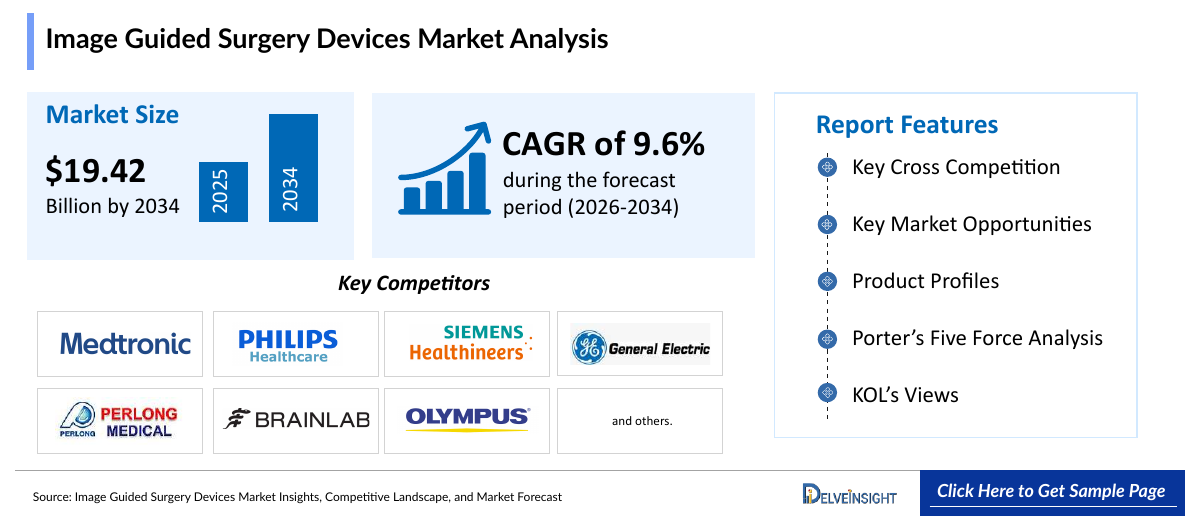
Image Guided Surgery Devices Market Key Growth Drivers
- The growing preference for minimally invasive surgery is driving demand, as image guidance enables smaller incisions, shorter procedures, and faster patient recovery across neurology, orthopedic, ENT, and oncology surgery.
- The rising global burden of cancer, neurological disorders, and musculoskeletal conditions is expanding the surgical caseload, with the International Agency for Research on Cancer projecting cancer cases to rise from 20 million in 2022 to 35 million by 2050.
- Integration of artificial intelligence, robotics, and augmented reality into navigation platforms, such as Medtronic's Stealth AXiS, Philips' AI-powered DeviceGuide, and Medivis' augmented reality cranial navigation, is improving surgical accuracy and workflow.
- Advances in imaging technology, including higher-resolution endoscopy, 3D reconstruction, mobile intraoperative CT, and AI-enhanced fluoroscopy, are widening the range of procedures that can be performed under image guidance.
- Expansion of hybrid operating rooms and integrated surgical suites is increasing hospital capital investment in multimodality imaging and navigation equipment.
- An ageing population, rising healthcare spending, and supportive reimbursement and regulatory pathways, particularly frequent FDA clearances and CE marking, are accelerating adoption of advanced surgical imaging.
- The convergence of minimally invasive surgery, disease burden, AI and robotics integration, and hybrid operating room investment is expected to sustain strong growth in the market through 2034.
Key Companies in Image Guided Surgery Devices Market
The competitive landscape is led by the following active manufacturers:
- Medtronic
- Koninklijke Philips N.V.
- Siemens Healthcare GmbH
- General Electric
- Perlong Medical Equipment Co., Ltd.
- Brainlab AG
- Olympus Corporation
- Stryker
- Abbott
- Getinge AB
For illustrative purposes, only the top 10 companies are listed in the Table of Contents. The report may include analysis and references to additional companies relevant to the market assessment.
Image Guided Surgery Devices Market Size
The following snapshot summarizes the principal report metrics for the Image Guided Surgery Devices market.
| Report Metrics | Details |
| 2025 Market Size | USD 8.51 billion |
| 2034 Projected Market Size | USD 19.42 billion |
| Growth Rate (2026-2034) | 9.6% CAGR |
| Largest Market | North America |
| Fastest Growing Market | Asia-Pacific |
| Market Structure | Moderately Concentrated |
All market values are expressed in USD and represent DelveInsight estimates synthesized from primary and secondary research.
Factors Contributing to the Growth of the Image Guided Surgery Devices Market
Market Drivers
Rising Preference for Minimally Invasive Surgery
The most powerful driver of the Image Guided Surgery Devices market is the global shift from open surgery to minimally invasive procedures. Image guidance lets surgeons see and track instruments relative to patient anatomy in real time through small access points, reducing blood loss, infection risk, hospital stay, and recovery time. Minimally invasive approaches now account for a large and growing share of surgeries in developed healthcare systems, and endoscopic, ultrasound-guided, and fluoroscopy-guided techniques are being extended to more complex neurology, orthopedic, ENT, and oncology cases. Because minimally invasive surgery depends on indirect visualization, every additional procedure moved away from open surgery raises demand for endoscopes, intraoperative imaging, and navigation systems. As patient and payer preference for faster recovery strengthens, adoption of image-guided surgery devices expands directly, anchoring market growth through 2034.
Rising Disease Burden Across Neurology, Orthopedics, and Oncology
The growing burden of cancer, neurological disease, and musculoskeletal disorders is expanding the pool of patients who need precision surgery. The International Agency for Research on Cancer recorded 20 million new cancer cases in 2022 and projects 35 million by 2050, while brain tumors, spinal disorders, trauma, and degenerative joint disease continue to rise with an ageing population. Tumor resection, spinal fusion, joint replacement, sinus surgery, and brain biopsy all depend on accurate localization of anatomy and instruments, and image guidance reduces the risk of damaging critical structures such as nerves, vessels, and eloquent brain tissue. As disease prevalence and the number of eligible patients increase, the volume and complexity of image-guided procedures rise in step, translating into sustained demand for imaging and navigation hardware and software across the forecast period.
Integration of AI, Robotics, and Augmented Reality
Technological convergence is a central growth engine for the market. Artificial intelligence now automates image segmentation, registration, and noise reduction; robotics improves trajectory accuracy; and augmented reality overlays anatomy directly into the surgeon's field of view. Medtronic received FDA clearance in February 2026 for its Stealth AXiS platform combining navigation, planning, and robotics for spine surgery; Royal Philips received FDA 510(k) clearance in March 2026 for the AI-powered DeviceGuide with EchoNavigator; Siemens Healthineers received clearance in May 2026 for six Artis systems with its Optiq AI imaging chain; and Medivis secured clearance in December 2025 for the first augmented reality system for intraoperative cranial guidance. These advances improve accuracy, shorten procedures, and reduce radiation exposure, encouraging hospitals to upgrade installed systems and broadening the addressable market through the forecast period.
Advances in Surgical Imaging Technology and Hybrid Operating Rooms
Continuous improvement in imaging technology is widening the clinical reach of image guided surgery. Higher-resolution 4K and 3D endoscopy, fluorescence-guided visualization, mobile intraoperative CT and C-arm systems, and AI-enhanced fluoroscopy provide clearer, faster, lower-dose guidance in the operating room. In March 2026, Olympus launched its VISERA ELITE III surgical imaging platform in the United States with 4K and 3D imaging and fluorescence-guided surgery tools, and GE HealthCare launched the Allia Moveo interventional imaging platform for hybrid operating rooms and interventional radiology. Hospitals are building hybrid operating rooms that combine fixed or mobile imaging with surgical tables and integrated displays, enabling complex procedures to be imaged and completed in a single setting. This wave of capital investment in integrated suites supports recurring demand for imaging systems, navigation, and workflow integration across the forecast period.
Growth of Robotic-Assisted and Navigated Orthopedic and Spine Surgery
Rapid growth in robotic-assisted and navigated orthopedic and spine surgery is increasing demand for image guidance. Platforms from Stryker, Medtronic, and Brainlab combine preoperative planning, intraoperative imaging, and optical tracking to position implants and instruments accurately, and manufacturers increasingly pair navigation with mobile CT and implant ecosystems. Stryker commercially launched its Q Guidance System with Cranial Guidance Software in 2023 to extend its spine and orthopedic navigation franchise into neurosurgery, while Brainlab's Loop-X mobile imaging robot, Curve navigation, and mixed-reality spine navigation are being adopted by leading orthopedic centers. As joint replacement and spinal procedure volumes rise with an ageing population, the installed base of navigation and intraoperative imaging platforms expands, driving system sales, software upgrades, and service revenue through the forecast period.
Supportive Regulatory Environment and Healthcare Investment
A supportive regulatory environment and rising healthcare investment are accelerating adoption. Frequent FDA 510(k) clearances and CE marking, such as Philips' Zenition 30 mobile C-arm in April 2024 and a steady stream of AI-enabled navigation and imaging clearances through 2026, shorten the path from innovation to clinical use. Governments and private providers in North America, Europe, and Asia-Pacific continue to invest in hospital infrastructure, advanced operating rooms, and digital surgery, while reimbursement frameworks in developed markets generally support image-guided procedures, particularly in neurosurgery and orthopedics. These conditions give manufacturers confidence to invest in research and development and give hospitals confidence to commit capital to navigation and imaging platforms, reinforcing market growth across the forecast period.
Strong Strategic Collaboration and Investment Activity
Active collaboration and investment across the medical technology sector are accelerating innovation and commercialization. Manufacturers are partnering with software specialists, implant makers, and clinical centers to build integrated surgical ecosystems: Philips developed DeviceGuide with Edwards Lifesciences for minimally invasive mitral valve repair, Brainlab entered a partnership in 2026 with Precision NeuroMed to develop a cloud-based treatment planning system for convection-enhanced drug delivery, and Getinge and GE HealthCare have combined operating tables with angiography systems for hybrid operating rooms. Start-ups such as Medivis, Centerline Biomedical, and Prana Surgical have each secured FDA clearance for new image-guided platforms, signaling investor and incumbent interest. This collaboration and clearance activity expands the product pipeline, validates the long-term growth of the sector, and channels demand toward providers with strong imaging, software, and clinical partnerships across the forecast period.
Market Restraints
Despite strong momentum, the Image Guided Surgery Devices market faces material constraints. The high capital cost of imaging and navigation systems is a significant barrier, with advanced platforms often costing in the range of USD 1 to 2 million per system, and annual maintenance and service commonly adding a meaningful further percentage of purchase cost, which limits adoption by smaller hospitals, specialty clinics, and providers in emerging economies. A shortage of surgeons, radiographers, and technicians trained to operate complex navigation and intraoperative imaging systems, together with long learning curves, slows utilization and workflow integration. Hybrid operating rooms require costly structural modification, radiation shielding, and integration with existing equipment, which lengthens deployment timelines. Stringent and evolving regulatory requirements across the FDA, the European Union Medical Device Regulation, and other regimes extend development timelines and raise compliance costs, while software-related recalls and accuracy concerns heighten scrutiny of navigation systems. Registration inaccuracy, line-of-sight limitations, and image-to-patient mismatch can reduce clinical confidence, and radiation exposure from X-ray fluoroscopy and CT-based guidance remains a safety consideration for patients and staff. Reimbursement for newer navigation and robotics-enabled procedures remains uneven across geographies, and tariffs and supply-chain disruptions in imaging components and semiconductors can raise costs. Together, these cost, workforce, regulatory, and integration barriers temper the pace of growth, even as the underlying drivers of minimally invasive surgery, disease burden, and technology convergence remain firmly intact.
Image Guided Surgery Devices Market Segment Analysis
The Image Guided Surgery Devices Market is segmented by product type (endoscopes, ultrasound systems, magnetic resonance imaging (MRI) systems, computed tomography (CT) systems, X-ray fluoroscopy systems, and others), application (neurology, orthopedic surgery, ear, nose, and throat (ENT) surgery, oncology surgery, and other applications), end-user (hospitals, specialty clinics, and others), and geography (North America, Europe, Asia-Pacific, and Rest of World).
By Product Type
Dominant Subsegment: Endoscopes.
The endoscopes segment accounted for 31% of the Image Guided Surgery Devices Market in 2025. Endoscopes are the leading product type because they are the most widely deployed visualization tool in minimally invasive surgery, used across ENT, neurology, orthopedic, and oncology procedures as well as general, urologic, and gastrointestinal surgery. Their relatively lower cost per unit compared with CT and MRI systems, combined with high procedure volumes, frequent replacement cycles, and recurring demand for scopes, camera heads, light sources, and processors, sustains large and dependable revenue. Continuous innovation, including 4K and 3D imaging, fluorescence-guided visualization, and AI-assisted image enhancement, as exemplified by Olympus' VISERA ELITE III platform, is widening clinical use and encouraging upgrades. Endoscopes are also increasingly combined with navigation, which lets surgeons track instruments in sinus and skull-base surgery. While ultrasound systems are expected to grow rapidly on the back of portability and lower cost, and CT, MRI, and X-ray fluoroscopy systems anchor hybrid operating rooms, the breadth, frequency, and recurring nature of endoscopy keep endoscopes the dominant product type across the forecast period.
By Application
Dominant Subsegment: Neurology.
The neurology segment accounted for 34% of the Image Guided Surgery Devices Market in 2025. Neurology, which includes cranial and spinal neurosurgery, is the leading application because brain and spine procedures were among the first to adopt image guidance and depend on it most heavily. The need to protect eloquent brain tissue, nerves, and vessels makes millimeter-scale accuracy essential, and neuronavigation, intraoperative MRI and CT, and ultrasound are standard in tumor resection, biopsy, shunt placement, deep brain stimulation, and spinal fusion. Manufacturers continue to invest in this space: Medtronic's Stealth AXiS combines navigation, planning, and robotics for spine surgery, Stryker commercially launched Q Guidance with cranial guidance software in 2023, Brainlab's navigation and mobile imaging are widely used in neurosurgery, and Medivis received clearance in December 2025 for augmented reality cranial navigation. A rising burden of brain tumors, trauma, and spinal disorders sustains caseload. While oncology surgery is expected to grow quickly as tumor margin visualization improves, and orthopedic and ENT surgery provide steady demand, the depth of neuronavigation adoption keeps neurology the dominant application across the forecast period.
By End-User
Dominant Subsegment: Hospitals.
The hospitals segment accounted for 70% of the Image Guided Surgery Devices Market in 2025. Hospitals are the leading end-user because they perform the large majority of complex image-guided procedures and have the patient volumes, capital budgets, multidisciplinary teams, and infrastructure needed to purchase and operate advanced imaging and navigation systems. Hybrid operating rooms, intraoperative CT and MRI suites, and integrated navigation platforms are concentrated in tertiary and academic hospitals that treat high-acuity neurology, orthopedic, ENT, and oncology cases. Access to skilled surgeons, strong reimbursement, and the ability to spread high equipment costs across many procedures reinforce hospital leadership. Specialty clinics and other settings, including ambulatory surgical centers, are expected to grow faster as portable imaging and compact navigation systems enable more procedures to move to lower-cost outpatient sites, but hospitals' scale, complexity of case mix, and capital capacity keep them the dominant end-user across the forecast period.
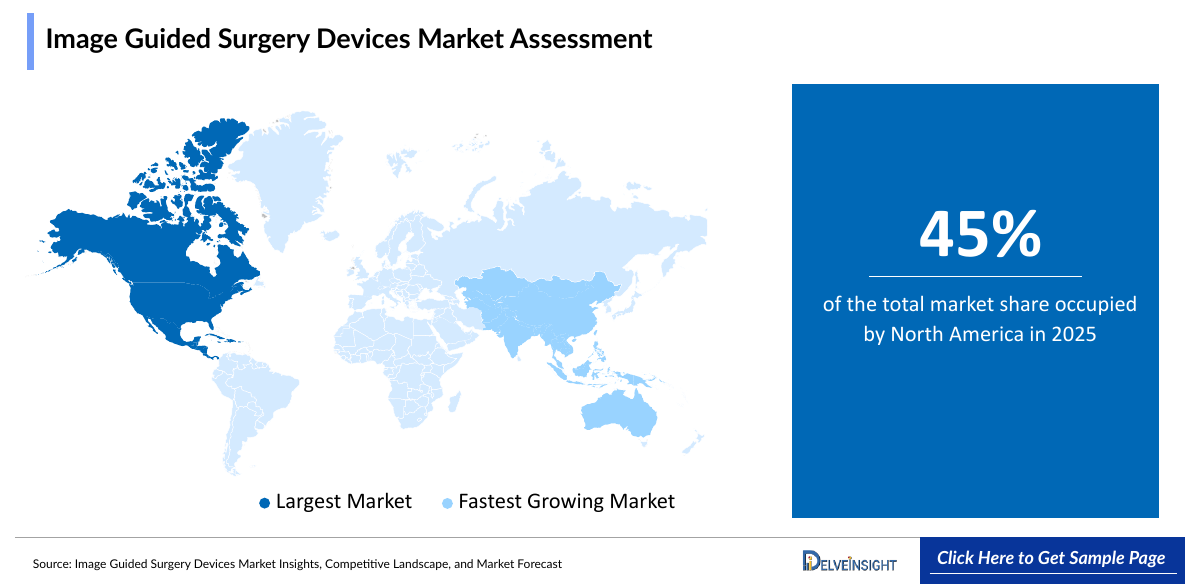
Image Guided Surgery Devices Market Region Analysis
Dominant Region: North America
North America accounted for 45% of the global Image Guided Surgery Devices Market revenue in 2025, representing the highest regional market share globally. The region's dominance reflects advanced healthcare infrastructure, high adoption of cutting-edge surgical technologies, the strong presence of leading device manufacturers, and favorable reimbursement and regulatory pathways, particularly in the United States. North America hosts a large concentration of hybrid operating rooms, academic medical centers, and early adopters of AI-enabled navigation and robotic-assisted surgery, and frequent FDA clearances, including recent clearances for Medtronic, Philips, GE HealthCare, Siemens Healthineers, and Abbott platforms, accelerate commercialization. High healthcare spending, a high burden of cardiovascular, neurological, musculoskeletal, and oncologic disease, and strong research and development investment anchor the region's continued leadership across the forecast period.
Fastest Growing Region: Asia-Pacific
Asia-Pacific is the fastest-growing region in the Image Guided Surgery Devices market. The region's elevated CAGR is driven by rising healthcare investment, expanding hospital infrastructure, a growing burden of cancer, cardiovascular, and neurological disease, and rapid adoption of advanced surgical technologies across China, Japan, India, South Korea, and Australia. China is investing in AI-enabled navigation, robotic-assisted surgery, and smart hospital infrastructure, Japan hosts leading endoscope and imaging manufacturers and an advanced surgical market, and India and Southeast Asia are expanding private hospital networks and medical tourism. Government healthcare reforms, improving access to care, rapid urbanization, and growing awareness of minimally invasive techniques are accelerating adoption, while domestic manufacturers such as Perlong Medical expand lower-cost endoscope, ultrasound, and X-ray offerings. The combination of rising disease burden, infrastructure build-out, and increasing affordability positions Asia-Pacific as the principal source of incremental growth over the forecast period.
Regional Commentary
North America
North America accounted for 45% of the global Image Guided Surgery Devices Market revenue in 2025. The United States dominates on the strength of its advanced hospital infrastructure, early adoption of AI, robotics, and hybrid operating rooms, favorable reimbursement, and the headquarters and clinical networks of leading device manufacturers, while frequent FDA clearances and strong research and development investment reinforce its leadership.
Europe
Europe is a large and advanced regional market, supported by strong public and private healthcare systems, a rising ageing population, and growing adoption of minimally invasive surgery, hybrid operating rooms, and AI-enabled imaging. Europe is also the home base of leading manufacturers such as Philips, Siemens Healthineers, Brainlab, and Getinge, and collaboration between hospitals and medical technology firms accelerates technology adoption, for example, flagship Brainlab spine and trauma navigation suites at leading orthopedic hospitals across Germany, France, the United Kingdom, Italy, and Spain.
Asia-Pacific
Asia-Pacific is the fastest-growing region, propelled by rising healthcare investment, expanding hospital infrastructure, and a growing patient population with neurological, cardiovascular, and oncologic disease across China, Japan, India, South Korea, and Australia. China's adoption of AI-powered navigation and robotic-assisted surgery, Japan's strength in endoscopy and imaging, and growing medical tourism and awareness of advanced surgical techniques across emerging economies are accelerating regional adoption.
Rest of World
The Rest of World region, spanning Latin America, the Middle East, and Africa, is an emerging growth frontier. Expanding hospital and surgical infrastructure, rising investment in advanced healthcare in the Gulf states, growing demand for minimally invasive surgery and diagnostic imaging, and training and equipment donation programs are gradually broadening access, although high equipment costs, limited healthcare budgets, and skills shortages continue to constrain adoption.
Image Guided Surgery Devices Market Competitive Landscape
The Image Guided Surgery Devices Market is classified as Moderately Concentrated. A group of global imaging and medical technology leaders with broad portfolios and large installed bases, including Medtronic, Koninklijke Philips N.V., Siemens Healthcare GmbH, General Electric, and Olympus Corporation, anchors the top tier, while specialized navigation, orthopedic, and hospital-integration players such as Brainlab AG, Stryker, Getinge AB, and Abbott compete through software, mobile intraoperative imaging, and integrated surgical ecosystems, and cost-focused manufacturers such as Perlong Medical Equipment Co., Ltd. extend access in price-sensitive markets, increasing competition in the fastest-growing product and application segments.
The competitive landscape can be evaluated across the following dimensions:
- Market concentration: Moderately concentrated, with global imaging and medical technology leaders anchoring the top tier and a growing field of specialized navigation, AI, and augmented reality providers.
- Leading players: Medtronic, Koninklijke Philips N.V., Siemens Healthcare GmbH, General Electric, and Olympus Corporation anchor the top tier through broad imaging portfolios and large installed bases.
- Geographic reach: Leaders operate global sales, service, and clinical-training networks across North America, Europe, and Asia-Pacific; Perlong Medical exports to a wide range of emerging markets.
- Product portfolio strength: Top players offer integrated portfolios spanning endoscopes, ultrasound, MRI, CT, X-ray fluoroscopy, navigation systems, planning software, and hybrid operating room equipment.
- Technology and software leadership: AI-driven image processing, navigation software, and workflow integration, such as Siemens Healthineers' Optiq AI and Philips' EchoNavigator, are a decisive advantage.
- Strategic partnerships: Collaborations with implant makers, software specialists, and clinical centers, such as Philips with Edwards Lifesciences, Brainlab with Precision NeuroMed, and Getinge with GE HealthCare, extend reach.
- Regulatory track record: Frequent FDA 510(k) clearances and CE marking, including Medtronic's Stealth AXiS, GE HealthCare's Allia Moveo, and Abbott's Ultreon 3.0, are key competitive moats.
- Manufacturing capabilities: Scale in optics, detectors, magnets, and precision tracking hardware, together with global service networks, underpin competitive positioning.
- Innovation focus: AI-enabled navigation, robotic-assisted surgery, augmented and mixed reality, mobile intraoperative imaging, and hybrid operating room integration.
Image Guided Surgery Devices Market Recent Developmental Activities
In May 2026, Siemens Healthcare GmbH, received FDA clearance for six new Artis interventional imaging systems featuring its Optiq AI imaging chain, including the Artis vision, icono.explore, and genio platforms. Strategic significance: Strengthens AI-enhanced fluoroscopy and angiography offerings for image-guided procedures and hybrid operating rooms.
In April 2026, Abbott received FDA clearance and CE Mark for its Ultreon 3.0 AI-powered coronary imaging platform based on optical coherence tomography. Strategic significance: Extends Abbott's AI-enabled intravascular imaging portfolio for precision-guided intervention.
In March 2026, General Electric (GE HealthCare), launched the Allia Moveo interventional imaging platform, which received FDA clearance and CE marking, with first installations in France and the United States. Strategic significance: Adds mobile, flexible imaging for interventional radiology and hybrid operating rooms.
In March 2026, Koninklijke Philips N.V. received FDA 510(k) clearance for DeviceGuide, AI-powered software integrated with EchoNavigator R5.0 and developed with Edwards Lifesciences for minimally invasive mitral valve repair. Strategic significance: Brings AI-driven real-time guidance to structural heart procedures and deepens a key clinical partnership.
In March 2026, Olympus Corporation launched the VISERA ELITE III surgical imaging platform in the United States, developed with Sony Olympus Medical Solutions, offering 4K and 3D imaging and fluorescence-guided surgery tools. Strategic significance: Strengthens Olympus' position in high-definition surgical visualization across multiple specialties.
In February 2026, Medtronic received FDA clearance for its Stealth AXiS surgical system, an integrated spine platform combining navigation, planning, and robotics. Strategic significance: Reinforces Medtronic's leadership in navigated and robotic-assisted spine surgery across hospitals and ambulatory surgical centers.
In February 2026, Brainlab AG entered a strategic partnership with Precision NeuroMed to develop a cloud-based treatment planning system for convection-enhanced drug delivery. Strategic significance: Extends Brainlab's digital planning and AI strategy into precision neurosurgical drug delivery.
In December 2025, Medivis Inc. received FDA 510(k) clearance for its Cranial Navigation platform, described as the first augmented reality system for intraoperative cranial neurosurgery guidance. Strategic significance: Opens a new augmented reality category in neuronavigation and signals start-up momentum.
In August 2024, Centerline Biomedical, received FDA 510(k) clearance for its IOPS Viewpoint Catheter, designed for real-time 3D endovascular navigation with reduced radiation exposure. Strategic significance: Advances radiation-free guidance for vascular procedures.
In April 2024, Koninklijke Philips N.V. received FDA 510(k) clearance for its Zenition 30 mobile C-arm to improve image clarity and workflow in image-guided surgery. Strategic significance: Expands access to mobile intraoperative imaging and addresses cost and staffing pressures in hospitals.
In 2023, Stryker commercially launched its Q Guidance System with Cranial Guidance Software, an image-based planning and intraoperative guidance platform for cranial surgery. Strategic significance: Extends Stryker's spine and orthopedic navigation franchise into neurosurgery.
Image Guided Surgery Devices Market Segmentation
Image Guided Surgery Devices Market by Product Type
- Endoscopes
- Ultrasound Systems
- Magnetic Resonance Imaging (MRI) Systems
- Computed Tomography (CT) Systems
- X-Ray Fluoroscopy Systems
- Others
Image Guided Surgery Devices Market by Application
- Neurology
- Orthopedic Surgery
- Ear, Nose, and Throat (ENT) Surgery
- Oncology Surgery
- Other Application
Image Guided Surgery Devices Market by End-User
- Hospitals
- Specialty Clinics
- Others
Image Guided Surgery Devices Market by Geography
- North America Image Guided Surgery Devices Market
- United States Image Guided Surgery Devices Market Size in USD million (2023-2034)
- Canada Image Guided Surgery Devices Market Size in USD million (2023-2034)
- Mexico Image Guided Surgery Devices Market Size in USD million (2023-2034)
- Europe Image Guided Surgery Devices Market
- Germany Image Guided Surgery Devices Market Size in USD million (2023-2034)
- United Kingdom Image Guided Surgery Devices Market Size in USD million (2023-2034)
- France Image Guided Surgery Devices Market Size in USD million (2023-2034)
- Italy Image Guided Surgery Devices Market Size in USD million (2023-2034)
- Spain Image Guided Surgery Devices Market Size in USD million (2023-2034)
- Rest of Europe Image Guided Surgery Devices Market Size in USD million (2023-2034)
- Asia-Pacific Image Guided Surgery Devices Market
- China Image Guided Surgery Devices Market Size in USD million (2023-2034)
- Japan Image Guided Surgery Devices Market Size in USD million (2023-2034)
- India Image Guided Surgery Devices Market Size in USD million (2023-2034)
- Australia Image Guided Surgery Devices Market Size in USD million (2023-2034)
- South Korea Image Guided Surgery Devices Market Size in USD million (2023-2034)
- Rest of Asia-Pacific Image Guided Surgery Devices Market Size in USD million (2023-2034)
- Rest of the World (RoW) Image Guided Surgery Devices Market
- Middle East Image Guided Surgery Devices Market Size in USD million (2023-2034)
- Africa Image Guided Surgery Devices Market Size in USD million (2023-2034)
- South America Image Guided Surgery Devices Market Size in USD million (2023-2034)
Image Guided Surgery Devices Market Recent Industry Trends and Milestones (2023-2026)
| Category | Key Developments |
| Image Guided Surgery Devices Market Product Approval | Regulatory momentum is accelerating the commercialization of AI-enabled and robotic navigation and imaging platforms. Medtronic received FDA clearance for Stealth AXiS in February 2026, Philips received FDA 510(k) clearance for DeviceGuide with EchoNavigator in March 2026, GE HealthCare's Allia Moveo received FDA clearance and CE marking in March 2026, Abbott's Ultreon 3.0 received FDA clearance and CE Mark in April 2026, Siemens Healthineers received FDA clearance for six Artis systems with Optiq AI in May 2026, and Medivis secured clearance for augmented reality cranial navigation in December 2025. Each clearance shortens time to clinical use and refreshes demand across hospitals. |
| Image Guided Surgery Devices Market Expansion | Manufacturers broadened imaging and navigation capability across the value chain. Olympus launched the VISERA ELITE III platform with 4K and 3D imaging and fluorescence guidance in the United States, GE HealthCare launched Allia Moveo for hybrid operating rooms, Philips introduced the Zenition 30 mobile C-arm, and Stryker commercially launched Q Guidance with cranial guidance software. Mobile intraoperative imaging, mixed-reality spine navigation from Brainlab, and server-based surgical planning expanded the range of procedures that can be performed under image guidance, while integrated hybrid operating room suites improved workflow. |
| Image Guided Surgery Devices Market Investment | Collaboration and capital deployment intensified. Philips co-developed DeviceGuide with Edwards Lifesciences, Brainlab partnered with Precision NeuroMed in February 2026 on a cloud-based treatment planning system, and Getinge and GE HealthCare combined operating tables and angiography systems for hybrid operating rooms. Hospitals continued to invest in hybrid operating rooms and flagship navigation suites, such as a Brainlab spine and trauma navigation installation at a leading London orthopedic hospital in 2026, and start-ups including Medivis, Centerline Biomedical, and Prana Surgical secured FDA clearance for new image-guided platforms. |
| Company Strategy | Medtronic: Integrated navigation, planning, and robotics for spine and cranial surgery. Koninklijke Philips N.V.: AI-powered guidance and mobile C-arm expansion, anchored by partnerships. Siemens Healthcare GmbH: AI imaging chains for interventional and hybrid operating room imaging. General Electric: Flexible interventional imaging for hybrid operating rooms. Perlong Medical Equipment Co., Ltd.: Cost-competitive endoscope, ultrasound, and X-ray offerings for emerging markets. Brainlab AG: Surgical planning software, mobile imaging, and mixed-reality navigation. Olympus Corporation: High-definition and fluorescence-guided surgical visualization. Stryker: Navigation for spine, cranial, and orthopedic surgery. Abbott: AI-enabled intravascular imaging. Getinge AB: Hybrid operating room integration. |
| Emerging Technologies | Artificial intelligence is automating segmentation, registration, and noise reduction, with Siemens Healthineers' Optiq AI, Philips' DeviceGuide, and Abbott's Ultreon 3.0 as examples. Robotic-assisted surgery, augmented and mixed reality, and mobile intraoperative CT are converging with navigation to improve accuracy and reduce radiation exposure. Fluorescence-guided surgery, 4K and 3D endoscopy, cloud-based surgical planning, and hybrid operating room integration are expanding, while collaborations between manufacturers, start-ups, and academic centers are accelerating translation of new image-guided technologies into practice. |
Image Guided Surgery Devices Market Startup Funding and Investment Trends
| Company | Total Funding | Funding Stage | Main Offering | Core Technology |
| Medivis Inc. | Not disclosed | FDA 510(k) cleared (December 2025) | Cranial navigation platform | Augmented reality intraoperative guidance |
| Request to unlock the report on the @ Image Guided Surgery Devices Market | ||||
Investment in the Image Guided Surgery Devices Market ecosystem has concentrated on AI-enabled navigation, augmented reality, and next-generation image-guided platforms. The following companies illustrate recent regulatory milestones and technology focus.
Capital and collaboration are flowing toward providers that combine imaging, navigation, and software into integrated surgical ecosystems. Start-ups such as Medivis, Centerline Biomedical, and Prana Surgical have each secured FDA clearance for new image-guided platforms, while established leaders including Medtronic, Philips, Siemens Healthineers, GE HealthCare, Olympus, Brainlab, and Stryker continue to invest in AI, robotics, and mixed-reality capabilities. Partnerships such as Philips with Edwards Lifesciences and Brainlab with Precision NeuroMed illustrate how incumbents are extending their platforms through collaboration. Collectively, these activities signal conviction that AI-enabled navigation, robotics, augmented reality, and hybrid operating room integration will define the next phase of competitive advantage in the global Image Guided Surgery Devices market.
Key Takeaways from the Image Guided Surgery Devices Market Report Study
- Market size analysis for the current Image Guided Surgery Devices market size (2025), and market forecast for 9 years (2026 to 2034).
- Top key product/technology developments, mergers, acquisitions, partnerships, and joint ventures that happened over the last 3 years.
- Key companies dominating the global Image Guided Surgery Devices market.
- Various opportunities available for competitors in the Image Guided Surgery Devices market space.
- What are the top-performing segments in 2025? How will these segments perform in 2034?
- Which are the top-performing regions and countries in the current Image Guided Surgery Devices market scenario?
- Which are the regions and countries where companies should concentrate their opportunities for Image Guided Surgery Devices market growth in the future?
Target audience who can benefit from this Image Guided Surgery Devices market report study
- Image Guided Surgery Devices product providers
- Research organizations and consulting companies
- Image Guided Surgery Devices-related organizations, associations, forums, and other alliances
- Government and corporate offices
- Start-up companies, venture capitalists, and private equity firms
- Distributors and traders dealing in Image Guided Surgery Devices
- Various end-users who want to know more about the Image Guided Surgery Devices market and the latest technological developments in the Image Guided Surgery Devices market.
Frequently Asked Questions
What is the growth rate of the Image Guided Surgery Devices market?
What is the market size of the Image Guided Surgery Devices market?
Which region dominates the Image Guided Surgery Devices market?
What are the key drivers of the Image Guided Surgery Devices market?
Who are the major players in the Image Guided Surgery Devices market?
Tags:
- Image Guided Surgery Devices
- Image Guided Surgery Devices Mechanism
- Image Guided Surgery Devices Companies
- Image Guided Surgery Devices Medical devices
License Type
single-user-license
Request Sample
View Pricing
Customize Reports As Per Your Needs
Don't see what you're looking for? Get a report tailored to your specific requirements. Customize your report now!
Recently Viewed Products