Otsuka’s SIMTRIYO Approval Opens Up a Brand-New ADHD Drug Class
Jul 31, 2026
Summary
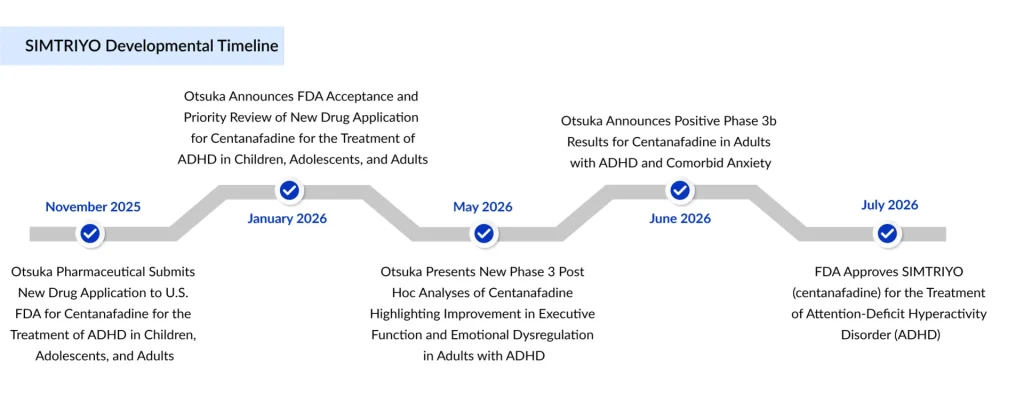
- FDA approved Otsuka’s SIMTRIYO (centanafadine) on July 24, 2026, for ADHD treatment in patients aged ≥6 years weighing at least 20 kg.
- First-in-class norepinephrine, dopamine, serotonin reuptake inhibitor (NDSRI), introducing a novel triple-mechanism approach.
- Approval backed by four Phase 3 trials across age groups showing statistically significant symptom improvement vs placebo.
- Additional Phase 3b data showed benefit in adults with ADHD and comorbid anxiety, an underserved segment.
For decades, ADHD treatment has largely orbited two lanes: stimulants like ADDERALL and VYVANSE, or non-stimulants like STRATTERA and INTUNIV. That lineup just got a new member, and it’s not a me-too drug. It’s an entirely new mechanism. On July 24, 2026, the FDA approved Otsuka Pharmaceutical’s SIMTRIYO (centanafadine), a once-daily extended-release capsule for attention-deficit/hyperactivity disorder in adults and children aged 6 and older who weigh at least 20 kg (about 44 lbs). What makes this approval genuinely newsworthy isn’t just another logo on the ADHD shelf; it’s the debut of a first-in-class norepinephrine, dopamine, serotonin reuptake inhibitor (NDSRI), the first drug of its kind ever cleared for ADHD in the U.S.
SIMTRIYO works by inhibiting the reuptake of three key neurotransmitters, norepinephrine, dopamine, and serotonin, increasing their availability in the brain pathways responsible for attention, impulse control, and behavioral regulation. Most existing ADHD medications target one or two of these systems; SIMTRIYO is the first approved therapy to act on all three simultaneously, which is what earns it the NDSRI classification. The approval covers a broad population: adults as well as pediatric and adolescent patients as young as 6. That pediatric-through-adult label is notable, since it gives clinicians a single option that can, in principle, travel with a patient across different life stages.
Downloads
Click Here To Get the Article in PDF

Recent Articles
- Sanofi Strengthens Amlitelimab’s Position in Atopic Dermatitis; Corcept Announces Statistically S...
- BYSANTI Approval Positions Vanda to Compete in the Antipsychotic Market
- From Wrist to Wellness: The Evolving Landscape of Wearable Medical Devices Market
- Ultomiris Phase III Trial Update Highlights Progress in Post-Transplant TMA; argenx Acquires Fort...
- Attention-Deficit/Hyperactivity Disorder (ADHD)
The FDA’s approval was supported by data from four pivotal Phase 3 clinical trials conducted across pediatric, adolescent, and adult populations. In these studies, SIMTRIYO demonstrated statistically significant and clinically meaningful improvements in ADHD symptoms compared with placebo, as assessed using the ADHD Rating Scale-5 (ADHD-RS-5) in children and adolescents and the Adult ADHD Investigator Symptom Rating Scale (AISRS) in adults. Clinical benefits were observed as early as the first week of treatment in both pediatric and adult patients, with efficacy maintained throughout the six-week treatment period in adult studies. SIMTRIYO also exhibited a consistent safety and tolerability profile across all age groups, although the most commonly reported adverse events differed by population. Decreased appetite and rash were more frequently observed in younger children, while adolescents commonly experienced nausea, headache, and abdominal pain, and adults most often reported insomnia, dry mouth, and diarrhea.
Speaking on the approval, John Kraus, M.D., Ph.D., Executive Vice President and Chief Medical Officer at Otsuka Pharmaceutical Development & Commercialization (OPDC), described SIMTRIYO as an important milestone in ADHD treatment, highlighting its novel mechanism of action. He noted that ADHD is a multifaceted disorder that affects individuals throughout their lives, from childhood into adulthood, and said the approval underscores the company’s dedication to advancing innovative therapies that address the evolving needs of patients and their families. He also expressed appreciation to the patients, caregivers, investigators, and clinical research teams whose participation and support made the development program possible.
Otsuka also noted that a separate Phase 3b study in adults with ADHD and comorbid anxiety showed statistically significant symptom improvement versus placebo, an encouraging signal for a patient population that’s often excluded from, or underserved by, standard ADHD trials.
SIMTRIYO’s prescribing information includes important safety considerations. The FDA has issued a boxed warning highlighting an increased risk of suicidal ideation and behavior, particularly in pediatric patients aged 6 to 12 years compared with placebo, emphasizing the need for careful monitoring and discontinuation if such symptoms develop. The label also warns of the potential for abuse, misuse, and addiction, consistent with other central nervous system (CNS) stimulant medications. As a CNS stimulant, SIMTRIYO must undergo Drug Enforcement Administration (DEA) scheduling before it can be marketed in the United States, a process that typically takes up to three months. Otsuka anticipates commercial availability later in 2026 following completion of this review. The DEA’s scheduling decision is expected to play a significant role in determining the drug’s commercial adoption and overall market trajectory.
ADHD is far from a niche condition. It’s estimated to affect roughly 22.5 million children, adolescents, and adults in the U.S. DelveInsight analysis revealed that more severe cases of ADHD in children, as reported by parents, were diagnosed earlier. The median age of diagnosis for severe ADHD was 4 years, while it was 6 years for moderate ADHD and 7 years for mild ADHD. Additionally, approximately one-third of children diagnosed with ADHD continue to retain the diagnosis into adulthood.
Otsuka has previously projected peak sales north of ¥100 billion (roughly $615 million) for SIMTRIYO. Analysts have called the FDA nod an important “de-risking event” for the company, and framed it as Otsuka’s next major CNS launch, following on the heels of REXULTI and ABILIFY MAINTENA, its established schizophrenia and antipsychotic franchises. That existing CNS infrastructure matters more than it might seem. ADHD is typically treated in community and primary-care settings rather than specialty clinics, giving Otsuka a chance to leverage a commercial footprint and prescriber network it has already built over years of psychiatric drug marketing.
The approval also lands at a strategically useful moment: it comes less than a year after the FDA declined to approve Otsuka and Lundbeck’s REXULTI combination for PTSD, following mixed trial results. SIMTRIYO gives the company’s CNS pipeline a much-needed win, and a genuinely differentiated one, at that.
SIMTRIYO represents a meaningful advancement for the millions of people with ADHD who experience inadequate responses to or cannot tolerate traditional stimulant therapies. Rather than offering another reformulation of an existing treatment, it introduces a novel mechanism of action, providing clinicians with a differentiated therapeutic option.
As highlighted by Dr. Lenard Adler of NYU Langone in Otsuka’s announcement, ADHD is a highly individualized disorder, and expanding the range of pharmacologically distinct treatments can help address the diverse needs of patients who have yet to find an effective therapy.
However, SIMTRIYO’s long-term market adoption will likely depend on several key factors, including its final DEA scheduling and the resulting impact on prescribing practices, real-world safety and tolerability outcomes in a broader patient population, and commercial considerations such as payer reimbursement, pricing, and overall market access following its launch.
In summary, Otsuka’s SIMTRIYO approval is more than a routine FDA nod; it’s the arrival of an entirely new pharmacological class for ADHD, backed by a robust four-trial Phase 3 program and a company with the CNS commercial muscle to actually launch it well. With DEA scheduling as the last hurdle, all eyes are now on how regulators classify the drug, a decision that could determine whether SIMTRIYO becomes a genuine blockbuster or a solid, steady performer in a market that’s clearly ready for something new.

Downloads
Article in PDF
Recent Articles
- Notizia
- VBL Therapeutics’ VB-111 (ofranergene obadenovec); BMS’s mavacamten (Camzyos); Merck’s KEYTRUDA; ...
- Cidara Therapeutics and J&J’s USD 780M Deal; FDA’s Approval to Supernus’s ADHD drug; Rain Th...
- Ultomiris Phase III Trial Update Highlights Progress in Post-Transplant TMA; argenx Acquires Fort...
- Ipsen’s Cabometyx Rejected by NICE; Vertex and CRISPR Therapeutics’s Submit BLA to the FDA for ex...