GSK/Ionis’ HIBSAGO: How the First FDA-Approved Antisense Drug for Chronic Hepatitis B Could Change the Treatment Arena
Nov 06, 2026
Table of Contents
Summary
- On October 20, 2026, the FDA approved HIBSAGO (bepirovirsen), the first antisense oligonucleotide for chronic hepatitis B, from Ionis and GSK.
- In the B-Well trials, 19% reached functional cure at week 72 versus 0% on placebo, and 26% when baseline HBsAg was 1,000 IU/mL or less.
- About 16 developers, including Arrowhead Pharmaceuticals, Vir Biotechnology, Aligos Therapeutics, Precision BioSciences, Arbutus Biopharma, Gilead Sciences, and others are pursuing siRNA, capsid modulators, antibodies, immune modulators, and gene editing.
Chronic hepatitis B (CHB) is one of the most persistent public health challenges in medicine. An estimated 250 to 300 million people live with the infection worldwide, including roughly 1.7 million in the United States. According to DelveInsight analysis, there were approximately 5 million prevalent cases of chronic hepatitis B across the 7MM in 2024. During the same year, an estimated 670,000 CHB patients received treatment in the 7MM. Over years or decades, ongoing viral activity inflames the liver and can progress to cirrhosis and hepatocellular carcinoma (HCC), the most common form of liver cancer.
Downloads
Click Here To Get the Article in PDF

Recent Articles
- UCB to Acquire Candid Therapeutics; Pfizer’s ELREXFIO Sets New Benchmark in PFS for Hard-to-Treat...
- FDA Approves BMS’s Reblozyl for MDS; FDA Awards Orphan Drug Designation to NXC-201; Janssen Submi...
- GSK Signs Exclusive Collaboration with SBP Group to Strengthen Commercialization of Bepirovirsen ...
- Search for the Cure Continues in the Chronic Hepatitis B Treatment Market
- Lion TCR Secures Triple FDA Milestones with IND Clearance for Chronic Hepatitis B; Corstasis Ther...
Today’s standard of care controls the virus but rarely ends the story. Oral nucleos(t)ide analogues (NAs) such as entecavir and tenofovir suppress HBV replication very effectively, yet they do not eliminate covalently closed circular DNA (cccDNA), the stable viral reservoir inside liver cells, and they seldom clear hepatitis B surface antigen (HBsAg). Most patients therefore stay on treatment for many years, often indefinitely. Ionis has noted that functional cure rates on standard antivirals are below 1% after a year of therapy. Pegylated interferon offers a finite course, but only a minority of patients respond, and side effects limit its use.
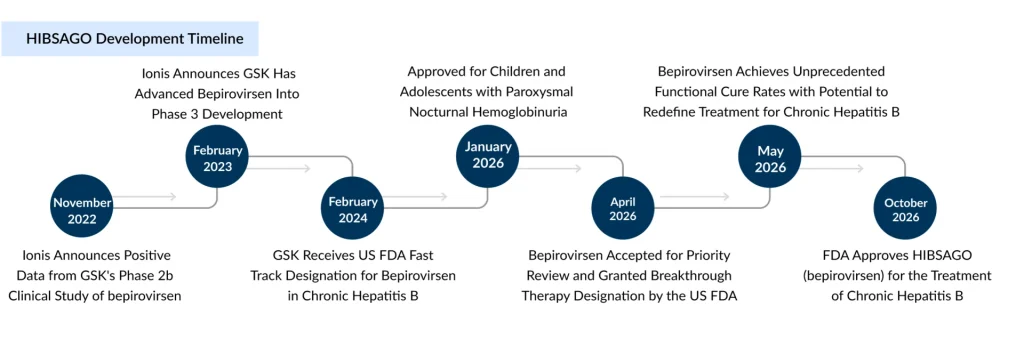
That is why the FDA’s approval of HIBSAGO (bepirovirsen) on October 20, 2026, is a genuine milestone. Discovered by Ionis and licensed to GSK in 2019, HIBSAGO is the first FDA-approved antisense oligonucleotide (ASO) for chronic hepatitis B. It is also the first hepatitis B therapy approved with the realistic aim of letting some patients stop all hepatitis B treatment while keeping the virus under control. The FDA granted it Fast Track, Breakthrough Therapy, and Priority Review designations.
How HIBSAGO Could Change the Chronic Hepatitis B Treatment Landscape
HIBSAGO works upstream of where NAs act. As an antisense oligonucleotide, it targets the genetic instructions the virus uses to copy itself and make viral proteins, which reduces both viral load and HBsAg, according to the FDA. That matters because HBsAg is widely thought to help the virus evade immune control. Lowering it is a central aim of every functional-cure strategy. NAs, by contrast, block the viral polymerase and stop replication, but they leave the cccDNA and integrated viral DNA that keep producing HBsAg largely untouched. HIBSAGO is therefore an add-on to an NA, not a replacement for it.
|
HIBSAGO vs. Nucleos(t)ide Analogues |
||
|
Feature |
Nucleos(t)ide analogues |
HIBSAGO (bepirovirsen) |
|
Mechanism |
Inhibit the HBV polymerase to block DNA replication |
Antisense oligonucleotide that targets HBV RNA, reducing viral proteins including HBsAg |
|
Administration |
Oral, once daily |
Subcutaneous injection for up to 24 weeks, given with an NA |
|
Treatment duration |
Years, often indefinite |
Finite 24-week course, then NA continued for at least 24 weeks; some patients may stop |
|
Virological outcome |
Durable HBV DNA suppression; HBsAg loss is uncommon |
Adds HBsAg reduction on top of HBV DNA suppression |
|
Functional cure |
Below 1% after a year, per Ionis |
19% pooled at week 72 in B-Well; 26% with baseline HBsAg of 1,000 IU/mL or less |
|
Key monitoring |
Routine labs and adherence |
Liver tests, platelet counts, kidney function and quantitative HBsAg |
From Lifelong Suppression to Sustained Off-treatment Response
The real shift is in the treatment goal. For decades, success in CHB has meant keeping HBV DNA undetectable for as long as the patient keeps swallowing the pill. HIBSAGO introduces a second possible goal: a sustained off-treatment response, meaning HBsAg loss and undetectable HBV DNA that persist after all therapy has stopped.
The pivotal B-Well 1 and B-Well 2 trials enrolled 1,834 adults across 29 countries, all on stable NA therapy with HBsAg between 100 and 3,000 IU/mL. Participants received bepirovirsen 300 mg weekly or placebo for 24 weeks, randomized 2:1. Functional cure at week 72 occurred in 20% of bepirovirsen patients in B-Well 1 (127 of 650) and 19% in B-Well 2 (106 of 570), versus none on placebo in either trial. In patients with baseline HBsAg of 1,000 IU/mL or less, rates reached 25% and 28%.
The FDA adds a useful second number: 24% of treated patients met the requirements to stop their NA, and 19% still had controlled virus and undetectable HBsAg 24 weeks after stopping all treatment. Hepatology guidance is increasingly treating functional cure as a legitimate objective, and GSK points to evidence linking it to lower risks of liver cancer and death.
Barriers to Broader Adoption
Eligibility is restricted to adults without cirrhosis who have been receiving nucleos(t)ide analogue (NA) therapy for at least six months, have suppressed HBV DNA levels, and have hepatitis B surface antigen (HBsAg) levels of 3,000 IU/mL or less. Consequently, many patients with chronic hepatitis B (CHB) may not meet the eligibility criteria at the outset. Safety and monitoring requirements also warrant careful consideration, as the boxed warning highlights the risks of serious liver reactions and thrombocytopenia, which can increase the risk of bleeding. The prescribing information further describes a gradual, dose-dependent decline in platelet counts in most patients, alongside warnings regarding worsening kidney function and serious inflammatory reactions, including vasculitis.
Common adverse effects include injection-site reactions, fever, fatigue, and headache. Access and implementation may also influence adoption, as the FDA has authorized a Roche quantitative HBsAg assay as a companion diagnostic, requiring laboratories and clinics to establish the necessary testing capabilities. In addition, injection training, specialist availability, and payer coverage are likely to shape real-world uptake, although these factors remain uncertain. Furthermore, additional evidence is needed to establish long-term treatment durability beyond the trial follow-up period, characterize safety in real-world settings, and evaluate outcomes across more diverse patient populations. Commentary in the American College of Gastroenterology’s evidence summary also emphasizes the need to confirm treatment durability over multiple years.
An Important Advance, Not a Universal Cure
The most useful framing is also the most sober one. Roughly four in five trial participants did not meet the functional-cure definition. Response was much lower in patients with higher baseline HBsAg: 10% in B-Well 1 and 5% in B-Well 2. HIBSAGO does not help people with cirrhosis under its current label, and it targets viral RNA rather than directly removing the cccDNA reservoir. It is best understood as the first approved tool that makes a finite course possible for a selected group, and as proof that the goal is reachable. It is a start, not the finish line.
Will HIBSAGO Open the Door for Other Functional-Cure Therapies?
HIBSAGO’s approval answers a question that has hung over the field for years: can a finite regimen produce enough sustained off-treatment responses to win FDA approval? Analysts at DelveInsight say that uncertainty is now resolved for bepirovirsen’s selected population, calling the approval a starting point for a multi-product market. DelveInsight counts about 16 companies behind GSK and Ionis, from large caps such as Gilead Sciences to smaller developers such as Arrowhead Pharmaceuticals and Aligos Therapeutics, plus private players including Argo Biopharmaceuticals and Tune Therapeutics.
The same analysts add an important caution: they would not carry HIBSAGO’s approval directly into higher efficacy assumptions for other programs. The approval validates a regulatory path and a commercial opportunity. It says nothing about whether any other investigational therapy will work, be safe, or be approved.
The table covers only a slice of a crowded field, and the data points come from very different trial designs, populations and endpoints. They should not be compared head to head.
|
Companies in Race to Develop CHB Drugs |
|||
|
Developer |
Candidate |
Approach |
Stage and reported data |
|
GSK and Arrowhead Pharmaceuticals |
Daplusiran/tomligisiran |
siRNA |
Being tested by GSK alongside HIBSAGO in the Phase 2b B-UNITED trial |
|
Vir Biotechnology (Brii Bio holds Greater China rights to elebsiran) |
Tobevibart plus elebsiran, with or without PEG-IFN |
Monoclonal antibody against HBsAg plus siRNA |
Phase 2 MARCH: functional cure in 11% (2 of 18) without and 15% (2 of 13) with PEG-IFN among patients with HBsAg below 1,000 IU/mL; Vir has since put its late-stage focus on hepatitis delta |
|
Aligos Therapeutics |
Pevifoscorvir sodium (ALG-000184) |
Oral capsid assembly modulator |
Phase 2 B-SUPREME against tenofovir in untreated adults; analysts flag Q3 2027 as the key efficacy readout |
|
Precision BioSciences |
PBGENE-HBV |
In vivo gene editing: lipid nanoparticle-delivered ARCUS nuclease aimed at cccDNA |
Phase 1/2a ELIMINATE-B; 16 patients and 38 doses as of May 4, 2026; company-reported biopsy evidence of a roughly 10-fold fall in cccDNA-derived transcripts; next update targeted for year-end 2026 |
|
Arbutus Biopharma |
Imdusiran (AB-729) |
GalNAc-conjugated siRNA |
Phase 2a; functional cure reported in small numbers of patients when combined with an NA plus PEG-IFN or low-dose nivolumab |
|
Gilead Sciences |
Selgantolimod |
TLR8 agonist (immune modulator) |
Evaluated in a Phase 2 collaboration with Vir’s siRNA and a PD-1 antagonist; safety and efficacy not established; current program status to be confirmed |
Four Approaches to Watch
siRNA. Small interfering RNAs silence all HBV transcripts, much like an ASO, but are typically given less often. Arrowhead’s candidate now sits in GSK’s own Phase 2b B-UNITED program with HIBSAGO, a sign that the antisense and RNAi camps may end up as partners as much as rivals.
Capsid assembly modulators. Aligos’s oral pevifoscorvir is being developed for patients with a higher antigen burden, a group HIBSAGO’s label does not reach. An AASLD abstract shows a reduction in HBsAg, which H.C. Wainwright believes supports exploring a functional-cure path, but the key Phase 2 efficacy readout is still about a year away.
Monoclonal antibodies and combinations. Vir’s tobevibart targets HBsAg directly. The MARCH results show how hard the problem is: the combination reduced antigen but produced functional cure in only a minority of patients with low baseline HBsAg. Immunotherapeutics such as Brii Bio’s BRII-179 are being paired with siRNA in an attempt to rebuild the immune response that antigen suppression alone may not restore.
Gene editing and gene targeting. Precision’s ELIMINATE-B is the first clinical test of editing cccDNA directly, which is the more ambitious route to a durable cure. The cohort is small, and the data are early, so it is best read as a proof-of-concept signal rather than evidence of efficacy.
The Unmet Needs HIBSAGO Leaves Open
The treatment may not benefit patients with HBsAg levels above the specified threshold or those with cirrhosis, as these individuals fall outside the approved population and demonstrated lower response rates in clinical trials. Patients who do not achieve a sustained response also represent a significant group, as approximately four in five trial participants failed to meet the definition of functional cure and will need to resume long-term nucleos(t)ide analogue (NA) therapy. Additionally, individuals who have not yet received suppressive NA therapy are ineligible because the approved indication requires at least six months of NA treatment with suppressed viral load before initiating therapy. Children and adolescents are also excluded, as the approval applies only to adults. Furthermore, the treatment does not provide a true virological cure, as eliminating covalently closed circular DNA (cccDNA) and integrated hepatitis B viral DNA remains an important objective for next-generation therapeutic approaches.
Conclusion: A New Direction for Chronic Hepatitis B Care
HIBSAGO’s FDA approval is a milestone on two fronts. For antisense therapeutics, it adds chronic hepatitis B to the list of diseases where an Ionis-discovered medicine has reached patients, further validating the company’s antisense platform. For hepatitis B care, it is the first approved therapy built around the possibility of stopping treatment rather than managing the virus indefinitely.
The promise is real. In the B-Well trials, about one in five treated patients reached functional cure, compared with none on placebo, and the FDA reports that 24% became eligible to stop their existing antiviral. For a disease in which cure has been a distant aspiration, a finite 24-week course that can change the trajectory for a subset of patients is a meaningful step.
The limits are just as real. The label is restricted to adults without cirrhosis whose virus is already suppressed and whose HBsAg is 3,000 IU/mL or less. The boxed warning for serious liver reactions and low platelet counts, along with kidney and inflammatory warnings, demands regular monitoring. Most patients did not achieve functional cure, and long-term durability is still being established. Used well, HIBSAGO is a precision tool for carefully selected patients, not a blanket answer for the millions living with CHB.
Could it be a catalyst for a broader generation of functional-cure CHB therapies? The early signs say yes. A regulatory path now exists; about 16 developers are pursuing siRNA, capsid modulators, antibodies, immune modulators, and gene editing, and GSK is already testing a combination with Arrowhead’s siRNA. But each of those programs must earn its own evidence. Approval of one drug proves the concept, not the next candidate.
If the field delivers, the long-term treatment paradigm could move from indefinite suppression for nearly everyone to finite, biomarker-guided regimens for a growing share of patients. HIBSAGO is the first step on that road.

Downloads
Article in PDF
Recent Articles
- UCB to Acquire Candid Therapeutics; Pfizer’s ELREXFIO Sets New Benchmark in PFS for Hard-to-Treat...
- GSK Receives FDA Fast Track Designation for Bepirovirsen; Gilead to Acquire CymaBay Therapeutics;...
- Lion TCR Secures Triple FDA Milestones with IND Clearance for Chronic Hepatitis B; Corstasis Ther...
- GSK Signs Exclusive Collaboration with SBP Group to Strengthen Commercialization of Bepirovirsen ...
- Chronic Hepatitis B: The Silent Epidemic Hiding in Plain Sight