B7-H4 Targeting Therapies Market Summary
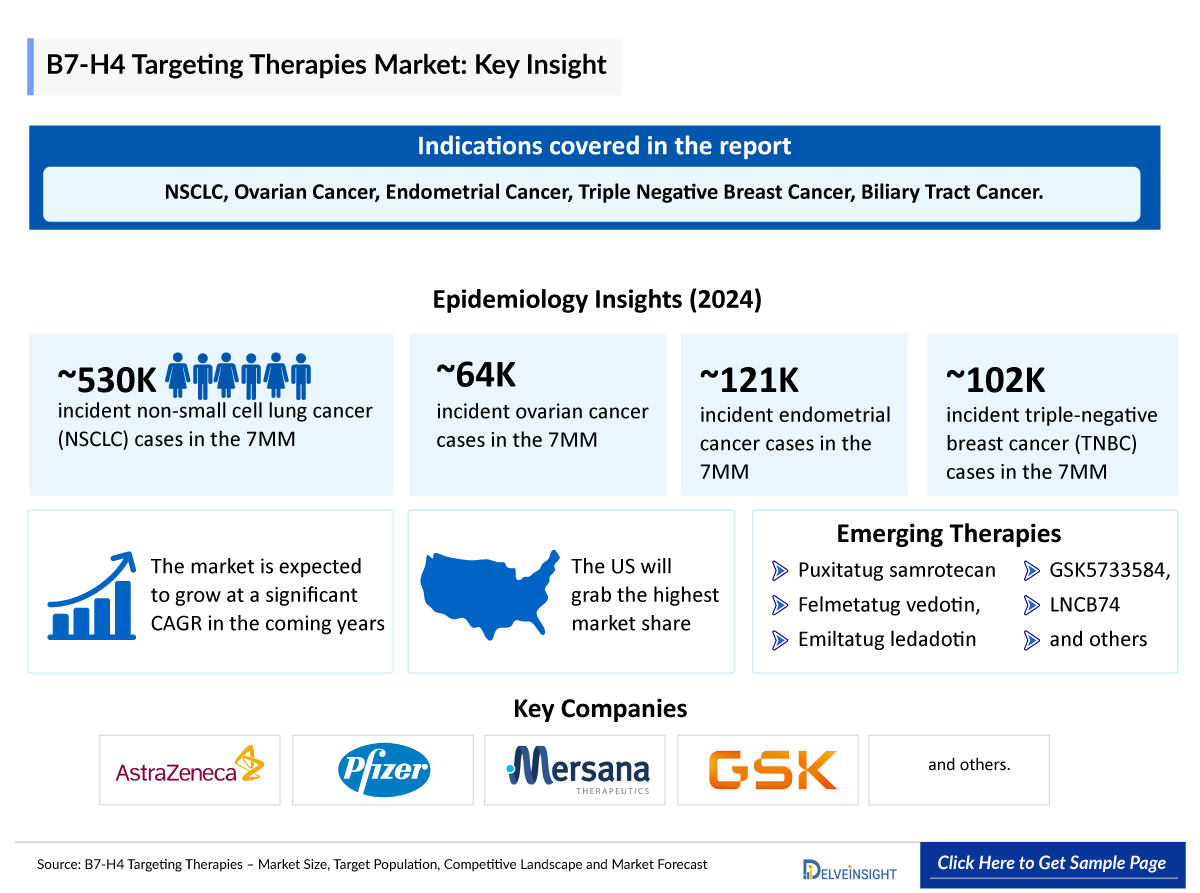
- The B7-H4 Targeting Therapies Market Size is anticipated to grow with a significant CAGR during the study period (2020-2040).
B7-H4 Targeting Therapies Market and Epidemiology Analysis
- In 2027, the United States is expected to hold the largest share of the total B7-H4 Market among the 7MM.
- B7-H4 has been identified as a novel marker and therapeutic target for treating various conditions, including tumors, inflammation, autoimmune diseases, and organ transplantation. Currently, it is being developed for advanced solid tumors and in an early stage of development.
- B7-H4–targeted therapies generally show manageable side effects, with no reported infusion reactions. Common toxicities include fatigue, neutropenia, anemia, neuropathy, and GI symptoms. ADC-related side effects match those of known cytotoxic agents.
- In a range of tumor types, such as bladder, Ovarian Cancer, and breast malignancies, B7-H4-directed ADCs have shown potential. Patients with these tumors frequently still have substantial unmet needs for safe and efficient targeted therapy, particularly if they have become resistant to or relapsed on standard-of-care treatments.
- Recently, in January 2025, the US Food and Drug Administration (FDA) granted an additional Fast Track Designation (FTD) to emiltatug ledadotin for the treatment of advanced or metastatic breast cancer in patients with human epidermal growth factor receptor 2 (HER2) low (IHC 1+ or IHC 2+/ISH–) or HER2-negative (IHC 0) disease, including triple-negative breast cancer (TNBC).
- AstraZeneca has leveraged its proprietary linker and topoisomerase I payload technologies to develop a series of internal ADCs, one of which is an investigational candidate targeting B7-H4, known as puxitatug samrotecan (AZD8205). As per the February 2025 presentation, AstraZeneca is expecting Phase I/II results of puxitatug samrotecan by 2026.
- In January 2025, Mersana Therapeutics announced positive initial clinical data from the Phase I dose escalation and backfill cohorts for emiltatug ledadotin, Mersana’s lead ADC candidate Dolasynthen targeting B7-H4.
- According to recent information, the clinical trial for PF-07260437, a bispecific antibody targeting B7-H4 and CD3, has been terminated by Pfizer due to an internal business decision, with the Phase I trial.
- Several B7-H4 Companies, including AstraZeneca, Pfizer (Seagen), Mersana Therapeutics, GlaxoSmithKline, and others, are engaged in the development of B7-H4 targeting therapies with a range of emerging drugs.
- FPA-150 was being developed by Five Prime Therapeutics in Phase I for Epithelial Ovarian Cancer. The company has not reported any development since its acquisition by Amgen.
- Combining B7-H4–targeted therapies with PD-1, PD-L1, or PARP inhibitors may help address resistance by activating complementary antitumor pathways. Such combinations could improve overall treatment efficacy and reduce the development of resistance.
Request for Unlocking the Sample Page of the "B7-H4 Market"
DelveInsight’s “B7-H4 Targeting Therapies Market, Competitive Landscape, and Market Forecast – 2040” report delivers an in-depth understanding of the B7-H4, historical and Competitive Landscape as well as the B7-H4 targeted therapies market trends in the United States, EU4 (Germany, France, Italy, and Spain) and the United Kingdom, and Japan.
The B7-H4 Targeting Therapies Market report provides current treatment practices, emerging drugs, market share of individual therapies, and current and forecasted 7MM B7-H4 market size from 2020 to 2040. The B7-H4 market report also covers current B7-H4 treatment practices/algorithms and unmet medical needs to curate the best opportunities and assess the market’s potential.
|
Study Period |
2020 to 2040 |
|
Forecast Period |
2025-2040 |
|
Geographies Covered |
|
|
B7-H4 Targeting Therapies Market |
|
|
B7-H4 Targeting Therapies Market Size | |
|
B7-H4 Targeting Therapies Companies |
Pfizer (Seagen), Mersana Therapeutics, and others |
|
B7-H4 Targeting Therapies Epidemiology Segmentation |
|
B7-H4 Treatment Market
B7-H4 Overview
The inhibitory molecule B7-H4, an important member of the B7 family, is abnormally expressed in tumors, inflammation, and autoimmune diseases. B7-H4 negatively regulates T cell immune response and promotes immune escape by inhibiting the proliferation, cytokine secretion, and cell cycle of T cells. Moreover, B7-H4 plays an extremely important role in tumorigenesis and tumor development, including cell proliferation, invasion, metastasis, anti-apoptosis, etc. In addition, B7-H4 has other biological functions, such as protection against type 1 diabetes (T1D) and islet cell transplantation. Therefore, B7-H4 has been identified as a novel marker or a therapeutic target for the treatment of tumors, inflammation, autoimmune diseases, and organ transplantation. The transmembrane protein B7-H4 has emerged as an interesting therapeutic target in multiple solid tumors, with investigators mostly focusing on the development of antibody-drug conjugates (ADCs) aimed at the pathway.
However, overexpression of B7-H4 has been reported in many tumor types, including ovarian, lung, Renal Cancer, Breast Cancer, and Gastric Cancers. B7-H4 expression has been associated with increased tumor size, increased primary tumor classification, and/or diminished survival in these and other tumor types. Additionally, the protein has a role in tumorigenesis and tumor development via cell proliferation, invasion, metastasis, antiapoptosis, and other mechanisms.
B7-H4 Epidemiology
The B7-H4 epidemiology chapter in the report provides historical as well as forecasted epidemiology segmented as total cases of selected indication for B7-H4, total eligible patient pool for B7-H4 in selected indication, total treated cases in selected indication for B7-H4 in the 7MM covering the United States, EU4 (Germany, France, Italy, and Spain), and the United Kingdom, and Japan from 2020 to 2040.
|
Epidemiology of Selected Indications | |
|
Indication |
Estimated Incidence Cases in 7MM (2024) |
|
NSCLC |
~530,300 |
|
Ovarian Cancer |
~64,300 |
|
Endometrial Cancer |
~121,400 |
|
Triple Negative Breast Cancer |
~102,400 |
|
Biliary Tract Cancer |
~45,700 |
|
B7-H4 expression in Selected Indications | |
|
Indication |
B7-H4 expression |
|
NSCLC |
~45% |
|
Ovarian Cancer |
~95% |
|
Endometrial Cancer |
~72% |
|
Triple Negative Breast Cancer |
~90% |
|
Biliary Tract Cancer |
~50% |
B7-H4 Drugs Market Chapters
The drug chapter segment of the B7-H4 Targeting Therapies Drugs Market Report encloses a detailed analysis of late-stage (Phase II and Phase I) pipeline drugs. It also helps understand the B7-H4’s clinical trials details, expressive pharmacological action, agreements and collaborations, approval and patent details, advantages and disadvantages of each included drug, and the latest news and press releases.
Emerging B7-H4 Drugs
-
Felmetatug vedotin (SGN-B7H4V): Pfizer (Seagen)
Felmetatug vedotin is a novel investigational vedotin antibody-drug conjugate comprising a B7-H4-directed human monoclonal antibody conjugated to the cytotoxic payload monomethyl auristatin E (MMAE) via a protease-cleavable maleimidocaproyl valine citrulline (mc-vc) linker. This vedotin linker-payload system has been clinically validated in multiple Food and Drug Administration-approved agents including brentuximab vedotin, enfortumab vedotin, and tisotumab vedotin. Currently, it is being developed in Phase I for the treatment of advanced solid tumors such as ovarian neoplasms, peritoneal neoplasms, triple-negative breast neoplasms, and others. Early results from Phase I study showed objective responses in 7 out of 28 breast cancer patients and 4 out of 20 ovarian cancer patients. Additionally, among 16 patients with endometrial cancer, 1 experienced a complete response.
In December 2023, Pfizer completed the acquisition of all outstanding common stock of Seagen for USD 229 in cash per share, for a total enterprise value of approximately USD 43 billion.
-
Emiltatug ledadotin: Mersana Therapeutics
Emiltatug ledadotin is a B7-H4-directed Dolasynthen antibody-drug conjugate with a precise, target-optimized drug-to-antibody ratio (DAR 6) and a proprietary payload with a controlled bystander effect. B7-H4 is overexpressed in a range of cancers, including breast, endometrial, and ovarian tumors. In 2022, Mersana initiated a multicenter Phase I trial to investigate the safety, tolerability, and anti-tumor activity of emiltatug ledadotin in patients with solid tumors, including in breast, endometrial, and ovarian cancers. The US FDA has granted fast track designation (FTD) to emiltatug ledadotin for the treatment of adult patients with advanced or metastatic triple-negative breast cancer. Currently, it is in Phase I of its developmental process.
In Phase I initial B7-H4 Targeting Therapies Clinical Trials results, emiltatug ledadotin was observed to be generally well tolerated, with no Grade 4 or 5 treatment-related adverse events (TRAEs) reported. The most common TRAEs of any grade across the entire patient population were transient aspartate aminotransferase (AST) increase (38% of patients), generally asymptomatic and reversible proteinuria (31%), generally low-grade nausea (29%) and low-grade fatigue (28%). The only Grade 3 TRAEs in =5% or more of all patients were AST increase (14%) and proteinuria (9%).
|
Comparison of Key Emerging Drugs | |||
|
Product |
Company |
Phase |
Indication |
|
Puxitatug samrotecan (AZD8205) |
AstraZeneca |
I/IIa |
Advanced solid tumors |
|
Felmetatug vedotin |
Pfizer (Seagen) |
I |
Advanced solid tumors |
|
Emiltatug ledadotin |
Mersana Therapeutics |
I |
Endometrial cancer, Ovarian cancer, Triple negative breast cancer |
|
GSK5733584 |
GlaxoSmithKline |
I |
Gynecologic malignancies |
|
LNCB74 |
NextCure |
Preclinical |
Multiple Cancers |
B7-H4 Market Outlook
The B7-H4 Targeting Therapies Market is expected to grow significantly in the coming years. This is due to the increasing number of patients who are being diagnosed with cancer, the growing awareness of B7-H4, and the increasing number of B7-H4 targeting therapies that are under clinical trials.
The B7-H4 Targeting Therapies Market Outlook is promising, driven by significant advancements in the development of innovative treatments for various cancers. Although no FDA-approved B7-H4 agents currently exist, preclinical and early-phase studies have demonstrated substantial potential, particularly with B7-H4 directed antibody-drug conjugate. Felmetatug vedotin, developed by Seagen, is a notable investigational antibody-drug conjugate comprising a B7-H4 directed human monoclonal antibody conjugated to monomethyl auristatin E (MMAE) via a clinically validated vedotin linker-payload system. It is in Phase I trials targeting advanced solid tumors, including ovarian and triple-negative breast cancers. Similarly, Mersana's emiltatug ledadotin, a B7-H4-directed Dolasynthen antibody-drug conjugate, features a target-optimized drug-to-antibody ratio and a controlled bystander effect. Emiltatug ledadotin is undergoing a multicenter Phase I trial for its safety and efficacy in breast, endometrial, and ovarian cancers, and has received FDA fast-track designation for advanced triple-negative breast cancer. Additionally, AstraZeneca's AZD8205 is in Phase I/IIa trials, targeting advanced solid tumors. These developments underscore the high potential of B7-H4-targeted therapies to address unmet needs in oncology, particularly for patients with refractory or relapsed cancers, positioning B7-H4 as a critical focus in the next generation of cancer treatment strategies.
The leading B7-H4 Targeting Therapies Companies such as AstraZeneca, Mersana Therapeutics, Pfizer (Seagen), GSK, and others, are involved in developing drugs for B7-H4 for various indications such as breast cancer, and non-small cell lung cancer. Overall, this is an exciting new class of agents with great potential for development. The maturation of current studies over the next few years will lead to a better understanding of B7-H4 and define their role in the therapy of cancer.
B7-H4 Drug Uptake
This section focuses on the uptake rate of potential emerging B7-H4 expected to be launched in the B7-H4 market during 2040.
B7-H4 Pipeline Development Activities
The B7-H4 Drugs Market report provides insights into different therapeutic candidates in Phase III, Phase II, and Phase I. It also analyzes key B7-H4 Companies involved in developing targeted therapeutics.
The presence of numerous drugs at different stages is expected to generate immense opportunities for the B7-H4 Market Growth over the forecast period
B7-H4 Clinical Trials Activities
The B7-H4 Market Report covers information on collaborations, acquisitions and mergers, licensing, and patent details for B7-H4 therapies.
Latest KOL Views on B7-H4 Targeting Therapies
To keep up with current and future B7-H4 market trends, we take Industry Experts’ opinions working in the domain through primary research to fill the data gaps and validate our secondary research. Industry experts were contacted for insights on B7-H4' evolving treatment landscape, patient reliance on conventional therapies, patient therapy switching acceptability, drug uptake, along challenges related to accessibility.
DelveInsight’s analysts connected with 15+ KOLs to gather insights; however, interviews were conducted with 10+ KOLs in the 7MM. Centers such as Johns Hopkins Sidney Kimmel Cancer Center, UCSF Health, Memorial Sloan Kettering Cancer Center, and others. Their opinion helps understand and validate current and emerging therapy treatment patterns or B7-H4 market trends. This will support the clients in potential upcoming novel treatments by identifying the overall scenario of the B7-H4 market and the unmet needs.
|
KOL Views |
|
“B7-H4 has regulatory activity being that it’s expressed by both tumor cells as well as myeloid cells that will infiltrate into the tumors.” Professor, Northwestern University Feinberg School of Medicine in Chicago |
|
KOL Views |
|
“Targeting B7-H4, especially in combination with other immunotherapies, could offer new hope for patients who currently have few options. It may become a key player in next-generation cancer treatments.” Researcher, Department of Cancer Epidemiology |
Qualitative Analysis
We perform Qualitative and market Intelligence analysis using various approaches, such as SWOT analysis and Conjoint Analysis. In the SWOT analysis, strengths, weaknesses, opportunities, and threats in terms of gaps in disease diagnosis, patient awareness, physician acceptability, competitive landscape, cost-effectiveness, and geographical accessibility of therapies are provided. Conjoint Analysis analyzes multiple approved and emerging therapies based on relevant attributes such as safety, efficacy, frequency of administration, route of administration, and order of entry. Scoring is given based on these parameters to analyze the effectiveness of therapy.
In efficacy, the trial’s primary and secondary outcome measures are evaluated; for instance, in event-free survival, one of the most important primary outcome measures is event-free survival and overall survival. Further, the therapies’ safety is evaluated wherein the acceptability, tolerability, and adverse events are majorly observed, and it sets a clear understanding of the side effects posed by the drug in the trials. In addition, the scoring is also based on the probability of success, and the addressable patient pool for each therapy. According to these parameters, the final weightage score and the ranking of the emerging therapies are decided.
B7-H4 Market Access and Reimbursement
Reimbursement may be referred to as the negotiation of a price between a manufacturer and payer that allows the manufacturer access to the market. It is provided to reduce the high costs and make the essential drugs affordable. Health technology assessment (HTA) plays an important role in reimbursement decision-making and recommending the use of a drug. These recommendations vary widely throughout the seven major markets, even for the same drug.
In the US healthcare system, both Public and Private health insurance coverage are included. Also, Medicare and Medicaid are the largest government-funded programs in the US. The major healthcare programs including Medicare, Medicaid, the Children's Health Insurance Program (CHIP), and the state and federal health insurance marketplaces are overseen by the Centers for Medicare & Medicaid Services (CMS). Other than these, Pharmacy Benefit Managers (PBMs), and third party organizations that provide services and educational programs to aid patients are also present.
The B7-H4 market report further provides detailed insights on the country-wise accessibility and reimbursement scenarios, cost-effectiveness scenario of approved therapies, programs making accessibility easier and out-of-pocket costs more affordable, insights on patients insured under federal or state government prescription drug programs, etc.
Key Updates on B7-H4 Market Landscape
In May 2024, Mersana Therapeutics announced that the maximum tolerated dose has not yet been established in the Phase I clinical trial of emiltatug ledadotin. Enrollment in dose escalation and backfill cohorts is continuing in parallel, with initial clinical data and the initiation of expansion expected in the second half of 2024.
- In April 2024, NextCure announced the presentation of new preclinical data on LNCB74, a B7-H4 targeting antibody-drug conjugate developed in partnership with LigaChem Biosciences (LCB), formerly LegoChem Biosciences, at the 2024 American Association for Cancer Research (AACR) Annual Meeting in San Diego. The poster presentation highlights LNBC74’s promising preclinical safety and anti-tumor activity.
- In October 2023, GSK and Hansoh Pharma announced that they have entered into an exclusive license agreement for HS-20089, a B7-H4 targeted antibody drug currently in Phase I (NCT05263479) clinical trials in China. Under the agreement, GSK will obtain exclusive worldwide rights (excluding China’s mainland, Hong Kong, Macau, and Taiwan) to progress the development and commercialization of HS-20089.
- In ASCO 2023, Mersana Therapeutics presented the trial design of a Phase Ib trial of a B7-H4 targeted ADC in breast, endometrial, and ovarian cancers.
- Although B7-H4 targeted therapeutics are still in the early stages of development and no FDA-approved drug exists yet, preclinical and early-phase studies have validated the initial interest in this pathway. Currently, there are several drugs in the early phase of clinical trials, including AZD8205, emiltatug ledadotin, felmetatug vedotin, GSK5733584, LNCB74, and others.
The abstract list is not exhaustive, will be provided in the final report
B7-H4 Market Report Scope
- The B7-H4 Market report covers a segment of key events, an executive summary, and a descriptive overview of the B7-H4, explaining its mechanism, and therapies (emerging).
- Comprehensive insight into the Competitive Landscape, and forecasts, the future growth potential of treatment rate, drug uptake, and drug information have been provided.
- Additionally, an all-inclusive account of emerging therapies and the elaborative profiles of late-stage and prominent therapies will impact the current landscape.
- A detailed review of the B7-H4 Market, historical and forecasted B7-H4 Market Size, B7-H4 Market Share by therapies, detailed assumptions, and rationale behind our approach is included in the report, covering the 7MM drug outreach.
- The B7-H4 Market Report provides an edge while developing business strategies, by understanding trends, through SWOT analysis, expert insights/KOL views, and treatment preferences that help shape and drive the 7MM B7-H4 market.
B7-H4 Market Report Insights
- B7-H4 Targeted Patient Pool
- Therapeutic Approaches
- B7-H4 Pipeline Analysis
- B7-H4 Market Size
- B7-H4 Market Trends
- Existing and Future B7-H4 Market Opportunity
B7-H4 Market Report Key Strengths
- 16 years Forecast
- The 7MM Coverage
- Key Cross Competition
- B7-H4 Drugs Uptake
- Key B7-H4 Market Forecast Assumptions
B7-H4 Market Report Assessment
- Current B7-H4 Treatment Practices
- B7-H4 Unmet Needs
- B7-H4 Pipeline Product Profiles
- B7-H4 Market Attractiveness
- Qualitative Analysis (SWOT and Conjoint analysis)
- B7-H4 Market Drivers
- B7-H4 Market Barriers
Key Questions Answered In The B7-H4 Market Report:
- What was the B7-H4 Market Size, the market size by therapies, market share (%) distribution, and what would it look like in 2040? What are the contributing factors for this growth?
- Which B7-H4 drug is going to be the largest contributor in 2040?
- Which is the most lucrative market for B7-H4?
- What are the risks, burdens, and unmet needs of treatment with B7-H4 based therapies? What will be the growth opportunities across the 7MM for the patient population of B7-H4 based therapies?
- What are the key factors hampering the growth of the B7-H4 market?
- What are the indications for which recent novel therapies and technologies have been developed to overcome the limitations of existing treatments?
- What key designations have been granted to the therapies for B7-H4?
- What is the cost burden of approved B7-H4 therapies on the patient?
- Patient acceptability in terms of preferred therapy options as per real-world scenarios?
- What are the country-specific accessibility issues of expensive, recently approved B7-H4 therapies?
Reasons to Buy the B7-H4 Market Report:
- The B7-H4 Market Report will help develop business strategies by understanding the latest trends and changing dynamics driving the B7-H4 Market.
- Understand the existing B7-H4 Market opportunities in varying geographies and the growth potential over the coming years.
- Distribution of historical and current patient share based on real-world prescription data along with reported sales of approved products in the US, EU4 (Germany, France, Italy, and Spain) and the United Kingdom, and Japan.
- Identifying strong upcoming B7-H4 companies in the B7-H4 Market will help devise strategies to help get ahead of competitors.
- Detailed analysis and ranking of indication-wise current and emerging therapies under the conjoint analysis section to provide visibility around leading indications.
- Highlights of Access and Reimbursement policies of approved therapies, barriers to accessibility of expensive off-label therapies, and patient assistance programs.
- To understand Key Opinion Leaders’ perspectives around the accessibility, acceptability, and compliance-related challenges of existing treatment to overcome barriers in the future.
- Detailed insights on the unmet needs of the existing B7-H4 Market so that the upcoming B7-H4 companies can strengthen their development and launch strategy
Stay updated with us for Recent Articles @ Latest DelveInsight Blogs

