
HER3 inhibitors Market Summary
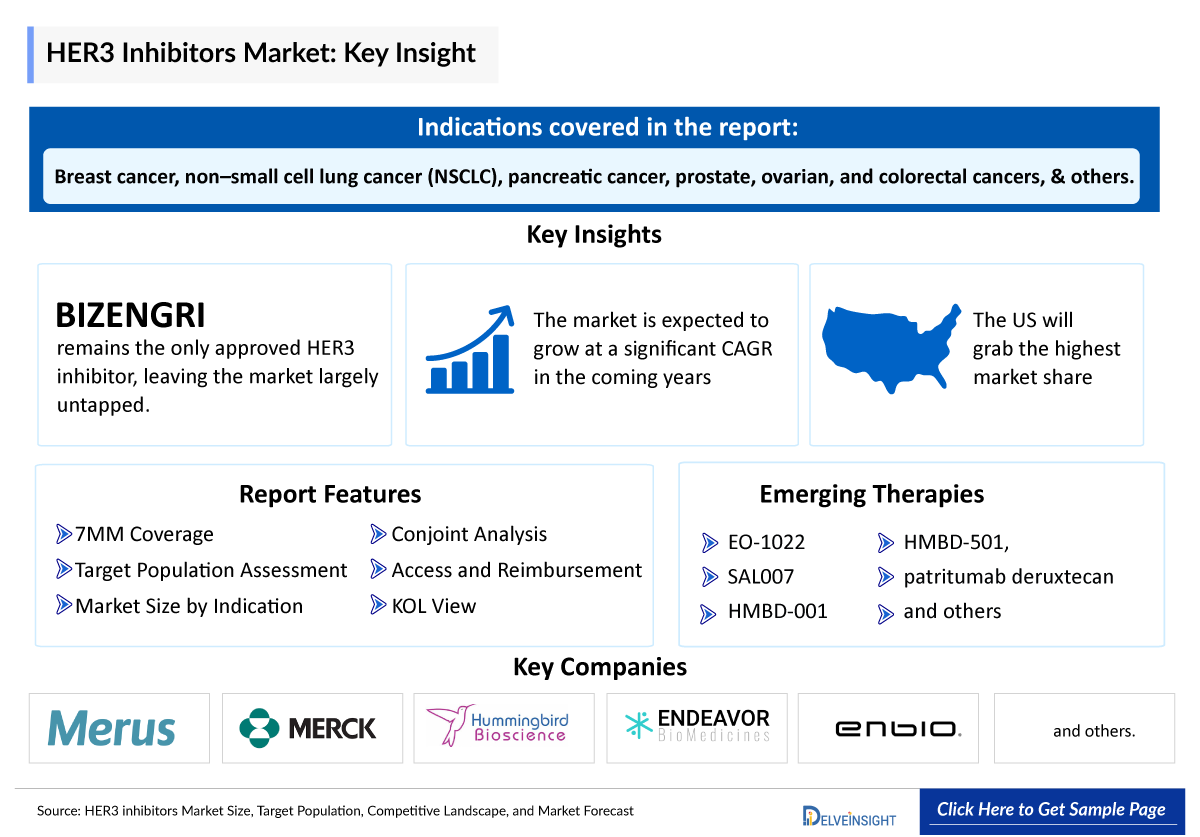
- The HER3 inhibitor market in the 7MM is projected to grow at a significant CAGR by 2034 in leading countries (US, EU4, UK and Japan).
HER3 Inhibitor Market and Epidemiology Analysis
- Human epidermal growth factor receptor 3 (HER3 also known as ErbB3) is a member of the EGFR (ErbB) family of receptor tyrosine kinases. Unlike other family members, HER3 lacks intrinsic kinase activity but becomes a potent signaling mediator when it forms heterodimers with other receptors such as HER2, EGFR, and MET. This dimerization activates downstream signaling pathways, notably PI3K/AKT and MAPK, which are critical for cancer cell survival and proliferation.
- HER3 is a validated target in several solid tumors, notably where its overexpression or activation contributes to tumor progression or resistance. Leading indications include breast cancer, non–small cell lung cancer (NSCLC), pancreatic cancer, prostate, ovarian, and colorectal cancers, and other indications. Patient selection often relies on HER3 expression and, in some cases, neuregulin (HRG) levels.
- Therapeutic strategies targeting HER3 include monoclonal antibodies (e.g., patritumab), antibody-drug conjugates (ADC) (e.g., patritumab deruxtecan, HMBD-501, EO-1022), bispecific antibodies, as well as ligand traps and small-molecule inhibitors.
- The HER3 inhibitor market is still largely untapped, with only BIZENGRI (zenocutuzumab-zbco) approved. However, emerging therapies like EO-1022, SAL007, HMBD-001, HMBD-501, patritumab deruxtecan, and others are shaping a promising pipeline.
- In December 2024, Merus NV announced that the FDA granted accelerated approval for BIZENGRI (zenocutuzumab-zbco), the first treatment for adults with advanced unresectable or metastatic pancreatic adenocarcinoma or NSCLC harboring NRG1 gene fusions, following progression on prior systemic therapy. Approval was based on the overall response rate and duration of response, with continued approval dependent on confirmatory trials.
- Leading companies in the HER3 market include Merus NV, Hummingbird Bioscience, Endeavor BioMedicines, EnBio, Callio Therapeutics, Avenzo Therapeutics, and Elevation Oncology, among others.
- In May 2025, Daiichi Sankyo and Merck voluntarily withdrew their Biologics License Application (BLA) for patritumab deruxtecan (HER3-DXd) for EGFR-mutated NSCLC. The decision followed topline results from the Phase III HERTHENA-Lung02 trial, where overall survival did not meet statistical significance. This withdrawal is unrelated to the June 2024 Complete Response Letter (CRL) concerning issues at a third-party manufacturing facility.
- In April 2025, Elevation Oncology announced preclinical proof-of-concept data for its novel HER3 ADC, EO-1022, which was presented in a late-breaking poster at the American Association for Cancer Research (AACR) 2025.
- In January 2025, EnBio and Avenzo Therapeutics announced an exclusive license agreement granting Avenzo global rights to develop, manufacture, and commercialize DB-1418/AVZO-1418.
Factors Contributing to HER3 Inhibitor Market Growth
HER3's Role in Resistance Mechanisms
HER3 activation drives resistance to EGFR and HER2-targeted therapies in breast, lung, and GI cancers, creating urgent demand for inhibitors to restore sensitivity.
Rising Cancer Incidence with HER3 Overexpression
Increasing prevalence of HER3-positive aggressive tumors in breast, NSCLC, colorectal, and ovarian cancers expands the addressable patient population.
Diversified Therapeutic Modalities
Development of monoclonal antibodies, ADCs (e.g., patritumab deruxtecan), and bispecifics (e.g., zenocutuzumab) provides versatile options for different clinical settings.
Biomarker-Driven Patient Selection
Advances in detecting HER3 expression, heregulin ligands, and pathway activation enable precision targeting and higher trial success rates.
Synergistic Combination Potential
Proven efficacy when paired with EGFR/HER2 inhibitors, immunotherapy, and chemotherapy positions HER3 agents as key components of multi-drug regimens.
Robust Industry Pipeline and Investments
Leading players like Daiichi Sankyo, Merus, Elevation Oncology, and AstraZeneca fuel innovation through substantial R&D and partnerships.
Improved Diagnostic Standardization
Evolving companion diagnostics and biomarker platforms support better patient stratification and regulatory approvals.
North America and Europe Market Dominance
High disease burden, regulatory support, and pharma leadership in advanced economies accelerate adoption and commercialization.
DelveInsight’s “HER3 inhibitors Market Size, Target Population, Competitive Landscape, and Market Forecast – 2034” report delivers an in-depth understanding of the HER3 inhibitors, historical and Competitive Landscape as well as the HER3 inhibitors market trends in the United States, EU4 (Germany, France, Italy, and Spain) and the United Kingdom, and Japan.
The HER3 inhibitors market report provides current treatment practices, emerging drugs, market share of individual therapies, and current and forecasted HER3 inhibitors market size from 2020 to 2034 across 7MM. The report also covers current HER3 inhibitors treatment practices/algorithms and unmet medical needs to curate the best opportunities and assess the market’s potential.
Scope of the HER3 Inhibitor Market Report | |
|
Study Period |
2020–2034 |
|
Forecast Period |
2025–2034 |
|
Geographies Covered |
US, EU4 (Germany, France, Italy, and Spain) the UK, and Japan |
|
HER3 Inhibitor Patient Pool |
Segmented by:
|
|
HER3 Inhibitor Key Companies |
|
|
HER3 Inhibitor Market |
Segmented by:
|
|
HER3 Inhibitor Market Analysis |
|
HER3 Inhibitors Understanding
HER3 Inhibitors Overview
HER3, also known as ErbB3, is a member of the ErbB/HER family of receptor tyrosine kinases, which also includes EGFR (HER1), HER2, and HER4. Unlike its family members, HER3 has impaired kinase activity and relies on dimerization with other ErbB receptors—especially HER2—to initiate downstream signaling pathways such as PI3K/AKT, which are crucial for cell proliferation and survival. Overexpression or activation of HER3 has been implicated in various cancers, including breast cancer, lung cancer, gastric cancer, and colorectal cancers, often contributing to tumor progression, therapeutic resistance, and poor prognosis.
HER3 inhibitors aim to block this signaling, either by preventing ligand binding, dimerization, or downstream signaling activation. Several therapeutic strategies have been explored, including monoclonal antibodies (e.g., patritumab), antibody-drug conjugates (e.g., EO-1022), and bispecific antibodies targeting HER3 and other receptors like HER2 or EGFR. Despite initial challenges due to HER3’s lack of intrinsic kinase activity, these agents have shown promise in clinical trials, particularly in tumors with HER3 overexpression or NRG1 fusions. Combination therapies with HER3 inhibitors and other targeted treatments or immunotherapies are also under investigation, potentially offering new options for patients with refractory or resistant cancers.
Further details related to country-based variations are provided in the report.
HER3 Inhibitors Market Overview
The HER3 inhibitors market is experiencing steady growth, driven by the increasing recognition of HER3 as a key driver of tumor progression and resistance in various cancers, including NSCLC, breast cancer, and pancreatic cancers. The market is fueled by advancements in targeted therapies and personalized medicine. Notable developments include the FDA approval of BIZENGRI (zenocutuzumab) in 2024 for NRG1 fusion-positive tumors and promising clinical results from patritumab deruxtecan (HER3-DXd), an antibody-drug conjugate showing efficacy in EGFR-resistant cancers. Other candidates like HMBD-501, HMBD-001, SAL007, and others are in mid-stage trials, expanding the therapeutic landscape. Innovations in companion diagnostics and drug delivery systems are enhancing treatment precision, though challenges like tumor heterogeneity and ligand-independent HER3 activation remain. Overall, the HER3 inhibitors market holds strong potential as both monotherapy and combination strategies evolve to address unmet needs in oncology.
The market is highly competitive with key players, including Merck, Hummingbird Bioscience, Endeavor BioMedicines, Elevation Oncology, and others investing heavily in R&D to develop HER3 inhibitors with enhanced potency and safety.
Further details related to country-based variations are provided in the report…
HER3 Inhibitors Potential Patient Pool
This chapter focuses on the HER3 inhibitors potential patient pool, covering nearly 10 key indications where HER3-targeted therapies may be applicable. It provides both historical and projected data on the total number of cases, the eligible population for treatment, and estimated treated patients across the 7 major markets (the United States, EU4 (Germany, France, Italy, and Spain), the United Kingdom, and Japan) from 2020 to 2034.
NOTE: The above figure is indicative and is subject to change as per report updation
HER3 Inhibitor Drug Chapters
The drug chapter segment of the HER3 inhibitors report encloses a detailed analysis of approved HER3 inhibitors, late-stage (Phase III and Phase II) HER3 inhibitors. It also helps understand the HER3 inhibitor clinical trial details, expressive pharmacological action, agreements and collaborations, approval and patent details, advantages and disadvantages of each included drug, and the latest news and press releases.
HER3 Inhibitor Marketed Drugs
BIZENGRI (zenocutuzumab-zbco): MERUS NV
BIZENGRI is a bispecific antibody that binds to the extracellular domains of HER2 and HER3 expressed on the surface of cells, including tumor cells, inhibiting HER2:HER3 dimerization and preventing NRG1 binding to HER3. BIZENGRI decreased cell proliferation and signaling through the phosphoinositide 3-kinase-AKT-mammalian target of the rapamycin pathway. In addition, BIZENGRI mediates antibody-dependent cellular cytotoxicity. BIZENGRI showed antitumor activity in mouse models of NRG1+ lung and pancreatic cancers.
Zenocutuzumab is the world’s first approved HER3-targeted drug and the first FDA-approved therapy for NRG1+ PDAC and NSCLC. It works by targeting and inhibiting the HER3 receptor, a critical driver of cancer progression. The approval is based on promising clinical data, including overall response rate and duration of response, with continued approval contingent on the results of confirmatory trials. BIZENGRI carries a Boxed Warning for embryo-fetal toxicity and has additional warnings for infusion-related reactions, hypersensitivity, interstitial lung disease, and left ventricular dysfunction.
Note: Detailed current therapies assessment will be provided in the full report of HER3 inhibitors
HER3 Inhibitor Emerging Drugs
Patritumab deruxtecan (MK-1022): Merck/ Daiichi Sankyo
Patritumab deruxtecan is an investigational antibody-drug conjugate that consists of a fully human anti-HER3 IgG1 monoclonal antibody linked to a topoisomerase I inhibitor payload. In October 2023, Daiichi Sankyo and Merck entered into a global collaboration to jointly develop and commercialize patritumab deruxtecan (HER3-DXd), and other drugs, except in Japan, where Daiichi Sankyo will maintain exclusive rights. Daiichi Sankyo will be solely responsible for manufacturing and supply.
In December 2021, Daiichi Sankyo announced that the FDA granted breakthrough therapy designation to patritumab deruxtecan, a first-in-class HER3-directed ADC, for treating metastatic or locally advanced EGFR-mutated NSCLC after progression on third-generation TKIs and platinum-based therapies.
HMBD-001: Hummingbird Bioscience
HMBD-001 is a clinical-stage IgG1 antibody designed to target HER3, discovered using Hummingbird Bioscience’s proprietary Rational Antibody Discovery (RAD) platform. HMBD-001 is the only anti-HER3 antibody in development that has the potential to fully block both ligand-dependent and ligand-independent HER3 activation and oncogenic signaling by targeting a key epitope located at the interface where HER3 forms heterodimers with HER2 or EGFR.
In preclinical models evaluating HMBD-001, superior affinity, and more potent tumor growth inhibition compared to existing anti-HER3 antibodies were observed. HMBD-001 is currently in Phase Ib clinical trials for biomarker-selected indications with a strong scientific rationale, which includes squamous non-small cell lung cancer, NRG1 fusions, and HER3 mutations.
Comparison of Key Emerging Drugs | |||||
|
Product |
Company |
RoA |
Highest Phase |
Designation |
Indication |
|
Patritumab deruxtecan |
Merck/ Daiichi Sankyo |
IV |
III |
Breakthrough Therapy Designation |
|
|
HMBD-001 |
Hummingbird Bioscience |
IV |
I/II |
N/A |
|
Note: Detailed emerging therapies assessment will be provided in the final report.
HER3 Inhibitor Market Recent Developments and Breakthroughs
- In February 2026, FDA granted orphan drug designation to zenocutuzumab-zbco (Bizengri, HER2/HER3 bispecific) for advanced unresectable/metastatic cholangiocarcinoma.
- In October 2025, Phase 3 BL-B01D1-303 interim results for iza-bren (EGFR/HER3 bispecific ADC) presented at ESMO, showing superior confirmed ORR vs. chemo in recurrent/metastatic nasopharyngeal carcinoma.
- In July 2025, the FDA granted fast track designation to DB-1310 for EGFR-mutated NSCLC post third-gen TKI and platinum chemo.
- In May 2025, Daiichi Sankyo and Merck voluntarily withdrew their Biologics License Application (BLA) for patritumab deruxtecan (HER3-DXd) for EGFR-mutated NSCLC. The decision followed topline results from the Phase III HERTHENA-Lung02 trial, where overall survival did not meet statistical significance. This withdrawal is unrelated to the June 2024 Complete Response Letter (CRL) concerning issues at a third-party manufacturing facility.
- In April 2025, Elevation Oncology announced preclinical proof-of-concept data for its novel HER3 ADC, EO-1022, which was presented in a late-breaking poster at the American Association for Cancer Research (AACR) 2025.
- In January 2025, EnBio and Avenzo Therapeutics announced an exclusive license agreement granting Avenzo global rights to develop, manufacture, and commercialize DB-1418/AVZO-1418.
HER3 Inhibitor Market Outlook
HER3-targeted therapies are a rapidly evolving area, with multiple agents in early- and late-stage clinical development. Combination strategies—such as pairing HER3 inhibitors with EGFR TKIs or immune checkpoint inhibitors—are being explored to enhance efficacy and overcome resistance. Biomarker-driven patient selection (e.g., HER3 expression or HER3+ circulating tumor cell count) may further refine the use of these therapies in clinical practice.
Leading companies in the HER3 space, such as Merus NV, Merck, Hummingbird Bioscience, Endeavor BioMedicines, EnBio, Callio Therapeutics, Avenzo Therapeutics, and Elevation Oncology, are actively developing HER3 inhibitors for various cancers, including breast cancer, NSCLC, pancreatic cancer, prostate cancer, ovarian cancer, colorectal cancers, and others. HER3-targeted therapies represent a promising approach to overcoming drug resistance, particularly in tumors where HER3 signaling drives progression and treatment failure.
HER3 inhibitor Drugs Uptake
This section focuses on the uptake rate of potential approved and emerging HER3 expected to be launched in the market during 2025–2034.
HER3 Inhibitor Clinical Trials Analysis
The report provides insights into different therapeutic candidates in Phase III, Phase II, and Phase I. It also analyzes key players involved in developing targeted therapeutics.
The presence of numerous drugs at different stages is expected to generate immense opportunities for the HER3 inhibitors market growth over the forecasted period.
Pipeline Development Activities
The report covers information on collaborations, acquisitions and mergers, licensing, and patent details for HER3 inhibitor therapies.
Latest KOL Views on HER3 Inhibitor
To keep up with current and future market trends, we take Industry Experts’ opinions working in the domain through primary research to fill the data gaps and validate our secondary research. Industry experts were contacted for insights on HER3 inhibitors' evolving treatment landscape, patient reliance on conventional therapies, patient therapy switching acceptability, drug uptake, along challenges related to accessibility.
DelveInsight’s analysts connected with 25+ KOLs to gather insights; however, interviews were conducted with 15+ KOLs in the 7MM. Centers such as Johns Hopkins, Sidney Kimmel Cancer Center, and others were contacted.
Their opinion helps understand and validate current and emerging therapy treatment patterns or HER3 inhibitor market trends. This will support the clients in potential upcoming novel treatments by identifying the overall scenario of the market and the unmet needs.
What KOLs are saying on the HER3 Inhibitor Patient Pool? |
|
“Once considered a passive player due to its weak kinase activity, HER3 is now recognized as a major contributor to the survival and spread of various solid tumors, including breast, lung, colorectal, pancreatic, and gynecologic cancers.” |
|
“Crucially, with HER3 therapies only a subset of tumors such as those with NRG1 gene fusions or high HER3 expression appear to respond well, highlighting the need for predictive biomarkers to guide treatment selection.” |
Qualitative Analysis
We perform Qualitative and market Intelligence analysis using various approaches, such as SWOT analysis. In the SWOT analysis, strengths, weaknesses, opportunities, and threats in terms of disease diagnosis, patient awareness, patient burden, competitive landscape, cost-effectiveness, and geographical accessibility of therapies are provided. These pointers are based on the analyst’s discretion and assessment of the patient burden, cost analysis, and existing and evolving treatment landscape.
HER3 Inhibitor Market Access and Reimbursement
Reimbursement may be referred to as the negotiation of a price between a manufacturer and a payer that allows the manufacturer access to the market. It is provided to reduce the high costs and make the essential drugs affordable. Health technology assessment (HTA) plays an important role in reimbursement decision-making and recommending the use of a drug. These recommendations vary widely throughout the seven major markets, even for the same drug.
In the US healthcare system, both Public and Private health insurance coverage are included. Also, Medicare and Medicaid are the largest government-funded programs in the US. The major healthcare programs, including Medicare, Continuing Medical Education (CME) program, the Children's Health Insurance Program (CHIP), and the state and federal health insurance marketplaces, are overseen by the Centers for Medicare & Medicaid Services (CMS). Other than these, Pharmacy Benefit Managers (PBMs), and third-party organizations that provide services, and educational programs to aid patients are also present.
The report further provides detailed insights on the country-wise accessibility and reimbursement scenarios, cost-effectiveness scenario of approved therapies, programs making accessibility easier and out-of-pocket costs more affordable, insights on patients insured under federal or state government prescription drug programs, etc.
Scope of the HER3 Inhibitor Market Report
- The report covers a segment of key events, an executive summary, and a descriptive overview of the HER3 inhibitors, explaining its mechanism, and current therapies and emerging therapies.
- Comprehensive insight into the competitive landscape, and forecasts, the future growth potential of treatment rate, drug uptake, and drug information have been provided.
- Additionally, an all-inclusive account of the current and emerging therapies and the elaborative profiles of late-stage and prominent therapies will impact the current landscape.
- A detailed review of the HER3 inhibitor market, historical and forecasted market size, market share by therapies, detailed assumptions, and rationale behind our approach is included in the report, covering the 7MM drug outreach.
- The report provides an edge while developing business strategies by understanding trends, through SWOT analysis, expert insights/KOL views, and treatment preferences that help shape and drive the 7MM HER3 inhibitor market.
HER3 Inhibitor Report Insights
- HER3 Inhibitors Targeted Patient Pool
- Therapeutic Approaches
- HER3 Inhibitor Pipeline Analysis
- HER3 Inhibitor Market Size and Trends
- Existing and future HER3 Inhibitor Market Opportunity
HER3 Inhibitor Report Key Strengths
- 10 years Forecast
- The 7MM Coverage
- Key Cross Competition
- Drugs Uptake and Key Market Forecast Assumptions
HER3 Inhibitor Report Assessment
- Current Treatment Practices
- Unmet Needs
- Pipeline Product Profiles
- Market Attractiveness
- Qualitative Analysis (SWOT)
Key Questions Answered in the HER3 Inhibitor Market Report
- What was the total HER3 inhibitor market size, the market size by therapies, market share (%) distribution, and what would it look like in 2034? What are the contributing factors for this growth?
- Which HER3 inhibitor drug is going to be the largest contributor in 2034?
- Which is the most lucrative HER3 inhibitor market?
- What are the pricing variations among different geographies for approved therapies?
- How the reimbursement landscape for HER3 inhibitors has evolved since the first drug approval? Do patients have any access issues that are driven by reimbursement decisions?
- What are the risks, burdens, and unmet needs of treatment with HER3 inhibitors? What will be the growth opportunities across the 7MM for the patient population of HER3 inhibitors?
- What are the key factors hampering the growth of the HER3 inhibitor market?
- What are the indications for which recent novel therapies and technologies have been developed to overcome the limitations of existing treatments?
- What key designations have been granted to the therapies for HER3 inhibitors?
- What is the cost burden of approved therapies on the patient?
- Patient acceptability in terms of preferred therapy options as per real-world scenarios?
- What are the country-specific accessibility issues of expensive, recently approved therapies?
Reasons to buy the HER3 Inhibitor Market Report
- The report will help develop business strategies by understanding the latest trends and changing dynamics driving the HER3 inhibitor market.
- Understand the existing market opportunities in varying geographies and the growth potential over the coming years.
- Distribution of historical and current patient share based on real-world prescription data along with reported sales of approved products in the US, EU4 (Germany, France, Italy, and Spain) the United Kingdom, and Japan.
- Identifying strong upcoming players in the market will help devise strategies to help get ahead of competitors.
- Detailed analysis and ranking of indication-wise current and emerging therapies under the conjoint analysis section to provide visibility around leading indications.
- Highlights of Access and Reimbursement policies of approved therapies, barriers to accessibility of expensive off-label therapies, and patient assistance programs.
- To understand Key Opinion Leaders’ perspectives around the accessibility, acceptability, and compliance-related challenges of existing treatment to overcome barriers in the future.
- Detailed insights on the unmet needs of the existing market so that the upcoming players can strengthen their development and launch strategy.

