New Antimicrobial Approvals and the Fight Against Drug-Resistant Infections
Sep 28, 2026
Table of Contents
Summary
- After years of a stalled pipeline, 2026 brought two major FDA antibiotic approvals, GSK/Spero Therapeutics’ UTEBZI (tebipenem pivoxil) and Wockhardt’s ZAYNICH (cefepime and zidebactam), signaling real progress against drug-resistant infections.
- Resistant bacteria are turning routine infections into medical emergencies, and complicated UTIs are a major flashpoint where standard oral drugs increasingly fail.
- Gepotidacin (BLUJEPA), zoliflodacin (NUZOLVENCE), sulopenem etzadroxil/probenecid, and aztreonam-avibactam all expand treatment options for resistant UTIs and gonorrhea.
- These approvals offer real hope, but only sustained stewardship, funding, and equitable access will keep resistance from catching up again.
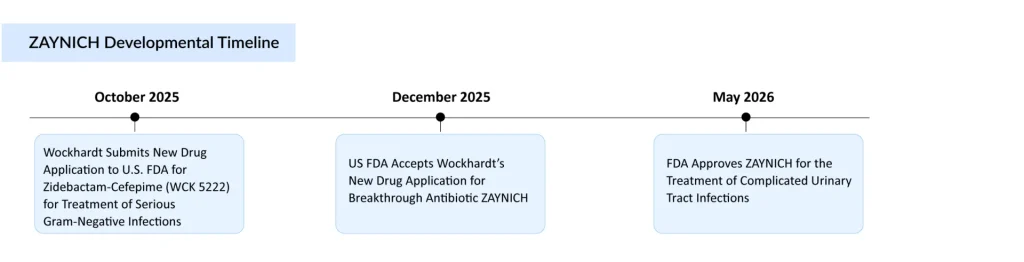
For more than a decade, the story of antibiotics has been one of retreat. Bacteria kept evolving new ways to dodge our drugs, while pharmaceutical pipelines for new antibiotics ran dry. That trend is finally starting to turn. In 2026, the U.S. FDA approved two significant new antibacterial treatments: GSK/Spero Therapeutics’ UTEBZI (tebipenem pivoxil), the first oral carbapenem antibiotic ever cleared in the United States, and Wockhardt’s ZAYNICH (cefepime and zidebactam), a novel intravenous combination built to outmaneuver even the toughest multidrug-resistant Gram-negative bacteria. Together, they represent more than just two new drug names on a pharmacy shelf; they’re a signal that innovation against antimicrobial resistance (AMR) is possible and urgently needed.
Downloads
Click Here To Get the Article in PDF

Recent Articles
- Antibiotic Resistance: The Big Challenge of Healthcare Industry
- Sygnis AG and ECACC Collaboration; BioNTech and Genentech Partnership; Partnership between Zydus ...
- Antimicrobial resistance crisis: A global need for antibiotic awareness
- BMS, and Exelixis’s Opdivo + CABOMETYX in First-Line Advanced Renal Cell Carcinoma; AIRSUPRA Now ...
- ORLYNVAH – The First Oral Penem in the US Market: A New Era in UTI Treatment
Why the World Needs New Antibiotics, Now More Than Ever
Antimicrobial resistance isn’t a distant, theoretical threat. It’s already one of the leading causes of death connected to infectious disease worldwide. Resistant bacteria turn once-routine infections, a urinary tract infection, a wound, a case of pneumonia, into life-threatening emergencies that don’t respond to first-line treatment.
Complicated urinary tract infections (cUTIs), including pyelonephritis (a kidney infection), sit at the center of this problem. They send millions of people to hospitals every year, and a meaningful share of those cases fail standard therapy because the causative bacteria have become resistant to common oral antibiotics. Until recently, patients with drug-resistant cUTIs often had only one option: hospitalization for intravenous carbapenems, sometimes requiring a PICC line or an infusion center, a costly, disruptive, and resource-intensive path for something as common as a UTI.
This is exactly the gap UTEBZI and ZAYNICH were designed to close.
GSK/Spero Therapeutics’ UTEBZI: The First Oral Carbapenem
Carbapenems have long been considered “last-resort” antibiotics, powerful drugs held in reserve for the most resistant infections. Until now, every carbapenem available in the U.S. had to be delivered intravenously. UTEBZI changes that. The FDA approved UTEBZI for the treatment of complicated urinary tract infections (cUTI), including pyelonephritis, in adult patients who have limited or no alternative oral treatment options. It works by binding to penicillin-binding proteins in the bacterial cell wall, disrupting the bacteria’s ability to build and maintain that wall, and it’s active against key cUTI pathogens including E. coli, Klebsiella pneumoniae, and Enterococcus faecalis.
In its pivotal Phase 3 trial, oral UTEBZI performed comparably to intravenous imipenem-cilastatin, a standard hospital-grade carbapenem, proving that a pill can now do a job that used to require an IV line. For patients, that means a real shot at avoiding hospitalization altogether, or being discharged sooner and finishing treatment at home.

Wockhardt’s ZAYNICH: A Combination Built for Superbugs
Where UTEBZI tackles the “how do we treat this outside the hospital” problem, ZAYNICH tackles the “what do we do when nothing else works” problem. ZAYNICH pairs a fourth-generation cephalosporin (cefepime) with zidebactam, a novel non-beta-lactam agent that binds a different penicillin-binding protein than cefepime does. The result is a synergistic, multi-target attack that remains effective even against bacteria carrying beta-lactamase enzymes, including metallo-beta-lactamases, and against other resistance tricks like efflux pumps and porin channel changes that let bacteria “shrug off” ordinary antibiotics.
ZAYNICH was approved for complicated urinary tract infections, including pyelonephritis, in adults, caused by designated susceptible Gram-negative microorganisms such as E. coli, Klebsiella pneumoniae, Proteus mirabilis, Enterobacter cloacae complex, and the notoriously hard-to-treat Pseudomonas aeruginosa. In its pivotal trial, ZAYNICH significantly outperformed meropenem, a current-generation carbapenem, on the combined measure of clinical cure and microbiological response, underscoring how much ground newer combination antibiotics can gain against resistant Gram-negative pathogens.
The Bigger Picture: More New Antibiotics Are Reaching Patients
UTEBZI and ZAYNICH are the headline stories, but they are part of a broader, long-overdue wave of antibacterial innovation. In recent years, several other notable approvals have emerged, reshaping the way clinicians approach resistant infections. Gepotidacin (BLUJEPA) marked the first new oral antibiotic class for uncomplicated urinary tract infections (UTIs) in nearly 30 years and was later also approved for uncomplicated gonorrhea. Zoliflodacin (NUZOLVENCE), meanwhile, is a first-in-class oral antibiotic approved for gonorrhea, providing an alternative as the infection becomes increasingly resistant to older therapies. Sulopenem etzadroxil/probenecid represents the first oral penem antibiotic for UTIs in women with limited oral treatment options, while aztreonam with avibactam combines a monobactam with a beta-lactamase inhibitor to target difficult-to-treat resistant Gram-negative infections, including those caused by metallo-beta-lactamase-producing pathogens. Taken together, this cluster of approvals suggests that the antibiotic pipeline, long criticized as dangerously thin, is showing genuine, albeit still fragile, signs of renewed life.
Antimicrobial Resistance and Pharmaceutical Innovation: A Complicated Relationship
Here’s the paradox at the heart of antibiotic development: the better a new antibiotic works, the less it gets used, and the less profitable it becomes. Physicians rightly hold powerful new drugs like UTEBZI and ZAYNICH in reserve for cases where older antibiotics have already failed, which keeps sales volumes low. That undercuts the financial incentive for companies to invest the hundreds of millions of dollars it takes to bring a new antibiotic to market in the first place.
This dynamic has pushed several antibiotic developers to the brink of insolvency even after winning FDA approval, and it’s why many recent antibiotic approvals have leaned on public and nonprofit funding, government biomedical research agencies, public-private partnerships, and global health funders to keep development programs alive. New reimbursement models, such as subscription-style payments that pay for a drug’s availability rather than the volume sold, are increasingly seen as necessary to keep the antibiotic pipeline from drying up again.
Guarding the New Arsenal: Why Antimicrobial Stewardship Matters
A new antibiotic is a depreciating asset. Every unnecessary prescription accelerates the timeline until resistance emerges against it, too. That’s why both UTEBZI and ZAYNICH carry explicit guidance limiting their use to infections that are proven, or strongly suspected, to be bacterial, and specifically to patients with limited or no alternative treatment options. Antimicrobial stewardship programs are the guardrails that make this work in practice. Hospitals and clinics use stewardship strategies to:
- Reserve novel antibiotics like UTEBZI and ZAYNICH for confirmed drug-resistant or high-risk infections rather than routine cases.
- Use rapid diagnostics to confirm the causative organism and its resistance profile before prescribing.
- Set defined treatment durations to avoid unnecessary prolonged courses.
- Track prescribing patterns and resistance trends to catch emerging problems early.
Without disciplined stewardship, even the most advanced antibiotic can follow the same path as its predecessors, dwindling in effectiveness within a few short years of widespread use.
Hospital Use vs. Community Use: Two Very Different Roles
UTEBZI and ZAYNICH occupy different, and complementary, niches in the resistance fight. ZAYNICH, delivered intravenously, is built for the hospital setting: severely ill, often hospitalized patients with complicated UTIs or pyelonephritis caused by resistant Gram-negative bacteria, where clinicians need a fast-acting, broad-spectrum option that can outflank beta-lactamase-driven resistance.
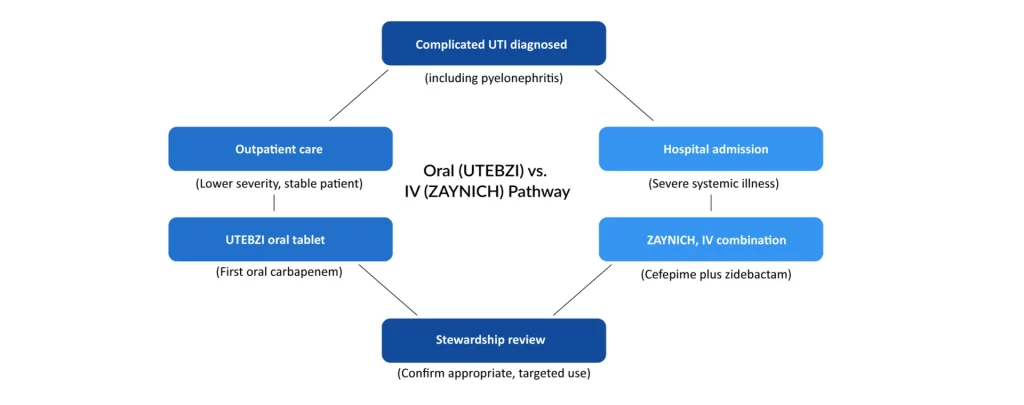
UTEBZI, as an oral tablet, opens the door to a fundamentally different care model. Patients who previously needed a hospital bed or an infusion center purely to receive IV carbapenem therapy may now be able to start, or finish, treatment with a pill at home. That has real implications for healthcare systems: shorter hospital stays, lower costs, reduced risk of hospital-acquired infections, and more capacity for patients who genuinely need inpatient care.
The net effect is a more flexible treatment ladder: IV combination therapy for the sickest, hospitalized patients, and an oral carbapenem option for appropriate patients who can safely be treated, or transitioned, outside the hospital.
Why This Matters Most in High-Resistance-Burden Countries
Antimicrobial resistance doesn’t affect every country equally. Low- and middle-income countries frequently carry the heaviest burden of resistant bacterial infections, driven by factors like limited access to diagnostics, inconsistent antibiotic quality, and higher rates of infectious disease overall, yet these are often the same countries where the newest antibiotics arrive last, if at all.
That brings drugs like UTEBZI and ZAYNICH meaningful well beyond the U.S. market. An oral carbapenem is particularly relevant in settings where IV infrastructure, infusion centers, and hospital beds are scarce resources; the ability to treat a serious resistant infection with a tablet rather than an IV line can be transformative for both patients and overcrowded health systems. Global health advocates increasingly evaluate new antibiotics not just on clinical merit, but on whether manufacturers have concrete plans to make them accessible and affordably priced in high-burden regions, a factor that will determine whether these scientific breakthroughs actually reach the patients who need them most.
Conclusion
UTEBZI and ZAYNICH aren’t just two more names to memorize on a drug formulary; they represent a rare and welcome momentum shift in the decades-long fight against drug-resistant bacteria. One brings the power of a carbapenem into a pill for the first time; the other brings a smarter, multi-target combination to the hospital bedside for the toughest Gram-negative infections. Alongside a growing list of other new approvals, they offer genuine hope that innovation can still outpace resistance, but only if health systems, prescribers, and policymakers protect these new tools through disciplined stewardship, sustainable funding models, and equitable global access. The drugs are here. Now it’s up to all of us to make sure they last.

Downloads
Article in PDF
Recent Articles
- Sygnis AG and ECACC Collaboration; BioNTech and Genentech Partnership; Partnership between Zydus ...
- Antimicrobial resistance crisis: A global need for antibiotic awareness
- Antibiotic Resistance: The Big Challenge of Healthcare Industry
- ORLYNVAH – The First Oral Penem in the US Market: A New Era in UTI Treatment
- BMS, and Exelixis’s Opdivo + CABOMETYX in First-Line Advanced Renal Cell Carcinoma; AIRSUPRA Now ...