A New Era of Dermatology: In-Depth Analysis of Energy-Based Aesthetic Device Applications
Dec 10, 2025
Table of Contents
The pursuit of enhanced appearance, well-being, and confidence has driven a remarkable revolution in modern medicine, with energy-based aesthetic devices standing at the epicenter of this transformation. These specialized apparatuses, employing energies such as lasers, radiofrequency (RF), ultrasound, and cryolipolysis, have fundamentally reshaped the landscape of cosmetic and dermatological treatments. By delivering controlled energy to target specific tissues, they offer minimally invasive or entirely non-invasive alternatives to traditional surgical interventions. This shift marks a profound evolution in healthcare, providing patients with key benefits: reduced downtime, minimal discomfort, and a level of precision that was previously unattainable.
The impact of this technology is amplified when considering the global need for effective dermatological solutions. As reported by analyses of the Global Burden of Disease (GBD) studies, skin diseases collectively formed the world’s fourth leading cause of non-fatal disease burden, highlighting the pervasive need for accessible and effective treatments across the globe. Energy-based devices provide solutions for an array of concerns that significantly affect quality of life, moving beyond purely cosmetic procedures to become an integral part of modern dermatological care.
Downloads
Click Here To Get the Article in PDF

Recent Articles
- Amber Implants Wins FDA 510(k) Clearance for VCFix® Spinal System; Merit Medical’s Embosphere Mic...
- Spineart’s PERLA® TL Application Receives FDA 510(k) Clearance for eCential Robotics’ Op.n® Platf...
- Glowing Prospects: Energy-Based Aesthetic Devices Market Outlook
- Suneva Medical-Viveon Health merger update; Smith+Nephew acquires Engage Surgical; Abiomed’...
- REVIAN RED System Delivers Positive Results, Insulet’s Omnipod Provides Notable Improvement in Ty...
Energy-Based Aesthetic Device: Market Dynamics and Industry Leaders
The rapid acceptance of these devices by both practitioners and patients has fueled significant market expansion. Intense technological advancements, particularly in device design, precision, and safety, have been pivotal in driving market growth. According to recent market assessments, the global energy-based aesthetic devices market was valued at a substantial USD 6 billion in 2024 and is projected to grow at a CAGR of ~9% during the forecast period of 2025 to 2032. This trajectory is expected to push the market valuation to USD 12 billion by 2032.
This remarkable growth is driven not only by technological momentum but also by the active participation of leading companies committed to innovation. These industry players are instrumental in maintaining high standards of safety and efficacy while expanding the applications of energy-based aesthetic medicine. Key companies operating in this market include established names such as Candela Corporation, Lumenis Ltd., Cynosure, Alma Lasers, Cutera, Merz Pharma GmbH & Co. KGaA, El.En. S.p.A., Bausch Health Companies Inc., Venus Concept, Sciton, Inc., Fotona, Aerolase, Lutronic Corp., Cartessa Aesthetics, EndyMed Medical, InMode Ltd., Quanta System S.p.A., SharpLight Technologies Ltd., Viora, Syneron Medical Ltd., and others. Their ongoing research and development efforts, coupled with a commitment to regulatory compliance, ensure a continuous flow of cutting-edge devices, ultimately enhancing patient experiences and driving the future of aesthetic medicine. However, challenges such as the considerable cost of these devices and the need for specialized practitioner training remain areas for strategic focus as the market matures.
Top Applications of Energy-based Aesthetic Devices
The versatility inherent in energy-based technologies, from concentrated light to high-frequency sound waves, enables them to address a broad spectrum of aesthetic and dermatological concerns. These devices cater to a wide range of needs, ranging from addressing the structural changes of aging skin to tackling persistent issues like unwanted hair and pigmentation. The following sections detail the primary applications where these technologies are making the most transformative impact.
Skin Rejuvenation and Resurfacing
Skin rejuvenation and resurfacing are foundational pillars of energy-based aesthetics, focusing on restoring the skin’s youthful texture, tone, and vitality.
Mechanism and Technology
Two key technologies dominate this application:
Laser Devices: Specific laser-based aesthetic devices are highly effective for addressing aging and sun-damaged skin. They utilize microscopic laser columns that penetrate deep into the dermal layer. The resulting controlled thermal injury accelerates collagen remodeling by treating only a fraction of tissue at a time, leaving surrounding tissue undisturbed to promote rapid healing. Fractional Resurfacing Devices operate on this principle by creating micro-injuries to promote widespread collagen regeneration, effectively addressing fine lines, wrinkles, and textural irregularities.
Intense Pulsed Light (IPL) Devices: While not an actual laser, IPL uses high-intensity pulses of broad-spectrum light. This light is filtered to target specific chromophores in the skin, making it excellent for correcting pigmentation irregularities and sun damage, contributing significantly to overall skin clarity and tone.
Impact
By stimulating the natural healing process and promoting the synthesis of new collagen and elastin, these treatments dramatically improve the appearance of rough texture, fine lines, and enlarged pores, delivering smooth, glowing, and revitalized skin without the extensive recovery associated with surgical facelifts or deep chemical peels.
Body Contouring and Fat Reduction
The ability to sculpt the body without surgical incisions has positioned body contouring and fat reduction as a major growth driver for the aesthetic device market. This application directly addresses aesthetic concerns stemming from the global rise in overweight and obesity.
Mechanism and Technology
Body contouring procedures leverage several distinct energy forms to target and destroy fat cells and tighten surrounding tissue:
Cryolipolysis Devices: These devices, often referred to as “fat freezing” devices, use controlled cooling to induce apoptosis (programmed cell death) in subcutaneous fat cells. The destroyed cells are then naturally eliminated by the body over time.
Ultrasound Devices: High-intensity focused ultrasound (HIFU) delivers focused sound waves deep into the tissue layers. This energy selectively heats and disrupts fat cells while also promoting collagen production and tissue tightening in the dermal layers, which is crucial for achieving smooth post-treatment contours.
Radiofrequency (RF) Devices: RF technology heats the underlying fatty and dermal layers. While the primary function is often skin tightening, the heat generated can also cause lipolysis (fat cell breakdown) and reduce the appearance of cellulite. New developments, such as the FDA-approved ‘SUPERB’ technology, are specifically designed to provide non-invasive treatment for short-term improvement in cellulite appearance.
Global Health Context
The rising global prevalence of weight-related health challenges underscores the societal relevance of non-invasive body contouring. The World Health Organization (WHO) highlights that overweight and obesity rates continue to grow in adults and children, noting that the percentage of adults 18 years of age and older living with obesity globally more than doubled, increasing from 7% in 1990 to 16% in 2022. As individuals increasingly seek innovative methods to address the aesthetic consequences of obesity and unhealthy lifestyles, energy-based devices offer a powerful, low-risk option for localized fat management and refinement.
Hair Removal and Reduction
Permanent or long-term hair reduction is one of the most widely accepted and sought-after applications of energy-based devices, offering convenience and freedom from daily grooming routines.
Mechanism and Technology
The core technology utilized here is the specialized Laser Device:
Laser Devices: These devices use concentrated beams of light energy calibrated to specific wavelengths. This light is selectively absorbed by melanin, the pigment found in the hair follicle. The resulting thermal energy rapidly heats and damages the follicle, inhibiting future hair growth. The precision of lasers ensures that the surrounding skin tissue remains unaffected, mainly promoting a safe and targeted treatment.
Versatility
Laser treatments are versatile, offering effective hair removal across various body areas, from the face and underarms to the back and legs. The success of the treatment lies in the practitioner’s ability to select the appropriate laser wavelength based on the patient’s skin tone and hair color, ensuring maximum efficacy and safety.
Scar and Stretch Mark Treatment
Scars and stretch marks, though common, often cause significant distress. Energy-based devices offer sophisticated options for improving their appearance by stimulating cellular repair and collagen reorganization.
Mechanism and Technology
Fractional Resurfacing Devices: These are particularly effective here. By creating controlled micro-injuries across the scarred tissue, they force the skin to activate its natural healing cascade. This process replaces the disorganized scar tissue with new, healthy collagen and elastin fibers, leading to a smoother, flatter, and less noticeable appearance of both hypertrophic scars and stretch marks (striae).
Laser Devices (e.g., Ablative and Non-Ablative): Lasers can target the vascular components of red, immature scars or precisely vaporize surface skin cells to trigger deep dermal remodeling, dramatically improving both texture and discoloration. Furthermore, companies are continually innovating in this space, exemplified by the launch of devices such as the Alma HybridTM, which is designed to enable endless options for skin rejuvenation and scar revision.
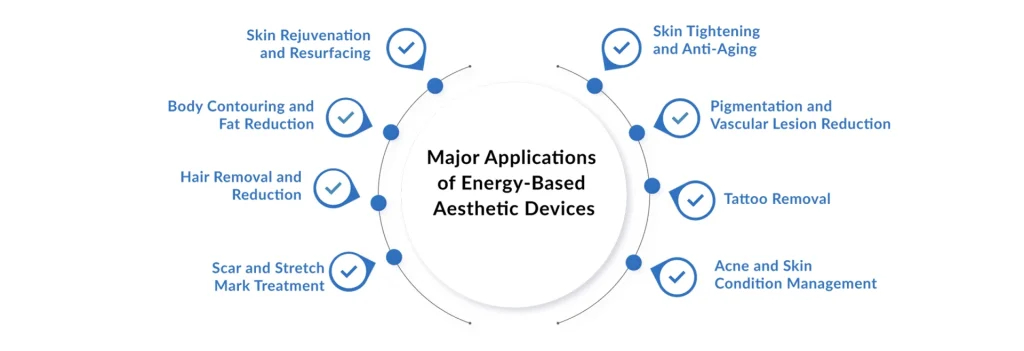
Skin Tightening and Anti-Aging
As global demographics shift towards an older population, the demand for non-surgical solutions to combat skin laxity and wrinkles has skyrocketed. Skin tightening is a core competency of several energy-based platforms.
Mechanism and Technology
The key to tightening lies in volumetric dermal heating to contract existing collagen and stimulate neocollagenesis:
Radiofrequency (RF) Devices: RF devices are immensely popular for skin tightening. They utilize electrical currents to heat the deeper layers of the skin (the dermis and subcutaneous tissues). This controlled heat causes immediate denaturation and contraction of existing collagen fibers, resulting in an instant tightening effect. More importantly, heat injury triggers the long-term production of new collagen and elastin, leading to progressive, lasting skin tightening, often used for wrinkle reduction and facial lifting.
Ultrasound Devices (HIFU): Delivering focused sound waves, these devices target the superficial muscular aponeurotic system (SMAS) layer, the same layer addressed in a surgical facelift, without cutting the skin. The precise thermal coagulation points generated result in significant lifting and tightening of the skin on the face, neck, and décolletage.
Demographic Imperative
Global demographic trends structurally support the focus on anti-aging treatments. According to the World Health Organization (WHO) and the United Nations (UN), the global population is aging rapidly. The number of people aged 60 years and older worldwide is projected to increase significantly, growing from 1 billion in 2020 to approximately 1.4 billion by 2030. Furthermore, the proportion of the world’s population over 60 years is expected to nearly double from 12% in 2015 to 22% by 2050. This massive demographic shift guarantees a sustained, growing market for non-surgical skin-tightening and anti-aging solutions.
As a result, the anti-aging product market is also witnessing robust growth. The global anti-aging product market is estimated to grow at a CAGR of 6.9% from 2025 to 2032, reaching USD 112.39 billion by 2032. The demand for anti-aging products is growing due to an aging population and increasing awareness and information about skincare and wellness across various media channels, which are key factors driving the market’s positive growth during the forecast period from 2025 to 2032.
Pigmentation and Vascular Lesion Reduction
Energy devices offer unmatched selectivity in targeting specific chromophores responsible for undesirable pigmentation and vascular marks, making them highly effective for achieving uniform skin tone.
Mechanism and Technology
Intense Pulsed Light (IPL) Devices: IPL devices excel in this category. They use broad-spectrum light that is finely tuned to target melanin (for brown spots, sun damage, and freckles) and hemoglobin (for redness, broken capillaries, and vascular lesions). The light energy is absorbed by these targets, converting it into heat that coagulates the vessels or shatters the pigmented cells, allowing the body to naturally clear them.
Laser Devices: Specific laser wavelengths are also used, particularly Nd:YAG or pulsed dye lasers, which are optimized for highly concentrated energy delivery to treat more resistant or deeper vascular lesions and certain types of deep pigmentation.
Tattoo Removal
What was once considered a permanent decision can now be reversed or faded using sophisticated energy technology, meeting the growing demand for tattoo revision.
Mechanism and Technology
Q-Switched and Picosecond Laser Devices: These specialized laser devices are the gold standard for tattoo removal. They operate by emitting extremely short, high-energy light pulses. This energy is absorbed by the tattoo ink particles, causing them to fragment into much smaller pieces rapidly. Once fragmented, these tiny ink particles can be recognized and eliminated by the body’s natural immune system. Different laser wavelengths are required to effectively target the full spectrum of tattoo colors.
Acne and Skin Condition Management
Beyond strictly cosmetic issues, energy-based devices provide therapeutic relief and long-term management for chronic dermatological conditions, significantly improving patients’ quality of life.
Mechanism and Technology
IPL and Specific Lasers: Light and laser technologies target the root causes of acne. They can destroy P. acnes bacteria, reduce the size and activity of overactive sebaceous (oil) glands, and decrease the redness and inflammation associated with active lesions.
Microneedling Devices: These devices, often enhanced with radiofrequency (RF) energy, create controlled micro-injuries. When used to treat acne scarring, they trigger collagen and elastin production, physically remodeling the scarred tissue to improve texture and appearance.
Hydro-dermabrasion Platforms: Devices like the Alma DermaClear 3-in-1 platform combine mechanical exfoliation with infusion of active ingredients, offering thorough cleansing, extraction, and hydration, which are essential steps in managing various skin conditions.
Public Health Relevance
The need for advanced acne treatment is critical globally. Acne is cited as the most common skin condition in the United States, affecting up to 50 million Americans annually. Furthermore, approximately 85% of people aged 12 to 24 experience at least mild acne, underscoring its widespread impact across demographic groups. By offering non-drug, targeted solutions, energy-based devices provide essential treatment avenues for a condition that frequently leads to psychosocial distress and scarring.
Innovations and Future Directions
The Energy-Based Aesthetic Devices market is a dynamic field where innovation is a constant. The future outlook holds considerable promise, underpinned by key trends poised to revolutionize treatment customization and delivery further.
A major developmental focus is on integrating advanced digital technologies. The incorporation of Artificial Intelligence (AI) and Machine Learning (ML) into aesthetic devices is poised to revolutionize treatment customization. AI algorithms will soon analyze individual patient parameters, such as skin type, depth of target tissue, and specific concern, to optimize energy delivery settings in real-time. This ensures even more precise, patient-specific outcomes, increasing efficacy and enhancing safety across all applications.
Furthermore, the industry is seeing a significant shift towards minimally and non-invasively performed options, aligning with broader consumer preferences for shorter recovery times and minimal discomfort. Companies are consistently introducing new devices, as evidenced by developments like Lutronic’s IntelliSTIM™ for muscle stimulation and Softwave Medical’s ‘SUPERB’ technology for cellulite.
Another crucial emerging trend reflects increasing societal awareness: a growing emphasis on eco-friendly and sustainable practices in the industry. As technological sophistication advances, so too must the industry’s commitment to reducing the environmental footprint of medical devices and operations.
In essence, the future of energy-based aesthetic medicine is defined by greater precision, enhanced personalization through digital intelligence, and a widening scope of applications that continue to bridge the gap between aesthetic goals and therapeutic medical effectiveness. While challenges surrounding accessibility and cost persist, continuous research and development by market leaders ensure that energy-based aesthetic devices will remain at the forefront of modern, non-surgical cosmetic care.

Downloads
Article in PDF
Recent Articles
- REVIAN RED System Delivers Positive Results, Insulet’s Omnipod Provides Notable Improvement in Ty...
- Spineart’s PERLA® TL Application Receives FDA 510(k) Clearance for eCential Robotics’ Op.n® Platf...
- Suneva Medical-Viveon Health merger update; Smith+Nephew acquires Engage Surgical; Abiomed’...
- Amber Implants Wins FDA 510(k) Clearance for VCFix® Spinal System; Merit Medical’s Embosphere Mic...
- Glowing Prospects: Energy-Based Aesthetic Devices Market Outlook