Replimune Strengthens Oncology Portfolio With TUDRIQEV Approval
Aug 14, 2026
Summary
- On August 6, 2026, the FDA granted accelerated approval to Replimune’s TUDRIQEV (vusolimogene oderparepvec-wtpg), formerly known as RP1, in combination with Bristol Myers Squibb’s OPDIVO (nivolumab).
- The therapy is indicated for adults with unresectable, advanced cutaneous melanoma whose disease has progressed after prior anti-PD-1 treatment.
- The approval followed two previous FDA rejections, in July 2025 and April 2026, making it a significant regulatory breakthrough for Replimune.
- The approval is based on tumor response data rather than confirmed overall survival benefits. Continued approval depends on results from the ongoing Phase 3 IGNYTE-3 confirmatory trial, which is expected to provide an overall survival readout around 2030.
Persistence pays off, and few biotechs know that better than Replimune right now. On August 6, 2026, the FDA granted accelerated approval to TUDRIQEV (vusolimogene oderparepvec-wtpg), the company’s engineered oncolytic viral immunotherapy, in combination with Bristol Myers Squibb’s PD-1 inhibitor OPDIVO (nivolumab), for adults with unresectable advanced cutaneous melanoma whose disease progressed on prior anti-PD-1 therapy.
It’s a genuine “third time’s the charm” moment. The therapy, long known in development circles as RP1, was rejected by the FDA not once but twice, first in July 2025, and again in April 2026, before finally clearing the finish line this August. For a company that weathered two Complete Response Letters, a leadership shake-up at the FDA, and public pressure from researchers and patient advocates, this approval marks a hard-won turning point.
Downloads
Click Here To Get the Article in PDF

Recent Articles
- Fourth FDA Approval for AbbVie’s Vraylar; FDA Approves Ferring’s Adstiladrin for NMIBC; Merck and...
- Dengvaxia study; Opdivo racks up; FDA issues plant; Teva’s Rimsa fraud; Mission bags Fox grant
- Roche’s TECENTRIQ HYBREZA: Setting New Standards as the First Subcutaneous Anti-PD-(L)1 Drug
- Checkpoint Inhibitors: A Potential Approach in the Fight Against Refractory Cancer
- Most Common Cancers
TUDRIQEV is a genetically modified oncolytic herpes simplex virus (HSV-1) therapy. In practice, that means the drug is injected directly into tumors, where it replicates inside cancer cells and destroys them from within. As those cells break apart, they release tumor antigens and immune-stimulating signals that help the body’s own immune system recognize and attack cancer more broadly, including in lesions the virus was never injected into. Paired with nivolumab, an anti-PD-1 checkpoint inhibitor, TUDRIQEV is designed for patients who’ve already progressed on immunotherapy, a group with historically limited options and a tough prognosis.
The approval rests on results from the Phase 1/2 IGNYTE trial, which enrolled 140 patients, 91 of whom (with at least one non-injected lesion) made up the efficacy-evaluable population. In that group, the TUDRIQEV-nivolumab combination delivered:
- An objective response rate (ORR) of 24.2%
- A median duration of response of 14.1 months
- A generally manageable safety profile, with mostly mild-to-moderate adverse events
The patient population skewed toward difficult-to-treat disease, 80% had Stage 4 melanoma, more than half were PD-L1 negative, and a notable share had liver or lung involvement, organs where metastatic melanoma is particularly hard to control.
Because approval came through the FDA’s accelerated approval pathway, it’s based on a surrogate endpoint (response rate) rather than a confirmed survival benefit. That means Replimune’s job isn’t finished: continued marketing approval depends on verifying real clinical benefit through the ongoing Phase 3 IGNYTE-3 confirmatory trial, which compares the TUDRIQEV-OPDIVO combination against physician’s choice of therapy. That trial has enrolled roughly a third of its target population, with an overall survival readout expected around 2030.
“This approval represents a major milestone for Replimune and reflects years of innovative research dedicated to bringing TUDRIQEV to patients with advanced melanoma who urgently need new treatment options,” said Sushil Patel, Ph.D., CEO of Replimune. “We are immensely grateful to the melanoma community, particularly the patients and investigators who contributed to the clinical trial, for their invaluable support in achieving this milestone. We also thank the FDA for recognizing the urgent need for this therapy and helping accelerate its availability to patients. Replimune is now concentrating on the key efforts required to make TUDRIQEV accessible to as many eligible patients as possible.”
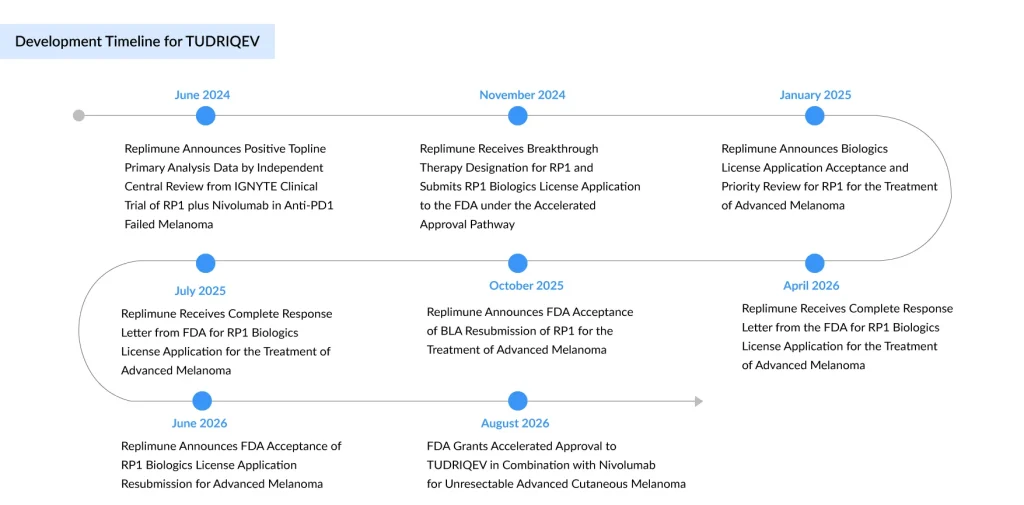
Understanding the approval means understanding the rejections that preceded it. The FDA’s central concern both times was the trial design: IGNYTE was a single-arm study, without a randomized comparator, which made it harder for reviewers to isolate TUDRIQEV’s true treatment effect from other variables. The agency’s first Complete Response Letter, in July 2025, argued the pivotal study wasn’t an “adequate and well-controlled clinical investigation.” The second rejection, in April 2026, kept the same core objection: the data package was “insufficient to conclude substantial evidence of effectiveness.”
Both decisions triggered real backlash. Twenty-two researchers involved in the drug’s trials sent an open letter urging the FDA to reconsider. Replimune resubmitted with new analyses on the TUDRIQEV’s mechanism of action and how patients performed relative to prior immunotherapy, and, notably, brought in a new review team for the third look, a move the agency said was meant to preserve objectivity.
That resubmission also landed amid leadership changes at the FDA, which analysts flagged as a possible factor opening the door to a different outcome. The turning point came at a late-July FDA advisory committee meeting, where independent experts sided with Replimune in a 10-3 vote, agreeing the efficacy signal was strong enough to support approval in a population with genuinely limited treatment alternatives.
More than half of advanced melanoma patients progress within six months of starting anti-PD-1 therapy, and once that happens, prognosis worsens sharply; median overall survival drops to under a year. TUDRIQEV gives physicians a new tool specifically for this progression setting, combining local, intratumoral viral therapy with systemic checkpoint inhibition rather than asking patients to simply switch to another systemic agent. Strong support from the oncology community throughout the review process suggests real enthusiasm for having another option in this space, even one still awaiting confirmatory survival data.
“Advanced melanoma patients have limited treatment options following anti-PD-1 therapy and continue to face significant disease burden and poor survival,” said Michael K. Wong, MD, PhD, primary investigator of the IGNYTE study and former Physician-in-Chief and Professor of Oncology at Roswell Park Comprehensive Cancer Center in Buffalo, NY. “The approval of TUDRIQEV provides a potent oncolytic immunotherapy for a broad range of patients, including those who are BRAF-naïve or previously treated, as well as those who experience relapse following adjuvant therapy. Notably, combining the therapy with nivolumab promotes immune activation while maintaining a favorable risk-benefit profile, with the flexibility to treat both superficial and visceral lesions.”
Sam Guild, President of AIM at Melanoma, said, “the approval of RP1 in combination with nivolumab marks an important advancement for patients with advanced melanoma who have not responded adequately to immunotherapy. With more than 8,500 melanoma-related deaths occurring annually in the U.S., there remains an urgent need for innovative and effective treatment options.”
TUDRIQEV’s approval is a case study in regulatory perseverance: two rejections, an advisory committee vote, and years of pushback from the scientific community before the FDA ultimately agreed the benefit outweighed the uncertainty. For patients with treatment-resistant advanced melanoma, it’s a new option in a space that desperately needs one. For Replimune, it’s validation of a decade-plus bet on oncolytic virus therapy, with the real test, a confirmatory Phase 3 readout, still years away.

Downloads
Article in PDF
Recent Articles
- EU Approves Datroway for First-Line Metastatic TNBC; FDA Broadens Pluvicto’s Reach with App...
- Kalydeco got approved; Opdivo for SCLC; FDA approved for pain relief; GC4419 obviates
- PD-1 and PD-L1 inhibitors – Competitive Landscape, Pipeline and Market Analysis, 2015
- Fourth FDA Approval for AbbVie’s Vraylar; FDA Approves Ferring’s Adstiladrin for NMIBC; Merck and...
- OPDIVO vs. KEYTRUDA: The Battle for Japan’s PD-1 Inhibitor Market Dominance