Medical Device Contract Manufacturing Market Summary
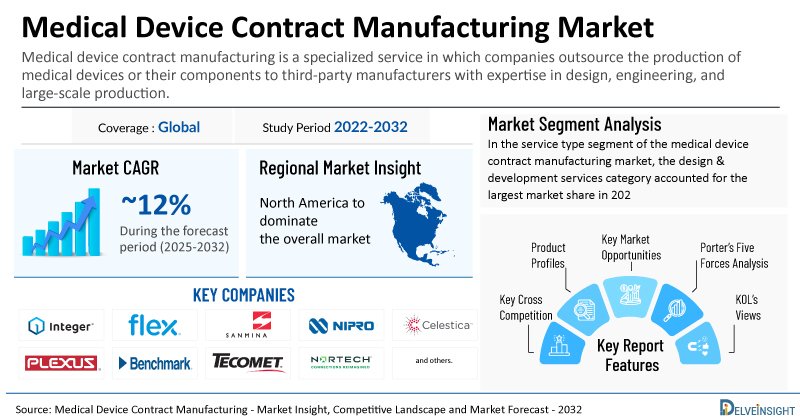
- Global medical device contract manufacturing market size was valued at USD 79,333.13 million in 2024, and projected to reach USD 195,7298 million by 2032.
- Global medical device contract manufacturing market is growing at a CAGR of 12.01% during the forecast period from 2025 to 2032
- The chronic and infectious diseases rising prevalence is driving continuous demand for innovative and high-quality medical devices, pushing companies to accelerate development efforts. In response, key medical device companies are significantly increasing their R&D investments and outsourcing manufacturing to Contract Manufacturing Organizations (CMOs) to reduce costs and speed up time-to-market.
Key Market Trends & Insights
- Some of the key medical devices contract manufacturing companies include Flex, Ltd., Integer Holdings Corporation, Gerresheimer AG, Sanmina Corporation, Nipro Corporation, Celestica International Lp., Plexus Corp., Benchmark Electronics Inc., West Pharmaceutical Services, Inc., Jabil Inc, Tecomet Inc., Nortech Systems Inc., TE Connectivity, Forefront Medical Technologies, Nordson Corporation, and others.
- North America is projected to account for the largest medical device contract manufacturing market share in 2024. This dominance can be attributed to increasing chronic disorders instances, the strong presence of established medical device companies, advanced healthcare infrastructure, and a robust regulatory framework.
- Among the medical device contract manufacturing market categorized by device type segmentation, the patient monitoring devices market is projected to capture a significant revenue share in 2024.
Medical Devices Contract Manufacturing Market Size & Forecast
- 2024 Market Size: USD 79,333.13
- 2032 Projected Market Size: USD 195,7298 million
- CAGR (2025-2032): CAGR of 12%
- North America: Largest market in 2025
Factors Contributing to the Rise in Growth of the Medical Devices Contract Manufacturing Market
- Rising demand for medical devices due to chronic diseases, aging populations, and healthcare expansion.
- Cost efficiency & scalability – outsourcing reduces operational costs and accelerates production.
- Focus on core competencies by OEMs, while delegating manufacturing to specialized CMOs.
- Regulatory compliance expertise offered by CMOs helps OEMs navigate strict global standards.
- Technological advancements like automation, 3D printing, and AI-driven manufacturing boosting efficiency.
- Customization and innovation – rising demand for patient-specific and minimally invasive devices.
- Growing prevalence of wearable and home healthcare devices fueling outsourcing needs.
- Expansion into emerging markets where CMOs provide localized, cost-effective manufacturing.
- Increasing M&A and partnerships between OEMs and CMOs to strengthen capabilities.
- Faster product development cycles required by competitive healthcare markets.
Medical Device Contract Manufacturing Market, segmented by Device Type (IVD Devices, Drug Delivery Devices, Diagnostic Imaging Devices, Patient Monitoring Devices, Cardiovascular Devices, Orthopedic Devices, and Others), Services (Device Development and Manufacturing Services, Quality Management Services, and Final Goods Assembly Services), Application (Laparoscopy, Pulmonary, Urology & Gynecology, Cardiovascular devices, Orthopedic devices, and Others), and Geography (North America, Europe, Asia-Pacific, and Rest of the World) is expected to grow at a steady CAGR forecast till 2032 owing to the rising prevalence of chronic and infectious diseases, surging R&D investments and increased outsourcing by the key market players, and increase in technological advancements driving the robust global medical device pipeline and approvals.
The global medical device contract manufacturing market size was valued at USD 79,333.13 million in 2024, growing at a CAGR of 12.01% during the forecast period from 2025 to 2032 to reach USD 195,7298 million by 2032. The chronic and infectious diseases rising prevalence is driving continuous demand for innovative and high-quality medical devices, pushing companies to accelerate development efforts. In response, key medical device companies are significantly increasing their R&D investments and outsourcing manufacturing to Contract Manufacturing Organizations (CMOs) to reduce costs and speed up time-to-market. This trend, combined with rapid technological advancements, is fueling a robust global medical devices pipeline and regulatory approvals. As a result, medical device contract manufacturers are experiencing heightened demand for their specialized services, which is collectively boosting the overall growth of the medical device contract manufacturing market during the forecast period from 2025 to 2032.
What are the latest Medical Device Contract Manufacturing Market Dynamics and Trends?
According to recent data provided by GLOBOCAN, in 2022 estimated new number of cancer cases was 20 million, and the projection is estimated to increase to 32.6 million by 2045.
In addition, data from the World Health Organization (2024), indicated that around 304 million individuals worldwide were living with chronic viral infections, specifically hepatitis B and hepatitis C, during the same year. Thus, the rising global burden of cancer and chronic viral infections like hepatitis B and C is driving the demand for advanced diagnostic and therapeutic medical devices. This growing need is prompting medical device companies to scale up production, accelerate innovation, and ensure regulatory compliance, factors that are increasingly leading them to partner with contract manufacturers. By offering specialized capabilities, cost-effective solutions, and rapid turnaround times, medical device contract manufacturers play a vital role in supporting the healthcare industry’s response to these widespread health challenges.
Furthermore, surging R&D investments and increased outsourcing by key medical device companies are significantly propelling the growth of the medical device contract manufacturing industry. Companies are allocating substantial resources to research and development to accelerate innovation and bring advanced medical devices to market more efficiently. For instance, in March 2025, Johnson & Johnson announced plans to invest over $55 billion in the United States over the next four years, focusing on enhancing manufacturing capacity, research and development, and technology, including the construction of new manufacturing facilities and expansion of existing ones.
Additionally, extensive strategic activities among the key medical device companies are likely to move forward the revenue shares of the healthcare contract manufacturing market. For example, in July 2024, DuPont announced the successful completion of its previously disclosed acquisition of Donatelle Plastics, a prominent medical device contract manufacturer known for its expertise in producing specialized medical components and devices.
Despite these promising growth factors, the medical device contract manufacturing services market faces challenges. The stringent regulatory hurdle in gaining product approval and challenges in supply chain management and capacity balancing demand high capital investment may hinder the medical device contract manufacturing market growth during the forecast period.
|
Report Metrics |
Details |
|
Study Period |
2022 to 2032 |
|
Base Year |
2024 |
|
Forecast Period |
2025 to 2032 |
|
Medical Devices Contract Manufacturing Market Size (2024) |
USD 79,333.13 Million |
|
Medical Devices Contract Manufacturing Market Size (2032) |
USD 195,7298 Million |
|
CAGR |
12.01% |
|
Key Companies | Flex, Ltd., Integer Holdings Corporation, Gerresheimer AG, Sanmina Corporation, Nipro Corporation, Celestica International Lp., Plexus Corp., Benchmark Electronics Inc., West Pharmaceutical Services, Inc., Jabil Inc, Tecomet Inc., Nortech Systems Inc., TE Connectivity, Forefront Medical Technologies, Nordson Corporation, and others. |
Medical Device Contract Manufacturing Market Segment Analysis
Medical Device Contract Manufacturing Market, segmented by Device Type (IVD Devices, Drug Delivery Devices, Diagnostic Imaging Devices, Patient Monitoring Devices, Cardiovascular Devices, Orthopedic Devices, and Others), and Services (Device Development and Manufacturing Services, Quality Management Services, and Final Goods Assembly Services), Application (Laparoscopy, Pulmonary, Urology & Gynecology, Cardiovascular devices, Orthopedic devices, and Others), and Geography (North America, Europe, Asia-Pacific, and Rest of the World).
Among the medical device contract manufacturing market categorized by device type segmentation, the patient monitoring devices market is projected to capture a significant revenue share in 2024. Patient monitoring devices play a pivotal role in boosting the overall medical devices contract manufacturing industry by addressing the growing need for continuous and remote health monitoring. These devices, which include wearable sensors, remote patient monitoring systems, and advanced diagnostic tools, are increasingly essential in managing chronic diseases, enhancing patient outcomes, and reducing healthcare management costs.
Medical device contract manufacturing companies are uniquely positioned to meet this demand due to their expertise in advanced manufacturing techniques, regulatory compliance, and scalability. They provide comprehensive services from designing and prototyping to large-scale production and distribution, enabling healthcare companies to bring innovative monitoring solutions to market quickly and efficiently.
The integration of cutting-edge technologies such as the Internet of Things (IoT), Artificial Intelligence (AI), and data analytics into remote patient monitoring devices further increases their complexity and functionality, necessitating the specialized skills and resources of medical device contract manufacturers.
Furthermore, several market players that are engaged in the implementation of strategic initiatives such as mergers & acquisitions, new product launches, and others are also contributing to the segmental growth. For instance, in April 2024, Philips and smartQare partnered to automate and simplify continuous patient monitoring both in and out of the hospital.
Additionally, in April 2024, Glucotrack, Inc., a medical device company specializing in diabetes technologies, announced its expansion into glucose monitoring in the epidural space, potentially integrating with treatments for Painful Diabetic Neuropathy (PDN).
Thus, the above-mentioned factors are expected to boost the market segment thereby increasing the overall medical device contract manufacturing market share.
Medical Device Contract Manufacturing Market Segmentation
Medical Device Contract Manufacturing Market by Device Type
- IVD Devices
- Drug Delivery Devices
- Diagnostic Imaging Devices
- Patient Monitoring Devices
- Cardiovascular Devices
- Orthopedic Devices, and Others
Medical Device Contract Manufacturing Market By Service
- Device Development and Manufacturing Services
- Quality Management Services
- Final Goods Assembly Services
Medical Device Contract Manufacturing Market By Application
- Laparoscopy
- Pulmonary
- Urology
- Gynecology
- Cardiovascular devices
- Orthopedic devices, and Others
Medical Device Contract Manufacturing Market by Geography
- North America Medical Device Contract Manufacturing Market
- United States Medical Device Contract Manufacturing Market
- Canada Medical Device Contract Manufacturing Market
- Mexico Medical Device Contract Manufacturing Market
- Europe Medical Device Contract Manufacturing Market
- France Medical Device Contract Manufacturing Market
- Germany Medical Device Contract Manufacturing Market
- United Kingdom Medical Device Contract Manufacturing Market
- Italy Medical Device Contract Manufacturing Market
- Spain Medical Device Contract Manufacturing Market
- Russia Medical Device Contract Manufacturing Market
- Rest of Europe
- Asia-Pacific Medical Device Contract Manufacturing Market
- China Medical Device Contract Manufacturing Market
- Japan Medical Device Contract Manufacturing Market
- India Medical Device Contract Manufacturing Market
- Australia Medical Device Contract Manufacturing Market
- South Korea Medical Device Contract Manufacturing Market
- Rest of Asia Pacific
- Rest of the World (RoW)
- Middle East Medical Device Contract Manufacturing Market
- Africa Medical Device Contract Manufacturing Market
- South America Medical Device Contract Manufacturing Market
Medical Device Contract Manufacturing Regional Analysis
North America is expected to dominate the overall Medical Device Contract Manufacturing market:
North America is projected to account for the largest medical device contract manufacturing market share in 2024. This dominance can be attributed to increasing chronic disorders instances, the strong presence of established medical device companies, advanced healthcare infrastructure, and a robust regulatory framework. The region benefits from high healthcare spending, a growing elderly population, and continuous demand for innovative and high-quality devices. Additionally, access to skilled labor, cutting-edge manufacturing technologies, and active investments in R&D make North America a hub for medical device production outsourcing, positioning it at the forefront of the global l medical device contract manufacturing market.
National Cancer Institute (2024), estimated that two million new cases of cancer will be diagnosed in the US by the end of 2024. Furthermore, it was estimated that prostate cancer , lung cancer (Non-Small Cell Lung Cancer, Small Cell Lung Cancer), and colorectal cancer are expected to represent approximately 48% of all cancer diagnoses in men. For women, the most prevalent cancers are breast cancer, lung cancer, and colorectal cancer, which are expected to account for about 51% of all new cancer diagnosed in North America.
According to Global Cancer Observatory’s data (2024), in 2022, the US represented 89.1% of all cancer cases and Canada represented 10.9% of all cancer cases in North America. The rising cancer burden in the region is driving increased demand for diagnostic and therapeutic medical devices, thereby boosting the need for medical device contract manufacturing services. As healthcare providers seek advanced technologies for early detection and treatment, original equipment manufacturers are turning to contract manufacturers to meet growing production needs efficiently. These partnerships enable rapid scaling, innovation, and regulatory compliance, essential in addressing the cancer care complexities.
Furthermore, the increase in strategic activities among the key medical device manufacturers is further expanding the market across the region. For instance, in December 2023, Visura Technologies Inc., a privately held medical device company based out of Minneapolis, Minnesota, partnered with YKK Corporation of America, a subsidiary of Japan’s YKK Corp., to launch Evevo Manufacturing LLC. This new joint venture is dedicated to supporting emerging medical device companies within the Minneapolis innovation ecosystem.
Hence, all the aforementioned factors are anticipated to boost the medical device contract manufacturing market in the region during the forecast period.
Key Myopia Treatment Devices Companies
The following are the leading companies in the Medical Device Contract Manufacturing market. These companies collectively hold the largest Medical Device Contract Manufacturing market share and dictate industry trends.
- Flex, Ltd.
- Integer Holdings Corporation
- Gerresheimer AG
- Sanmina Corporation
- Nipro Corporation
- Celestica International Ltd.
- Plexus Corp.
- Benchmark Electronics Inc.
- West Pharmaceutical Services, Inc.
- Jabil Inc.
- Tecomet Inc.
- Nortech Systems Inc.
- TE Connectivity
- Forefront Medical Technologies
- Nordson Corporation
- and others
Medical Device Contract Manufacturing Market Recent Developments:
- In June 2025, DuPont announced that it had signed an agreement to acquire Donatelle Plastics Incorporated, a leading medical device contract manufacturer specializing in the design, development, and manufacture of medical components and devices. The transaction was expected to close in the third quarter of 2024, subject to the satisfaction of customary closing conditions and receipt of regulatory approvals.
- In May 2025, Quasar Medical expanded its capability by acquiring Nordson’s contract manufacturing unit, enhancing its manufacturing services in the medical devices sector.
- In May 2025, Boyd Biomedical launched an integrated service model from design to launch and opened a new facility in Waltham, Massachusetts to support full device commercialization.
- In February 2025, Arterex, a leading global medical device developer and contract manufacturer, announced the successful acquisition of Phoenix S.r.l., a European-based medical device developer and manufacturer with a strong international presence. The financial details of the transaction have not been disclosed.
Key Medical Device Contract Manufacturing Highlights Summary (2022–2025)
| Category | Highlights (2022–2025) |
|---|---|
| Product Launches | • CMOs introduced advanced 3D printing and additive manufacturing services for implants and surgical tools. • Launch of AI-enabled quality control platforms to enhance device reliability. • Miniaturized device components production expanded for wearables and diagnostics. |
| Regulatory Approvals | • Multiple CMOs achieved ISO 13485:2016 certifications across regions. • FDA/EMA approvals granted for outsourced drug-device combination products. • Expansion of cleanroom-certified facilities meeting EU MDR compliance. |
| Partnerships | • Jabil partnered with Medtronic (2023) for cardiovascular device manufacturing. • Flex partnered with emerging medtech startups for wearable and diagnostic devices. • Strategic alliances formed for low-cost, high-volume manufacturing in Asia-Pacific. |
| Acquisitions | • Integer Holdings acquired Aran Biomedical (2023) to enhance bioresorbable and textile implant manufacturing. • TE Connectivity acquired micro-manufacturing specialists to expand minimally invasive device offerings. • Consolidation among CMOs to strengthen regulatory and R&D capabilities. |
| Company Strategy | • Focus on end-to-end solutions: design, prototyping, regulatory support, and production. • Investments in automation, robotics, and smart manufacturing. • Expansion into drug-delivery systems and combination products manufacturing. |
| Setbacks | • Supply chain disruptions (semiconductors, raw materials) impacted device timelines. • Rising regulatory scrutiny under EU MDR slowed approval cycles. • Labor shortages in high-skill manufacturing regions. |
| Emerging Technology | • Digital twins & AI-powered simulations for faster prototyping and validation. • Use of biocompatible 3D printing for patient-specific devices. • Robotics in precision assembly of minimally invasive devices. |
Impact Analysis
AI Advancement in Medical Device Contract Manufacturing
- AI-driven predictive maintenance in manufacturing equipment to minimize downtime and ensure consistent device quality.
- Automated defect detection using computer vision for precision inspection of medical devices and components.
- AI-powered quality control systems ensuring compliance with FDA, ISO, and EU MDR regulations.
- Smart supply chain optimization with AI algorithms predicting demand, reducing raw material shortages, and optimizing inventory.
- Generative design & digital twins for rapid prototyping, simulation, and validation of medical devices before mass production.
- AI-based process automation in cleanroom environments for assembly and packaging.
- Machine learning algorithms to enhance precision in additive manufacturing (3D printing) for implants and patient-specific devices.
- AI-enabled data analytics to track device performance post-manufacture and provide feedback loops for continuous improvement.
- Natural Language Processing (NLP) tools to speed up documentation, compliance checks, and regulatory submissions.
- Robotics + AI integration for high-precision assembly in minimally invasive and micro-scale devices.
Tariff Inclusion in Medical Device Contract Manufacturing
The imposition of import tariffs on medical devices and components has significantly impacted the Medical Device Contract Manufacturing sector. These tariffs have led to increased costs, supply chain disruptions, and strategic shifts in manufacturing and sourcing. Understanding and navigating these changes is crucial for stakeholders aiming to maintain competitiveness and ensure uninterrupted patient care.
How This Analysis Helps Clients
- Cost Management: By understanding the tariff landscape, clients can anticipate cost increases and adjust pricing strategies accordingly, ensuring profitability.
- Supply Chain Optimization: Clients can identify alternative sourcing options and diversify their supply chains to reduce dependency on high-tariff regions, enhancing resilience.
- Regulatory Navigation: Expert guidance on navigating the evolving regulatory environment helps clients maintain compliance and avoid potential legal challenges.
- Strategic Planning: Insights into tariff impacts enable clients to make informed decisions about manufacturing locations, partnerships, and market entry strategies.
Startup Funding & Investment Trends in Medical Device Contract Manufacturing
| Company Name | Total Funding | Main Products / Focus | Stage of Development | Core Technology |
|---|---|---|---|---|
| Cipher Surgical | $10 million (Series A, 2025) | OpClear system for lens cleaning during minimally invasive surgery | Early / Commercial Prep | Automated laparoscopic lens cleaning technology |
| Ronovo Surgical | $42.1 million (Series B, 2024) | Carina modular robotic system for laparoscopic surgeries | Clinical Trials | Configurable robotic laparoscopic platform |
| CMR Surgical | $974.7 million total funding | Versius surgical robot for minimally invasive procedures | Late-stage / Scaling Globally | Modular surgical robotics with AI-enhanced tissue sensing |
Request Medical Device Contract Manufacturing Market Sample Page for more recent Developments.
Key Takeaways from the Medical Device Contract Manufacturing Market Report Study
- Current medical device contract manufacturing market size analysis (2024), and market forecast for 8 years (2025 to 2032)
- Key product/technology developments, medical device contract manufacturers mergers, acquisitions, partnerships, and joint ventures happened over the last 3 years.
- Key medical device contract manufacturing companies dominating the medical device contract manufacturing industry.
- Various opportunities available in the medical device contract manufacturing competitive landscape.
- What are the top-performing medical device contract manufacturing market segments in 2024? How these segments will perform in 2032?
- Which are the top-performing regions and countries in the current medical device contract manufacturing market landscape?
- Which are the regions and countries where companies should have concentrated on opportunities for medical device contract manufacturing market growth in the coming future?
Target Audience Who Can be benefited from this Medical Device Contract Manufacturing Market Report Study
- Medical device contract manufacturing companies
- Research organizations and consulting companies
- Medical device contract manufacturing-related organizations, associations, forums, and other alliances
- Government and corporate offices
- Start-up medical device contract companies, venture capitalists, and private equity firms
- Medical device contract manufacturing distributors and traders dealing in medical device contract manufacturing
- Various end-users who want to know more about the medical device contract manufacturing market and the latest technological developments in the medical device contract manufacturing market.

