
Neuromodulation Devices Market Summary
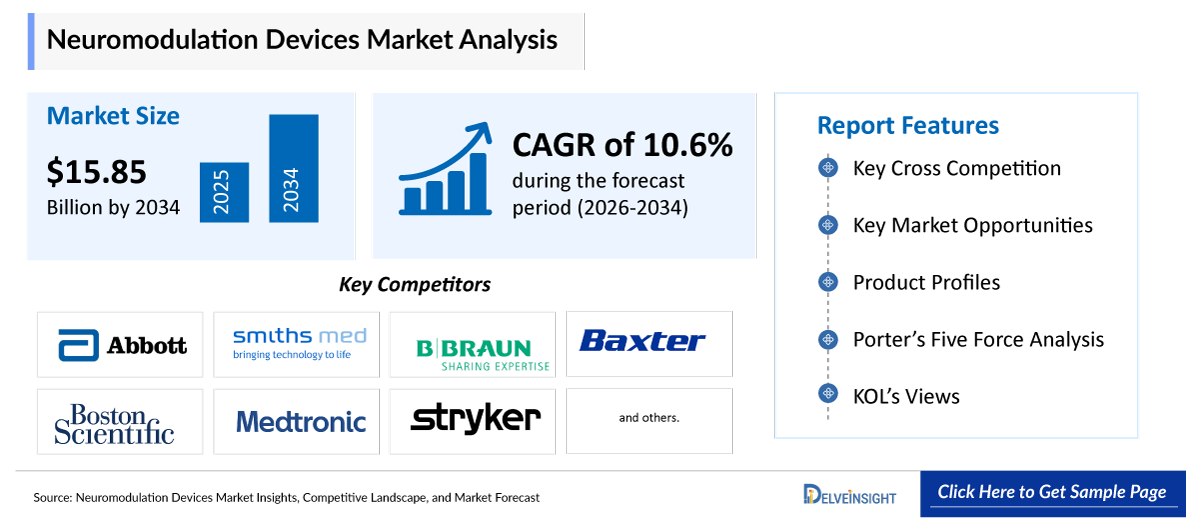
- The Neuromodulation Devices Market is estimated at USD 6.42 billion in 2025 and is projected to reach USD 15.85 billion by 2034. Growth is anchored in the rising global burden of chronic pain and neurological disorders, rapid adoption of closed-loop and AI-enabled stimulation platforms, and expanding regulatory approvals and reimbursement across major markets.
- The Global Neuromodulation Devices Market is growing at a CAGR of 10.6% during the forecast period from 2026 to 2034.
Neuromodulation Devices Market Trends & Insights
- By device type, the spinal cord stimulators segment dominated the neuromodulation devices market with a 42% share in 2025.
- By application, the pain management segment dominated the neuromodulation devices market with a 47% share in 2025.
- By type, the invasive segment dominated the neuromodulation devices market with a 94% share in 2025.
- By end-users, the hospitals segment dominated the neuromodulation devices market with a 51% share in 2025.
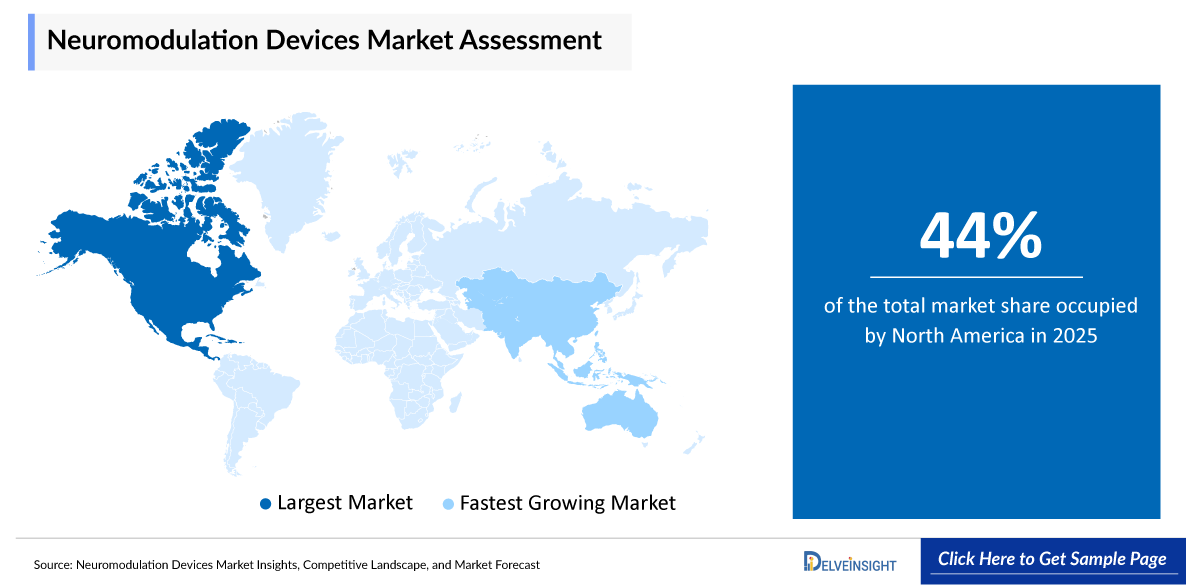
- North America dominated the global neuromodulation devices market revenue with a 44% share in 2025, representing the highest regional market share globally.
Request to unlock the sample page of the "Neuromodulation Devices Market"
Neuromodulation Devices Market Size
The following snapshot summarizes the principal report metrics for the neuromodulation devices market.
|
Report Metrics |
Details |
|
2025 Market Size | |
|
2034 Projected Market Size | |
|
Growth Rate (2026-2034) | |
|
Largest Market |
North America |
|
Fastest Growing Market |
Asia-Pacific |
|
Market Structure |
Moderately Concentrated |
All market values are expressed in USD and represent DelveInsight estimates synthesized from primary and secondary research.
Factors Contributing to the Growth of the Neuromodulation Devices Market
Neuromodulation Devices Market Drivers
-
Rising Prevalence of Chronic Pain and Spinal Disorders
The most powerful driver of the Neuromodulation Devices market is the rising global prevalence of chronic pain, failed back surgery syndrome, and other refractory neuropathic conditions. Spinal cord stimulation delivers mild electrical pulses that interrupt pain signals before they reach the brain, reducing reliance on long-term opioid therapy and improving quality of life for patients who have not responded to conservative treatment.
Manufacturers continue to differentiate on therapy precision and convenience: Nevro's HFX iQ platform applies an algorithm trained on tens of millions of data points drawn from more than 80,000 implanted patients, Medtronic's Inceptiv is among the thinnest implantable SCS devices available and senses the body's response to therapy fifty times per second, and Abbott's Proclaim Plus system with FlexBurst360 therapy extends coverage across up to six distinct pain areas. As national clinical guidelines increasingly recommend neuromodulation ahead of opioid escalation, demand for spinal cord stimulation capacity is expected to anchor market growth through 2034.
-
Growing Burden of Neurological and Movement Disorders
The expanding global burden of neurological and movement disorders, including Parkinson's disease, essential tremor, and drug-resistant epilepsy, is driving demand for deep brain and vagus nerve stimulation. The Parkinson's Foundation estimates that roughly 1 million people are living with Parkinson's disease in the United States, a number projected to rise to 1.2 million by 2030, while LivaNova's VNS Therapy remains a leading implantable option for patients with drug-resistant epilepsy who are unsuitable candidates for resective brain surgery.
The completed CORE-VNS study, described as the largest real-world neuromodulation study for epilepsy, reported a median seizure reduction at 36 months of 80% for focal onset motor seizures with impaired awareness and 95% for focal-to-bilateral tonic-clonic seizures. As the treated population for movement and seizure disorders expands, demand for deep brain and vagus nerve stimulation devices rises correspondingly.
-
Technological Advancement Toward Closed-Loop and AI-Enabled Stimulation
A wave of technological innovation toward closed-loop, adaptive, and artificial-intelligence-enabled stimulation is broadening clinical adoption and improving therapeutic precision across device categories. Medtronic's BrainSense Adaptive DBS system, approved by the FDA in February 2025 following a CE Mark, is described by the company as the first closed-loop neuromodulation therapy that automatically adjusts stimulation in real time based on a patient's own brain signals, building on the ADAPT-PD clinical trial.
In spinal cord stimulation, Saluda Medical's Evoke system measures evoked compound action potentials to adjust therapy more than one hundred times per second, and Nevro's HFX iQ platform, launched in the United States and select European markets from 2025, incorporates AI-driven adaptive algorithms under its HFX AdaptivAI branding. These closed-loop and sensing-enabled platforms are expected to remain a central axis of competitive differentiation through the forecast period.
-
Expanding Regulatory Approvals and Reimbursement Support
A growing wave of regulatory approvals and reimbursement decisions is increasing patient access to neuromodulation therapy. In September 2025, Medtronic received FDA approval for its Altaviva implantable tibial neuromodulation system for urge urinary incontinence, expanding options beyond its established InterStim sacral neuromodulation franchise.
In November 2025, the U.S. Centers for Medicare & Medicaid Services assigned LivaNova's VNS Therapy to an upgraded New Technology Ambulatory Payment Classification effective January 2026, improving procedure economics for hospitals, while LivaNova separately initiated a formal CMS review in June 2025 seeking to broaden Medicare coverage of VNS Therapy to treatment-resistant depression.
Each approval and reimbursement expansion creates durable, recurring demand for neuromodulation devices and reinforces the value of regulatory track record and payer relationships across the industry.
-
Rising Strategic Investment and M&A Activity
Active consolidation and strategic investment are reshaping the competitive landscape and expanding manufacturing and technology capacity. Boston Scientific announced an agreement in October 2025 to acquire Nalu Medical, a specialist in peripheral nerve stimulation for chronic pain, for approximately USD 533 million, its third neuromodulation-related acquisition of 2025, with the transaction expected to complete in the first half of 2026.
Separately, Globus Medical announced in February 2025 that it would acquire Nevro Corp. in a transaction valued at approximately USD 250 million, aiming to combine its spine portfolio with Nevro's spinal cord stimulation franchise.
This wave of consolidation reflects the strategic value large medical technology companies place on neuromodulation platforms and is expected to continue reshaping market share through the forecast period.
-
Growing Preference for Non-Opioid, Device-Based Pain Management
Rising public health concern over long-term opioid use is increasing physician and patient preference for device-based, reprogrammable, non-pharmacological alternatives for chronic pain and related conditions. Neuromodulation devices offer a durable therapeutic option with a favorable long-term side-effect profile relative to chronic opioid therapy, and rising government funding for neuromodulation research and clinical evidence generation, together with growing registry-based post-market data, is reinforcing physician and payer confidence in these therapies.
As reimbursement bodies increasingly recognize neuromodulation as a frontline or early-line option rather than a last resort, procedure volumes are expected to expand steadily across the forecast period.
Neuromodulation Devices Market Restraints
Despite strong momentum, the Neuromodulation Devices market faces material constraints. Implantable neuromodulation systems and their associated surgical procedures carry high upfront costs, and reimbursement policy and coverage criteria vary considerably across geographies, which can slow adoption in price-sensitive and emerging markets. The invasive nature of many devices carries inherent surgical risks, including infection, lead migration, and hardware-related complications, while battery longevity, MRI-compatibility limitations, and the need for periodic device replacement add to long-term cost of care.
A shortage of physicians trained in device implantation and programming constrains scale-up in several regions, and stringent regulatory pathways for implantable Class III devices lengthen development and approval timelines. Reimbursement and adoption of newer applications, including neuromodulation for depression, respiratory, and other emerging indications, remain uneven, and consolidation among a small number of large manufacturers concentrates competitive risk.
Together, these cost, safety, regulatory, workforce, and reimbursement barriers temper the pace of growth, even as the underlying drivers of rising disease burden, technological innovation, and non-opioid demand remain firmly intact.
Neuromodulation Devices Overview
A neuromodulation device is a medical technology, implantable or non-invasive, that delivers targeted electrical, magnetic, or other energy-based stimulation to the central or peripheral nervous system to modulate nerve activity for therapeutic benefit. Because chronic pain, movement disorders, and pelvic-floor and neurological conditions often prove refractory to pharmacological therapy, clinicians increasingly turn to device-based neuromodulation as a durable, non-opioid, and reprogrammable alternative.
These devices span spinal cord stimulators, deep brain stimulators, sacral nerve stimulators, vagus nerve stimulators, and other emerging platforms such as peripheral nerve and dorsal root ganglion stimulators. The market is organized by device type, led by spinal cord stimulation for chronic pain and failed back surgery syndrome; by application across pain management, urinary and Fecal incontinence, neurological disorders, respiratory disorders, and other indications; by type across invasive (implantable) and non-invasive (transcutaneous or external) systems; and by end-user across hospitals, specialty clinics, and other care settings.
Driven by the rising global prevalence of chronic pain and neurological disorders, rapid technological progress toward closed-loop and artificial-intelligence-enabled stimulation, and expanding regulatory approvals and reimbursement, neuromodulation devices have become an established pillar of modern pain management and neurological care.
Neuromodulation Devices Market Key Growth Drivers
- The rising global prevalence of chronic pain and failed back surgery syndrome is driving durable demand for spinal cord stimulation, reinforced by continued platform upgrades such as Nevro's HFX iQ and Medtronic's Inceptiv closed-loop rechargeable stimulator.
- The growing burden of neurological and movement disorders is expanding demand for deep brain and vagus nerve stimulation; the Parkinson's Foundation estimates around 1 million people are living with Parkinson's disease in the U.S., a figure projected to reach 1.2 million by 2030.
- Rapid technological advancement toward closed-loop, adaptive, and AI-enabled stimulation is improving outcomes and broadening adoption, exemplified by Medtronic's BrainSense Adaptive DBS system, which received FDA approval in February 2025 as the first closed-loop neuromodulation therapy for Parkinson's disease.
- Expanding regulatory approvals and reimbursement support are increasing patient access, including Medtronic's September 2025 FDA approval of the Altaviva tibial neuromodulation system for urge urinary incontinence and LivaNova's November 2025 CMS reimbursement upgrade for VNS Therapy under the 2026 Medicare Hospital Outpatient Prospective Payment System.
- Active strategic investment and M&A are consolidating and expanding neuromodulation capacity, including Boston Scientific's agreement to acquire Nalu Medical for approximately USD 533 million (announced October 2025) and Globus Medical's approximately USD 250 million acquisition of Nevro Corp. (announced February 2025).
- Growing physician and patient preference for device-based, non-pharmacological alternatives to opioid therapy, combined with rising government funding for neuromodulation research, is broadening the addressable patient population across pain and neurological indications.
- The convergence of technological innovation, expanding indications, rising disease burden, and reimbursement support is expected to sustain strong double-digit growth in the market through 2034.
Major Neuromodulation Devices Companies
The Neuromodulation Devices Competitive Landscape is led by the following active device manufacturers:
- Abbott Laboratories
- Smith's Medical
- B. Braun Melsungen AG
- Baxter International Inc.
- Boston Scientific Corp.
- LivaNova PLC.
- Medtronic
- Nevro Corp.
- Stryker
For illustrative purposes, only the top 10 companies are listed in the Table of Contents. The report may include analysis and references to additional companies relevant to the market assessment.
Neuromodulation Devices Market Segment Analysis
The Neuromodulation Devices by Device Type (Spinal Cord Stimulators, Deep Brain Stimulators, Sacral Nerve Stimulators, Vagus Nerve Stimulators, and Others), Application (Pain Management, Urinary & Faecal Incontinence, Neurological Disorders, Respiratory Disorders, and Others), Type (Invasive, Non-Invasive), End-Users (Hospitals, Specialty Clinics, and Others), and Geography (North America, Europe, Asia-Pacific, and Rest of World).
-
Neuromodulation Devices Market Segmentation By Device Type
Dominant Subsegment: Spinal Cord Stimulators. The spinal cord stimulators category is expected to dominate the market.
Dominant: Small Molecule ~ 42%
The spinal cord stimulators segment accounted for 42% of the neuromodulation devices market in 2025. Spinal cord stimulators are the leading device type because chronic pain, particularly failed back surgery syndrome and other neuropathic pain conditions, affects a very large and growing patient population, and because SCS therapy is among the most clinically established and reimbursed neuromodulation modalities.
Continuous product innovation, including rechargeable, closed-loop, and sensing-enabled systems from Medtronic, Abbott, Boston Scientific, and Nevro, has broadened patient eligibility and improved outcomes, while national clinical guidelines increasingly position SCS ahead of opioid escalation.
Deep brain stimulators are expected to post the fastest growth of any device type over the forecast period, propelled by expanding indications in Parkinson's disease and essential tremor and by the commercial rollout of closed-loop adaptive DBS platforms, while sacral and vagus nerve stimulators continue to see steady adoption in incontinence and Epilepsy care, respectively. Nonetheless, the scale, reimbursement maturity, and breadth of chronic pain indications addressed by spinal cord stimulation secure the segment's leadership across the forecast period.
-
Neuromodulation Devices Market Segmentation By Application
Dominant Subsegment: Pain Management. The pain management category is expected to dominate the market.
Dominant: Pain Management ~ 47%
The pain management segment accounted for 47% of the Neuromodulation Devices market in 2025. Pain management leads all applications because chronic pain, including failed back surgery syndrome, complex regional pain syndrome, and painful diabetic neuropathy, affects a very large global population and is frequently refractory to pharmacological treatment, making device-based neuromodulation an increasingly preferred long-term therapy.
Spinal cord, dorsal root ganglion, and peripheral nerve stimulation together address a broad range of chronic pain etiologies, and growing public health emphasis on reducing opioid dependence is reinforcing physician referral toward device-based options.
Neurological disorders, spanning Parkinson's disease, essential tremor, and drug-resistant epilepsy, represent the fastest-growing application as adaptive DBS and next-generation VNS platforms expand treated populations, while urinary and faecal incontinence maintains steady demand through sacral and tibial neuromodulation, and respiratory disorder applications remain a smaller but emerging category.
The sheer scale and clinical maturity of chronic pain indications secure pain management's leadership across the forecast period.
-
Neuromodulation Devices Market Segmentation By Type
Dominant Subsegment: Invasive. The invasive category is expected to dominate the market.
Dominant: Invasive ~ 94%
The invasive segment accounted for approximately 94% of the Neuromodulation Devices market in 2025. Invasive, implantable systems dominate because they deliver stimulation directly to targeted neural structures with greater precision, durability, and clinically demonstrated efficacy than external alternatives, and because the majority of established reimbursement pathways and long-term outcomes data are built around implantable spinal cord, deep brain, sacral nerve, and vagus nerve stimulators.
Continued innovation in miniaturized, longer-lasting, and MRI-conditional implants, together with growing physician familiarity with minimally invasive percutaneous lead placement, reinforces the durability of invasive systems' leadership.
Non-invasive and transcutaneous neuromodulation devices, while representing a smaller share of the market, are growing quickly as wearable and at-home therapies gain regulatory clearance for indications such as migraine, depression, and rehabilitation, expanding the addressable market beyond surgical candidates.
Even so, the clinical effectiveness and reimbursement depth of implantable systems secure the invasive segment's clear leadership across the forecast period.
-
Neuromodulation Devices Market Segmentation By End-Users
Dominant Subsegment: Hospitals. The hospitals category is expected to dominate the market.
Dominant: Hospitals ~ 51%
The hospitals segment accounted for 51% of the Neuromodulation Devices market in 2025. Hospitals lead among end-users because implantation of neuromodulation devices is a surgical procedure that requires specialized operating-room infrastructure, imaging support, and multidisciplinary care teams spanning neurosurgery, pain management, and urology, which are most readily available within hospital and integrated health-system settings. Hospitals also serve as the primary site for complex revision procedures and for management of post-implant complications.
Specialty clinics, including dedicated pain-management and ambulatory surgical centers, are the fastest-growing end-user category as procedural volumes shift toward lower-cost, outpatient-based settings for less complex implants such as percutaneous SCS leads and sacral nerve stimulators, supported by growing reimbursement for outpatient procedures. Nonetheless, the complexity and multidisciplinary requirements of neuromodulation implantation secure hospitals' leadership across the forecast period.
Neuromodulation Devices Market Region Analysis
-
Dominant Region: North America
North America accounted for 44% of the global neuromodulation devices market revenue in 2025, representing the highest regional market share globally. The region's dominance reflects a high prevalence of chronic pain and neurological disorders, well-established reimbursement pathways through Medicare and private payers, deep clinical-research infrastructure, and the concentration of leading manufacturers including Medtronic, Abbott, Boston Scientific, and Nevro within the United States.
Favorable reimbursement decisions, such as the 2025-2026 CMS payment classification upgrade for LivaNova's VNS Therapy and Medicare coverage support for spinal cord and sacral neuromodulation, continue to reinforce adoption. Heavy investment in next-generation adaptive DBS, AI-enabled SCS platforms, and peripheral nerve stimulation technology, combined with active M&A among leading device makers, sustains the region's leadership across the forecast period.
Dominant: North America ~ 44% (Largest)
- Fastest Growing Region: Asia-Pacific
Asia-Pacific is the fastest-growing region in the neuromodulation devices market. The region's elevated growth is driven by rising prevalence of chronic pain and neurological disorders, expanding healthcare infrastructure and neurosurgical capacity, and growing government and private investment in advanced pain-management and neurology care across China, Japan, India, South Korea, and Australia.
Japan continues to expand physician training and adoption of deep brain stimulation for movement disorders, China is scaling neurosurgical and pain-management infrastructure, and India offers a large and underserved patient population alongside improving access to specialty care.
Rising disposable incomes, growing insurance penetration, and increasing awareness of device-based alternatives to long-term pharmacological pain management are accelerating regional adoption, positioning Asia-Pacific as the principal source of incremental growth over the forecast period.
Neuromodulation Devices Regional Commentary
- North America
North America accounted for 44% of the global Neuromodulation Devices market revenue in 2025. The United States dominates on the strength of its reimbursement infrastructure, dense concentration of leading manufacturers, and deep clinical-research base, while ongoing FDA approvals for adaptive DBS, tibial and sacral neuromodulation, and peripheral nerve stimulation reinforce the region's leadership.
- Europe
Europe is a large and technologically advanced regional market, supported by established CE Mark and national reimbursement frameworks, a strong base of neurosurgical and pain-management centers, and active clinical evidence generation. Regional manufacturing and clinical partnerships across Germany, the United Kingdom, France, Italy, and Spain support both diagnostic assessment and long-term management of chronic pain and neurological disorders.
- Asia-Pacific
Asia-Pacific is the fastest-growing region, propelled by rising chronic pain and neurological disease burden, expanding neurosurgical and pain-management infrastructure, and growing healthcare investment across China, Japan, India, South Korea, and Australia. Physician training programs and improving reimbursement access are accelerating regional adoption of spinal cord and deep brain stimulation.
- Rest of World
The Rest of World region, spanning Latin America, the Middle East, and Africa, is an emerging growth frontier. Expanding healthcare infrastructure, rising awareness of neuromodulation as an alternative to long-term pharmacological pain management, and gradually improving access to specialty neurosurgical and pain-management care are broadening adoption, while international partnerships support training and technology transfer.
Neuromodulation Devices Market Competitive Landscape
The Neuromodulation Devices market is classified as Moderately Concentrated. A group of large, diversified medical technology companies with deep neuromodulation portfolios, including Medtronic, Abbott Laboratories, Boston Scientific Corp., and LivaNova PLC, anchor the top tier through broad device-type coverage, established reimbursement relationships, and global commercial reach, while focused specialists such as Nevro Corp. compete through differentiated spinal cord stimulation technology and continued clinical evidence generation.
Diversified medical technology companies including Baxter International Inc., B. Braun Melsungen AG, Smith's Medical, and Stryker participate through adjacent interventional pain, infusion, and surgical technology portfolios that support the broader chronic-pain and neurological-care ecosystem in which neuromodulation devices are used.
The Neuromodulation Devices Competitive Landscape can be evaluated across the following dimensions:
- Market concentration: Moderately concentrated, with large diversified device makers leading and a smaller field of focused neuromodulation specialists.
- Leading players: Medtronic, Abbott Laboratories, Boston Scientific Corp., and LivaNova PLC. anchor the top tier through broad device portfolios and global commercial infrastructure.
- Geographic reach: Leaders operate global commercial and clinical-support networks spanning North America, Europe, and expanding Asia-Pacific operations.
- Portfolio strength: Top players offer end-to-end neuromodulation portfolios spanning spinal cord, deep brain, sacral, and vagus nerve stimulation alongside supporting digital health platforms.
- Technology innovation: Closed-loop, sensing-enabled, and AI-driven platforms, including Medtronic's BrainSense Adaptive DBS and Nevro's HFX iQ with HFX AdaptivAI, are a decisive competitive advantage.
- Strategic partnerships and M&A: Active consolidation, including Boston Scientific's agreement to acquire Nalu Medical and Globus Medical's acquisition of Nevro Corp., is reshaping competitive share.
- Regulatory and reimbursement depth: Proven approval track records and payer relationships, exemplified by LivaNova's CMS reimbursement upgrade for VNS Therapy, are a key barrier to entry.
- Manufacturing capabilities: Precision electronics manufacturing, implantable-grade battery technology, and biocompatible lead design are key competitive moats.
- Innovation focus: Closed-loop and AI-enabled stimulation, miniaturization, MRI-conditional labeling, and expansion into peripheral nerve stimulation and new indications.
Neuromodulation Devices Market Recent Developmental Activities
- In Aug 2026, Neurolief expanded veterans' access to its prescription neuromodulation technology for major depression and migraine through a new U.S. Department of Veterans Affairs (VA) contract, streamlining the distribution of its non-invasive Relivion system to VA healthcare facilities nationwide.
- In January 2026, Boston Scientific Corp. progressed toward completing its previously announced acquisition of Nalu Medical, expanding its neuromodulation portfolio into peripheral nerve stimulation for chronic pain. Strategic significance: Broadens Boston Scientific's chronic-pain portfolio beyond spinal cord stimulation into peripheral nerve stimulation.
- In November 2025, LivaNova PLC announced that the U.S. Centers for Medicare & Medicaid Services assigned VNS Therapy to an upgraded New Technology Ambulatory Payment Classification, effective January 2026, improving hospital procedure economics. Strategic significance: Broadens patient access to VNS Therapy and strengthens LivaNova's reimbursement position in drug-resistant epilepsy.
- In October 2025, Boston Scientific Corp. entered a definitive agreement to acquire Nalu Medical, Inc. for an upfront cash payment of approximately USD 533 million, its third neuromodulation-related acquisition of 2025. Strategic significance: Adds differentiated peripheral nerve stimulation technology to Boston Scientific's chronic-pain portfolio.
- In September 2025, Medtronic received U.S. FDA approval for its Altaviva implantable tibial neuromodulation system for urge urinary incontinence. Strategic significance: Expands Medtronic's pelvic-health neuromodulation portfolio beyond sacral neuromodulation into tibial stimulation.
- In June 2025, LivaNova PLC initiated a formal review with the U.S. Centers for Medicare & Medicaid Services to reconsider and potentially broaden Medicare coverage of VNS Therapy to unipolar treatment-resistant depression. Strategic significance: Seeks to expand the reimbursed patient population for VNS Therapy beyond epilepsy.
- In April 2025, Abbott Laboratories launched a next-generation delivery system to streamline electrode placement during implantation of its Proclaim dorsal root ganglion stimulation system. Strategic significance: Improves procedural efficiency and physician adoption of Abbott's DRG stimulation therapy for complex regional pain syndrome.
- In February 2025, Medtronic received U.S. FDA approval for its BrainSense Adaptive deep brain stimulation system for Parkinson's disease, shortly following CE Mark approval in Europe. Strategic significance: Establishes the first FDA-approved closed-loop neuromodulation therapy for Parkinson's disease, reinforcing Medtronic's DBS technology leadership.
- In February 2025, Globus Medical announced a definitive agreement to acquire Nevro Corp. in a transaction valued at approximately USD 250 million, combining Globus's spine portfolio with Nevro's spinal cord stimulation franchise. Strategic significance: Consolidates spinal cord stimulation technology within a larger musculoskeletal technology platform and reshapes competitive dynamics in the SCS segment.
- In 2025, Nevro Corp. advanced the U.S. market launch of its HFX iQ spinal cord stimulation system with HFX AdaptivAI, an algorithm trained on data from more than 80,000 implanted patients, following FDA approval and limited market release. Strategic significance: Strengthens Nevro's differentiated AI-enabled SCS technology ahead of its integration into Globus Medical.
- In 2025, Abbott Laboratories continued to expand its Proclaim Plus spinal cord stimulation system featuring FlexBurst360 therapy, extending BurstDR stimulation coverage across up to six independent pain areas. Strategic significance: Broadens the addressable patient population for Abbott's SCS platform through configurable, multi-area stimulation.
Neuromodulation Devices Market Segmentation
Neuromodulation Devices Market by Device Type
- Spinal Cord Stimulators
- Deep Brain Stimulators
- Sacral Nerve Stimulators
- Vagus Nerve Stimulators
- Others
Neuromodulation Devices Market by Application
- Pain Management
- Urinary & Faecal Incontinence
- Neurological Disorders
- Respiratory Disorders
- Others
Neuromodulation Devices Market by Type
- Invasive
- Non-Invasive
Neuromodulation Devices Market by End-Users
- Hospitals
- Specialty Clinics
- Others
Neuromodulation Devices Market by Geography
- North America Neuromodulation Devices Market
- United States Neuromodulation Devices Market Size in USD million (2023-2034)
- Canada Neuromodulation Devices Market Size in USD million (2023-2034)
- Mexico Neuromodulation Devices Market Size in USD million (2023-2034)
- Europe Neuromodulation Devices Market
- Germany Neuromodulation Devices Market Size in USD million (2023-2034)
- United Kingdom Neuromodulation Devices Market Size in USD million (2023-2034)
- France Neuromodulation Devices Market Size in USD million (2023-2034)
- Italy Neuromodulation Devices Market Size in USD million (2023-2034)
- Spain Neuromodulation Devices Market Size in USD million (2023-2034)
- Rest of Europe Neuromodulation Devices Market Size in USD million (2023-2034)
- Asia-Pacific Neuromodulation Devices Market
- China Neuromodulation Devices Market Size in USD million (2023-2034)
- Japan Neuromodulation Devices Market Size in USD million (2023-2034)
- India Neuromodulation Devices Market Size in USD million (2023-2034)
- Australia Neuromodulation Devices Market Size in USD million (2023-2034)
- South Korea Neuromodulation Devices Market Size in USD million (2023-2034)
- Rest of Asia-Pacific Neuromodulation Devices Market Size in USD million (2023-2034)
- Rest of the World (RoW) Neuromodulation Devices Market
- Middle East Neuromodulation Devices Market Size in USD million (2023-2034)
- Africa Neuromodulation Devices Market Size in USD million (2023-2034)
- South America Neuromodulation Devices Market Size in USD million (2023-2034)
Neuromodulation Devices Market Recent Industry Trends and Milestones (2023-2026)
Category |
Key Developments |
|
Neuromodulation Devices Market Product Approval |
Regulatory momentum is expanding patient access. The FDA approved Medtronic's BrainSense Adaptive DBS system for Parkinson's disease in February 2025, the first closed-loop neuromodulation therapy of its kind, and approved Medtronic's Altaviva tibial neuromodulation system for urge urinary incontinence in September 2025. Abbott continued to expand its Proclaim Plus and Proclaim DRG systems, while LivaNova's VNS Therapy received an upgraded CMS payment classification effective January 2026. Each approval and reimbursement decision creates durable demand for compliant, evidence-backed neuromodulation devices. |
|
Neuromodulation Devices Market Advancement |
Manufacturers broadened closed-loop and AI-enabled capabilities across device categories. Nevro advanced the U.S. and European launch of HFX iQ with HFX AdaptivAI, Saluda Medical's Evoke system continued to scale evoked compound action potential-based adaptive stimulation, and Medtronic's Inceptiv brought sensing-enabled closed-loop stimulation to a rechargeable, miniaturized SCS platform. Abbott's FlexBurst360 therapy expanded configurable multi-area pain coverage, while providers continued to invest in MRI-conditional labeling and remote programming capabilities. |
|
Neuromodulation Devices Market Investment |
Capital and consolidation accelerated across the industry. Boston Scientific agreed to acquire Nalu Medical for approximately USD 533 million in October 2025, its third neuromodulation-related acquisition of the year, with completion expected in the first half of 2026. Globus Medical announced an approximately USD 250 million acquisition of Nevro Corp. in February 2025 to combine spine and spinal cord stimulation portfolios. These transactions underscore the strategic value large medical technology companies place on neuromodulation platforms. |
|
Company Strategy |
Medtronic: Closed-loop DBS and pelvic-health neuromodulation leadership through BrainSense and Altaviva. Abbott Laboratories: Configurable, multi-area SCS and DRG stimulation leadership through Proclaim Plus and delivery-system innovation. Boston Scientific Corp.: Portfolio expansion into peripheral nerve stimulation through the Nalu Medical acquisition. LivaNova PLC: Reimbursement expansion and new-indication pursuit for VNS Therapy in epilepsy and depression. Nevro Corp.: AI-enabled SCS differentiation through HFX iQ ahead of integration into Globus Medical. Baxter International Inc., B. Braun Melsungen AG, Smith's Medical, and Stryker: Adjacent interventional pain, infusion, and surgical technology portfolios supporting the broader chronic-pain care pathway. |
|
Emerging Technologies |
Closed-loop and AI-enabled stimulation represent the leading edge of innovation, with adaptive DBS and sensing-enabled SCS systems moving from early commercial launch toward broader adoption. Peripheral nerve and dorsal root ganglion stimulation are expanding treatment options for complex regional pain syndrome and localized peripheral pain, while non-invasive and wearable neuromodulation platforms are emerging for indications such as migraine and depression. Miniaturization, longer battery life, MRI-conditional labeling, and remote, app-based programming continue to improve the patient and physician experience, and growing collaboration between device manufacturers, academic centers, and health systems is accelerating clinical evidence generation for new indications. |
Neuromodulation Devices Market Startup Funding and Investment Trends
Investment in the Neuromodulation Devices ecosystem has concentrated on peripheral nerve stimulation, closed-loop and AI-enabled platforms, and expansion into new neurological and pain indications. The following companies illustrate recent funding and investment activity and technology focus.
|
Company |
Total Funding |
Funding Stage |
Main Offering |
Core Technology |
|
Nalu Medical, Inc. |
USD 533 million acquisition |
Acquired by Boston Scientific (2025-2026) |
Peripheral nerve stimulation |
Miniaturized, battery-free implantable pulse generator |
|
Saluda Medical Pty Ltd. |
Venture-backed |
Growth venture |
Closed-loop SCS |
Evoked compound action potential sensing |
|
Request for unlocking the report of the @ Neuromodulation Devices Market | ||||
Capital continues to flow toward providers that combine differentiated closed-loop technology with commercial-stage traction. Boston Scientific's approximately USD 533 million agreement to acquire Nalu Medical and Globus Medical's approximately USD 250 million acquisition of Nevro Corp. both underscore the strategic value placed on established neuromodulation platforms with clinical evidence and reimbursement depth.
Emerging and specialized providers such as Saluda Medical continue to scale adaptive, sensing-enabled spinal cord stimulation technology, while established leaders including Medtronic, Abbott, and LivaNova continue to invest internally in next-generation deep brain, sacral, and vagus nerve stimulation platforms.
Collectively, these investments signal conviction that closed-loop precision, AI-enabled adaptive therapy, and expansion into new pain and neurological indications will define the next phase of competitive advantage in the global Neuromodulation Devices market.
Key Takeaways from the Neuromodulation Devices Market Report Study
- Market size analysis for the current neuromodulation devices market size (2025), and market forecast for 9 years (2026 to 2034).
- Top key product/technology developments, mergers, acquisitions, partnerships, and joint ventures that happened over the last 3 years.
- Key companies dominating the global neuromodulation devices market.
- Various opportunities available for competitors in the neuromodulation devices market space.
- What are the top-performing segments in 2025? How will these segments perform in 2034?
- Which are the top-performing regions and countries in the current neuromodulation devices market scenario?
- Which are the regions and countries where companies should concentrate their opportunities for neuromodulation devices market growth in the future?
Target audience who can benefit from this neuromodulation devices market report study
- Neuromodulation devices product providers
- Research organizations and consulting companies
- Neuromodulation devices-related organizations, associations, forums, and other alliances
- Government and corporate offices
- Start-up companies, venture capitalists, and private equity firms
- Distributors and traders dealing in neuromodulation devices
- Various end-users who want to know more about the neuromodulation devices market and the latest technological developments in the neuromodulation devices market.
Stay updated with us for Recent Articles @ New DelveInsight Blogs

