Interpreting the Growth and Major Developments in the Medical Device Contract Manufacturing Market
Jun 19, 2026
Table of Contents
Medical device contract manufacturing has evolved into one of the most dynamic and strategically critical segments of the global healthcare supply chain. As original equipment manufacturers (OEMs) and innovators face mounting pressure to accelerate time-to-market, reduce capital expenditure, and navigate an increasingly complex regulatory landscape, the appeal of outsourcing to a specialized medical device contract manufacturer has never been stronger.
The global medical device contract manufacturing industry was valued at approximately USD 88.66 billion in 2025 and is projected to reach USD 246.42 billion by 2034, registering a robust CAGR of 12.06% during the forecast period from 2026 to 2034. This staggering growth trajectory is underpinned by several converging macro and micro forces: aging global populations, rising chronic disease prevalence, the proliferation of minimally invasive surgical techniques, and sustained innovation in connected and implantable health technologies.
Downloads
Click Here To Get the Article in PDF

Recent Articles
- GenScript Enters Distribution Agreement with EUROIMMUN; Biomerics’s New Facility in Galway (Irela...
- Antibody-Drug Conjugate and Big Pharmaceutical Companies
- Cambrex acquires Avista; Sobi pays $50M; LEO Pharma signs deal; Boston Scientific remunerates
- Quest Introduced Consumer-Initiated Blood Test for Alzheimer’s Disease Risk Assessment; DuP...
From drug delivery device contract manufacturing and implantable medical device contract manufacturing to the United States medical sector contract electronic manufacturing and India IVD contract manufacturing, the sector spans a remarkably diverse set of product categories, technologies, and geographies. This report provides a comprehensive analysis of the market, examining growth drivers, regional dynamics, key players, technological disruptions, and the outlook for medtech contract manufacturing through 2034.
Defining Medical Device Contract Manufacturing
Contract manufacturing for medical devices refers to the outsourcing of production, assembly, testing, packaging, and related services for medical equipment and devices to specialized third-party manufacturers. A contract medical device manufacturer may provide end-to-end services from concept design and prototyping to full-scale production and regulatory support or focus on specific niche manufacturing capabilities such as precision machining, injection molding, or electronic assembly.
The term medical contract manufacturing encompasses a broad spectrum: from large, fully integrated top medical device contract manufacturing companies capable of handling Class III implantable devices, to highly specialized boutique manufacturers focused on single-use consumables or diagnostic components. Understanding this diversity is essential for OEM brand owners seeking the right medical device manufacturing partner.
Historical Context and Evolution
The MDCM industry traces its roots to the 1970s and 1980s, when large device manufacturers began outsourcing low-complexity components to reduce costs. By the 1990s and 2000s, outsourcing expanded to include entire sub-assemblies, as the complexity of devices, particularly in cardiovascular, orthopedic, and diagnostic imaging, grew substantially. The 2010s witnessed the emergence of fully integrated CDMOs capable of supporting a product from concept to commercial launch.
The COVID-19 pandemic (2020-2022) served as a watershed moment, exposing the fragility of single-source, geographically concentrated supply chains. This prompted a global reevaluation of manufacturing strategy, accelerating investments in near-shoring, supply chain diversification, and dual-sourcing. Simultaneously, demand for ventilators, diagnostic equipment, personal protective equipment (PPE), and remote patient monitoring devices surged, creating both short-term revenue spikes and long-term capacity investments in the MDCM sector.
Industry Note: The global wearable medical device market, a critical growth vector for CMOs, exceeded USD 60 billion in 2024 and is growing at over 25% annually, creating substantial new outsourcing opportunities in miniaturized electronics and biocompatible materials.
Strategic Rationale for Outsourcing
OEMs pursue contract manufacturing for a variety of strategic reasons:
Capital Efficiency: CMOs absorb significant capital expenditure (cleanrooms, specialized equipment, sterilization infrastructure), allowing OEMs to deploy capital toward R&D, clinical studies, and market expansion.
Speed-to-Market: Leveraging an established CMO’s validated processes can compress the new product introduction (NPI) timeline from years to months.
Regulatory Expertise: ISO 13485, FDA 21 CFR Part 820, EU MDR, and other frameworks demand significant ongoing investment in quality and compliance infrastructure, areas where CMOs have developed deep competencies.
Scalability: CMOs can absorb volume fluctuations more efficiently than in-house facilities, particularly important for innovative products with uncertain demand curves.
Global Market Access: CMOs with international certifications and multi-site operations enable OEMs to access markets such as China, Japan, and Brazil that require local manufacturing or registration.
Key Growth Drivers for Medical Device Contact Manufacturing
The explosive growth of contract manufacturing medical devices is not a coincidence; it reflects fundamental shifts in the economics and strategy of healthcare product development. Below, we examine the primary forces propelling medical device manufacturing outsourcing to unprecedented scale.
Cost Optimization Imperative
Perhaps the most immediate driver for medical device outsourced manufacturing is cost. Building and maintaining in-house GMP-compliant manufacturing facilities requires enormous capital investment, often tens or hundreds of millions of dollars alongside ongoing expenditures for quality systems, calibration, environmental controls, and skilled personnel. By partnering with medical contract manufacturers who already possess these assets and can amortize costs across multiple clients, OEM device companies can redirect capital toward R&D, clinical trials, and market access activities.
Industry studies suggest that medical device manufacturing services delivered through contract models can reduce total manufacturing cost by 15-35% compared to equivalent in-house operations, with the savings being most pronounced for mid-volume specialty products where fixed overhead absorption is challenging.
Regulatory Complexity and Quality Expertise
The regulatory environment governing contract manufacturing medical device production has grown dramatically more complex over the past decade. In the United States, FDA 21 CFR Part 820 Quality System Regulations (now transitioning toward ISO 13485:2016 harmonization under the Quality Management System Regulation – QMSR), combined with heightened scrutiny around 510(k) and PMA submissions, have made in-house compliance extraordinarily resource-intensive.
In Europe, the transition from Medical Device Directive (MDD) to Medical Device Regulation (MDR – EU 2017/745) created seismic disruption, forcing OEMs to re-evaluate their supply chains entirely. A capable medical contract manufacturer with established ISO 13485 certification, FDA registration, CE marking experience, and dedicated regulatory affairs teams represents a compelling risk mitigation tool, essentially enabling the OEM to access hard-won compliance infrastructure without building it from scratch.
Technology Specialization
The fabrication of modern medical devices increasingly demands highly specialized technical capabilities. Implantable medical device contract manufacturing, for example, requires mastery of biocompatible material selection, hermetic sealing, RFID/wireless integration, battery technology, and sterility assurance, each representing years of knowledge accumulation. Similarly, contract manufacturing of drug delivery devices demands expertise spanning fluid dynamics, precision dispensing mechanisms, human factors engineering, and combination product regulatory pathways.
Rather than attempting to build all these competencies internally, technology companies and pharma-device convergence players increasingly rely on specialized contract manufacturers of medical devices as competency repositories, allowing the brand holder to focus on the intellectual property and go-to-market strategy while the contract medical device manufacturers handle the technical execution.
Speed-to-Market Pressure
In today’s competitive medtech landscape, being first or second to market can determine the commercial success of an entire product line. Established medical device contract manufacturing companies offer a significant advantage: pre-validated manufacturing processes, existing tooling libraries, qualified supplier networks, and experienced teams that can dramatically compress development and scale-up timelines. Where an internal team might require 18-24 months to establish a new manufacturing line, a skilled medical device contract manufacturing company with relevant prior experience can sometimes compress this to 6-12 months.
Aging Population & Chronic Disease Burden
Demographic megatrends are creating sustained demand for the products that medical device contract manufacturing companies produce. According to WHO projections, the global population aged 65 and over will reach 1.6 billion by 2050, up from approximately 771 million in 2022. This demographic shift directly correlates with rising demand for orthopedic implants, cardiac devices, diabetes management equipment, and ophthalmic products, all prime product categories for healthcare contract manufacturing partnerships.
Top Medical Device Contract Manufacturers: Competitive Landscape
The competitive landscape of medical device contract manufacturing companies is characterized by a mix of large, diversified global players and highly specialized niche manufacturers. The following profiles cover the top medical device contract manufacturers globally, including key capabilities, revenue scale, and strategic positioning.

OEM Contract Manufacturing for Medical Devices
A specific and growing subset of medical device contract manufacturing is OEM contract manufacturing of medical devices, where the contract manufacturer produces complete, finished devices that are branded and sold by the OEM partner without disclosing the manufacturer’s identity. This model is particularly prevalent in diagnostics, wound care, ophthalmic devices, and consumer medical products.
The OEM model allows brand holders to maintain their market presence and customer relationships while leveraging the manufacturing excellence of specialized contract manufacturer medical device partners. It also enables rapid portfolio expansion; a brand owner can introduce new product categories within months by partnering with an established top medical device contract manufacturer rather than investing in new manufacturing competencies.
Technology Trends Reshaping the Industry
Advanced Manufacturing Technologies
The medtech contract manufacturing landscape is being transformed by a wave of advanced manufacturing technologies that are simultaneously improving quality, reducing costs, and enabling entirely new device architectures:
|
Next-gen Technologies Transforming Medical Device Manufacturing |
|||
|
Technology |
Application in Medical Device CMO |
Market Impact |
Adoption Rate |
|
Additive Manufacturing (3D Printing) |
Custom implants, patient-specific ortho, anatomical models, prototyping |
High enabling mass customization |
Rapidly accelerating |
|
Micro/Nano-Manufacturing |
MEMS sensors, micro-needles, neural probes, lab-on-chip |
Transformative for diagnostics |
Growing steadily |
|
Robotic Process Automation |
Assembly, testing, packaging, inspection of medical devices |
Cost reduction 20-40% |
Mainstream adoption |
|
AI/ML Quality Systems |
Defect detection, predictive maintenance, process optimization |
Quality improvement, FDA readiness |
Early mainstream |
|
Clean Room Electronics Mfg. |
U.S. medical sector contract electronic manufacturing |
Critical for Class II/III devices |
Established |
|
Laser Machining & Cutting |
Stent cutting, ophthalmic tools, minimally invasive components |
Precision enhancement |
Well-established |
|
Injection Molding Automation |
High-volume disposables, drug delivery housings |
Scale efficiency |
Fully mainstream |
|
Biocompatible Materials R&D |
Implantable medical device contract manufacturing |
Quality & longevity |
Active development |
Drug Delivery Device Contract Manufacturing
One of the fastest-growing and most technically demanding specializations within medical contract manufacturing is drug delivery device contract manufacturing, encompassing auto-injectors, prefilled syringes, wearable patch pumps, metered-dose inhalers (MDIs), dry powder inhalers (DPIs), nasal drug delivery systems, ocular drug delivery implants, and implantable drug depots.
The convergence of pharmaceutical and device technologies, particularly in biologics delivery, has created intense demand for manufacturers capable of navigating both FDA 21 CFR Part 4 (combination product regulations) and the full ICH Q10 pharmaceutical quality framework.
Implantable Medical Device Contract Manufacturing
Implantable medical device contract manufacturing represents the highest-complexity, highest-margin tier of medical device outsourced manufacturing. Products in this category, including cardiac rhythm management devices, cochlear implants, spinal cord stimulators, deep brain stimulators, retinal implants, and orthopedic joint replacements, require mastery of a uniquely challenging set of technical requirements:
- Biocompatible and biostable materials selection (titanium, PEEK, silicone, zirconia)
- Hermetic sealing to protect electronics from body fluids over device lifetimes of 10+ years
- Wireless power and data telemetry integration (Bluetooth, NFC, ultrasound-based)
- Ultra-high-reliability battery and power management systems
- ISO 10993 biocompatibility testing and ISO 14971 risk management
The top contract medical device manufacturer partners for implantable devices include Integer Holdings, Creganna Medical (now part of TE Connectivity), Lake Region Medical, and Norman Noble.
India IVD Contract Manufacturing: A Rising Force
India’s Strategic Position
India’s emergence as a competitive destination for in-vitro diagnostics contract manufacturing, including rapid tests, ELISA kits, molecular diagnostics consumables, and clinical chemistry reagents, represents one of the most significant structural shifts in global medical contract manufacturing services over the past five years.
India already commands over 20% of global generic pharmaceutical exports and has an established world-class API (active pharmaceutical ingredient) manufacturing base. The transfer of this excellence to medical devices, particularly IVD, is now well underway, supported by the government’s Production Linked Incentive (PLI) scheme, dedicated Medical Device Parks (MDPs), and investments in regulatory alignment with ISO 13485 and CDSCO guidelines.
Leading Indian medical contract manufacturers in the IVD space include Meril Life Sciences, Transasia Bio-Medicals, Agappe Diagnostics, J. Mitra & Co., and a growing cohort of export-oriented companies backed by international PE investment. Many of these medical contract manufacturing companies are investing aggressively in WHO GMP prequalification, CE marking, and U.S. FDA 510(k) clearances to access global markets.
Regulatory Framework for Medical Device Contract Manufacturing
Global Regulatory Landscape
For any contract manufacturer of medical devices, regulatory compliance is not merely a legal obligation; it is the foundational capability that determines commercial viability. The global regulatory landscape for contract manufacturing medical device activities has grown dramatically more complex and harmonized over the past decade, with major regulatory bodies implementing increasingly stringent requirements.
Challenges Facing the Medical Contract Manufacturing Industry
Supply Chain Vulnerabilities
The COVID-19 pandemic brutally exposed the fragility of globally distributed supply chains for contract manufacturing medical devices. Shortages of semiconductors, specialty polymers, precision-machined components, and sterilization materials created severe disruptions across the medical device contract manufacturing industry. While the acute crisis has abated, the structural vulnerabilities remain.
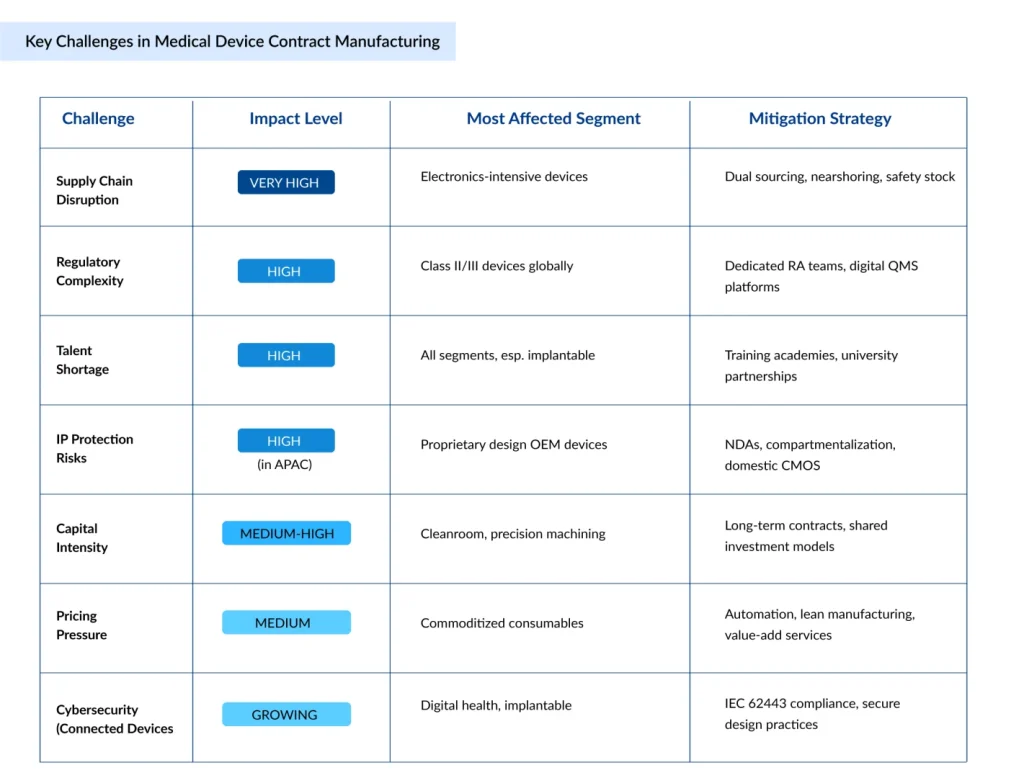
Many medical device contract manufacturing companies are actively reshoring or dual-sourcing critical components, building strategic inventory buffers, and investing in supply chain visibility platforms. The nearshoring trend, moving manufacturing of complex medical devices from Asia to Mexico, Eastern Europe, or closer-to-market locations, is one of the most significant strategic responses, particularly for top medical device contract manufacturing companies serving North American OEM customers.
Talent Scarcity
Access to skilled engineering, quality, and regulatory talent represents a persistent constraint on medical contract manufacturing services capacity growth. The intersection of biomedical engineering, materials science, regulatory affairs, and manufacturing process expertise required to excel in contract medical device manufacturing is rare and highly competitive. Leading contract manufacturers of medical devices are investing heavily in internal training academies, university partnerships, and competitive compensation packages to retain critical talent.
Intellectual Property Protection
For OEM device companies considering medical device manufacturing outsourcing, intellectual property protection is a paramount concern, particularly when engaging manufacturers in jurisdictions with less robust IP enforcement. The risk of design information, manufacturing processes, or proprietary material formulations being compromised requires rigorous contractual protections, compartmentalization strategies, and careful geographic decision-making. This concern is a significant factor in the preference many U.S. and European OEMs maintain for domestic or allied-nation medical device contract manufacturer partners.
Strategic Partnership Selection: Choosing the Right Medical Device Manufacturing Partner
Framework for CMO Partner Selection
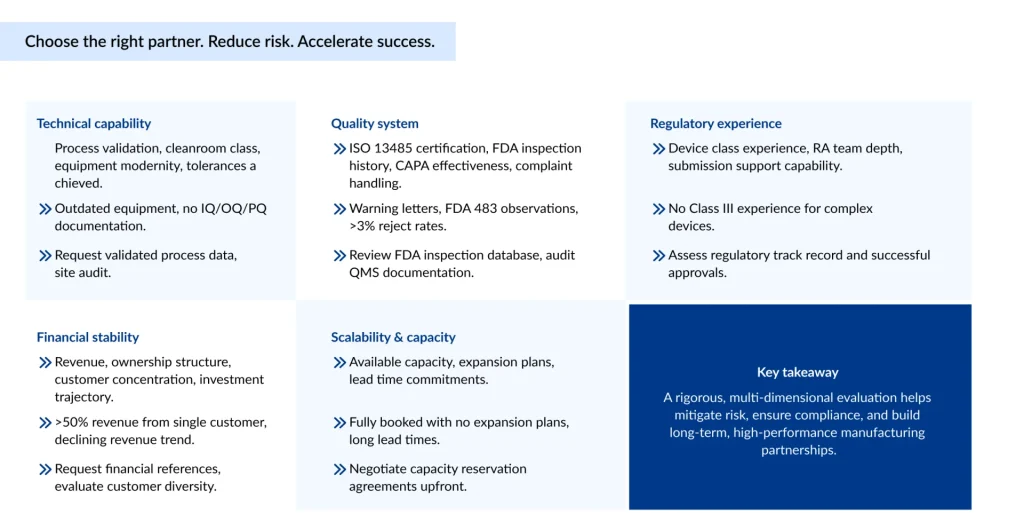
Selecting the right medical device manufacturing partner is arguably the most consequential strategic decision an OEM device company will make, more impactful than many product design decisions. The wrong medical device contract manufacturing partnership can result in quality failures, regulatory enforcement actions, delayed product launches, and irreparable brand damage. A rigorous partner selection framework for contract medical device manufacturing should evaluate candidates across five primary dimensions:
Medical Device Contract Design Integration
An increasingly important service offered by leading medical device contract manufacturing companies is medical device contract design, where the CMO is engaged not merely as a manufacturer executing OEM-provided specifications, but as a design partner contributing engineering expertise from the earliest concept stages. This design-for-manufacturability (DFM) integrated approach can reduce total product development cost by 20–40% and compress development timelines by providing real-time feedback on design decisions’ manufacturing implications.
The medical device contract manufacturing industry has experienced a significant wave of mergers, acquisitions, and strategic investments over the past five years, driven by the strategic imperative to build scale, diversify capabilities, and establish geographic presence across key markets. Private equity firms have been particularly active, attracted by the defensive growth characteristics, recurring revenue models, and favorable demographic tailwinds of the healthcare contract manufacturing sector.
|
Notable M&A Transactions (2019-2024) |
|||||
|
Year |
Acquirer |
Target |
Deal Value |
Strategic Rationale |
Segment |
|
2024 |
Jabil Healthcare |
Specialized Drug Delivery Assets |
Undisclosed |
Expand drug delivery device contract manufacturing |
Drug Delivery |
|
2023 |
Integer Holdings |
Lake Region Medical (integration) |
Prior deal |
Deepen cardiovascular CMO capabilities |
Cardiovascular |
|
2023 |
STERIS |
Surgical Instrument Mfg. Assets |
Undisclosed |
Expand contract medical device manufacturing |
Instruments |
|
2022 |
Nordson Corporation |
Plas-Pak Industries |
$275 Mn |
Drug delivery device systems |
Drug Delivery |
|
2021 |
Flex |
Anord Mardix |
$540 Mn |
Power electronics for medical applications |
Electronics |
|
2020 |
Viant Medical |
Multiple CMO bolt-ons |
n/a |
Geographic & capability expansion |
Multi-segment |
|
2019 |
TE Connectivity |
Creganna Medical |
$895 Mn |
Minimally invasive catheter CMO leadership |
Vascular |
The global medical device contract manufacturing industry stands at a remarkable inflection point. The convergence of demographic pressures, technological innovation, regulatory evolution, and strategic outsourcing trends has created a market trajectory that few segments of the broader manufacturing economy can match. From the United States medical sector contract electronic manufacturing ecosystem to the rapidly expanding India IVD contract manufacturing landscape, from implantable medical device contract manufacturing to contract manufacturing of drug delivery devices, the sector is demonstrating both breadth and depth in its growth narrative.
For OEM medical device companies, the strategic imperative is clear: establishing high-quality, long-term partnerships with the right medical device contract manufacturer is not simply an operational decision; it is a core competitive strategy. The ability to access world-class medical device manufacturing services without building them in-house represents a fundamental reshaping of the innovation-to-market value chain in healthcare technology.
For investors and strategic acquirers, the medical device contract manufacturing industry offers one of the most attractive risk-adjusted return profiles in healthcare: defensive revenue characteristics, long-term contracted relationships, high switching costs, favorable demographic tailwinds, and substantial runway for continued consolidation. The top medical device contract manufacturers of 2032 are being built today through organic growth, capability investment, and strategic M&A, and the race to leadership positions is intensifying.
As medtech contract manufacturing continues to mature and professionalize, the companies that will emerge as top medical device contract manufacturing companies will be those that invest not only in manufacturing capacity but in regulatory excellence, technological differentiation, customer partnership depth, and talent development. The future of medical device manufacturing outsourcing belongs to those partners who can genuinely serve as an extension of their OEM customers’ R&D and operations capabilities, not merely as production facilities.

Downloads
Article in PDF
Recent Articles
- GenScript Enters Distribution Agreement with EUROIMMUN; Biomerics’s New Facility in Galway (Irela...
- Quest Introduced Consumer-Initiated Blood Test for Alzheimer’s Disease Risk Assessment; DuP...
- Antibody-Drug Conjugate and Big Pharmaceutical Companies
- Cambrex acquires Avista; Sobi pays $50M; LEO Pharma signs deal; Boston Scientific remunerates