Neurotechnology: Transforming the Future of Brain Health and Human–Machine Interaction
Jul 29, 2026
Table of Contents
For most of medical history, the brain has been the one organ we could describe but barely touch. Today, that’s changing fast. A new wave of devices, implants, and algorithms is learning to listen to the brain’s electrical language, and, increasingly, to talk back to it. This convergence of neuroscience, engineering, and artificial intelligence is called neurotechnology, and it’s quietly becoming one of the most consequential frontiers in modern medicine.
From helping a paralyzed patient move a cursor with a single thought, to calming the tremors of Parkinson’s disease, to detecting a seizure before it starts, neurotechnology is rewriting what’s possible in brain health. It’s also blurring the line between human cognition and machine intelligence in ways that were pure science fiction just a decade ago.
Downloads
Click Here To Get the Article in PDF

What Is Neurotechnology? Decoding the Brain’s Digital Frontier
Neurotechnology refers to the family of devices, tools, and systems designed to monitor, interpret, influence, or interface with the brain and nervous system. It sits at the intersection of neuroscience, biomedical engineering, data science, and increasingly, artificial intelligence. Unlike traditional medicine, which mostly treats the brain indirectly through drugs or surgery, neurotechnology aims to engage with neural activity directly, reading electrical signals, mapping brain regions, or delivering targeted stimulation to correct dysfunction. The field spans a wide spectrum, from life-changing implants that restore movement and speech to consumer wearables that simply help people track focus and sleep. What ties it all together is a single idea: the brain’s signals can be captured, decoded, and acted upon.
Several core technology categories make this possible. Brain-computer interfaces (BCIs) are systems that create a direct communication pathway between the brain and an external device, translating neural signals into commands that can move a cursor, control a robotic limb, or generate synthetic speech, using either implanted electrodes or non-invasive sensors placed on the scalp. Neurostimulation devices work in the opposite direction, delivering carefully calibrated electrical or magnetic energy into the brain to correct abnormal activity, with deep brain stimulation (DBS) surgically implanting electrodes to treat conditions like Parkinson’s disease, and transcranial magnetic stimulation (TMS) using magnetic pulses from outside the skull to modulate mood disorders such as depression, entirely without surgery. Neuroimaging tools remain the backbone of brain diagnostics, with electroencephalography (EEG) capturing the brain’s electrical rhythms in real time through scalp sensors, and functional MRI (fMRI) tracking blood flow to reveal which brain regions activate during specific tasks, together giving clinicians and researchers an unprecedented window into brain structure and function. Finally, wearable neurodevices are bringing this technology out of the hospital and into everyday life, with headbands, earbuds, and smartwatches now capable of continuously monitoring cognitive load, stress, sleep quality, and attention, giving individuals real-time insight into their own brain health.
Key Applications of Neurotechnology in Healthcare
Neurotechnology’s most powerful use case remains healthcare, where it’s moving from experimental therapy to standard-of-care treatment for some of the most burdensome neurological and psychiatric conditions in the world.
Parkinson’s Disease
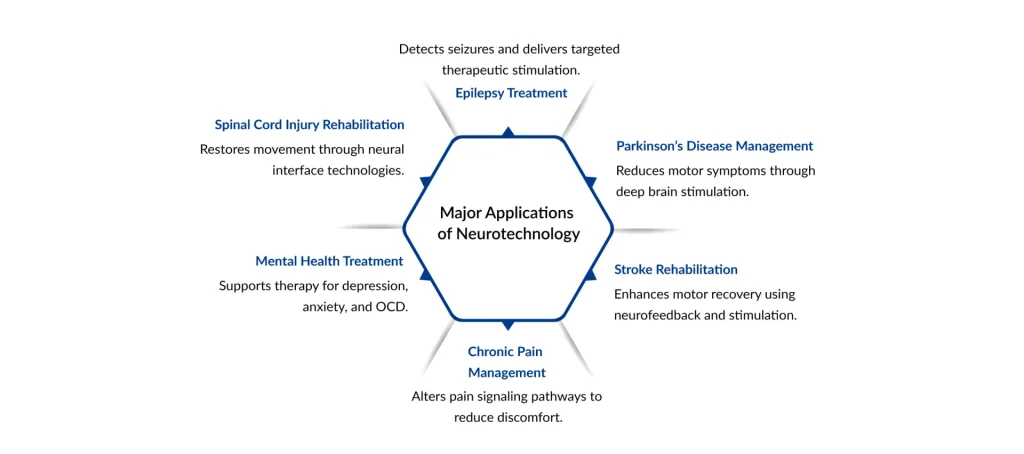
Deep brain stimulation has become one of neurotechnology’s clearest clinical success stories for Parkinson’s disease. By implanting electrodes into specific motor-control regions of the brain and delivering continuous, precisely tuned electrical pulses, DBS can dramatically reduce tremors, rigidity, and slowed movement in patients who no longer respond well to medication alone. Newer “closed-loop” or adaptive DBS systems take this further, sensing abnormal brain activity in real time and adjusting stimulation automatically, rather than delivering a fixed, constant signal.
Epilepsy
For epilepsy patients whose seizures resist medication, neurotechnology offers a way to intervene before a seizure fully develops. Responsive neurostimulation systems continuously monitor brain electrical activity and deliver a corrective pulse the moment they detect the abnormal patterns that precede a seizure, effectively interrupting it before it escalates. Combined with high-resolution EEG mapping used to pinpoint the exact seizure origin, these tools are giving patients with drug-resistant epilepsy a realistic path to fewer, less severe seizures.
Depression and Anxiety
Mental health has become one of the fastest-growing frontiers for neurotechnology. Transcranial magnetic stimulation is now a recognized treatment option for patients with treatment-resistant depression, using magnetic pulses to stimulate underactive regions of the brain associated with mood regulation, without the systemic side effects of medication. Meanwhile, EEG-based biofeedback and wearable stress-monitoring devices are helping patients with anxiety build real-time awareness of their physiological state, supporting therapies like neurofeedback that train the brain toward healthier patterns of activity.
Stroke Rehabilitation
Recovering movement and speech after a stroke is often a long, uncertain process, and neurotechnology is helping make it more precise. Brain-computer interfaces paired with robotic exoskeletons can detect a stroke survivor’s intent to move a limb and translate that signal into actual physical movement, reinforcing the neural pathways responsible for motor control. Non-invasive brain stimulation is also being explored to enhance neuroplasticity, essentially helping the brain “rewire” itself around damaged tissue, accelerating recovery of both movement and language.
Rise of Brain-Computer Interfaces (BCIs)
No corner of neurotechnology has captured public imagination quite like the brain-computer interface. What was once confined to research labs is now an active, competitive industry, with implanted and non-invasive systems both advancing at a striking pace. Companies like Neuralink and Synchron are running human clinical trials that allow patients with severe paralysis to control computers, communicate, and interact with digital devices using thought alone, while firms such as Paradromics, Blackrock Neurotech, Precision Neuroscience, and Kernel are pursuing their own approaches, ranging from high-density cortical implants to minimally invasive designs delivered through blood vessels rather than open brain surgery. NeuroPace’s responsive neurostimulation system, meanwhile, stands out as one of the few bidirectional BCIs already cleared for clinical use, specifically for epilepsy.
On the non-invasive side, EEG-based headsets and emerging sensor technologies are bringing BCI capability to broader audiences, detecting patterns of attention, relaxation, and mental workload without any surgery at all. These consumer-facing tools trade some signal precision for accessibility, but they’re expanding what a “brain-computer interface” means in everyday life, from gaming and meditation apps to workplace fatigue monitoring.
Importantly, most implanted BCIs remain in research or expanded-access programs rather than full commercial availability, with realistic timelines for broader clinical rollout still a few years out. But the trajectory is unmistakable: as AI-driven signal decoding improves, BCIs are shifting from a hardware challenge to an intelligence challenge, focused less on simply capturing brain signals and more on accurately interpreting what they mean.
Neurotechnology in the Pharmaceutical Ecosystem
Neurotechnology isn’t just reshaping devices and diagnostics, it’s becoming a strategic asset across the pharmaceutical value chain. In clinical trials for neurological and psychiatric drugs, EEG and neuroimaging biomarkers are increasingly used as objective, quantifiable endpoints, helping researchers detect a drug’s effect on brain activity earlier and more precisely than relying on subjective symptom scales alone. This is particularly valuable in notoriously hard-to-measure conditions like depression, schizophrenia, and Alzheimer’s disease, where neurotechnology-derived biomarkers can help de-risk costly late-stage trials.
Neurotechnology is also enabling entirely new categories of combination therapy, where a drug and a device work together, such as pairing pharmacological treatment with neurostimulation to enhance therapeutic response in depression or chronic pain. For pharmaceutical and market access teams, this convergence is opening new competitive and partnership dynamics: device makers, digital health companies, and traditional pharma players are increasingly collaborating, licensing technology, or acquiring neurotech capabilities outright to strengthen their neuroscience pipelines. As regulatory bodies grow more comfortable evaluating digital biomarkers and software-based endpoints, neurotechnology is poised to become a standard component of neuroscience drug development, not just a parallel industry.
Challenges and Ethical Considerations
Neurotechnology has the potential to transform healthcare, communication, and human performance, but its rapid advancement also introduces significant technical, regulatory, and societal challenges. One of the primary concerns is the collection, storage, and use of neural data, which is among the most sensitive forms of personal information. BCIs, neuroimaging systems, and wearable neurodevices generate data that may reveal cognitive patterns, emotions, or behavioral tendencies, raising critical questions about privacy, data ownership, and cybersecurity. Unauthorized access to neural information or misuse of brain data could have far-reaching consequences, making robust encryption, transparent data governance, and strict regulatory oversight essential for maintaining user trust.
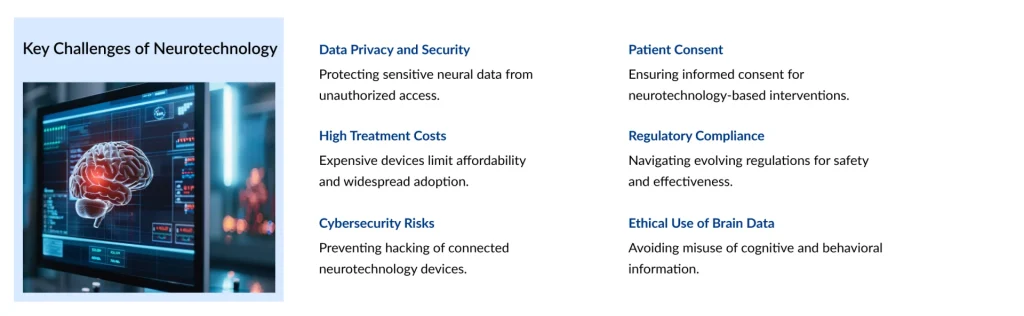
Ethical considerations surrounding neurotechnology extend beyond data privacy to issues of informed consent, fairness, and accessibility. Patients participating in clinical trials or using implantable neurodevices must fully understand the potential risks, long-term implications, and limitations of these technologies. Additionally, as neurotechnology expands into areas such as cognitive enhancement, there is growing concern about equitable access and the possibility of widening socioeconomic disparities if advanced neurotechnologies remain available only to affluent populations. Ethical debates also encompass the use of neurotechnology in workplaces, education, and defense, where concerns about autonomy, coercion, and potential misuse continue to shape policy discussions.
Regulatory agencies, healthcare providers, technology developers, and policymakers must collaborate to establish comprehensive ethical frameworks that encourage innovation while safeguarding individual rights. Developing internationally harmonized standards for device safety, clinical validation, cybersecurity, and responsible artificial intelligence integration will be critical as neurotechnology becomes more widely adopted. Transparent governance, continuous post-market surveillance, and public engagement can help address ethical concerns while fostering confidence among patients, clinicians, and investors. Balancing technological progress with ethical responsibility will be essential to ensuring that neurotechnology delivers sustainable benefits across healthcare and broader society.
The Future of Neurotechnology
The numbers tell a clear story: neurotechnology is moving from niche to mainstream. As per DelveInsight analysis, the global neurotechnology market is projected to grow from USD 17.2 billion in 2025 to USD 57 billion by 2034, expanding at a CAGR of 14.26% during the forecast period (2026–2034). Spinal cord stimulators represent the largest share of the neurostimulation segment, contributing nearly 43% of the neurotechnology market’s total revenue in 2025. Their growing adoption is primarily attributed to their effectiveness in treating chronic, refractory pain disorders such as failed back surgery syndrome and neuropathic pain. By delivering controlled electrical impulses to the spinal cord, these implantable devices interrupt pain signaling pathways, offering patients a durable, opioid-sparing therapeutic option.
North America is projected to hold the largest share of the global neurotechnology market, accounting for approximately 39% in 2025. The region’s leadership is driven by its well-established healthcare infrastructure, significant investments in research and development, and the strong presence of major industry players, including Neuralink, Medtronic, and Abbott. Meanwhile, the Asia-Pacific region is anticipated to register the fastest growth over the next decade. This rapid expansion is attributed to the rising prevalence of neurological disorders, ongoing improvements in healthcare infrastructure, and increasing investments in advanced medical technologies across key markets such as China, Japan, India, and South Korea.
The competitive landscape spans both legacy medical device giants and a new generation of neurotech-native startups. Established players like Medtronic, Abbott, Boston Scientific, LivaNova, and Nevro dominate the neurostimulation and neuromodulation segment, while a wave of specialized companies, Neuralink, Synchron, Paradromics, Blackrock Neurotech, Precision Neuroscience, Kernel, and NeuroPace, are pushing the boundaries of brain-computer interfaces and closed-loop neural devices. On the wearable and consumer side, companies such as Emotiv, Muse, and Neurable are expanding access to EEG-based cognitive monitoring beyond clinical settings.
Looking ahead, the defining shift in neurotechnology won’t just be better hardware; it will be smarter software. As AI-driven signal decoding matures, devices will move from crudely reading brain activity to genuinely understanding intent, unlocking more natural, higher-bandwidth communication between humans and machines. Expect to see neurotechnology increasingly embedded in mainstream neurology and psychiatry care pathways, deeper integration with pharmaceutical R&D as a source of objective biomarkers, and a steady expansion of wearable neurodevices into consumer health and workplace wellness. The brain, long medicine’s final frontier, is finally becoming legible, and the technology built to read, treat, and interface with it is set to be one of the defining growth stories of the next decade.

Downloads
Article in PDF
Recent Articles
- Zealand Pharma’s Phase III Results of Glepaglutide; FDA Approves Amylyx’s ALS Drug Relyvrio; Novo...
- What is the Link Between Alzheimer’s and Menopause?
- Alzheimer’s Treatment: Latest Breakthroughs and Advancements in Therapeutic Development
- Role of Seizures Alert and Monitoring Devices in the Management of Epilepsy
- Sanofi’s Rare Disease Drug Xenpozyme’ Approval; FDA Approves Novartis’ Pluvicto; AstraZenec...