Organ Preservation Solutions: The Silent Lifeline Between Donation and Transplantation
Sep 23, 2026
Table of Contents
Every successful transplant tells two stories. The first is the one everyone sees, a patient receiving a second chance at life. The second is quieter, playing out inside a cooler or perfusion device, where a carefully engineered organ preservation solution is fighting, cell by cell, to keep a donor organ alive long enough to make that second chance possible.
Organ preservation solutions are specialized pharmaceutical fluids used to flush, store, and protect donor organs from the moment they are removed from a donor’s body until they are transplanted into a recipient. Their formulations are built around a single, high-stakes objective: slow biological time. By suppressing cellular metabolism, correcting electrolyte imbalances, and neutralizing the damaging biochemical cascades triggered by a sudden loss of blood supply, these solutions buy transplant teams the one resource they can never manufacture more of: time.
Downloads
Click Here To Get the Article in PDF

Recent Articles
The Critical Bridge Between Procurement and Transplantation
Organ procurement and organ transplantation are rarely simultaneous events. Donor organs are frequently recovered in one city, matched to a recipient hundreds of miles away, and transported across health systems, time zones, and sometimes international borders. Between the moment of procurement and the moment of implantation lies a fragile window known as cold ischemic time, the period during which an organ has no active blood supply and must survive on stored energy reserves alone.
This is precisely where organ preservation solutions step in as the connective tissue of the entire transplant chain. Immediately after procurement, organs are flushed with a preservation solution to remove residual blood, cool the tissue, and replace the cellular environment with a chemically protective medium. The organ is then stored, either statically in cold solution or dynamically via machine perfusion, until it reaches the recipient’s operating room.
Without an effective preservation strategy, this bridge collapses almost instantly. Cells deprived of oxygen and nutrients rapidly deplete their energy stores, swell, and begin a self-destructive cascade that can render an otherwise healthy organ non-viable within hours. Preservation solutions are what make logistically complex, life-saving allocation systems possible at all.
Why Preserving Donor-Organ Viability is Non-Negotiable
Transplant success is not simply a matter of surgical precision; it begins long before the recipient ever enters the operating theater. An organ’s condition at the moment of implantation directly determines its short-term function, its risk of rejection, and its long-term survival in the recipient’s body.
Poorly preserved organs are strongly associated with delayed graft function, higher rates of primary non-function, increased acute rejection episodes, and shortened graft survival. In liver and kidney transplantation especially, preservation-related injury has been shown to compromise outcomes even when the surgery itself is technically flawless. As transplant programs increasingly rely on organs from marginal and extended-criteria donors, older donors, donors after circulatory death (DCD), and organs with comorbidities, the margin for preservation error shrinks even further.
In short: a transplant is only as good as the organ that arrives on the table. Preservation solutions are the difference between a viable graft and a wasted opportunity.
How Organ Preservation Solutions Work
Organ preservation solutions do far more than simply keep organs cold. They employ a deliberate, multi-pronged biochemical strategy designed to place cells in a protective state of suspended animation while actively countering the injury pathways triggered by ischemia. The foundational principle behind these solutions is hypothermia-induced metabolic suppression. Cooling an organ to approximately 0–4°C substantially reduces its metabolic rate, slowing the consumption of oxygen and energy substrates and thereby giving cells more time by reducing their demand for resources that are no longer being supplied through blood flow. However, cold temperature alone is a relatively blunt preservation mechanism; it slows cellular damage but does not stop it, so preservation solutions incorporate additional protective components to enhance the effects of hypothermia.
One of the key functions of preservation solutions is preventing cellular swelling. When blood flow stops, the ion pumps responsible for maintaining cellular volume begin to fail as cellular energy stores are depleted. This causes sodium and water to move into cells, resulting in swelling that can eventually lead to cellular rupture. Preservation solutions help prevent this process by incorporating impermeant agents, including lactobionate, raffinose, and hydroxyethyl starch, which remain outside the cell membrane and create an osmotic balance that limits excessive water movement into cells. At the same time, these solutions help maintain membrane integrity, which is critical because cell membranes represent one of the first lines of defense against ischemic injury. Colloids and antioxidants included in many preservation formulations help stabilize lipid membranes, reduce the release of damaging enzymes, and protect the structural integrity of both plasma membranes and intracellular organelles such as mitochondria.
Another important objective is preserving ATP levels. Because cells cannot efficiently generate new energy in the absence of oxygen, preservation solutions may contain ATP precursors such as adenosine, along with metabolic substrates that support residual energy production. These components also provide the raw materials required for rapid ATP resynthesis once blood flow is restored following transplantation. In parallel, preservation solutions are designed to reduce oxidative stress, which becomes particularly important when oxygen returns to previously ischemic tissue. The sudden reintroduction of oxygen can trigger a surge of damaging free radicals and reactive oxygen species. Antioxidants and free-radical scavengers, including allopurinol, glutathione, and mannitol, can help neutralize these reactive molecules and limit the resulting cellular damage.
Perhaps the most important function of a modern preservation solution is its ability to mitigate ischemia–reperfusion injury (IRI), which occurs when blood flow and oxygen supply are restored to the transplanted organ. The transition from ischemia back to normal circulation can cause substantial damage because the sudden return of oxygen interacts with cells that have already been weakened and chemically destabilized during the ischemic period. Consequently, well-designed preservation solutions are formulated not only to protect the organ during storage but also to prepare it to better withstand the physiological stress associated with reoxygenation and reperfusion.
All of these protective mechanisms operate alongside tightly controlled temperature management. Even relatively small temperature increases can accelerate metabolic activity and reduce the period during which an organ can remain viable outside the body. Similarly, cold ischemic time represents more than simply a measure of elapsed time; it is effectively a countdown with direct clinical implications. As the duration of storage outside the body increases, cumulative cellular injury also increases, regardless of how effective the preservation solution may be. For this reason, minimizing cold ischemic time remains a central objective in transplantation logistics, even as advances in preservation chemistry continue to extend organ viability and improve the ability to protect organs during transport and storage.
Major Types of Organ Preservation Solutions: A Comparative Breakdown
Not all preservation solutions are created equal. Each major formulation reflects a different philosophy on how best to protect organs, and each has carved out a distinct clinical niche based on its strengths and trade-offs.
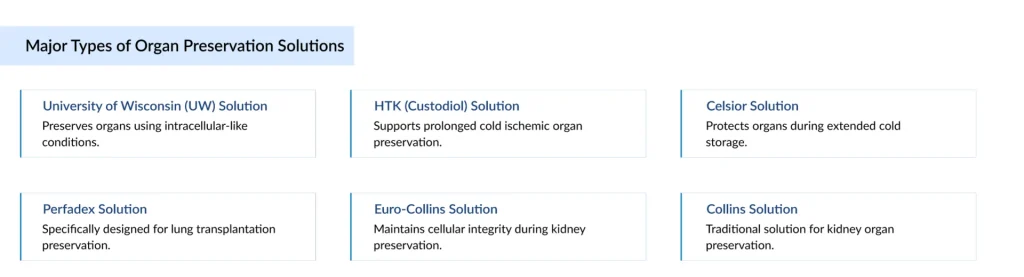
University of Wisconsin (UW) Solution
Widely regarded as the gold-standard benchmark since its introduction in the late 1980s, UW solution uses lactobionate and raffinose as impermeants, combined with hydroxyethyl starch as a colloid, along with adenosine and allopurinol for energy support and antioxidant protection. The product offers several advantages, including an exceptional track record in liver, kidney, and pancreas preservation, the ability to support extended static cold storage times, and extensive real-world clinical validation. However, its relatively high viscosity can complicate flushing, while its higher cost and potassium content require careful handling. It is typically used for liver, kidney, and pancreas transplantation, particularly in standard-criteria donor organs where longer storage windows are required.
Histidine–Tryptophan–Ketoglutarate (HTK) Solution
HTK solution (also known as Custodiol) takes a different approach, relying on histidine as a buffer, tryptophan for membrane stabilization, and ketoglutarate as a metabolic substrate. Its low viscosity allows for rapid, low-pressure flushing. The solution offers several advantages, including excellent flush characteristics, lower cost compared with UW, and strong performance in cardiac and hepatic preservation. However, it is generally associated with shorter safe preservation windows than UW and requires larger flush volumes. Its typical applications include heart and liver preservation, with increasing use in kidney and pancreas preservation, particularly in settings where rapid perfusion is prioritized.
Celsior Solution
Designed as a hybrid formulation, Celsior combines features of both UW and HTK, using lactobionate and mannitol for osmotic control alongside glutathione and histidine for antioxidant and buffering support. The solution offers several advantages, including low viscosity, strong antioxidant protection, and the convenience of a single solution for both flushing and storage. However, limitations include mixed evidence regarding the optimal preservation duration for certain organs and less extensive long-term data compared with UW solution. It is widely used in heart and lung transplantation, with its use increasingly expanding to kidney and liver preservation.
Institut Georges Lopez-1 (IGL-1) Solution
IGL-1 is a UW-inspired formulation that replaces hydroxyethyl starch with polyethylene glycol (PEG), aiming to reduce viscosity while retaining strong protective performance. The advantages include easier flushing compared with UW due to its lower viscosity, while PEG provides membrane-stabilizing and anti-inflammatory properties, with several studies demonstrating outcomes comparable to UW. However, it is still building a long-term clinical evidence base compared with older preservation solutions, and its availability varies by region. It is typically used for kidney and liver transplantation, particularly in European transplant centers.
Custodiol-N and Emerging Formulations
Newer entrants like Custodiol-N aim to refine the HTK platform with enhanced antioxidant systems and additional protective agents targeting reperfusion injury more directly. Beyond specific branded products, the broader innovation trend includes PEG-based solutions, oxygen-carrying preservation fluids, and formulations specifically engineered for use with machine perfusion rather than static storage. The solution is designed to address known limitations of legacy approaches, particularly those related to extended preservation and reperfusion protection. However, its limitations include a relatively newer clinical evidence base and adoption that is still growing compared with more established solutions. It is increasingly being used for extended-criteria donor organs and in combination with hypothermic or normothermic machine perfusion platforms.
Organ-Specific Applications: One Size Does Not Fit All
Organ preservation is never a one-size-fits-all process, as each organ has a distinct metabolic profile, tolerance to ischemia, and susceptibility to specific forms of injury. Kidneys are relatively resilient to cold ischemia compared with other organs and can generally tolerate longer periods of static cold storage; however, kidneys obtained from extended-criteria or donation-after-circulatory-death (DCD) donors can benefit substantially from hypothermic machine perfusion, which has been shown to reduce the incidence of delayed graft function. In contrast, livers are highly metabolically active and particularly vulnerable to preservation injury, especially when grafts are fatty or otherwise marginal. As a result, liver preservation is increasingly supported by machine perfusion technologies, including both hypothermic and normothermic approaches, which can enable clinicians to assess and, in some cases, recondition organs before transplantation.
Hearts have one of the lowest tolerances for ischemia among transplantable organs and typically must be transplanted within a narrow time window. This limited window has driven growing interest in ex vivo perfusion systems capable of maintaining the heart in a beating, metabolically active state during transport rather than depending exclusively on static cold storage. Lungs are also particularly susceptible to reperfusion injury and edema, and preservation solutions are therefore specifically formulated to address these risks. Ex vivo lung perfusion (EVLP) has consequently emerged as an important technology for preserving and evaluating marginal lung grafts before transplantation.
Pancreatic grafts are highly vulnerable to autodigestion caused by their own enzymes once ischemia begins, making rapid and effective flushing, along with antioxidant protection, especially important for limiting tissue damage during storage. The intestine presents some of the most complex preservation challenges of any transplantable organ because of its dense bacterial load, high metabolic demand, and susceptibility to mucosal injury, factors that generally require shorter preservation periods and highly specialized preservation protocols.
Benefits and Limitations of Organ Preservation Solutions: Weighing the Trade-Offs
Organ preservation solutions play a critical role in transplantation by helping maintain the viability and functional integrity of donor organs between procurement and implantation. These solutions are designed to reduce cellular metabolism, limit ischemic injury, maintain osmotic balance, and protect cell membranes during periods of cold storage or machine perfusion. By extending the safe preservation window, they can provide transplant teams with greater flexibility to coordinate organ recovery, transportation, recipient preparation, and surgical procedures. Advanced preservation solutions and perfusion-based approaches may also support the assessment and, in some cases, recovery of organs that might otherwise be considered unsuitable for transplantation.
A major benefit of organ preservation solutions is their ability to minimize tissue damage caused by ischemia and subsequent reperfusion. Their carefully formulated electrolytes, buffers, antioxidants, impermeants, and other protective components help maintain intracellular and extracellular conditions during preservation. This can contribute to better post-transplant organ function and potentially improve graft survival. Longer preservation periods can also facilitate organ sharing across greater geographic distances, increase logistical flexibility, and potentially reduce organ wastage. In addition, improved preservation technologies may expand the donor pool by enabling the use of marginal or extended-criteria organs, thereby helping address the persistent shortage of transplantable organs.
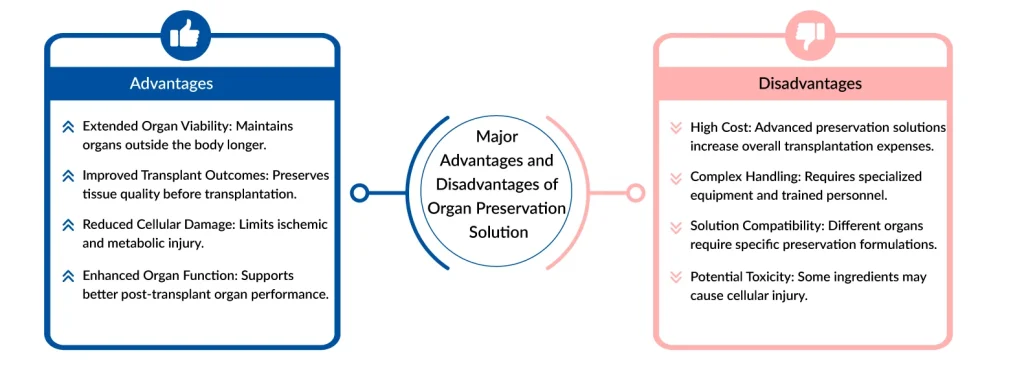
Despite these advantages, organ preservation solutions have several limitations. The effectiveness of a solution can vary according to the type of organ, preservation temperature, storage duration, donor characteristics, and method of preservation, meaning that no single formulation is universally optimal. Prolonged ischemic storage can still cause cellular and mitochondrial injury despite the use of protective solutions, while preservation itself cannot completely prevent ischemia-reperfusion damage. Some advanced preservation approaches also require specialized equipment, trained personnel, and substantial infrastructure, increasing costs and operational complexity. Furthermore, differences in clinical protocols and limited comparative evidence for newer formulations can make it difficult to establish standardized preservation practices.
Organ Preservation Solutions Market and Industry Perspective: A Convergence of Chemistry and Technology
The global shortage of transplantable organs has placed organ preservation squarely at the center of transplant innovation strategy. With demand for organs far outpacing supply, healthcare systems can no longer afford to lose viable organs to preventable preservation failures, making advanced preservation solutions and technologies a critical lever for expanding the usable donor pool. This growing pressure is driving a clear industry trend toward the convergence of preservation chemistry, machine perfusion systems, and real-time organ diagnostics. Static cold storage solutions are increasingly being paired with or replaced by hypothermic, normothermic, and oxygen-carrying machine perfusion platforms that not only preserve organs but also actively monitor viability biomarkers, metabolic function, and injury indicators in real time, transforming preservation from a passive holding process into an active organ optimization strategy.
As per DelveInsight analysis, the organ preservation solution market is valued at approximately USD 340 million in 2025 and is projected to reach USD 785 million by 2034, expanding at a CAGR of 9.7% during the forecast period from 2026 to 2034. Market growth is primarily driven by the increasing number of organ transplant procedures, the rising prevalence of end-stage organ failure, higher organ donation rates, and the expansion of transplant centers and organ procurement organizations. In addition, growing government initiatives aimed at promoting organ donation and transplantation are expected to further support market expansion throughout the forecast period. By solution type, UW solution continues to command the largest share of the preservation fluid market, reflecting its decades-long position as the clinical benchmark, although HTK, Celsior, and next-generation formulations are gaining traction.
The competitive landscape includes a combination of specialized preservation-fluid manufacturers and diversified transplant technology companies. The major players include Bridge to Life Ltd., XVIVO Perfusion AB, Institut Georges Lopez (IGL), Dr. Franz Köhler Chemie GmbH, Organ Recovery Systems, TransMedics, Inc., OrganOx Limited, Preservation Solutions, Inc., Essential Pharmaceuticals LLC, Paragonix Technologies, Carnamedica Sp. z o.o., S.A.L.F. S.p.A., Waters Medical Systems LLC, Transplant Biomedicals S.L., Vivalyx GmbH lead through isotope ownership and multi-site reach.
Additional participants across the value chain include preservation fluid formulators, contract manufacturers, specialty pharmaceutical companies developing next-generation cytoprotective additives, and a broad network of regional distributors serving individual transplant markets.
Future Outlook
The next era of organ preservation will likely be defined less by the static solution in a cooler and more by intelligent, dynamic preservation ecosystems, combining refined chemical formulations with machine perfusion, real-time viability diagnostics, and even organ reconditioning capabilities. As extended-criteria and DCD organs become a larger share of the donor pool, the ability to actively protect, assess, and even improve organ quality during preservation, rather than simply slowing decline, will become a defining differentiator for transplant programs and technology developers alike. The organs of the future may not just be preserved. They may be actively optimized, monitored, and prepared for transplantation in ways that meaningfully expand who can receive the gift of a transplant, and how successfully their new organ performs for years to come.

Downloads
Article in PDF