Software as a Medical Device: The Invisible Engine of Digital Health
Sep 16, 2026
Table of Contents
Healthcare used to be defined by devices you could hold: a stethoscope, an MRI scanner, an insulin pump. Increasingly, it’s defined by devices you can’t hold at all. An algorithm that flags a suspicious mole from a smartphone photo. A program that reads a chest CT and prioritizes the most urgent case in a radiologist’s queue. An app that adjusts a diabetes management plan in real time based on continuous glucose data.
None of these tools are “software that comes with” a medical device; they are the medical device. This category is known as Software as a Medical Device (SaMD), and it has quietly become one of the fastest-growing and most consequential segments of the health technology landscape.
Downloads
Click Here To Get the Article in PDF

Recent Articles
- Artificial Intelligence and Machine Learning in Software as a Medical Device (SaMD)
- FiberSense CGM System Secures CE Mark; AMDI™ Fast PCR System Achieves FDA 510(k) Clearance and CL...
- Bracco Receives FDA Clearance for Additional Clinical Use of Max 3™ Syringeless MR Injector; Rapi...
- 22 Healthcare Trends & Innovations to Watch in 2022 and Beyond
- 8 Promising Technologies Powering a More Efficient Operating Room
For healthcare executives, medtech innovators, pharmaceutical leaders, digital health investors, and policymakers, understanding SaMD is no longer optional. It shapes product strategy, regulatory planning, reimbursement models, and, most importantly, how care is delivered to patients. This article breaks down what SaMD is, how it’s transforming care delivery, the value it creates, and the real challenges organizations must navigate to bring it to market responsibly.
What is Software as a Medical Device (SaMD)?
The International Medical Device Regulators Forum (IMDRF), the body whose framework underpins how the FDA, the EU, and regulators in Canada, Japan, Australia, and the UK approach this category, defines SaMD as: Software intended to be used for one or more medical purposes that performs those purposes without being part of a hardware medical device.
In plain language: SaMD is software that independently diagnoses, monitors, treats, or otherwise manages a medical condition, on its own, not as a component bolted onto a physical device. It typically runs on general-purpose hardware: a smartphone, a laptop, a hospital server, or the cloud, rather than dedicated medical hardware.
IMDRF further specifies that a “medical purpose” includes the diagnosis, prevention, monitoring, treatment, or alleviation of disease or injury; supporting or sustaining life; informing clinical management; or providing information through in-vitro examination of specimens.
SaMD vs. Software In a Medical Device (SiMD)
It is easy to conflate Software as a Medical Device (SaMD) with software that operates within a medical device, but regulators draw a clear distinction between the two. SaMD performs a medical function independently of any specific hardware, such as an algorithm that analyzes mammograms to identify images that are likely to indicate malignancies and runs on a standard hospital workstation. In contrast, Software in a Medical Device (SiMD) is embedded within and operates a physical medical device, such as the firmware that controls the pacing rate of an implanted pacemaker or the operating software that regulates an infusion pump.
The distinction matters because it changes how the product is engineered, validated, and regulated. SaMD is evaluated as a standalone device based on what it does and how it’s used; SiMD is evaluated as part of the physical device it lives inside.
SaMD vs. General Wellness Apps
Not every health-related app is SaMD. A step counter, a meditation app, or a general nutrition tracker is typically considered a wellness product, not a medical device, because it doesn’t diagnose, treat, or otherwise perform a defined medical function tied to a specific disease or condition. The dividing line between general wellness software and Software as a Medical Device (SaMD) is primarily determined by its intended use. For example, an app designed simply to remind users to drink more water would generally be considered a general wellness product, whereas an app that analyzes photographs of skin lesions and generates a melanoma risk score to support a clinical decision would fall under SaMD. Similarly, a fitness tracker that displays trends in resting heart rate may be considered general wellness software, while software that analyzes heart rhythm data to detect atrial fibrillation and inform treatment decisions would be classified as SaMD.
How SaMD Is Transforming Healthcare Delivery
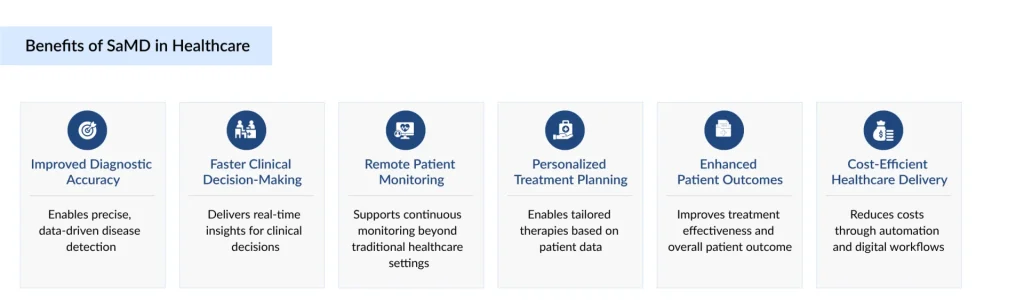
SaMD isn’t a single product category; it’s a set of capabilities now embedded across nearly every point in the care journey. A few of the most active areas:
AI-Enabled Diagnostics
Software that analyzes medical images, X-rays, CT scans, MRIs, retinal photographs, and pathology slides to detect abnormalities, prioritize urgent cases, or support a diagnosis. Examples include tools that flag suspected large-vessel strokes on CT angiography for faster triage, or software that screens retinal images for diabetic retinopathy in primary care settings without requiring an ophthalmologist to be present.
Clinical Decision Support (CDS)
Software that synthesizes patient data, labs, vitals, history, and imaging to help clinicians choose a course of action. This might mean flagging a drug interaction risk, suggesting a sepsis risk score based on real-time vitals, or recommending a treatment pathway based on published clinical guidelines and the patient’s specific profile.
Remote Patient Monitoring (RPM)
Software that continuously or periodically collects physiological data, heart rate, blood glucose, blood pressure, oxygen saturation, from a patient outside the clinical setting and analyzes it to detect trends, deterioration, or the need for intervention. This underpins much of the shift toward hospital-at-home and post-acute care models.
Digital Therapeutics (DTx)
Software-delivered interventions intended to prevent, manage, or treat a medical condition, often through structured, evidence-based programs, for example, a cognitive behavioral therapy program delivered via app to treat insomnia or substance use disorder, used either standalone or alongside medication.
Chronic Disease Management
Software that helps patients and care teams manage long-term conditions such as diabetes, hypertension, or COPD, combining monitoring, personalized coaching, medication adherence support, and clinician alerts into a single ongoing management loop via chronic disease management apps.
Personalized Care and Telehealth Integration
SaMD increasingly powers the “backend intelligence” of telehealth, risk-stratifying patients before a virtual visit, personalizing follow-up care plans based on outcomes data, and helping care teams extend individualized attention across much larger patient panels than would otherwise be possible.
Implementation and Commercialization Challenges
The path from a promising algorithm to a deployed, trusted clinical tool is long, and organizations consistently underestimate several hurdles:
Clinical Validation and Patient Safety
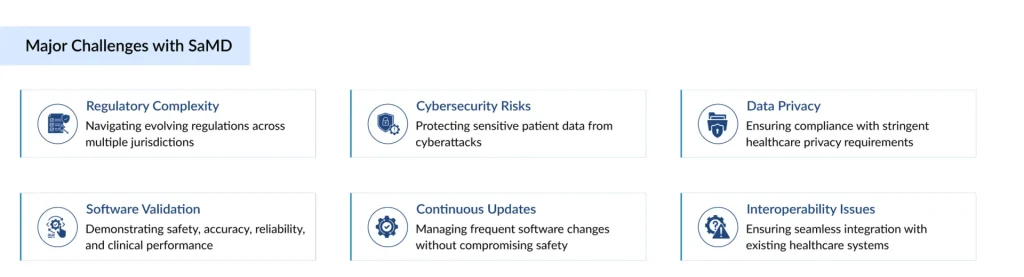
SaMD must demonstrate that it performs its intended function safely and effectively, not just in a research dataset, but across the real-world populations and settings where it will be used. Performance can degrade when a tool trained on one population or one type of imaging equipment is deployed in a different clinical context, which is why prospective, real-world validation matters as much as retrospective accuracy metrics.
Cybersecurity
Because SaMD often processes sensitive patient data and connects to networks, hospital systems, or the cloud, it inherits the full weight of healthcare cybersecurity risk. Vulnerabilities can affect not just data privacy but patient safety directly, if an attacker can manipulate outputs or disrupt monitoring. Regulators now expect cybersecurity to be designed in from the start, not patched on afterward.
Interoperability with Electronic Health Records (EHRs)
A diagnostic or monitoring tool that can’t exchange data cleanly with a hospital’s EHR creates friction that undermines adoption, regardless of how accurate the underlying algorithm is. Standards such as HL7 FHIR have improved interoperability, but integration remains a significant technical and operational lift for most health systems.
Privacy and Data Governance
SaMD tools often rely on large volumes of sensitive health data for both operation and ongoing improvement. Organizations must navigate frameworks like HIPAA (in the U.S.) or GDPR (in the EU), establish clear data governance policies, and be transparent with patients about how their data is used, particularly as tools increasingly rely on continuous data collection.
Algorithmic Bias
If an algorithm is trained on data that underrepresents certain populations, by race, age, sex, geography, or disease subtype, its performance can vary meaningfully across groups, sometimes in ways that aren’t apparent until the tool is deployed broadly. Addressing this requires deliberate attention to training data composition, subgroup performance analysis, and ongoing monitoring after launch.
Reimbursement
Payment pathways for software-based interventions remain less mature and more inconsistent than those for drugs or hardware devices. Companies must often build the case for reimbursement, new or existing billing codes, value-based contracts, or bundled payment models, alongside their clinical and regulatory strategy, not after it.
Regulatory Compliance
Perhaps the most important thing to understand about SaMD regulation is this: oversight is generally risk-based, and the software’s intended use is what determines its classification and pathway. A tool that provides general informational support to a clinician who retains full decision-making authority may face a different regulatory bar than a tool that autonomously determines a diagnosis or treatment without clinician review. This is why intended-use statements, from the earliest stages of product design, effectively define the entire regulatory strategy; changing the intended use later can mean restarting much of the classification and evidence-generation process.
The Growing Role of AI/ML-Based SaMD
Artificial intelligence (AI) and machine learning (ML) have emerged as the fastest-growing segment of Software as a Medical Device (SaMD), while also driving significant regulatory innovation. This is largely because traditional medical device regulation has historically been built around the assumption that a product remains essentially unchanged after approval. AI/ML-based SaMD, however, can evolve as models are retrained on new data, potentially improving performance but also introducing the risk of performance degradation or unintended changes. In response, regulators are developing frameworks that enable innovation while maintaining safety, effectiveness, and accountability throughout the product lifecycle.
One of the key concepts shaping this approach is Good Machine Learning Practice (GMLP), a set of principles developed collaboratively by international regulators to promote sound practices across the AI/ML product lifecycle, encompassing areas such as data management, model development and training, performance evaluation, and human factors. Another important mechanism is the Predetermined Change Control Plan (PCCP), which allows manufacturers to define in advance a specific scope of anticipated algorithm modifications, along with the validation and assessment methodologies that will be used to evaluate those changes. When subsequent updates remain within these predefined and regulator-approved boundaries, manufacturers may be able to implement them without submitting a completely new premarket application for every modification. The FDA’s PCCP framework therefore reflects a broader shift toward a total product lifecycle approach to AI/ML SaMD oversight, in which regulatory review is increasingly viewed as an ongoing process rather than a single event that occurs before market entry.
Continuous and transparent performance monitoring is also becoming increasingly important because AI/ML models may experience performance drift as real-world conditions change, including shifts in patient populations, clinical practices, or the equipment used to generate input data. Manufacturers are consequently expected to establish mechanisms for monitoring real-world performance after launch and to identify and communicate material changes when they occur. At the same time, robust software quality systems and change-management processes are becoming even more critical. Standards such as IEC 62304 and ISO 13485 provide important foundations for ensuring that software modifications are appropriately documented, tested, validated, and controlled throughout the product’s lifecycle.
Overall, the regulatory direction is increasingly moving away from a one-time “approve and freeze” model toward a more dynamic framework that recognizes the evolving nature of AI/ML-based medical software. Under this approach, continuous learning and algorithmic updates can be accommodated, provided that they occur within clearly defined, auditable, and clinically validated boundaries that preserve the safety and performance of the device.
Looking Ahead: SaMD as the Connective Tissue of Digital Health
SaMD is not a niche category anymore; it’s becoming the connective tissue linking diagnostics, therapeutics, monitoring, and care coordination into something closer to a continuous, adaptive system of care. As validation methods mature, interoperability standards improve, and regulatory frameworks like PCCPs make room for iterative AI/ML improvement, SaMD is positioned to make healthcare more proactive (catching disease earlier), more personalized (adapting to individual patient data), more connected (bridging clinical settings and the home), and more accessible (extending specialist-level insight to settings that previously lacked it).
As per DelveInsight analysis, the global software as a medical device market was valued at USD 2.10 billion in 2025 and is projected to reach USD 8.90 billion by 2034. The SaMD market is anticipated to grow at a CAGR of 17.4% from 2026 to 2034, driven by the increasing adoption of artificial intelligence and machine learning in clinical software, the expansion of digital therapeutics and remote healthcare services, the evolution of regulatory frameworks for software and adaptive algorithms, and the growing need for diagnostic and clinical decision-support solutions that enhance patient care.
By type, diagnostic and screening software represented the leading segment of the SaMD market, accounting for a 42% share in 2025. North America held the largest regional share of the SaMD market, at 45% in 2025. Meanwhile, Asia-Pacific is expected to emerge as the fastest-growing regional market through 2034.
Additionally, the market remains fragmented, with leading players including Koninklijke Philips N.V., Siemens Healthineers AG, GE HealthCare Technologies Inc., Medtronic plc, and Aidoc Medical Ltd. Other notable participants include Viz.ai, Inc., Digital Diagnostics Inc., HeartFlow, Inc., Cognoa, Inc., and Huma Therapeutics Limited. Companies such as Cleerly, Inc., Paige.AI, Inc., and RapidAI further contribute to the competitive landscape across clinical artificial intelligence, medical imaging, and digital therapeutics software.
Given how quickly this landscape shifts, through funding rounds, acquisitions, new clearances, and occasional high-profile shutdowns, any specific market figures or company list should be treated as a snapshot rather than a permanent ranking, and validated against current data before being used in investment or strategy decisions.
Realizing that potential responsibly will depend on the same discipline that has always defined good medicine: rigorous evidence, transparent performance reporting, and a clear-eyed view of both what these tools can do and where their limitations still lie. For the organizations that get this balance right, SaMD offers not just a new product category, but a genuinely different way of delivering care.

Downloads
Article in PDF
Recent Articles
- 22 Healthcare Trends & Innovations to Watch in 2022 and Beyond
- Top healthcare innovations changing the healthcare dynamics
- Artificial Intelligence and Machine Learning in Software as a Medical Device (SaMD)
- Most Promising Artificial Intelligence Applications in the Healthcare Segment
- Sonomotion Secures FDA Clearance for Break Wave™ Lithotripsy System; Aidoc Earns FDA Clearance fo...