Scholar Rock’s ISEMBYLD Sets a New Course in SMA With Muscle-Targeted Therapy
Sep 18, 2026
Table of Contents
Summary
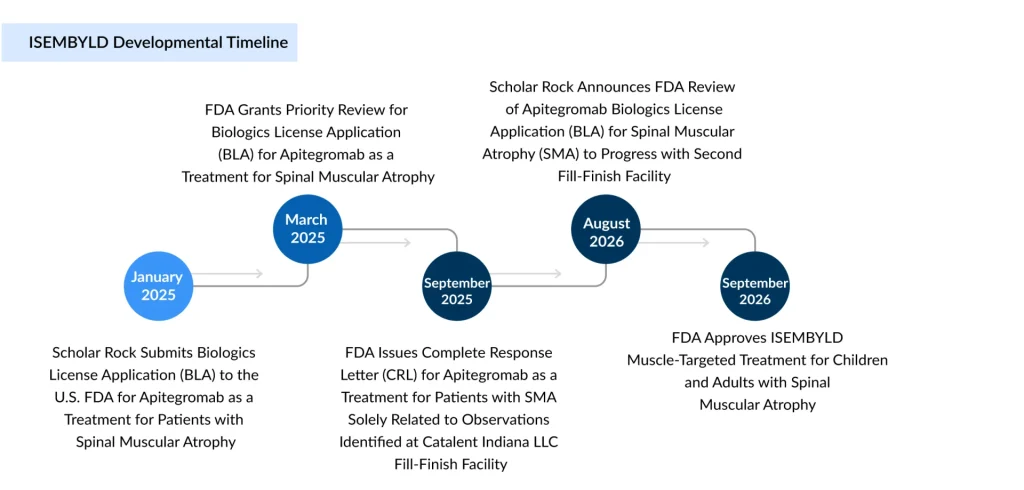
- The FDA approved Scholar Rock’s ISEMBYLD on September 11, 2026, the first and only muscle-targeted therapy for SMA, for adults and children aged 2+ who are already on an SMN2-targeted treatment.
- The FDA approval was based on the Phase 3 SAPPHIRE trial, which enrolled 188 patients aged 2–21 with 5q SMA across nine countries, all receiving SMN2-targeted therapy.
- Scholar Rock with ISEMBYLD aims to challenge the market positions of Biogen/Ionis’ SPINRAZA and Roche’s EVRYSDI.
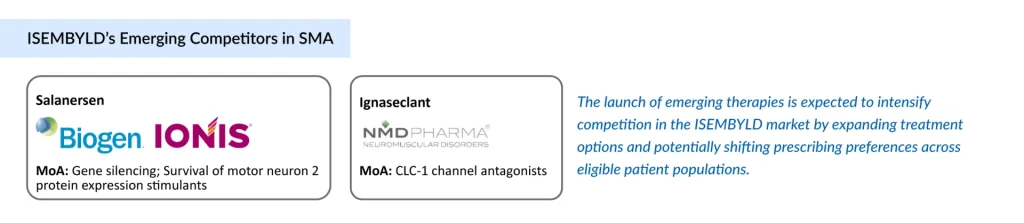
- Emerging therapies that could potentially compete with ISEMBYLD include Biogen/Ionis Pharmaceuticals’ salanersen, NMD Pharma’s ignaseclant, and others.
Spinal muscular atrophy (SMA) has long been one of medicine’s cruelest paradoxes, a disease that is genetically well understood, yet devastating in its physical toll. SMA is a rare, progressive neuromuscular disorder caused by a faulty SMN1 gene, which fails to produce enough survival motor neuron protein. Without it, motor neurons in the spinal cord degenerate, leading to irreversible muscle wasting, loss of mobility, and, in its most severe forms, life-threatening respiratory complications.
Downloads
Click Here To Get the Article in PDF

Recent Articles
- Spinal Muscular Atrophy: Current and Emerging Therapies
- Vedanta raises; Relay Therapeutics reels in; Gene therapy for SMA
- Can Spinal Muscular Atrophy be treated by Protease Inhibitors?
- Nucleic Acids and Gene Therapies in Neuromuscular Disorders: Next-Generation Therapeutic Strategies
- Innovent Biologics reaps; Jeff Aronin’s lead; Alexion gives out; Stoke Therapeutics receives
While spinal muscular atrophy prevalence is often cited at roughly 1 in 10,000 live births, with an estimated 6,600 people living with the condition in the United States alone, the numbers barely capture the day-to-day reality of the disease. Even patients who respond well to survival motor neuron 2 (SMN2)-targeted therapies frequently continue to lose strength, mobility, and independence over time. Muscle, once damaged, does not repair itself just because the underlying genetic signal has been corrected. This gap between “stopping neuron loss” and “restoring muscle function” has been the single biggest unmet need in SMA care for years.
That gap is precisely why the recent approval of Scholar Rock’s ISEMBYLD (apitegromab-mstn) is being called a defining moment for the SMA community. For the first time, the SMA treatment landscape includes a therapy that works downstream of the motor neuron, directly on muscle itself, rather than only upstream at the genetic level. It’s a shift that could redefine what “response to treatment” even means for thousands of families navigating this disease.
A New Treatment for Spinal Muscular Atrophy: What Makes ISEMBYLD Different
Every spinal muscular atrophy medicine approved before ISEMBYLD, from splice-modifying oligonucleotides to gene replacement therapy, has worked by increasing the amount or function of the SMN protein, aiming to prevent further motor neuron loss. That strategy has transformed outcomes for infants diagnosed early, but for many older children, adolescents, and adults already living with accumulated muscle damage, it hasn’t been enough on its own. This is where ISEMBYLD enters the SMA treatment story as a genuinely differentiated spinal muscular atrophy drug, rather than another entrant chasing the same mechanism.
ISEMBYLD is a fully human monoclonal IgG4 antibody engineered to bind promyostatin and latent myostatin, blocking the activation of myostatin signaling. Myostatin is a natural regulator that limits muscle growth; by inhibiting its activation, ISEMBYLD is designed to unlock greater muscle mass and functional capacity in patients whose motor neurons are already being supported by an SMN2-targeted spinal muscular atrophy medication.
In simple terms: existing therapies try to save the wiring (motor neurons), while ISEMBYLD tries to strengthen the machine the wiring controls (skeletal muscle). Used together, the two approaches attack SMA from opposite ends of the same problem, which is exactly the combination strategy regulators evaluated in its pivotal trial.
The approval comes one year after Scholar Rock’s initial attempt to secure FDA approval for ISEMBYLD resulted in a complete response letter (CRL), following unresolved compliance issues at a Novo Nordisk-operated manufacturing facility, which has since been rebranded as Novo. The FDA approval was anchored in the Phase 3 SAPPHIRE study, a randomized, double-blind, placebo-controlled trial spanning nine countries and enrolling 188 patients with 5q SMA aged 2 to 21 years, all of whom were already receiving an SMN2-targeted treatment. The trial met its primary endpoint, showing a statistically significant improvement in motor function, measured via the Hammersmith Functional Motor Scale Expanded (HFMSE), compared with placebo at one year.
Among patients aged 2 to 12 in the main efficacy population, roughly 34% on ISEMBYLD achieved a clinically meaningful motor function improvement, compared with about 14% on placebo. Earlier supportive data from the TOPAZ and ONYX studies helped build the scientific case, and additional post hoc analyses even suggested benefit in nonambulatory patients with Type 2 or Type 3 SMA, a population that has historically had the fewest options among gene therapy options for older children with spinal muscular atrophy and adults.
ISEMBYLD received Fast Track, Orphan Drug, and Rare Pediatric Disease designations before its approval for adults and children aged 2 years and older who are currently receiving an SMN2-targeted therapy, administered as a monthly infusion.
How ISEMBYLD Will Compete With the Established Duo: SPINRAZA and EVRYSDI
The critical nuance is that ISEMBYLD is not positioned to replace Biogen/Ionis’ SPINRAZA (nusinersen) or Roche’s EVRYSDI (risdiplam), but rather to be layered on top of these established therapies, fundamentally reframing the competitive dynamics within the spinal muscular atrophy (SMA) treatment landscape. SPINRAZA, an intrathecally delivered antisense oligonucleotide, remains a foundational SMA therapy for patients across a broad age range and benefits from more than a decade of real-world clinical experience. Meanwhile, EVRYSDI, an oral, at-home SMN2 splicing modulator, has gained broad adoption because of its convenience and wide approved age range.
Rather than directly displacing these therapies, ISEMBYLD is establishing a complementary fourth category as an add-on treatment for patients who are stable or responding to an SMN2-targeted therapy but continue to experience functional plateaus. From a clinical perspective, this suggests that the future of SMA treatment may increasingly shift from determining which individual drug to use toward determining which combination of therapies can provide the greatest functional benefit, representing a potentially meaningful evolution in how SMA treatment is prescribed, reimbursed, and monitored.
However, ISEMBYLD will still face significant competitive and commercial pressures, as payers are likely to scrutinize the incremental cost of combination therapy relative to potentially modest absolute improvements in HFMSE scores. Prescribers will also require more robust long-term evidence demonstrating durability, safety across real-world patient populations, and the specific subgroups most likely to benefit from treatment. Ultimately, whether ISEMBYLD develops into a standard-of-care add-on therapy or remains a niche option for patients with suboptimal responses to existing treatments will depend substantially on post-marketing evidence and payer willingness to support the additional costs associated with combination therapy.
The Next Wave: Emerging Competitors to ISEMBYLD on the Horizon
ISEMBYLD’s approval doesn’t happen in a vacuum. It arrives amid one of the most active pipelines rare disease neurology has seen in years, with several ongoing spinal muscular atrophy treatment clinical trials 2026 poised to reshape the field yet again within a short window.
Biogen/Ionis’s Salanersen: A Once-Yearly Successor to SPINRAZA
Salanersen (ION306/BIIB115) is an investigational antisense oligonucleotide built on the same mechanism as SPINRAZA but engineered for greater potency and a once-yearly intrathecal dosing schedule, a dramatic convenience improvement over SPINRAZA’s chronic dosing intervals. Early Phase 1b data, including in children previously treated with gene therapy who had suboptimal clinical status, showed substantial reductions in neurofilament light chain (a biomarker of neurodegeneration) along with new WHO motor milestone achievements. The FDA has granted salanersen Breakthrough Therapy Designation, and Biogen has outlined a three-study global Phase 3 program (including presymptomatic and post-gene-therapy populations) that could position salanersen as a genuine successor within the SMN2-targeted class and, notably, a potential future partner therapy for muscle-targeted drugs like ISEMBYLD, rather than a pure rival.
NMD Pharma’s Ignaseclant: An Oral, Muscle-Targeted Rival
Ignaseclant (formerly NMD670), from Denmark’s NMD Pharma, takes a different but philosophically related approach to ISEMBYLD: it’s a first-in-class, small-molecule ClC-1 ion channel inhibitor designed to directly enhance skeletal muscle excitability and function, independent of the SMN pathway. It’s being developed as an oral therapy, a potentially major convenience advantage over infused or intrathecal options, across multiple neuromuscular indications, including SMA, generalized myasthenia gravis, and Charcot-Marie-Tooth disease. With Phase 2 SMA data (the SYNAPSE-SMA study) expected, ignaseclant could become the most direct future competitor to ISEMBYLD’s “strengthen the muscle” strategy, especially if its oral format proves more attractive to patients tired of chronic infusions or spinal injections.
The Road Ahead
For a disease community that spent decades with no approved spinal muscular atrophy medication at all, the current moment can feel almost dizzying: four distinct mechanisms now available or in late-stage development, each addressing a different piece of the puzzle: gene replacement, SMN2 splicing correction, SMN protein upregulation, and now, muscle-targeted enhancement.
The practical upshot for clinicians is a more personalized, combination-oriented approach to spinal muscular atrophy treatments, especially for older children and adults who have plateaued on monotherapy. For families, ISEMBYLD represents renewed hope that “stable” doesn’t have to be the ceiling, that meaningful, measurable gains in strength and function are still possible even years after diagnosis.
ISEMBYLD’s approval marks a genuine inflection point, not because it replaces what came before, but because it proves that targeting muscle directly, alongside motor neuron-focused therapy, can produce measurable functional gains. With salanersen, ignaseclant, and other ongoing SMN2-splicing research all advancing through the SMA pipeline, the next few years of ongoing spinal muscular atrophy treatment clinical trials 2026 and beyond will likely determine which combinations, not which single drug, define the standard of care.
One thing is clear: the era of a single spinal muscular atrophy drug being “the” answer is over. The future belongs to combination strategies, and ISEMBYLD has just claimed its place at that table.

Downloads
Article in PDF
Recent Articles
- 7 Emerging Spinal Muscular Atrophy Therapies Offering Hope for Patients
- Spinal Muscular Dystrophy Treatment: A Deep Dive into Current Therapies and Future Prospects
- Spinal Muscular Atrophy Market is expected to augment at a CAGR of 10.42%
- Vedanta raises; Relay Therapeutics reels in; Gene therapy for SMA
- Spinal Muscular Atrophy: Current and Emerging Therapies