Wiskott–Aldrich Syndrome Treatment Landscape: How Gene Therapy Is Rewriting the Future of a Rare Immune Disorder
Nov 20, 2026
Table of Contents
Summary
- Wiskott–Aldrich syndrome is a rare X-linked primary immunodeficiency caused by variants in the WAS gene, which encodes the WASp protein.
- Its classic triad is microthrombocytopenia, recurrent infections, and eczema, with added risks of autoimmunity and lymphoma.
- It affects about 1 to 10 per million live male births worldwide, roughly 4 per million in the US, with an estimated 500 people living with WAS in the US.
- Supportive care and allogeneic HSCT have been the mainstays of treatment, but donor availability and transplant complications limit HSCT for some.
- WASKYRA (etuvetidigene autotemcel) was approved by the FDA in December 2025 and received European Commission authorization on January 9, 2026, offering a potentially curative option for eligible patients without a matched related donor.
- Genethon’s long-term patient follow-up through 2032 will help confirm how durable and safe the therapy is.
What Is Wiskott–Aldrich Syndrome?
Wiskott–Aldrich syndrome is a rare, inherited primary immunodeficiency, meaning the immune system is faulty from birth rather than weakened by an outside cause such as a virus or a medication. It follows an X-linked recessive pattern of inheritance and is caused by pathogenic variants in the WAS gene. The WAS gene carries the instructions for building the Wiskott–Aldrich syndrome protein, or WASp. When the gene is altered, the body makes too little WASp, or makes a version that does not work properly. That single missing or faulty protein sets off a chain of problems across the blood and immune system.
Downloads
Click Here To Get the Article in PDF

Recent Articles
- WASKYRA Wins FDA Approval, Marking a Historic Leap for Rare Disease Gene Therapies
- BMS’s LPA1 Antagonist; Alnylam’s KARDIA-1 Phase 2 Study; Day One Biopharma Sought FDA Appro...
- Ultomiris Phase III Trial Update Highlights Progress in Post-Transplant TMA; argenx Acquires Fort...
- PTC Therapeutics’ Gene Therapy Upstaza; Sanofi and Regeneron’s Dupixent; Bayer CAR-T Collaboratio...
- Alternative Therapeutic Strategies Beyond HSCT: Reimagining Curative Options in Hematologic Disease
The condition is named after two physicians who described it separately: Alfred Wiskott, a German pediatrician, who reported a family of brothers with bloody diarrhea, eczema, and low platelets in the 1930s, and Robert Aldrich, who traced the same pattern through a large family in the 1950s and showed it was inherited through the X chromosome.
Why One Protein Matters So Much: The Role of WASp
To understand WAS, it helps to picture what WASp does. Immune cells and platelets are constantly changing shape, moving, and communicating. They rely on an internal scaffold, the cytoskeleton, which is built from a protein called actin. WASp acts as a key organizer of this scaffold, helping cells remodel their internal framework on demand. WASp is found in hematopoietic cells, the family of cells produced in the bone marrow that includes white blood cells and platelets. Without functional WASp, these cells struggle to move to sites of infection, to form tight connections with other immune cells, and to be produced and released in healthy form. The result is two big problems at once: immune cells that do not work properly, and platelets that are abnormally small and produced in low numbers.
The Classic Triad: Three Hallmark Signs of WAS
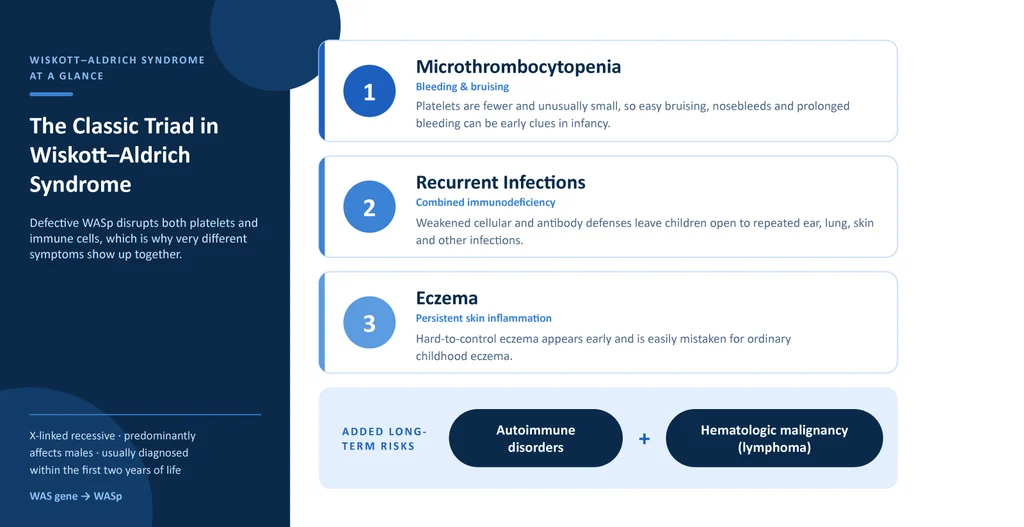
Doctors traditionally describe Wiskott–Aldrich syndrome through a classic triad of features. Not every Wiskott–Aldrich syndrome patient has all three at the same time, but together they form the signature of the disease.
Microthrombocytopenia: Small, Scarce Platelets
Platelets are the tiny cell fragments that help blood clot. In WAS, there are too few of them, and the ones present are unusually small. This is often the first clue. Babies may show pinpoint skin spots, easy bruising, nosebleeds, prolonged bleeding, or blood in the stool, sometimes within the first days or weeks of life. Because platelets are low, even a minor injury can cause more bleeding than expected.
Recurrent Infections From Combined Immunodeficiency
WAS affects more than one arm of the immune system, which is why it is described as a combined immunodeficiency. Children are vulnerable to repeated ear infections, pneumonia, sinus infections, skin infections, and other illnesses that are more frequent, more severe, or slower to clear than in other children. The immune system also tends to respond poorly to certain vaccines, which is one reason early specialist care matters.
Eczema
Many children with WAS develop eczema, a red, itchy, inflamed skin condition that often appears in infancy. In WAS, eczema can be persistent and difficult to control, and broken skin can in turn become an entry point for infection.
Beyond the Triad: Autoimmunity and Cancer Risk
The effects of WAS do not stop at the three classic signs. Because the immune system is not just weak but also poorly regulated, patients face a higher risk of autoimmune disorders, conditions in which the body mistakenly attacks its own tissues. These can include inflammation of blood vessels, autoimmune destruction of blood cells, and other immune-driven complications. Patients are also at increased risk of hematologic malignancies, cancers of the blood and lymphatic system, with lymphoma being the most notable. This elevated lifetime risk is one of the reasons doctors take a long-term view of WAS, and it strengthens the case for treatments that correct the underlying problem rather than only managing symptoms.
Rare by the Numbers: Who Gets WAS and Why Boys Bear the Brunt
WAS is exceptionally rare. Globally, it is estimated to occur in 1 to 10 cases per million live male births. The most widely cited figure comes from the United States, at roughly 4 cases per million live male births, or about 1 in 250,000. An estimated 500 people are living with WAS in the US, and incidence is considered comparable across Europe and the rest of the world.
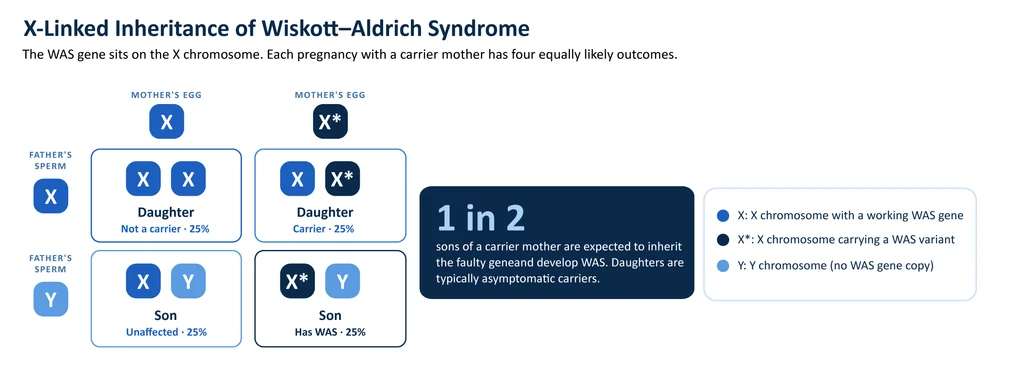
Because the WAS gene is carried on the X chromosome, the disorder predominantly affects males. A boy has one X chromosome, so a single faulty copy is enough to cause disease. Females, with two X chromosomes, are typically asymptomatic carriers, although rare symptomatic female cases have been reported. Symptoms usually surface in infancy, and most patients are diagnosed within the first two years of life. Advances in genetic testing, newborn screening, and growing clinical awareness are helping bring that window forward, which is good news: the earlier WAS is identified, the sooner families can plan protective care and discuss definitive treatment options.
Holding the Line: Supportive Care and the Standard of Treatment
Until recently, the management of Wiskott–Aldrich syndrome primarily relied on supportive care aimed at protecting patients from disease-related complications and maintaining their health until they could receive definitive treatment. The current standard of care involves a combination of approaches, including antimicrobial prophylaxis to prevent infections, immunoglobulin replacement therapy to compensate for inadequate antibody production, platelet transfusions to manage significant bleeding or provide support during surgical procedures, and eczema treatments to control skin inflammation and minimize infection-prone skin damage.
Additionally, autoimmune complications are treated as they arise. Although these interventions play an important role in improving patients’ quality of life and reducing disease-related risks, they primarily address the symptoms and complications rather than the underlying genetic defect. As the WAS gene remains defective, patients continue to face the risk of autoimmune disorders and lymphoma despite supportive management. Consequently, supportive care is considered a bridging approach rather than a definitive solution, highlighting the need for curative therapies that can address the underlying cause of the disease.
The Proven Cure and Its Catch: Stem Cell Transplantation for WAS Treatment
Allogeneic hematopoietic stem cell transplantation (HSCT) is the established curative treatment for Wiskott–Aldrich syndrome. The procedure involves replacing the patient’s defective blood-forming stem cells with healthy donor-derived stem cells, enabling the development of a functional immune system and normal platelet production through the introduction of cells carrying a working copy of the affected gene. The success of HSCT depends significantly on the timing of transplantation and donor availability, with outcomes generally being more favorable when the procedure is performed early in life using a well-matched donor. However, its application is limited by certain challenges, particularly the availability of a suitable Human Leukocyte Antigen (HLA)-matched donor and the risk of transplant-related complications, which may make the procedure unsuitable for some patients. Consequently, patients who lack an appropriate matched donor may have limited access to a curative treatment option, highlighting an important unmet medical need that gene therapy aims to address.
A Landmark Moment: WASKYRA Becomes the First Gene Therapy for WAS
In December 2025, the US Food and Drug Administration approved etuvetidigene autotemcel (WASKYRA), the first cell-based gene therapy for Wiskott–Aldrich syndrome treatment. It marks a historic shift in how the disease can be treated. WASKYRA is indicated for pediatric patients aged six months and older, and for adults who have a confirmed WAS gene mutation and are eligible for HSCT but lack a suitable HLA-matched related stem cell donor. In other words, it was built for the patients the transplant pathway has struggled to reach.
WASKYRA is an autologous therapy, meaning it uses the patient’s own cells. Rather than relying on a donor, the approach corrects the underlying genetic defect itself, instead of simply controlling its manifestations. That removes the need to find a matched donor and offers a potentially curative path for people who previously had few options. Momentum continued across the Atlantic. On January 9, 2026, WASKYRA received European Commission marketing authorization, following a positive opinion from the European Medicines Agency (EMA). The decision further expands patient access to this innovative treatment and signals growing regulatory confidence in gene therapy for rare immune disorders.
Behind the Breakthrough: Genethon and the Long Game of Follow-Up
The progress did not appear overnight. Genethon, a French non-profit research organization dedicated to developing gene therapies for rare diseases, played a central role in bringing this therapy to patients. It carried out the preclinical research and sponsored the pivotal Wiskott–Aldrich syndrome clinical studies conducted in France and the United Kingdom.
Genethon’s commitment does not end with approval. The organization continues to follow patients enrolled in these trials through 2032, tracking how long the benefits last and monitoring the therapy’s long-term safety. This kind of extended follow-up is essential in gene therapy, where regulators, doctors, and families all want to know not just whether a treatment works today, but whether it keeps working years down the line.
Other gene therapy approaches that target the root genetic cause of WAS, rather than managing individual symptoms, have also shown encouraging clinical outcomes, reflecting a broader field that is gaining strength.
From Managing Symptoms to Rewriting the Code: What Lies Ahead
The treatment story for Wiskott–Aldrich syndrome now has three chapters. First came supportive care, which protects patients day to day. Second came allogeneic HSCT, a proven cure for those with a well-matched donor and a body able to withstand the procedure. Third, and newest, is gene therapy, which corrects the genetic defect in a patient’s own cells.
As gene therapy continues to advance, it is expected to redefine the treatment paradigm for WAS, addressing a longstanding unmet need for patients who lack suitable HSCT donors. Earlier diagnosis through newborn screening and genetic testing will make the most of these options, because early intervention gives children the best chance of avoiding the infections, bleeding episodes, and complications that define the disease.
Important questions remain, including long-term durability, safety, and access across healthcare systems. Still, for a condition once defined by limited choices, the direction is unmistakably hopeful.

Downloads
Article in PDF
Recent Articles
- PTC Therapeutics’ Gene Therapy Upstaza; Sanofi and Regeneron’s Dupixent; Bayer CAR-T Collaboratio...
- WASKYRA Wins FDA Approval, Marking a Historic Leap for Rare Disease Gene Therapies
- FDA Approves Omeros’ YARTEMLEA: A Breakthrough for Stem Cell Transplant Patients Facing TA-TMA
- Alternative Therapeutic Strategies Beyond HSCT: Reimagining Curative Options in Hematologic Disease
- BMS’s LPA1 Antagonist; Alnylam’s KARDIA-1 Phase 2 Study; Day One Biopharma Sought FDA Appro...