CGRP Inhibitors in Migraine: The Breakthrough Class Rewriting How the World Treats Its Most Disabling Headache Disorder
Oct 05, 2026
Table of Contents
Summary
- Migraine affects approximately one in seven people globally and remains underdiagnosed and undertreated.
- Migraine care has shifted from repurposed drugs such as antihypertensives, antidepressants, and anticonvulsants toward mechanism-specific therapies targeting the CGRP pathway.
- Unlike triptans, CGRP-targeted therapies are non-vasoconstrictive, potentially broadening treatment options for patients with cardiovascular risk factors.
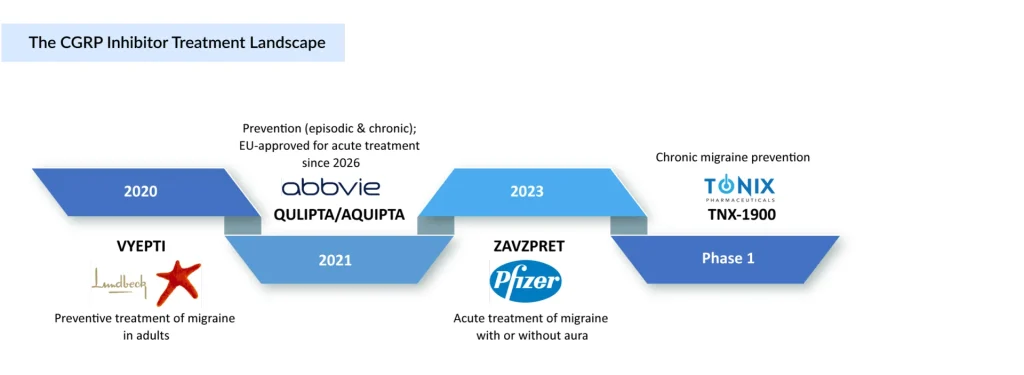
- Currently, Pfizer’s ZAVZPRET, H. Lundbeck A/S’s VYEPTI, and AbbVie’s QULIPTA/AQUIPTA are already winning the fight against migraine.
- Tonix Pharmaceuticals’ TNX-1900 represents a different approach by potentially reducing CGRP release rather than directly blocking CGRP or its receptor.
For decades, migraine treatment was a story of borrowed tools. Patients relied on drugs designed for other conditions, such as antihypertensives, antidepressants, and anticonvulsants, that happened to reduce attack frequency. Acute therapy meant triptans and NSAIDs, which many patients couldn’t tolerate or didn’t respond to. Then came calcitonin gene-related peptide (CGRP). This neuropeptide is released from trigeminal nerve endings during a migraine attack. It drives vasodilation, neurogenic inflammation, and pain signaling. Blocking it, either by neutralizing the peptide itself or by blocking its receptor, gave neurologists the first mechanism-based therapies built specifically for migraine.
Downloads
Click Here To Get the Article in PDF

Recent Articles
- AstraZeneca Scraps £450M UK Vaccine Factory; FDA Approves First Non-Opioid Pain Reliever JOURNAVX...
- BMS Sells NY Biologics Plant; FDA Approves Mitsubishi Tanabe’s Radicava, Love Pharma Acquires Mic...
- Ipsen to Buy Epizyme; BioMarin’s Gene Therapy for Hemophilia; AbbVie’s Qulipta for Ch...
- Viz.ai’s AI Algorithm for Abdominal Aortic Aneurysm; BrainTale Unveils the New Version of I...
- Integra to Buy J&J’s Acclarent; B. Braun Launches the CARESITE Micro Luer Access Devic; FDA ...
The class has expanded rapidly since 2018, when the first CGRP-targeting monoclonal antibody reached the market. It now encompasses monoclonal antibodies used for migraine prevention, including erenumab, fremanezumab, galcanezumab, and eptinezumab, as well as small-molecule CGRP receptor antagonists, known as “gepants,” which are used for both acute treatment and prevention. Acute-treatment gepants include ubrogepant, rimegepant, and zavegepant, while atogepant and rimegepant are used for preventive treatment.
Two key characteristics distinguish this class from traditional migraine therapies. First, CGRP-targeting therapies are non-vasoconstrictive, making them a treatment option for patients with cardiovascular risk factors who may not be suitable candidates for triptans. Second, these therapies generally have a favorable tolerability profile in clinical practice. As a result, migraine management is increasingly shifting from simply controlling symptoms toward targeting the underlying biology of the disease.
The Migraine Patient Burden: A Silent Global Crisis
Migraine is far more than “just a bad headache.” It is a chronic neurological disease with attacks that can last from four hours to three days. Migraine affects approximately one in seven people globally, making it one of the most prevalent neurological disorders worldwide. The condition disproportionately affects women, particularly during their peak working and caregiving years. According to DelveInsight, the US had the largest prevalent migraine population among the 7MM, with around 46 million cases in 2025. This burden is expected to increase substantially in the coming years, driven by improvements in diagnostic practices and population growth.
In the UK, episodic migraine represented more than 2 million diagnosed cases in 2025, continuing to impose a considerable burden on patients’ daily lives and overall health. Migraine prevalence is generally higher among women than men, with approximately 35 million women affected in the US in 2025. Women are also more likely to experience frequent migraine attacks and greater levels of disability, while men generally have a lower prevalence but may experience comparable disease severity when affected.
The World Health Organization has consistently identified migraine as one of the major contributors to years lived with disability worldwide, placing it among conditions that can substantially affect quality of life. The economic impact is also considerable, extending beyond the direct burden on patients. Migraine contributes to workplace absenteeism, as well as “presenteeism,” in which individuals continue working despite significantly reduced productivity during an attack. Consequently, employers and healthcare systems face substantial economic losses from missed workdays, diminished productivity, and disability-related claims associated with migraine.
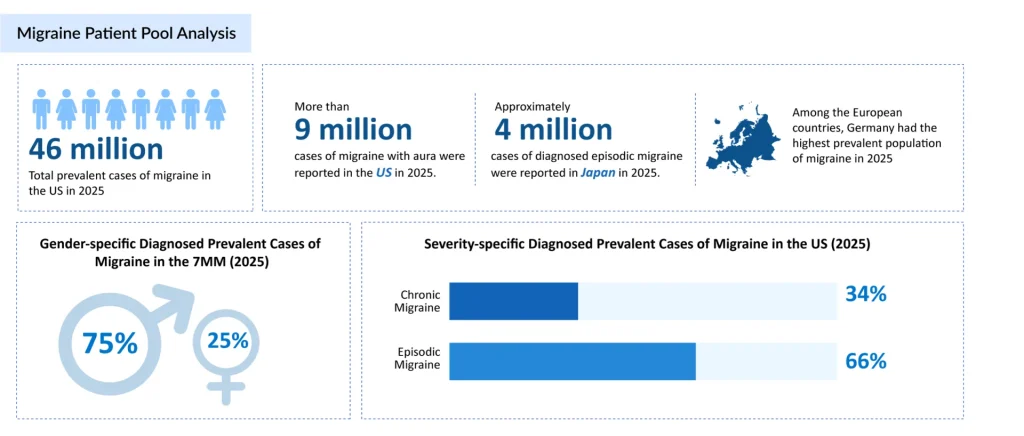
Despite this burden, migraine remains under-diagnosed and under-treated. Many patients never see a specialist. Many others stop preventive therapy because of side effects such as weight gain, fatigue or cognitive slowing. That gap between need and satisfaction is what the CGRP class is designed to close, and why drug developers keep investing in it.
The CGRP Arsenal: Drugs Already Winning the Fight Against Migraine
The approved CGRP toolkit now covers both sides of migraine care: stopping an attack in progress and preventing attacks from happening. Two drugs illustrate the range well, one built for speed and one built for durability.
Pfizer’s ZAVZPRET: The Fast-Acting Nasal Spray
Pfizer’s ZAVZPRET (zavegepant) was approved by the US FDA in March 2023 as the first and only CGRP receptor antagonist nasal spray for the acute treatment of migraine with or without aura in adults. The nasal route is particularly relevant during migraine attacks, as gastric emptying can slow and nausea may make swallowing an oral tablet difficult or even impossible. By bypassing the digestive tract, ZAVZPRET provides a practical alternative for patients who experience early vomiting or require rapid relief. In pivotal Phase 3 trials, a single 10 mg dose demonstrated superiority over placebo on the co-primary endpoints of pain freedom and freedom from the most bothersome symptom at two hours after dosing, with some patients reporting relief as early as 15 minutes after administration.
The most commonly reported adverse events included taste disturbance, nasal discomfort, and nausea. Strategically, ZAVZPRET strengthens Pfizer’s broader migraine franchise, which also includes the oral gepant, rimegepant, providing patients with both nasal and oral treatment options based on their attack patterns and preferences. The therapy may also represent an important option for patients who do not respond adequately to triptans or are unable to use them.
H. Lundbeck A/S’s VYEPTI: The Infusion That Works Fast
While ZAVZPRET targets the acute migraine attack, Lundbeck’s VYEPTI takes a preventive approach through a distinctive intravenous delivery model. Approved by the FDA in February 2020 for the preventive treatment of migraine in adults, VYEPTI is the first and only intravenous CGRP-targeting monoclonal antibody and is administered as an approximately 30-minute infusion once every three months. This quarterly dosing schedule requires only four treatment days per year, which may offer a convenient option for patients who struggle with adherence to daily oral medications or monthly injections. Intravenous administration also delivers the full dose directly into the bloodstream, supporting a rapid onset of action.
Clinical evidence from the PROMISE-1 trial in episodic migraine and the PROMISE-2 trial in chronic migraine demonstrated that VYEPTI significantly reduced monthly migraine days compared with placebo, with benefits emerging early, including fewer migraine days during the first weeks following infusion. Across clinical studies, its safety profile remained consistent, with nasopharyngitis and hypersensitivity reactions among the reported adverse events. Strategically, Lundbeck gained VYEPTI through its acquisition of Alder BioPharmaceuticals, and the therapy subsequently became an important component of the company’s neurology portfolio. Its infusion-based administration model aligns well with specialty-care settings and may appeal to patients seeking a less frequent, “set it and forget it” preventive treatment approach.
AbbVie’s QULIPTA/AQUIPTA: The Oral Preventive Gepant
AbbVie’s QULIPTA (atogepant) is a once-daily oral CGRP receptor antagonist. It was first approved for the prevention of episodic migraine in 2021, and its label was later expanded to include chronic migraine, making it the only oral CGRP therapy approved for preventing both forms of the disease. Since that initial approval, atogepant has been prescribed to nearly 200,000 patients in the US alone.
2026 has been a landmark year for atogepant, marked by significant advances in both its global regulatory expansion and clinical positioning. In June 2026, the European Commission approved AQUIPTA (atogepant) for the acute treatment of migraine with or without aura, to be taken as needed. This approval represents an important expansion of the drug’s role, as atogepant was previously established primarily as a preventive therapy.
With the new indication, atogepant is now approved in the EU for both migraine prevention through daily dosing and acute treatment through as-needed dosing, supported by data from the Phase III ECLIPSE trial. Globally, atogepant is now approved for migraine prophylaxis in more than 60 countries. Further strengthening its clinical profile, the Phase III TEMPLE study demonstrated that atogepant had significantly better tolerability than topiramate, a long-established oral migraine preventive. Treatment discontinuation due to adverse events was reported in 12.1% of patients receiving atogepant compared with 29.6% of those receiving topiramate, highlighting atogepant’s potential as an important frontline preventive treatment option.
Recently, in September 2026, AbbVie reported positive topline results from the Phase 3 LUNA study assessing atogepant for the preventive treatment of menstrual migraine in adults. The findings further underscore AbbVie’s focus on advancing migraine research and its ongoing efforts to develop innovative treatment options for people living with complex and debilitating migraine attacks.
Tonix Pharmaceuticals’ TNX-1900: An Emerging Challenger Taking a Different Route to CGRP
Tonix’s TNX-1900 remains the most mechanistically distinct candidate in the migraine pipeline. It is an intranasal potentiated oxytocin formulation, a non-CGRP-antagonist approach in development for chronic migraine. Its proposed mechanism includes inhibiting the release of CGRP in blood vessels within the brain, their lining, and the brainstem, and suppressing signaling in pain neurons. In other words, instead of blocking CGRP or its receptor, it aims to reduce how much CGRP is released in the first place.
The Phase 2 PREVENTION study was double-blind and placebo-controlled, and enrollment began in February 2023. The clinical phase closed in October 2023, with 88 patients having completed their final study visit. Tonix has continued exploring the mechanism since then. In March 2026, it announced that the first participant was dosed in a Phase 1 investigator-initiated study assessing TNX-1900’s effect on trigeminal nerve-mediated vasodilation of the forehead in healthy female volunteers.
Sadaf Javed, Functional Head of Forecasting & Analytics at Delveisnight, said that for a company managing several clinical setbacks elsewhere in its portfolio, TNX-1900’s continued mechanistic investment signals that Tonix still sees migraine, and a non-antagonist route to CGRP modulation, as one of its more promising long-term bets. It remains an early-stage, higher-risk candidate worth watching rather than a near-term market entrant.
Future Outlook: Where CGRP Therapy Goes Next
The CGRP class has already transformed migraine care, but the treatment landscape continues to evolve, with several themes likely to shape its next phase. As real-world evidence accumulates, clinical guidelines are increasingly supporting the use of CGRP-targeted therapies earlier in the treatment journey, rather than reserving them for patients who have failed multiple older preventive options. This shift could substantially expand the population eligible for these therapies.
At the same time, clinicians are exploring combination and sequencing strategies, including the use of acute and preventive gepants together and switching between different mechanisms when patients experience a plateau in response. Further evidence is expected to clarify optimal treatment sequences and combinations that can address both acute attacks and long-term prevention. Delivery innovation is also becoming an important differentiator, with nasal sprays, orally dissolving tablets, once-daily oral therapies, and quarterly infusions offering patients greater convenience. Future developments could include longer-acting formulations and simpler at-home treatment options.
Another area of focus is the expansion of treatment into populations with continued unmet needs, particularly pediatric and adolescent patients, as well as older adults and other special populations. In parallel, the industry is seeking solutions for patients who do not respond adequately to CGRP blockade. Candidates such as TNX-1900 and PACAP-directed therapies represent efforts to address these non-responders through alternative or next-generation approaches, while the development of predictive biomarkers could eventually enable more personalized treatment selection. Access and affordability will also remain important factors, as treatment costs and insurance restrictions continue to influence uptake across markets. As competition increases and longer-term evidence becomes available, payer dynamics are likely to play a significant role in determining how broadly these therapies are adopted.
Overall, CGRP inhibitors have helped move migraine from an underserved condition into one of neurology’s most active therapeutic areas. Pfizer’s ZAVZPRET offers rapid relief through nasal delivery, Lundbeck’s VYEPTI provides low-maintenance preventive treatment through quarterly infusions, and AbbVie’s atogepant demonstrates the potential of oral preventive therapy alongside injectable CGRP-targeted options. Meanwhile, Tonix’s TNX-1900 highlights the industry’s broader pursuit of new approaches for patients who may not benefit sufficiently from existing CGRP therapies. For the approximately one billion people living with migraine, these advances represent not only a significant therapeutic and commercial opportunity but also the potential for more effective, convenient, and personalized care.

Downloads
Article in PDF
Recent Articles
- Migraine Market: How Pharma Companies are trying to Uncomplicate the Disease and Bring in Novel T...
- Kallyope’s Elismetrep Achieves Primary and Secondary Endpoints in Phase 2b Clinical Study; IDEAYA...
- Ipsen to Buy Epizyme; BioMarin’s Gene Therapy for Hemophilia; AbbVie’s Qulipta for Ch...
- Neuroscience Highlights – 17/07/2018
- TAGRISSO Delivers Landmark Eight-Year Survival Outcomes in Early-Stage EGFR-Mutated Lung Cancer; ...