The Emergence of Oral PCSK9 Inhibitors: A Transformative Innovation in Lipid Management
Aug 07, 2026
Table of Contents
Summary
- For nearly a decade, PCSK9 inhibitors have been highly effective at lowering LDL cholesterol, but their growth has been limited by the need for injections.
- The U.S. FDA approval of Merck’s LIPFENDRA (enlicitide) changes that by introducing the first oral PCSK9 inhibitor, marking a major shift from needle-based to pill-based treatment.
- The approval was backed by findings from the Phase III CORALreef program, involving nearly 17,000 patients participating in the CORALreef Lipids and CORALreef HeFH studies, as well as the ongoing CORALreef Outcomes cardiovascular trial.
- Merck’s approval creates competitive pressure on Amgen, Sanofi, Regeneron, and Novartis, who will now need to defend their positions through pricing, payer access, and future formulation improvements.
- Several oral PCSK9 candidates are still in development, including AstraZeneca’s AZD0780 and Aqur Biosciences’ AQR-008, showing that this category is still evolving.
For nearly a decade, PCSK9 inhibitors have been one of the most important weapons against stubborn LDL cholesterol, but they’ve always come with a catch: the needle. From Amgen’s REPATHA to Regeneron and Sanofi’s PRALUENT to Novartis’ siRNA therapy LEQVIO, every approved PCSK9-targeted treatment has required an injection, a barrier that has quietly kept millions of eligible patients away from a drug class capable of slashing “bad” cholesterol by more than half.
Downloads
Click Here To Get the Article in PDF

Recent Articles
- Key Cardiovascular Deals of 2025: Sealing the Heartbeat
- Novartis Secures FDA Traditional Approval for Fabhalta in Primary IgAN; GSK Reports Mixed Phase I...
- Cholesterol drug Praluent successful in reducing heart risk
- PCSK9 Inhibitors: A New Era for Cholesterol Management
- KINECT 4 Study; KindredBio Announces Results; Mylan and Aspen’s Launch; EMA investigates; Amgen’s...
That barrier just came down. With the U.S. FDA approval of Merck’s LIPFENDRA (enlicitide), the world’s first oral PCSK9 inhibitor, the PCSK9 inhibitor market has entered an entirely new chapter, one where a once-daily pill can deliver injectable-level LDL-C reduction. This shift doesn’t just add another name to the list of PCSK9 inhibitors names; it fundamentally changes who can be treated, how early physicians are willing to intervene, and how the leading biopharmaceutical companies PCSK9 inhibitor portfolios will compete over the next decade.
The Shift from Needle to Pill: A New Era in Lipid Management
Until now, the PCSK9 inhibitors list has been dominated by three heavyweight injectables: REPATHA (evolocumab), Amgen’s monoclonal antibody administered every two to four weeks; PRALUENT (alirocumab), Regeneron and Sanofi’s monoclonal antibody delivered via subcutaneous injection; and LEQVIO (inclisiran), Novartis’ siRNA-based therapy, which is administered only twice yearly but still requires in-office or clinician-administered injections.
These PCSK9 inhibitor drugs have proven remarkably effective at lowering LDL-C, yet real-world uptake has lagged far behind their clinical promise. Prescriber unfamiliarity, prior-authorization hurdles, and, perhaps most significantly, patient reluctance around self-injection or recurring office visits have kept these therapies confined largely to high-risk patients who have already failed statins and other oral options.
This is exactly the gap that oral PCSK9 inhibitor drugs are positioned to close. A convenient tablet removes the single biggest psychological and logistical barrier to PCSK9 therapy: the injection itself. Physicians who have historically been hesitant to escalate patients past statins onto an injectable may now feel far more comfortable adding an oral PCSK9 inhibitor earlier in the treatment pathway, particularly for patients with heterozygous familial hypercholesterolemia (HeFH) or those who simply cannot reach their LDL-C goals on statins alone.
For the PCSK9 inhibitors manufacturers that built their franchises on injectable formats, this is a genuine competitive inflection point. Amgen, Sanofi, Regeneron, and Novartis will need to defend market share not through head-to-head efficacy alone; oral and injectable PCSK9 drugs appear broadly comparable on LDL-C reduction, but through pricing strategy, payer relationships, and potentially their own next-generation oral or extended-dosing formulations. Meanwhile, an oral option expands the addressable population substantially, meaning the overall PCSK9 inhibitors market may grow rather than simply redistribute among existing players. In short, this isn’t just a new entrant; it’s a structural shift in how the entire PCSK9 inhibitor market will be defined going forward.
Merck’s LIPFENDRA: World’s First Oral PCSK9 Treatment
The U.S. FDA has officially approved LIPFENDRA tablets, 20 mg, as an adjunct to diet and exercise to reduce LDL-C in adults with hypercholesterolemia, including HeFH, making it the first-ever approved oral PCSK9 inhibitor and a genuine milestone among approved PCSK9 inhibitors. LIPFENDRA is built on macrocyclic peptide technology, a chemistry platform that allows a molecule to bind PCSK9 with the specificity typically associated with injectable biologics while retaining the oral bioavailability of a small-molecule drug. Mechanistically, it works the same way as its injectable predecessors: by blocking the interaction between PCSK9 and LDL receptors, allowing the liver to clear more LDL cholesterol from the bloodstream.
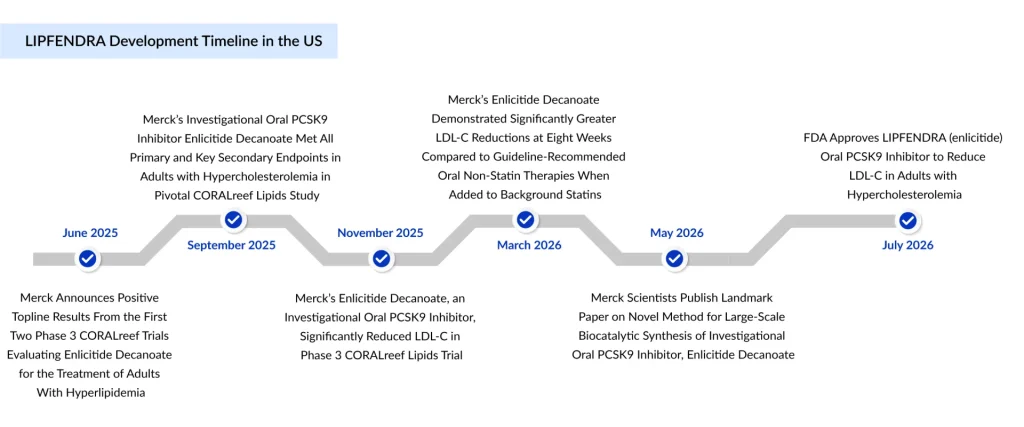
The approval was supported by the CORALreef Phase 3 program, encompassing roughly 17,000 patients across the CORALreef Lipids and CORALreef HeFH trials, plus an ongoing CORALreef Outcomes cardiovascular study. At 24 weeks, LIPFENDRA delivered a placebo-adjusted LDL-C reduction of 56% in the general hypercholesterolemia population and 59% in patients with HeFH, figures that place it firmly on par with the strongest injectable PCSK9 therapy results, while offering the convenience of a once-daily pill rather than a subcutaneous injection. Notably, LIPFENDRA moved through the FDA’s Commissioner’s National Priority Voucher (CNPV) program, an expedited review pathway, underscoring the regulatory urgency around bringing new oral lipid-lowering options to market.
For clinicians and patients, this is more than a new SKU added to the PCSK9 inhibitors drugs name roster; it’s the first time an entire class of biologic-grade cholesterol therapy has been made available in pill form. For an obvious subset of patients, those unable or unwilling to tolerate injections, LIPFENDRA effectively creates access to PCSK9 therapy where none previously existed. And for Merck, it establishes first-mover advantage in what analysts already expect to become a multibillion-dollar category within the broader PCSK9 market.
Emerging Oral PCSK9 Inhibitor Developers and Investigational Candidates
LIPFENDRA’s approval hasn’t ended the race for oral PCSK9 dominance; if anything, it has intensified it. Several new PCSK9 inhibitors are moving through active development, each representing a different strategic bet on how to build the next generation of oral lipid-lowering therapy.
AZD0780 is currently AstraZeneca’s leading oral PCSK9 inhibitor small molecule development 2025 candidate, and it has already advanced into Phase 3 testing. In its Phase 2b PURSUIT trial, AZD0780 delivered a 50.7% placebo-adjusted LDL-C reduction at a 30 mg dose on top of statin therapy, with earlier Phase 1 data showing total LDL-C reductions approaching 78% from baseline when combined with rosuvastatin. AstraZeneca has also highlighted that AZD0780 can reportedly be dosed without regard to food, a meaningful differentiator, since some oral PCSK9 candidates require empty-stomach administration. A dedicated Phase 3 cardiovascular outcomes trial is now underway, positioning AZD0780 as one of the most closely watched oral PCSK9 inhibitors in development 2026.
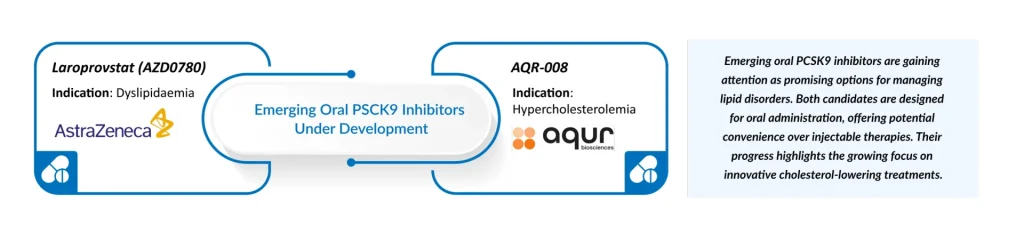
Aqur Biosciences’ AQR-008 takes a distinctly different mechanistic route. Rather than directly inhibiting PCSK9 production, AQR-008 targets the EGF-A domain of the LDL receptor itself, blocking PCSK9 from binding to LDL-R while preserving PCSK9’s other biological functions that remain under active research. This “receptor-protective” approach reflects a broader trend among emerging PCSK9 inhibitor drugs: rather than simply replicating the mechanism of the first approved therapies, newer developers are exploring differentiated targets designed to improve selectivity, safety, and convenience.
Beyond these two headline programs, the wider oral PCSK9 inhibitors development status 2026 landscape includes additional small-molecule and macrocyclic peptide candidates from both large pharmaceutical companies and specialized biotechs, alongside academic and translational research into fully small-molecule PCSK9 antagonists designed for even simpler, more cost-effective manufacturing than peptide-based approaches. Collectively, these programs illustrate that LIPFENDRA is not the finish line for oral PCSK9 therapy, it’s the starting gun for a much larger wave of latest PCSK9 inhibitors 2026 innovation, as leading biopharmaceutical companies PCSK9 inhibitor divisions race to bring differentiated PCSK9i drugs to market.
The Road Ahead for Oral PCSK9 Inhibitors
The FDA approval of LIPFENDRA is likely to function as a catalyst rather than a conclusion. Having demonstrated that an oral PCSK9 inhibitor can match injectable-level efficacy while dramatically improving convenience, Merck has effectively validated the entire oral PCSK9 category, and validated it in a way that will pressure every competing manufacturer to accelerate their own timelines.
Expect three parallel effects to play out across the PCSK9 inhibitor market over the coming years. First, injectable incumbents, REPATHA, PRALUENT, and LEQVIO, will face growing pressure to demonstrate differentiated value, whether through pricing, dosing convenience (as with LEQVIO’s twice-yearly schedule), or expanded cardiovascular outcomes data. Second, developers with oral candidates already in the clinic, particularly AstraZeneca’s AZD0780, will push to close the gap with Merck as quickly as trial data allows, while earlier-stage innovators like Aqur Biosciences work to prove out differentiated mechanisms that could offer safety or efficacy advantages down the line. Third, and perhaps most importantly, overall PCSK9 therapy utilization is likely to expand, as oral administration lowers the threshold for physicians to prescribe and patients to accept PCSK9-targeted treatment earlier in the cardiovascular risk continuum.
Longer term, the emergence of oral PCSK9 inhibitors could meaningfully reshape cardiovascular disease prevention. Atherosclerotic cardiovascular disease remains one of the leading causes of death worldwide, and a substantial share of at-risk patients never reach guideline-recommended LDL-C targets on statins alone. An accessible, needle-free PCSK9 option, one that can be prescribed as easily as any other daily pill, has the potential to close that treatment gap at a population level, not just an individual one.
LIPFENDRA may be the first approved PCSK9 inhibitors entrant in oral form, but it almost certainly won’t be the last. As AZD0780, AQR-008, and other undisclosed programs progress through late-stage trials, the pcsk9 inhibitor market is poised for a new era of competition, one measured not just by LDL-C reduction, but by how effectively each therapy can turn a proven biological mechanism into a treatment patients will actually take. For the next decade of lipid management and cardiovascular prevention, that shift from needle to pill may prove to be the real breakthrough.

Downloads
Article in PDF
Recent Articles
- Novartis Secures FDA Traditional Approval for Fabhalta in Primary IgAN; GSK Reports Mixed Phase I...
- Notizia
- Cholesterol drug Praluent successful in reducing heart risk
- PCSK9 Inhibitors: A New Era for Cholesterol Management
- KINECT 4 Study; KindredBio Announces Results; Mylan and Aspen’s Launch; EMA investigates; Amgen’s...