
Ophthalmic Devices Market Summary
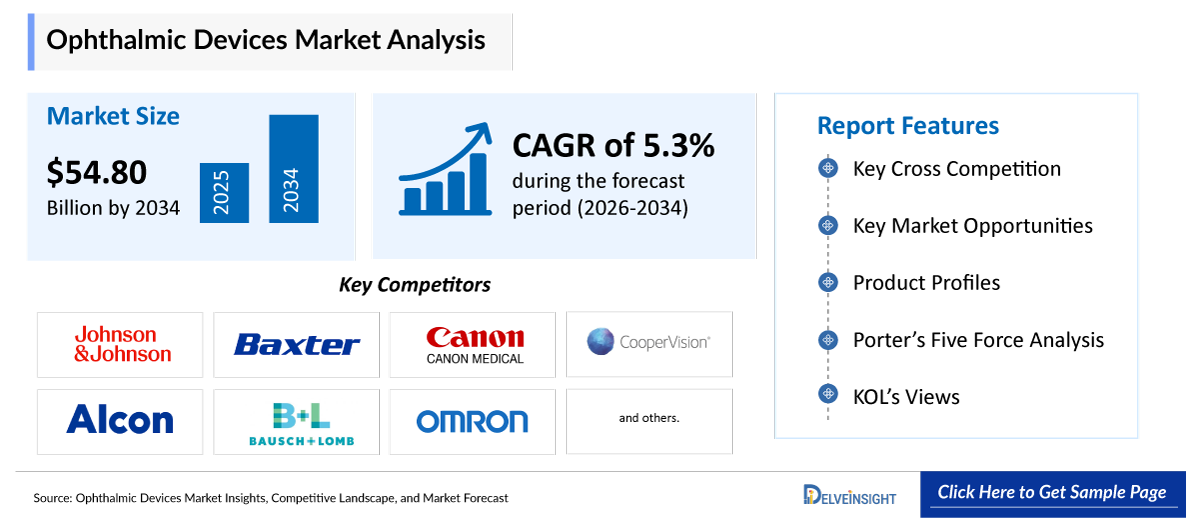
- The ophthalmic devices market is estimated at USD 34.50 billion in 2025 and is projected to reach USD 54.80 billion by 2034. Growth is anchored in the rising global prevalence of cataract, glaucoma, and retinal disorders, the accelerating myopia epidemic, an aging population, and continuous technological advancement in surgical, diagnostic, and lens-based eye-care solutions.
- The global Ophthalmic Devices market is growing at a CAGR of 5.3% during the forecast period from 2026 to 2034.
- By product type, the lenses segment dominated the ophthalmic devices market with a 41% share in 2025.
- By application, the cataract segment dominated the ophthalmic devices market with a 38% share in 2025.
- By end-user, the hospitals segment dominated the ophthalmic devices market with a 46% share in 2025.
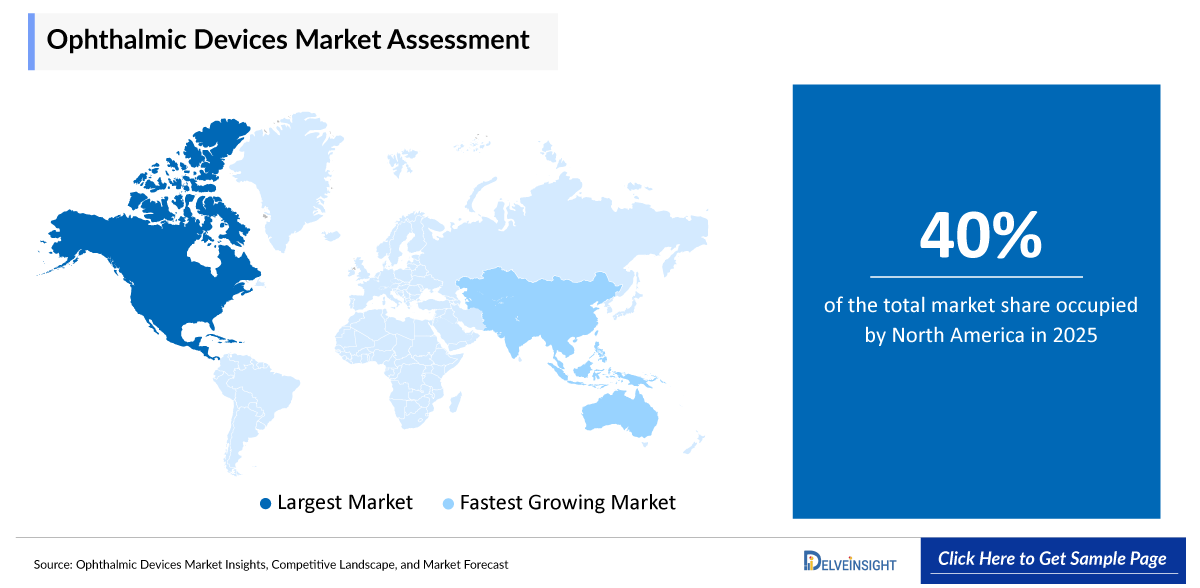
- North America dominated the global ophthalmic devices market revenue with a 40% share in 2025, representing the highest regional market share globally.
Ophthalmic devices encompass the specialized medical instruments and implants used to diagnose, monitor, and treat disorders of the eye and visual system. Because ocular conditions such as cataract, glaucoma, retinopathies, age-related macular degeneration, and refractive error affect a growing share of the aging and screen-exposed global population, hospitals, specialty eye clinics, and ambulatory surgical centers rely on an expanding toolkit of surgical devices, diagnostic and monitoring systems, and corrective lenses to deliver precise, minimally invasive eye care. Surgical devices span phacoemulsification systems for cataract removal, ophthalmic viscoelastic devices that protect intraocular tissue during surgery, glaucoma drainage devices, vitrectomy systems for retinal procedures, and excimer and photocoagulation lasers used in refractive and retinal treatment. Diagnostic and monitoring devices, including optical coherence tomography systems, ophthalmic ultrasound systems, fundus cameras, slit lamps, and corneal topography systems, enable early detection and longitudinal tracking of ocular disease. Lenses, comprising intraocular lenses, soft and rigid gas-permeable contact lenses, and spectacle lenses, remain the largest revenue contributor given the sheer scale of global vision-correction demand. Driven by rising disease burden, an aging population, the global rise in myopia, and continuous innovation in femtosecond and excimer laser platforms and premium lens technology, ophthalmic devices have become indispensable infrastructure underpinning modern eye-care delivery.
Ophthalmic Devices Market Key Growth Drivers
- The rising global prevalence of cataract, glaucoma, and retinal disorders is expanding procedure volumes, with the World Health Organization estimating that approximately 153 million people worldwide are affected by some form of visual impairment.
- The accelerating global myopia epidemic is driving demand for corrective and myopia-control lenses, with the WHO and Brien Holden Vision Institute projecting myopia to affect 50% of the global population by 2050.
- An aging global population is expanding cataract surgical volumes and increasing demand for premium intraocular lenses and phacoemulsification platforms.
- Continuous technological advancement in optical coherence tomography, AI-enabled diagnostic screening, and femtosecond and excimer laser platforms is improving detection accuracy and surgical precision.
- Growing adoption of minimally invasive ophthalmic surgery is increasing demand for advanced phacoemulsification systems, glaucoma drainage devices, and small-incision vitrectomy systems.
- Expanding reimbursement frameworks and the shift of cataract and refractive procedures toward ambulatory surgical centers and specialty clinics are broadening access to advanced ophthalmic devices.
- Strong M&A, investment, and strategic partnership activity, including Alcon's planned acquisition of STAR Surgical Company and BVI Medical's USD 1 billion capital raise, is expanding competitive capacity across the value chain.
Key Companies in Ophthalmic Devices Market
The competitive landscape is led by the following active device manufacturers:
- Johnson & Johnson Services, Inc.
- Baxter
- CANON MEDICAL SYSTEMS EUROPE B.V.
- CooperVision, Inc.
- Alcon Inc.
- Bausch & Lomb, Inc.
- OMRON Corporation
- Ziemer Ophthalmic Systems AG
- Essilor Instruments USA Ltd.
- Konan Medical USA, Inc.
For illustrative purposes, only the top 10 companies are listed in the Table of Contents. The report may include analysis and references to additional companies relevant to the market assessment.
Ophthalmic Devices Market Size
The following snapshot summarizes the principal report metrics for the ophthalmic devices market.
|
Report Metrics |
Details |
|
2025 Market Size |
USD 34.50 billion |
|
2034 Projected Market Size |
USD 54.80 billion |
|
Growth Rate (2026-2034) |
5.3% CAGR |
|
Largest Market |
North America |
|
Fastest Growing Market |
Asia-Pacific |
|
Market Structure |
Moderately Fragmented |
All market values are expressed in USD and represent DelveInsight estimates synthesized from primary and secondary research.
Factors Contributing to the Growth of the Ophthalmic Devices Market
Market Drivers
Rising Global Prevalence of Cataract, Glaucoma, and Retinal Disorders
The most fundamental driver of the Ophthalmic Devices market is the sheer scale of global eye-disease burden. Cataract, glaucoma, diabetic retinopathy, and age-related macular degeneration together account for the large majority of avoidable vision impairment and blindness worldwide, and the World Health Organization estimates that approximately 153 million people globally live with some form of visual impairment. As disease prevalence rises alongside population aging and the growing burden of diabetes-related eye complications, demand for diagnostic imaging, surgical intervention, and corrective lenses grows in parallel. Hospitals and specialty eye clinics increasingly invest in phacoemulsification systems, optical coherence tomography platforms, and vitrectomy systems to manage rising patient volumes, anchoring durable, recurring demand for ophthalmic devices through 2034.
Rapid Growth of the Global Myopia Epidemic
Myopia has become a defining growth driver for the vision-correction segment of the market. The World Health Organization and the Brien Holden Vision Institute project that myopia will affect roughly half of the global population by 2050, with high myopia affecting approximately one in ten people. This has accelerated demand for corrective and myopia-management spectacle and contact lenses, exemplified by the U.S. FDA's September 2025 authorization of Essilor Stellest myopia-control lenses following clinical data showing a substantial reduction in myopia progression, and by CooperVision's expanding MiSight 1-day pediatric myopia-control lens franchise. As childhood myopia prevalence climbs across urbanized, screen-intensive populations, demand for both diagnostic corneal topography and corrective lens technology continues to expand.
Aging Population and Expanding Cataract Surgical Volumes
The global aging population is directly expanding cataract surgical volumes, the single largest procedure category in ophthalmology. Cataract remains a leading cause of reversible blindness, and rising life expectancy across North America, Europe, and Asia-Pacific is increasing the pool of patients eligible for surgery. This is driving sustained demand for phacoemulsification devices, ophthalmic viscoelastic devices that protect the eye during surgery, and both standard and premium intraocular lenses, including toric, multifocal, and extended-depth-of-focus designs. As surgical volumes climb and patients increasingly opt for premium lens upgrades, demand for advanced surgical devices and lens technology is expected to grow steadily through the forecast period.
Technological Advancements in Diagnostic Imaging and AI-Enabled Screening
Continuous innovation in diagnostic and monitoring technology is expanding the clinical utility and adoption of ophthalmic devices. Optical coherence tomography systems now deliver higher-resolution, faster imaging for early detection of glaucoma, diabetic retinopathy, and macular degeneration, while artificial-intelligence-enabled screening tools are improving diagnostic accuracy and enabling broader population-level screening. Advances in corneal topography, ophthalmic ultrasound, and fundus imaging are supporting earlier intervention and better surgical planning. As healthcare systems prioritize early detection to reduce the downstream cost of vision loss, demand for advanced diagnostic and monitoring devices continues to expand across hospitals, specialty clinics, and screening programs.
Increasing Adoption of Minimally Invasive Ophthalmic Surgery
A structural shift toward minimally invasive ophthalmic surgery is reshaping demand across the surgical device segment. Smaller-incision phacoemulsification, microinvasive glaucoma surgery, and small-gauge vitrectomy systems reduce recovery time, lower complication rates, and improve patient throughput, encouraging both hospitals and specialty clinics to upgrade surgical platforms. Glaucoma drainage devices and excimer and photocoagulation lasers are similarly evolving toward more precise, less invasive designs. As surgeons and patients increasingly favor minimally invasive approaches, device manufacturers are directing R&D investment toward next-generation, precision-engineered surgical systems, reinforcing sustained capital-equipment and consumables demand.
Expanding Reimbursement and Growth of Ambulatory Surgical Centers
The continued shift of cataract, refractive, and select retinal and glaucoma procedures toward ambulatory surgical centers and specialty eye clinics is broadening access to ophthalmic devices. Favorable reimbursement structures in the United States and parts of Europe, combined with lower per-case costs at ambulatory sites relative to hospital outpatient departments, are encouraging providers to invest in office-based diagnostic and surgical equipment. This shift is expanding the addressable base of specialty-clinic customers for device manufacturers and is expected to sustain procedure-volume growth across the forecast period.
Strong M&A, Investment, and Strategic Partnership Activity
Robust deal-making and capital investment are accelerating capability build-out across the ophthalmic devices value chain. Alcon's August 2025 agreement to acquire STAR Surgical Company adds the EVO Implantable Collamer Lens portfolio for myopia correction, BVI Medical raised USD 1 billion in March 2025 to expand its surgical device platform, and EssilorLuxottica's planned acquisition of the Optegra eye-hospital network extends its reach into diagnostics and surgical services across Europe. This wave of consolidation and investment is expanding manufacturing capacity, broadening product portfolios, and validating the long-term growth trajectory of the sector.
Market Restraints
Despite strong momentum, the Ophthalmic Devices market faces material constraints. The high cost of advanced diagnostic and surgical platforms, including premium femtosecond laser systems and optical coherence tomography devices, limits adoption among smaller clinics and providers in price-sensitive and emerging markets. Reimbursement for premium intraocular lenses, advanced diagnostic imaging, and select minimally invasive procedures remains uneven across geographies, constraining upgrade cycles. A global shortage of trained ophthalmologists and ophthalmic surgeons, particularly in rural and low-income regions, limits the pace at which surgical device capacity can be absorbed. Stringent regulatory approval pathways for implantable devices such as intraocular and glaucoma drainage devices lengthen development timelines and raise compliance costs, while device recalls and post-market surveillance requirements add further operational burden. Intensifying price competition, particularly in commoditized categories such as standard intraocular lenses and soft contact lenses, is pressuring margins for established manufacturers. Limited eye-care infrastructure and diagnostic screening access in parts of Africa, Latin America, and South Asia continue to constrain market penetration, even as the underlying drivers of disease burden, myopia growth, and technological advancement remain firmly intact.
Ophthalmic Devices Market Segment Analysis
The Ophthalmic Devices by Product Type (Surgical Devices [Phacoemulsification Devices, Ophthalmic Viscoelastic Devices, Glaucoma Drainage Devices, Vitrectomy Systems, Excimer Lasers, Photocoagulation Lasers, Others], Diagnostic and Monitoring Devices [Optical Coherence Tomography Systems, Ophthalmic Ultrasound Systems, Fundus Cameras, Slit Lamps, Corneal Topography Systems, Others], Lenses [Intraocular Lenses, Contact Lenses (Soft Contact Lenses, Rigid Gas Permeable Contact Lenses), Spectacle Lenses, Others], Others), Application (Glaucoma, Cataract, Retinopathies, Age-Related Macular Degeneration, Myopia, Others), End-User (Hospitals, Specialty Clinics, Others), and Geography (North America, Europe, Asia-Pacific, and Rest of World).
By Product Type
Dominant Subsegment: Lenses. The lenses category is expected to dominate the market.
Dominant: Small Molecule ~ 51%
The lenses segment accounted for 41% of the ophthalmic devices market in 2025. Lenses lead the product-type segmentation because they address the largest and most universal category of eye-care need: vision correction. Intraocular lenses capture recurring demand tied to the very large and growing volume of cataract surgeries performed worldwide, while soft contact lenses and spectacle lenses serve a vast and expanding base of patients with refractive error and myopia. The accelerating global myopia epidemic, growing adoption of premium toric and multifocal intraocular lenses, and rising demand for daily-disposable and myopia-control contact lenses, illustrated by CooperVision's MiSight 1-day and EssilorLuxottica's Essilor Stellest, sustain the segment's scale. While diagnostic and monitoring devices are the fastest-growing product category, propelled by optical coherence tomography and AI-enabled screening, the sheer volume and recurrence of lens-based vision correction secure the lenses segment's leadership across the forecast period.
By Application
Dominant Subsegment: Cataract. The cataract category is expected to dominate the market.
Dominant: Cataract ~ 38%
The cataract segment accounted for 38% of the ophthalmic devices market in 2025. Cataract is the leading application because it remains the single largest cause of reversible blindness worldwide and generates the highest volume of ophthalmic surgical procedures. Rising life expectancy and an aging global population continue to expand the eligible patient pool, driving sustained demand for phacoemulsification devices, ophthalmic viscoelastic devices, and both standard and premium intraocular lenses. The high-frequency, well-reimbursed nature of cataract surgery, combined with growing patient demand for premium lens upgrades, secures large and dependable device demand. While myopia is the fastest-growing application given the accelerating global myopia epidemic among children and young adults, the scale, frequency, and clinical maturity of cataract surgery keep it the dominant application across the forecast period.
By End-User
Dominant Subsegment: Hospitals. The hospitals category is expected to dominate the market.
Dominant: Hospitals ~ 46%
The hospitals segment accounted for 46% of the ophthalmic devices market in 2025. Hospitals lead the end-user segmentation because they perform the majority of complex ophthalmic surgical procedures, including vitrectomy, glaucoma drainage device implantation, and cataract surgery for higher-risk patients, and because they maintain the capital-intensive diagnostic infrastructure, including optical coherence tomography and ophthalmic ultrasound systems, required for comprehensive eye-care delivery. Hospitals also serve as the primary referral point for retinal disease and advanced glaucoma management, sustaining consistent demand for both surgical and diagnostic devices. Specialty clinics are the fastest-growing end-user category as routine cataract and refractive procedures increasingly shift to lower-cost, higher-throughput ambulatory settings, but the breadth of services and diagnostic depth concentrated in hospitals preserve their leadership across the forecast period.
Ophthalmic Devices Market Region Analysis
Dominant Region: North America
Dominant: North America ~ 40% (Largest)
North America accounted for 40% of the global ophthalmic devices market revenue in 2025, representing the highest regional market share globally. The region's dominance reflects advanced healthcare infrastructure, high adoption of innovative surgical and diagnostic technology, favorable reimbursement frameworks for cataract and refractive procedures, and the concentrated presence of leading device manufacturers including Alcon, Johnson & Johnson Vision, Bausch & Lomb, and CooperVision. The United States drives the bulk of regional demand, supported by a large aging population, high cataract surgical volumes, and rapid adoption of premium intraocular lenses and advanced diagnostic imaging. Continued innovation, including Alcon's Voyager DSLT glaucoma laser and expanding ambulatory surgical center capacity, reinforces the region's leadership, while strong private and public reimbursement sustains device upgrade cycles across the forecast period.
Fastest Growing Region: Asia-Pacific
Asia-Pacific is the fastest-growing region in the ophthalmic devices market. The region's elevated CAGR is driven by a large and rapidly aging population, rising cataract surgical volumes, an accelerating childhood myopia epidemic across China, Japan, South Korea, and India, and expanding healthcare infrastructure investment. China is scaling domestic ophthalmic device manufacturing and hospital capacity, Japan continues to adopt advanced diagnostic and myopia-control technologies, exemplified by CooperVision's 2025 MiSight approval, India benefits from expanding low-cost cataract surgical capacity and rising eye-health awareness, and South Korea and Australia are adopting premium diagnostic and surgical platforms. Government screening programs, rising disposable income, and growing medical tourism further accelerate device adoption, positioning Asia-Pacific as the principal source of incremental growth over the forecast period.
Regional Commentary
North America
North America accounted for 40% of the global Ophthalmic Devices market revenue in 2025. The United States dominates on the strength of its healthcare infrastructure, reimbursement clarity, high cataract surgical volumes, and concentration of leading manufacturers, while continued innovation in premium lenses and minimally invasive surgical platforms reinforces its leadership.
Europe
Europe is a large and advanced regional market, supported by well-established reimbursement systems, a strong base of ophthalmic device manufacturers including Ziemer Ophthalmic Systems and Canon Medical Systems Europe, and rising adoption of advanced diagnostic imaging. EssilorLuxottica's planned acquisition of the Optegra eye-hospital network across the United Kingdom, Czech Republic, Poland, Slovakia, and the Netherlands illustrates the region's growing integration of diagnostics, surgery, and vision care.
Asia-Pacific
Asia-Pacific is the fastest-growing region, propelled by a large aging population, accelerating cataract surgical volumes, and a rapidly rising childhood myopia epidemic across China, Japan, India, and South Korea. Expanding hospital infrastructure, government screening initiatives, and growing adoption of myopia-control lens technology are accelerating regional device demand.
Rest of World
The Rest of World region, spanning Latin America, the Middle East, and Africa, is an emerging growth frontier. Expanding eye-care infrastructure, rising awareness of preventable blindness, and growing government and non-governmental screening initiatives are gradually broadening access to diagnostic and surgical ophthalmic devices, while international partnerships and medical tourism support continued build-out of regional capacity.
Ophthalmic Devices Market Competitive Landscape
The Ophthalmic Devices market is classified as Moderately Fragmented. A group of large, diversified players with broad surgical, diagnostic, and lens portfolios, including Alcon, Johnson & Johnson Vision, Bausch & Lomb, and CooperVision, anchor the top tier through global manufacturing scale and reimbursement relationships, while specialized diagnostic and surgical-equipment providers such as Canon Medical Systems Europe, Ziemer Ophthalmic Systems, Konan Medical, OMRON, Essilor Instruments, and Baxter compete through technology depth, regional presence, and focused product innovation, sustaining active competition across surgical, diagnostic, and lens categories.
The competitive landscape can be evaluated across the following dimensions:
- Market concentration: Moderately fragmented, with large diversified vision-care companies leading and a broad field of specialized surgical, diagnostic, and imaging device providers.
- Leading players: Alcon, Johnson & Johnson Vision, Bausch & Lomb, and CooperVision anchor the top tier through global manufacturing scale and broad surgical and lens portfolios.
- Geographic reach: Leaders operate global commercial networks spanning North America, Europe, and Asia-Pacific; Alcon reported first-quarter 2026 sales of USD 2.7 billion, underscoring the scale of leading players.
- Product portfolio strength: Top players offer end-to-end portfolios spanning surgical devices, diagnostic and monitoring systems, and intraocular, contact, and spectacle lenses.
- Technology and innovation access: Ownership of advanced surgical laser platforms, premium intraocular lens technology, and AI-enabled diagnostic imaging is a decisive competitive advantage.
- Strategic partnerships: Tie-ups such as Ziemer's collaboration with CorneaGen on the GALILEI CTAK module and CooperVision's regulatory partnerships extend clinical reach.
- M&A activity: Active consolidation, including Alcon's planned acquisition of STAR Surgical Company and EssilorLuxottica's planned acquisition of the Optegra eye-hospital network.
- Manufacturing capabilities: Precision optics manufacturing, laser-system engineering, and lens-casting capacity at scale are key competitive moats.
- Innovation focus: Myopia-control lens technology, AI-enabled diagnostic screening, minimally invasive surgical platforms, and premium intraocular lens design.
Ophthalmic Devices Market Recent Developmental Activities
In 2026, Alcon Inc. reported first-quarter 2026 sales of USD 2.7 billion, up 10% on a reported basis, with growth momentum from its Unity and Tryptyr product launches. Strategic significance: Reinforces Alcon's leadership position across surgical and vision-care device categories.
In 2026, Bausch & Lomb, Inc. introduced PreserVision AREDS3, an updated formulation supporting the nutritional management of age-related macular degeneration. Strategic significance: Extends Bausch & Lomb's vision-care portfolio addressing retinal disease management.
In August 2025, Alcon Inc. entered into a definitive merger agreement to acquire STAR Surgical Company, adding the EVO Implantable Collamer Lens portfolio for moderate-to-high myopia correction. Strategic significance: Expands Alcon's premium refractive lens portfolio and strengthens its myopia-correction offering.
In September 2025, Essilor Instruments USA Ltd. (EssilorLuxottica) received U.S. FDA authorization for Essilor Stellest myopia-control spectacle lenses following clinical data showing a substantial reduction in myopia progression and axial elongation. Strategic significance: Strengthens the company's position in the fast-growing myopia-management lens category.
In August 2025, CooperVision, Inc. received approval from Japan's Ministry of Health, Labour and Welfare for its MiSight 1-day contact lenses, the first soft contact lens authorized in Japan for pediatric myopia control. Strategic significance: Extends CooperVision's myopia-management franchise into a major Asia-Pacific market.
In May 2025, Bausch & Lomb, Inc. launched the Zenlens CHROMA HA scleral contact lens in the United States, a wavefront-guided, custom scleral lens technology. Strategic significance: Broadens Bausch & Lomb's specialty contact lens portfolio for complex corneal conditions.
In February 2025, Alcon Inc. made its Voyager direct selective laser trabeculoplasty (DSLT) device commercially available in the United States as the first automated DSLT system for glaucoma management. Strategic significance: Adds an innovative, gonio-lens-free glaucoma treatment platform to Alcon's surgical portfolio.
In 2025, Ziemer Ophthalmic Systems AG partnered with CorneaGen to launch the GALILEI CTAK diagnostic module supporting corneal tissue addition keratoplasty procedures on its GALILEI platform. Strategic significance: Extends Ziemer's diagnostic platform into emerging corneal surgical applications.
In 2025, Johnson & Johnson Services, Inc. (Vision) continued the rollout of its ACUVUE contact lens portfolio, including drug-eluting and myopia-management lens technologies. Strategic significance: Reinforces Johnson & Johnson's leadership in the global contact lens category.
In 2024, Bausch & Lomb, Inc., introduced INFUSE One Day for Astigmatism, a silicone hydrogel daily disposable contact lens featuring approximately 55% moisture content. Strategic significance: Strengthens Bausch & Lomb's daily-disposable toric contact lens offering.
Ophthalmic Devices Market Segmentation
Ophthalmic Devices Market by Product Type
- Surgical Devices
- Phacoemulsification Devices
- Ophthalmic Viscoelastic Devices
- Glaucoma Drainage Devices
- Vitrectomy Systems
- Excimer Lasers
- Photocoagulation Lasers
- Others
- Diagnostic and Monitoring Devices
- Optical Coherence Tomography Systems
- Ophthalmic Ultrasound Systems
- Fundus Cameras
- Slit Lamps
- Corneal Topography Systems
- Others
- Lenses
- Intraocular Lenses
- Contact Lenses
- Soft Contact Lenses
- Rigid Gas Permeable Contact Lenses
- Spectacle Lenses
- Others
- Others
Ophthalmic Devices Market by Application
- Glaucoma
- Cataract
- Retinopathies
- Age-Related Macular Degeneration
- Myopia
- Others
Ophthalmic Devices Market by End-User
- Hospitals
- Specialty Clinics
- Others
Ophthalmic Devices Market by Geography
- North America Ophthalmic Devices Market
- United States Ophthalmic Devices Market Size in USD million (2023-2034)
- Canada Ophthalmic Devices Market Size in USD million (2023-2034)
- Mexico Ophthalmic Devices Market Size in USD million (2023-2034)
- Europe Ophthalmic Devices Market
- Germany Ophthalmic Devices Market Size in USD million (2023-2034)
- United Kingdom Ophthalmic Devices Market Size in USD million (2023-2034)
- France Ophthalmic Devices Market Size in USD million (2023-2034)
- Italy Ophthalmic Devices Market Size in USD million (2023-2034)
- Spain Ophthalmic Devices Market Size in USD million (2023-2034)
- Rest of Europe Ophthalmic Devices Market Size in USD million (2023-2034)
- Asia-Pacific Ophthalmic Devices Market
- China Ophthalmic Devices Market Size in USD million (2023-2034)
- Japan Ophthalmic Devices Market Size in USD million (2023-2034)
- India Ophthalmic Devices Market Size in USD million (2023-2034)
- Australia Ophthalmic Devices Market Size in USD million (2023-2034)
- South Korea Ophthalmic Devices Market Size in USD million (2023-2034)
- Rest of Asia-Pacific Ophthalmic Devices Market Size in USD million (2023-2034)
- Rest of the World (RoW) Ophthalmic Devices Market
- Middle East Ophthalmic Devices Market Size in USD million (2023-2034)
- Africa Ophthalmic Devices Market Size in USD million (2023-2034)
- South America Ophthalmic Devices Market Size in USD million (2023-2034)
Ophthalmic Devices Market Recent Industry Trends and Milestones (2023-2026)
|
Category |
Key Developments |
|
Ophthalmic Devices Market Product Approval |
Regulatory momentum is expanding device adoption. The FDA authorized EssilorLuxottica's Essilor Stellest myopia-control lenses in September 2025 following clinical data showing a substantial reduction in myopia progression, while Alcon's Voyager DSLT device gained U.S. commercial availability in February 2025 as the first automated device of its kind for glaucoma. CooperVision's MiSight 1-day gained Japanese regulatory approval in August 2025 for pediatric myopia control. Each approval creates durable demand for compliant manufacturing and expands the addressable patient population for advanced ophthalmic devices. |
|
Ophthalmic Devices Market Expansion |
Manufacturers broadened surgical, diagnostic, and lens capacity across the value chain. Bausch & Lomb launched the Zenlens CHROMA HA scleral lens and INFUSE One Day for Astigmatism, expanding its specialty and daily-disposable contact lens portfolios, while Ziemer Ophthalmic Systems partnered with CorneaGen to extend its GALILEI diagnostic platform into corneal surgical applications. EssilorLuxottica advanced its planned acquisition of the Optegra eye-hospital network to expand integrated diagnostic and surgical service capacity across Europe. |
|
Ophthalmic Devices Market Investment |
Capital and consolidation accelerated across the sector. Alcon agreed to acquire STAR Surgical Company in August 2025 to add the EVO Implantable Collamer Lens portfolio, BVI Medical raised USD 1 billion in March 2025 in partnership with TPG to expand its surgical device platform, and EssilorLuxottica advanced its planned acquisition of the Optegra eye-hospital network. These moves reflect sustained investor and strategic confidence in the long-term growth of the ophthalmic devices sector. |
|
Company Strategy |
Alcon Inc.: Broad surgical and vision-care leadership reinforced by the STAR Surgical acquisition and Voyager DSLT launch. Bausch & Lomb, Inc.: Expanding specialty and daily-disposable contact lens portfolio alongside retinal-health nutritional products. Johnson & Johnson Services, Inc. (Vision) and CooperVision, Inc.: Leadership in daily-disposable and myopia-management contact lens technology. Essilor Instruments USA Ltd. (EssilorLuxottica): Expansion into myopia-control lenses and integrated eye-care services. Canon Medical Systems Europe B.V., Ziemer Ophthalmic Systems AG, Konan Medical USA, Inc., OMRON Corporation, and Baxter: Specialized diagnostic imaging, surgical platform, and ophthalmic solution providers competing through technology depth and regional presence. |
|
Emerging Technologies |
Diagnostic and monitoring devices are the leading edge of innovation, with AI-enabled optical coherence tomography screening and advanced corneal topography improving early disease detection. Minimally invasive surgical platforms, including microinvasive glaucoma surgery and small-gauge vitrectomy systems, are gaining adoption, while myopia-control lens technology, including drug-eluting and specialty optical designs, is expanding rapidly. Telehealth-enabled screening and portable diagnostic devices are broadening access in underserved regions, and premium intraocular lens designs continue to advance toward extended-depth-of-focus and light-adjustable technology. |
Ophthalmic Devices Market Startup Funding and Investment Trends
Investment in the Ophthalmic Devices ecosystem has concentrated on myopia-management lens technology, minimally invasive surgical platforms, and AI-enabled diagnostic imaging. The following companies illustrate recent funding and investment activity and technology focus.
|
Company |
Total Funding |
Funding Stage |
Main Offering |
Core Technology |
|
BVI Medical, Inc. |
USD 1 billion raise |
Growth capital (2025) |
Ophthalmic surgical devices |
Surgical platform expansion |
|
STAR Surgical Company |
Not disclosed |
Acquired by Alcon (2025) |
Implantable Collamer Lens (ICL) |
Phakic refractive lens technology |
|
Request for unlocking the report of the @ Ophthalmic Devices Market | ||||
Capital continues to flow toward providers that combine myopia-management technology, minimally invasive surgical platforms, and premium lens innovation. Alcon's planned acquisition of STAR Surgical Company adds a differentiated phakic refractive lens portfolio, while BVI Medical's USD 1 billion capital raise, backed by TPG, positions it to compete more directly with established leaders such as Johnson & Johnson and Alcon in ophthalmic surgical devices. Collectively, these investments signal conviction that myopia-control technology, AI-enabled diagnostics, and minimally invasive surgical innovation will define the next phase of competitive advantage in the global Ophthalmic Devices market.
Key Takeaways from the Ophthalmic Devices Market Report Study
- Market size analysis for the current ophthalmic devices market size (2025), and market forecast for 9 years (2026 to 2034).
- Top key product/technology developments, mergers, acquisitions, partnerships, and joint ventures that happened over the last 3 years.
- Key companies dominating the global ophthalmic devices market.
- Various opportunities available for competitors in the ophthalmic devices market space.
- What are the top-performing segments in 2025? How will these segments perform in 2034?
- Which are the top-performing regions and countries in the current ophthalmic devices market scenario?
- Which are the regions and countries where companies should concentrate their opportunities for ophthalmic devices market growth in the future?
Target audience who can benefit from this Ophthalmic Devices market report study
- Ophthalmic devices product providers
- Research organizations and consulting companies
- Ophthalmic devices-related organizations, associations, forums, and other alliances
- Government and corporate offices
- Start-up companies, venture capitalists, and private equity firms
- Distributors and traders dealing in ophthalmic devices
- Various end-users who want to know more about the ophthalmic devices market and the latest technological developments in the ophthalmic devices market.