Vital Sign Monitoring Devices Market Summary
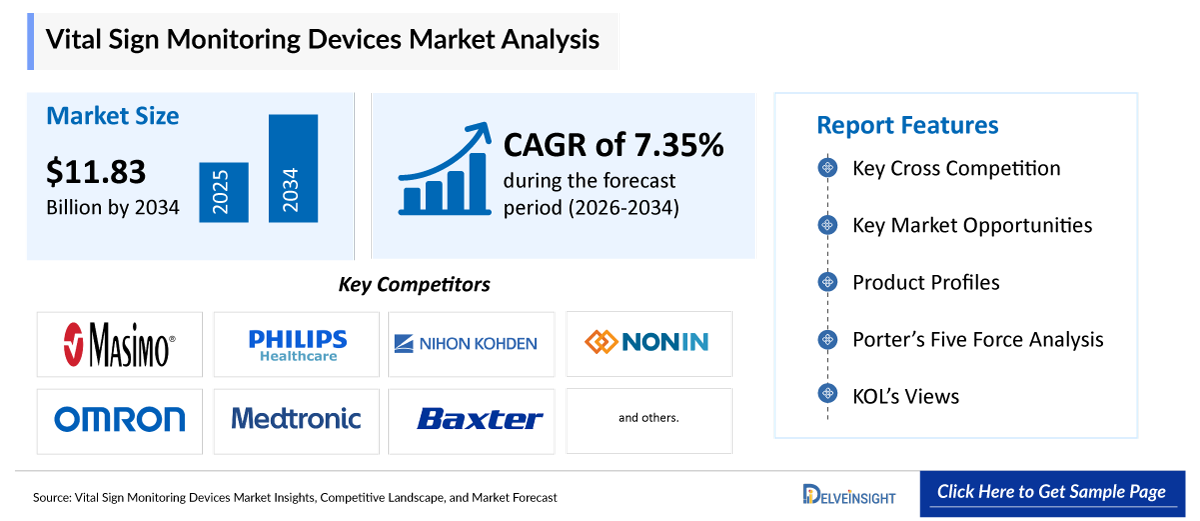
- The Vital Sign Monitoring Devices Market Size is estimated at USD 6.27 billion in 2025 and is projected to reach USD 11.83 billion by 2034. Growth is anchored in rising chronic disease and hypertension prevalence, expanding remote patient monitoring and hospital-at-home programs, and increasing integration of AI-enabled early warning parameters into standalone and combined monitoring devices.
- The Global Vital Sign Monitoring Devices Market Size is growing at a CAGR of 7.35% during the forecast period from 2026 to 2034.
Vital Sign Monitoring Devices Market Trends and Insights
- By product type, the standalone monitoring devices segment dominated the vital sign monitoring devices market, with blood pressure monitoring devices representing the leading category at approximately 48% share in 2025.
- By blood pressure monitor type, the automated blood pressure monitors segment is the leading and fastest-growing subsegment as mercury-based devices are phased out.
- By end-user, the hospitals segment dominated the vital sign monitoring devices market with an approximately 44% share in 2025.
- North America dominated the global vital sign monitoring devices market revenue with an approximately 43% share in 2025, representing the highest regional market share globally.
Request for Unlocking the Sample Page of the "Vital Sign Monitoring Devices Market"
Vital Sign Monitoring Devices Market Size
The following snapshot summarizes the principal report metrics for the vital sign monitoring devices market.
|
Report Metrics |
Details |
|
2025 Vital Sign Monitoring Devices Market Size | |
|
2034 Projected Vital Sign Monitoring Devices Market Size | |
|
Vital Sign Monitoring Devices Growth Rate (2026-2034) | |
|
Largest Vital Sign Monitoring Devices Market |
North America |
|
Fastest Growing Vital Sign Monitoring Devices Market |
Asia-Pacific |
|
Vital Sign Monitoring Devices Market Structure |
Fragmented |
All market values are expressed in USD and represent DelveInsight estimates synthesized from primary and secondary research.
Factors Contributing to the Growth of the Vital Sign Monitoring Devices Market
Vital Sign Monitoring Devices Market Drivers
-
Rising Chronic Disease Burden and Hypertension Prevalence
The most consistent driver of the Vital Sign Monitoring Devices Market is the rising global burden of hypertension, cardiovascular disease, and diabetes. The World Health Organization attributes approximately 17.9 million deaths annually to cardiovascular disease, a large share linked to undiagnosed or poorly controlled high blood pressure. Routine blood pressure, oxygen saturation, and temperature monitoring are central to early detection and ongoing management of these conditions across hospitals, clinics, and the home. As chronic disease prevalence rises alongside an aging population, the frequency and clinical importance of vital sign monitoring increases correspondingly, anchoring market growth through 2034.
-
Expansion of Remote Patient Monitoring and Hospital-at-Home Programs
The rapid scaling of hospital-at-home and remote patient monitoring programs is shifting a meaningful share of vital sign monitoring from inpatient wards into homecare settings. Reimbursement support for remote monitoring, combined with wireless pulse oximeters, automated blood pressure monitors, and connected thermometers, allows clinicians to track patients outside traditional hospital settings while maintaining continuity of care.
Hospitals are reallocating capital from standalone bedside units toward connected device ecosystems that feed directly into electronic health records, a trend that is expanding the addressable market for both standalone and combined monitoring devices.
-
Phase-Out of Mercury-Based Devices and Shift to Digital Alternatives
Regulatory phase-down of mercury-containing sphygmomanometers and thermometers under the Minamata Convention on Mercury is structurally reshaping the blood pressure and temperature monitoring device segments. As mercury blood pressure monitors and mercury thermometers are progressively withdrawn from clinical use, healthcare providers are transitioning to aneroid and automated blood pressure monitors and to digital and infrared thermometers. This regulatory-driven replacement cycle is expanding unit volumes for automated and digital device categories independent of underlying disease incidence.
-
Integration of AI-Enabled Monitoring Parameters
Manufacturers are increasingly embedding artificial intelligence into standalone and combined monitoring devices to expand their clinical value. OMRON Healthcare's FDA De Novo authorization for AI-powered IntelliSense atrial fibrillation detection in home blood pressure monitors, and Masimo's FDA clearance of AI-enabled Opioid-Induced Respiratory Depression detection on its Radius VSM platform, illustrate how monitoring devices are evolving beyond simple spot-check measurement toward predictive, early-warning tools. This innovation supports premium pricing and expands the addressable use cases for both hospital-grade and home-use devices.
-
Strategic Partnerships and Platform Expansion among Leading Manufacturers
Leading manufacturers are expanding distribution and technology integration through strategic alliances. Philips and Masimo renewed and expanded their multi-year partnership to integrate SET pulse oximetry and Radius PPG into Philips' multi-parameter patient monitors, Medtronic and GE HealthCare broadened their long-running alliance around Nellcor pulse oximetry, and Medtronic extended its partnership with Mindray North America into ambulatory surgery centers. GE HealthCare's CE-marked Carevance monitor and Mindray's BeneVision V Series, launched with ultrasound-integrated hemodynamic assessment, reflect continued platform investment by top-tier competitors, sustaining innovation and market accessibility across the forecast period.
Vital Sign Monitoring Devices Market Restraints
Despite steady momentum, the Vital Sign Monitoring Devices Market faces material constraints. Accuracy and reliability concerns persist for certain consumer-grade wearable pulse oximeters and blood pressure monitors, and regulatory scrutiny has intensified around pulse oximetry accuracy across different skin pigmentation levels.
Pricing pressure and uneven reimbursement for home and remote monitoring devices constrain adoption in cost-sensitive markets, while stringent regulatory clearance requirements, particularly for AI-enabled features, can lengthen time to market. Intensifying competition from consumer electronics companies entering the health-monitoring space is compressing margins for legacy device makers, and dependence on accurate, low-friction patient or caregiver use in homecare settings introduces variability that clinical-grade hospital devices do not face.
Together, these accuracy, pricing, regulatory, and competitive pressures temper the pace of growth even as underlying demand drivers remain firmly intact.
Vital Sign Monitoring Devices Overview
A vital sign monitoring device is a medical instrument used to measure and track core physiological parameters, including blood oxygen saturation, blood pressure, and body temperature, across hospitals, clinics, and home care settings. These devices range from single-parameter standalone instruments, such as fingertip pulse oximeters and automated blood pressure monitors, to combined monitoring devices that capture multiple vital signs simultaneously for use in intensive care, perioperative, and remote patient monitoring environments.
The Vital Sign Monitoring Devices Market is organized by product type across standalone monitoring devices, including pulse oximeters, blood pressure monitoring devices, and temperature monitoring devices, and combined monitoring devices; and by end-user across hospitals, clinics, homecare settings, and others.
Driven by rising chronic disease burden, an aging population, the phase-down of mercury-containing devices, and growing adoption of AI-enabled, connected, and wearable monitoring technology, vital sign monitoring devices have become essential infrastructure across the continuum of care.
Vital Sign Monitoring Devices Market Key Growth Drivers
- The rising global burden of chronic and cardiovascular disease is expanding demand for routine vital sign monitoring, with the World Health Organization attributing approximately 17.9 million deaths annually to cardiovascular disease, the majority linked to poorly controlled hypertension.
- An aging global population and growing prevalence of diabetes and respiratory conditions are increasing the frequency of blood pressure, oxygen saturation, and temperature monitoring across care settings.
- Expanding hospital-at-home and remote patient monitoring programs are shifting monitoring volume from inpatient wards into homecare settings, supported by wireless, connected pulse oximeters and automated blood pressure monitors.
- Regulatory phase-down of mercury-containing sphygmomanometers and thermometers under the Minamata Convention on Mercury is accelerating the transition to digital, aneroid, and automated alternatives.
- Integration of AI-enabled parameters, including atrial fibrillation and opioid-induced respiratory depression detection, into pulse oximeters and blood pressure monitors is expanding the clinical value and price point of standalone devices.
- Strategic partnerships and platform expansions, including the renewed Philips-Masimo monitoring alliance, GE HealthCare's Carevance launch, and the Medtronic-Mindray ambulatory surgery center partnership, are broadening distribution of combined and standalone monitoring devices.
- The convergence of chronic disease burden, remote monitoring adoption, mercury phase-out, and AI-enabled innovation is expected to sustain steady growth in the market through 2034.
Vital Sign Monitoring Devices Market Segment Analysis
The Vital Sign Monitoring Devices by Market by Product Type (Standalone Monitoring Devices [Pulse Oximeter {Fingertip Pulse Oximeters, Handheld Pulse Oximeters, Bench-Top Pulse Oximeters, and Wearable Pulse Oximeters}, Blood Pressure Monitoring Devices {Mercury Blood Pressure Monitors, Aneroid Blood Pressure Monitors, Automated Blood Pressure Monitors}, Temperature Monitoring Devices {Digital Thermometers, Infrared Thermometers, and Others}, and Others] and Combined Monitoring Devices), End-User (Hospitals, Clinics, Homecare Settings, and Others), and Geography (North America, Europe, Asia-Pacific, and Rest of World).
-
Vital Sign Monitoring Devices Market Segmentation By Product Type
Dominant Subsegment: Machines.
Dominant: Blood Pressure Monitoring Devices ~ 48%
The Blood Pressure Monitoring Devices segment accounted for approximately 48% of the Vital Sign Monitoring Devices market in 2025. Blood pressure monitors are the leading product category because hypertension screening and management are required across nearly every clinical encounter, from routine outpatient visits to intensive care, and because home blood pressure monitoring has become a standard of care for hypertension management.
Within the segment, Automated Blood Pressure Monitors are the leading and fastest-growing subtype as mercury and aneroid devices are phased out under mercury-reduction regulations and replaced with digital, oscillometric, and increasingly AI-enabled automated monitors. Pulse Oximeters represent the fastest-growing product category overall, propelled by rising demand for wearable and fingertip devices in home and ambulatory settings, while Temperature Monitoring Devices maintain steady demand led by infrared, non-contact thermometers.
Combined Monitoring Devices, which capture multiple vital signs on a single platform, are gaining share in hospital ICUs, operating rooms, and perioperative settings, but the breadth and recurrence of blood pressure monitoring across all care settings secures the standalone blood pressure monitor segment's leadership across the forecast period.
-
Vital Sign Monitoring Devices Market Segmentation By End-User
Dominant Subsegment: Hospitals.
Dominant: Hospitals ~ 44%
The hospitals segment accounted for approximately 44% of the vital sign monitoring devices market in 2025. Hospitals remain the leading end-user because vital sign monitoring is a mandatory, continuous component of inpatient care across emergency departments, intensive care units, general wards, and operating rooms, requiring high volumes of both standalone and combined monitoring devices.
Clinics represent a steady, recurring end-user segment supporting routine outpatient screening, while Homecare Settings are the fastest-growing end-user category as hospital-at-home programs, remote patient monitoring reimbursement, and consumer-grade wearable pulse oximeters and blood pressure monitors expand access to monitoring outside traditional facilities. Nonetheless, the scale, regulatory requirements, and continuous monitoring needs of hospitals secure their leadership across the forecast period.
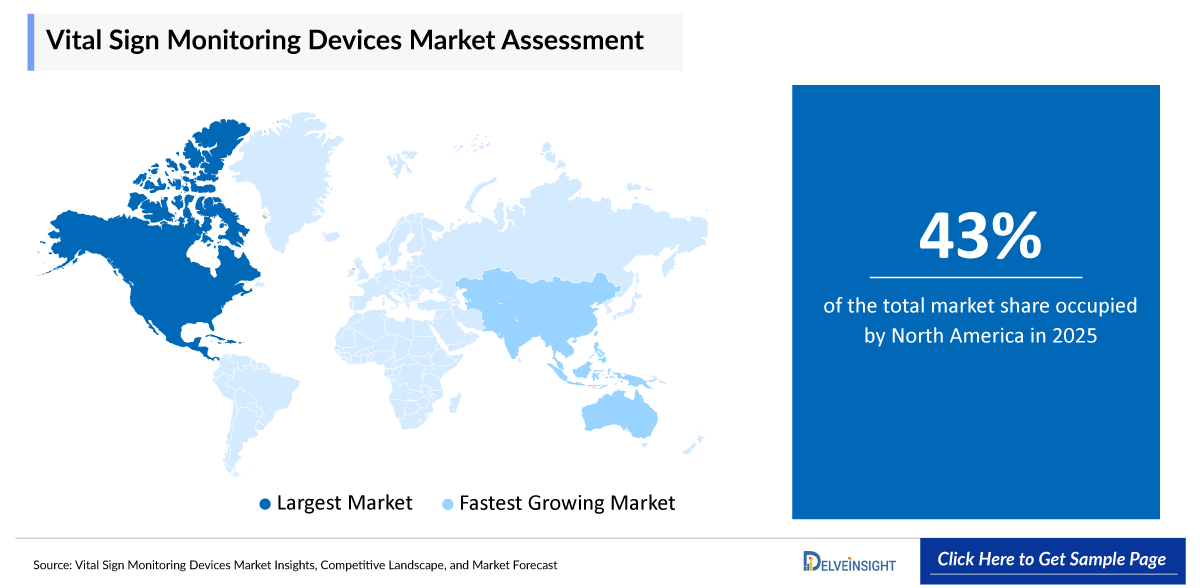
Vital Sign Monitoring Devices Market Region Analysis
- Dominant Region: North America
Dominant: North America ~ 43% (Largest)
North America accounted for approximately 43% of the global vital sign monitoring devices market revenue in 2025, representing the highest regional market share globally. The region's dominance reflects advanced hospital infrastructure, high adoption of remote patient monitoring and hospital-at-home programs, strong reimbursement support, and the concentrated presence of leading manufacturers including Masimo, GE HealthCare, Medtronic, and Baxter.
The United States hosts the largest base of AI-enabled monitoring device deployment, supported by FDA clearances such as OMRON's AI-powered AFib-detection blood pressure monitors and Masimo's AI-enabled respiratory depression detection. Continued investment in connected monitoring platforms and strategic partnerships among top-tier device makers anchor the region's continued leadership across the forecast period.
- Fastest Growing Region: Asia-Pacific
Asia-Pacific is the fastest-growing region in the vital sign monitoring devices market. The region's elevated CAGR is driven by rising cardiovascular and chronic disease incidence, rapid expansion of hospital infrastructure, and growing government healthcare investment across China, Japan, India, South Korea, and Australia.
China is expanding hospital and homecare monitoring device adoption, Japan's aging population is driving demand for connected home blood pressure and temperature monitoring, and India is scaling low-cost manufacturing and distribution of standalone monitoring devices.
The combination of rising disease burden, healthcare infrastructure build-out, and increasing consumer adoption of wearable pulse oximeters and blood pressure monitors positions Asia-Pacific as the principal source of incremental growth over the forecast period.
Vital Sign Monitoring Devices Regional Commentary
- North America
North America accounted for approximately 43% of the global Vital Sign Monitoring Devices market revenue in 2025. The United States dominates on the strength of its hospital infrastructure, remote patient monitoring reimbursement, and concentrated presence of leading manufacturers, while continued AI-enabled product clearances and strategic partnerships reinforce its leadership.
- Europe
Europe is a large and advanced regional market, supported by established regulatory frameworks under the EU Medical Device Regulation, well-developed hospital networks, and an aging population driving sustained demand for both standalone and combined monitoring devices. Regional mercury-reduction regulation continues to accelerate the shift from mercury-based to digital and automated blood pressure and temperature monitors across Germany, France, the United Kingdom, Italy, and Spain.
- Asia-Pacific
Asia-Pacific is the fastest-growing region, propelled by rising chronic disease incidence, rapid hospital infrastructure build-out, and growing consumer adoption of wearable and connected monitoring devices across China, Japan, India, South Korea, and Australia. Government healthcare investment and expanding homecare monitoring adoption are accelerating regional growth.
- Rest of World
The Rest of World region, spanning Latin America, the Middle East, and Africa, is an emerging growth frontier. Expanding hospital and primary-care infrastructure, rising demand for blood pressure and oxygen saturation monitoring amid growing chronic disease burden, and gradual adoption of digital and automated devices in place of mercury-based instruments are broadening access, while international distribution partnerships support regional capacity build-out.
Vital Sign Monitoring Devices Market Competitive Landscape
The Vital Sign Monitoring Devices Market is classified as Fragmented. A group of globally integrated players with broad hospital and homecare distribution, including Masimo, Koninklijke Philips N.V., GE HealthCare, Medtronic, and Shenzhen Mindray Bio-Medical Electronics Co., Ltd., anchor the top tier, while specialized and regionally strong providers such as OMRON Corporation, NIHON KOHDEN CORPORATION, Nonin, Baxter, and Lepu Medical Technology (Beijing) Co., Ltd. compete through product specialization, consumer-channel reach, and regional manufacturing scale, alongside a long tail of smaller standalone-device manufacturers.
The Vital Sign Monitoring Devices Competitive Landscape can be evaluated across the following dimensions:
- Market concentration: Fragmented, with a handful of globally integrated players competing alongside numerous specialized and regional standalone-device manufacturers.
- Leading players: Masimo, Koninklijke Philips N.V., GE HealthCare, Medtronic, and Shenzhen Mindray Bio-Medical Electronics Co., Ltd. anchor the top tier through broad hospital and combined-device portfolios.
- Geographic reach: Leaders operate global distribution networks spanning hospital, clinic, and consumer retail channels; OMRON's home blood pressure monitors are distributed across more than 100 countries.
- Product portfolio strength: Top players offer end-to-end standalone and combined monitoring devices spanning pulse oximetry, blood pressure, temperature, and multi-parameter platforms.
- Technology access: Ownership of proprietary sensing technologies, such as Masimo's SET pulse oximetry and OMRON's IntelliSense AFib algorithm, is a decisive competitive advantage.
- Strategic partnerships: Tie-ups between hardware and technology leaders, such as the renewed Philips-Masimo alliance and the Medtronic-Mindray ambulatory surgery center partnership, extend reach and technology access.
- M&A and alliance activity: Active partnership expansion, including Medtronic's broadened GE HealthCare and Mindray alliances, underscores the strategic value of combined distribution and technology access.
- Manufacturing capabilities: Consumer-scale manufacturing for standalone devices and regulated GMP production for hospital-grade combined monitors are key competitive moats.
- Innovation focus: AI-enabled early warning and arrhythmia detection, connected and wearable form factors, and the phase-out of mercury-based devices are the leading edges of innovation.
Vital Sign Monitoring Devices Market Recent Developmental Activities
- In October 2025, GE HealthCare received CE mark for its Carevance patient monitor, a cost-effective, clinically reliable monitoring solution designed for broader hospital accessibility across Europe. Strategic significance: Expands GE HealthCare's addressable hospital monitoring segment with a validated, lower-cost platform.
- In January 2026, Medtronic and GE HealthCare announced an expansion of their long-running patient monitoring alliance to bring Medtronic's Nellcor pulse oximetry technology to more healthcare settings. Strategic significance: Broadens distribution of Nellcor pulse oximetry and reinforces the companies' joint patient monitoring platform.
- In January 2026, Medtronic and Mindray North America broadened their strategic patient monitoring partnership beyond hospitals into ambulatory surgery centers across the United States. Strategic significance: Extends combined monitoring device distribution into the fast-growing ambulatory surgery center channel.
- In 2025, Koninklijke Philips N.V. and Masimo announced a multi-year renewal and expansion of their strategic partnership to accelerate integration of Masimo's SET pulse oximetry and Radius PPG technologies into Philips' multi-parameter patient monitors through 2026 and beyond. Strategic significance: Deepens combined-device technology integration between two leading monitoring platform providers.
- In May 2025, Shenzhen Mindray Bio-Medical Electronics Co., Ltd. launched its next-generation BeneVision V Series patient monitoring system at Euroanaesthesia 2025, featuring ultrasound-integrated hemodynamic assessment and a cable-lite monitoring workflow. Strategic significance: Strengthens Mindray's combined monitoring device platform for ICU and perioperative use.
- In November 2024, OMRON Healthcare received FDA De Novo authorization for home blood pressure monitors featuring AI-powered IntelliSense atrial fibrillation detection, with commercial launch in the United States in early 2025. Strategic significance: Adds AI-enabled arrhythmia screening to a leading consumer blood pressure monitor franchise.
- In 2026, Masimo received FDA 510(k) clearance for AI-enabled Opioid-Induced Respiratory Depression detection on its Radius VSM wearable vital signs monitor. Strategic significance: Expands Masimo's combined monitoring device capability into predictive respiratory risk detection.
Major Vital Sign Monitoring Devices Companies
The Vital Sign Monitoring Devices Competitive Landscape is led by the following active device manufacturers:
- Masimo
- Koninklijke Philips N.V.
- NIHON KOHDEN CORPORATION
- Nonin
- OMRON Corporation
- Baxter
- Medtronic
- Lepu Medical Technology (Beijing) Co., Ltd.
- GE HealthCare
- Shenzhen Mindray Bio-Medical Electronics Co., Ltd.
For illustrative purposes, only the top 10 companies are listed in the Table of Contents. The report may include analysis and references to additional companies relevant to the market assessment.
Vital Sign Monitoring Devices Market Segmentation
Vital Sign Monitoring Devices Market by Product Type
- Standalone Monitoring Devices
- Pulse Oximeter
- Fingertip Pulse Oximeters
- Handheld Pulse Oximeters
- Bench-Top Pulse Oximeters
- Wearable Pulse Oximeters
- Blood Pressure Monitoring Devices
- Mercury Blood Pressure Monitors
- Aneroid Blood Pressure Monitors
- Automated Blood Pressure Monitors
- Temperature Monitoring Devices
- Digital Thermometers
- Infrared Thermometers
- Others
- Others
- Combined Monitoring Devices
Vital Sign Monitoring Devices Market by End User
- Hospitals
- Clinics
- Homecare Settings
- Others
Vital Sign Monitoring Devices Market by Geography
- North America Vital Sign Monitoring Devices Market
- United States Vital Sign Monitoring Devices Market Size in USD million (2023-2034)
- Canada Vital Sign Monitoring Devices Market Size in USD million (2023-2034)
- Mexico Vital Sign Monitoring Devices Market Size in USD million (2023-2034)
- Europe Vital Sign Monitoring Devices Market
- Germany Vital Sign Monitoring Devices Market Size in USD million (2023-2034)
- United Kingdom Vital Sign Monitoring Devices Market Size in USD million (2023-2034)
- France Vital Sign Monitoring Devices Market Size in USD million (2023-2034)
- Italy Vital Sign Monitoring Devices Market Size in USD million (2023-2034)
- Spain Vital Sign Monitoring Devices Market Size in USD million (2023-2034)
- Rest of Europe Vital Sign Monitoring Devices Market Size in USD million (2023-2034)
- Asia-Pacific Vital Sign Monitoring Devices Market
- China Vital Sign Monitoring Devices Market Size in USD million (2023-2034)
- Japan Vital Sign Monitoring Devices Market Size in USD million (2023-2034)
- India Vital Sign Monitoring Devices Market Size in USD million (2023-2034)
- Australia Vital Sign Monitoring Devices Market Size in USD million (2023-2034)
- South Korea Vital Sign Monitoring Devices Market Size in USD million (2023-2034)
- Rest of Asia-Pacific Vital Sign Monitoring Devices Market Size in USD million (2023-2034)
- Rest of the World (RoW) Vital Sign Monitoring Devices Market
- Middle East Vital Sign Monitoring Devices Market Size in USD million (2023-2034)
- Africa Vital Sign Monitoring Devices Market Size in USD million (2023-2034)
- South America Vital Sign Monitoring Devices Market Size in USD million (2023-2034)
Vital Sign Monitoring Devices Market Recent Industry Trends and Milestones (2023-2026)
|
Category |
Key Developments |
|
Vital Sign Monitoring Devices Market Product Approval |
Regulatory momentum is expanding both consumer and clinical demand. The FDA granted OMRON Healthcare De Novo authorization in November 2024 for home blood pressure monitors with AI-powered IntelliSense AFib detection, which launched in the United States in early 2025, and cleared Masimo's AI-enabled Opioid-Induced Respiratory Depression detection on the Radius VSM in 2026. GE HealthCare's Carevance patient monitor received CE mark in October 2025. Each approval creates durable demand for validated, connectivity-ready monitoring hardware across hospital, clinic, and home settings. |
|
Vital Sign Monitoring Devices Market Expansion |
Manufacturers broadened capability across the care continuum. Mindray launched its next-generation BeneVision V Series patient monitoring system with ultrasound-integrated hemodynamic assessment at Euroanaesthesia 2025, GE HealthCare unveiled Carevance for cost-effective bedside monitoring, and OMRON expanded its AFib-detection blood pressure monitor line. Decentralized, connected, and multi-parameter combined monitoring devices continued to gain share over single-parameter standalone units. |
|
Vital Sign Monitoring Devices Market Investment |
Strategic alliances accelerated. Philips and Masimo announced a multi-year renewal and expansion of their partnership to integrate SET pulse oximetry and Radius PPG into Philips multi-parameter monitors through 2026 and beyond. Medtronic and GE HealthCare expanded their long-running patient monitoring alliance to widen distribution of Nellcor pulse oximetry technology, while Medtronic and Mindray North America broadened their strategic partnership beyond hospitals into ambulatory surgery centers in January 2026. |
|
Company Strategy |
Masimo: Continued leadership in noninvasive SET pulse oximetry and AI-enabled early-warning parameters. Koninklijke Philips N.V.: Deepened its patient monitoring alliance with Masimo to integrate advanced parameters into its monitor portfolio. GE HealthCare: Broadened its Carevance and Nellcor-branded monitoring lines and expanded distribution through the Medtronic alliance. OMRON Corporation: Advanced consumer and clinical blood pressure monitoring with AI-based AFib screening. Shenzhen Mindray Bio-Medical Electronics Co., Ltd.: Scaled its BeneVision monitor platform and extended its Medtronic ASC partnership. Medtronic, Baxter, NIHON KOHDEN CORPORATION, Nonin, and Lepu Medical Technology (Beijing) Co., Ltd.: Sustained investment in connected, multi-parameter, and home-care-ready vital sign monitoring hardware. |
|
Emerging Technologies |
AI-enabled early warning scoring, opioid-induced respiratory depression detection, and atrial fibrillation screening are moving from hospital bedside monitors into wearable and home-use devices. Continued phase-down of mercury-containing sphygmomanometers and thermometers under the Minamata Convention on Mercury is accelerating the shift to digital, aneroid, and automated alternatives. Bluetooth-enabled connectivity, cloud-based remote patient monitoring platforms, and integration with electronic health records are becoming standard across both standalone and combined monitoring devices. |
Vital Sign Monitoring Devices Market Startup Funding and Investment Trends
Investment in the Vital Sign Monitoring Devices ecosystem has concentrated on AI-enabled early warning parameters, connected and wearable device platforms, and combined multi-parameter monitors for hospital and ambulatory surgery center use. The following companies illustrate recent activity and technology focus.
|
Company |
Total Funding |
Funding Stage |
Main Offering |
Core Technology |
|
Aktiia (rebranded Hilo) |
$42M |
Series B |
CALFREE™ cuffless blood-pressure solution (optical, wrist/smartphone integration) |
Calibration-free optical PPG/AI algorithms for BP estimation |
|
Request for unlocking the report of the @ Vital Sign Monitoring Devices Market | ||||
Capital and strategic investment continue to flow toward providers that combine proprietary sensing technology with broad distribution. Philips and Masimo's renewed multi-year partnership underscores the strategic value of combined-device technology integration, while Medtronic's expanded alliances with both GE HealthCare and Mindray North America reflect the growing importance of ambulatory and cross-platform distribution.
Collectively, these investments signal conviction that AI-enabled monitoring parameters, connected device ecosystems, and expansion into homecare and ambulatory settings will define the next phase of competitive advantage in the global Vital Sign Monitoring Devices market.
Key Takeaways from the Vital Sign Monitoring Devices Market Report Study
- Market analysis for the current vital sign monitoring devices market size (2025), and market forecast for 9 years (2026 to 2034).
- Top key product/technology developments, mergers, acquisitions, partnerships, and joint ventures that happened over the last 3 years.
- Key companies dominating the global vital sign monitoring devices market.
- Various opportunities available for competitors in the vital sign monitoring devices market space.
- What are the top-performing segments in 2025? How will these segments perform in 2034?
- Which are the top-performing regions and countries in the current vital sign monitoring devices market scenario?
- Which are the regions and countries where companies should concentrate their opportunities for vital sign monitoring devices market growth in the future?
Target audience who can benefit from this Vital Sign Monitoring Devices Market Report Study
- Vital sign monitoring devices product providers
- Research organizations and consulting companies
- Vital sign monitoring devices-related organizations, associations, forums, and other alliances
- Government and corporate offices
- Start-up companies, venture capitalists, and private equity firms
- Distributors and traders dealing in vital sign monitoring devices
- Various end-users who want to know more about the vital sign monitoring devices market and the latest technological developments in the vital sign monitoring devices market.
Stay updated with us for Recent Articles @ New DelveInsight Blogs