Intratumoral Cancer Therapy: A Potential Weapon To Fight the Battle Against Cancer
Aug 05, 2026
Table of Contents
Summary
- Intra-tumoral cancer therapies involve the direct administration of antitumor agents into tumors, promoting localized tumor destruction, stimulating the release of tumor-associated antigens, and activating an immune response within the tumor microenvironment that may also generate systemic antitumor effects.
- At present, the approved ITCT landscape comprises only three therapies: IMLYGIC (talimogene laherparepvec/T-VEC; Amgen), approved in the US and Europe in 2015; DELYTACT (teserpaturev/G47∆; Daiichi Sankyo), approved in Japan in 2021; and HENSIFY, approved in Europe in 2019.
- Promising pipeline therapies include JNJ-1900/NBTXR3 (NANOBIOTIX/Johnson & Johnson), CAN-2409 (Candel Therapeutics), Multikine (CEL-SCI), INT230-6 (Intensity Therapeutics), Tigilanol tiglate (QBiotics), among others.
- The intratumoral cancer therapies market across the 7MM was valued at nearly USD 115 million in 2025 and is anticipated to expand at a robust CAGR of 49% by 2034 across the major markets, including the US, EU4, the UK, and Japan.
Cancer remains one of the most stubborn adversaries in medicine. The WHO has attributed nearly 10 million deaths a year to the disease, and despite decades of progress in surgery, chemotherapy, radiation, and immunotherapy, many patients still run into the same wall: treatments that are either too diffuse to hit the tumor hard enough, or too toxic to tolerate once they do. Systemic therapies travel through the entire body to reach a tumor that may occupy only a small fraction of it, and a large share of the resulting side effects come from that mismatch between where the drug goes and where it’s actually needed.
Downloads
Click Here To Get the Article in PDF

Recent Articles
- Oncolytic Virus Cancer Therapy: Transforming Cancer Treatment
- 7 HSV-associated Oncolytic Virus Therapies in Late and Mid-Stage
- Top 7 Emerging Vaccinia Virus-associated Oncolytic Virus Therapies
- From Seagen to Innovent: Inside Pfizer’s Playbook for Oncology Leadership
- Oncolytic Viruses: Can Be The Next Frontier in Cancer Immunotherapy?
That mismatch is exactly what intratumoral cancer therapy (ITCT) is designed to close. Instead of dosing the whole body and hoping enough drug reaches the tumor, ITCT delivers the therapeutic agent directly into or immediately around the tumor itself. It’s a simple idea with far-reaching implications, and it’s quickly becoming one of the more closely watched frontiers in oncology.
What Is Intratumoral Cancer Therapy?
Intratumoral cancer therapy refers to the direct, local delivery of anticancer agents into the tumor or its immediate microenvironment, rather than administering them systemically through an IV or in pill form. The approach spans a surprisingly diverse toolkit: oncolytic viruses that infect and destroy cancer cells from within, recombinant fusion proteins, gene therapies, radioenhancing nanoparticles, synthetic double-stranded RNA complexes, immune receptor agonists, and small molecules that trigger localized cell death, all injected or otherwise delivered straight into the tumor.
By putting the therapy where the disease actually lives, ITCT achieves high drug concentrations exactly at the tumor site, induces local tumor cell death, releases tumor antigens, and activates an immune response that starts locally but is designed to spread. It’s this last part, the potential for a localized injection to trigger a body-wide immune reaction, that has made the field so compelling to oncologists and drug developers alike.
Turning “Cold” Tumors “Hot”
A great deal of cancer immunotherapy’s promise has been limited by a basic biological problem: many tumors are immunologically “cold.” They don’t provoke inflammation, they aren’t infiltrated by T cells, and as a result, the immune system essentially ignores them. Checkpoint inhibitors and other immunotherapies work by releasing the brakes on an immune response that already exists, but if there’s no meaningful immune response to begin with, releasing the brakes doesn’t help much.
This is where intratumoral therapy earns its reputation as a potential game-changer. By injecting immune-activating agents directly into a cold tumor, ITCT can convert it into a “hot” tumor, one that shows visible signs of inflammation and becomes infiltrated by T cells that can recognize and attack cancer cells. Once a tumor is hot, it becomes a much better candidate for immunotherapy, including combination with checkpoint inhibitors.
Mechanistically, intratumoral immunotherapies work by recruiting immune cells into the tumor microenvironment and priming T cells to mount a systemic, polyclonal antitumor response, often referred to as the abscopal effect, where treating one tumor lesion can trigger regression of untreated lesions elsewhere in the body. Because the tumor itself becomes the source of antigens, this approach can also help address intratumoral heterogeneity, since antigens are drawn from multiple tumor clones rather than a single predetermined target.
Patient Burden: The Scale of Unmet Need
Intratumoral approaches are being investigated across a wide swath of solid tumor types, reflecting both the modality’s flexibility and the persistent unmet need in cancers that respond poorly to systemic treatment. Disease areas under active study include melanoma (and uveal melanoma specifically), head and neck squamous cell carcinoma, pancreatic cancer, brain cancer, prostate cancer, soft tissue sarcoma, non-small cell lung cancer (NSCLC), adrenocortical carcinoma, and basal cell carcinoma (BCC).
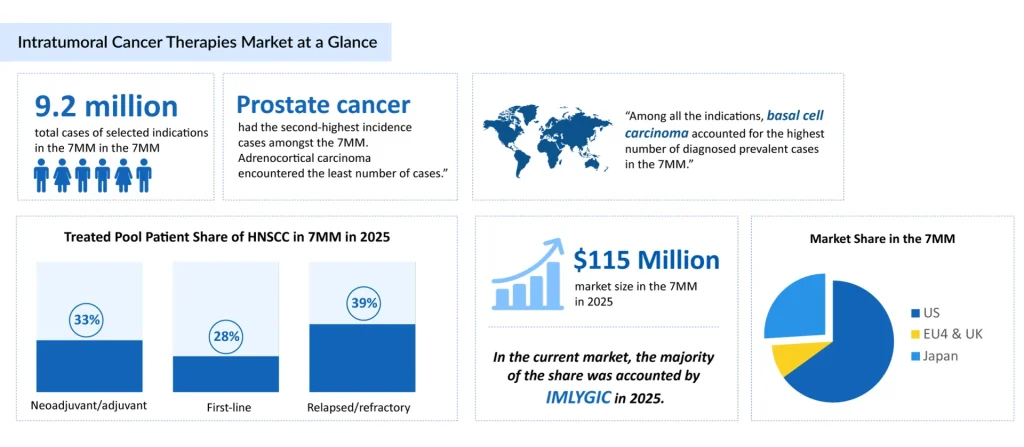
As per DelveInsight analysis, in 2025, the total cases of selected indications for ITCT were 9.2 million cases in the 7MM, which is anticipated to increase by 2036. BCC alone represents one of the largest patient pools among these indications given how common the cancer is. Prostate cancer had the second-highest number of incident cases amongst the 7MM. Adrenocortical carcinoma encountered the least number of cases.
Taken together, this epidemiological picture explains much of the commercial and clinical logic behind the current wave of intratumoral development: a handful of very large disease pools (BCC, prostate cancer, NSCLC) offer significant long-term opportunity even at modest penetration rates, while smaller, harder-to-treat populations (ACC, uveal melanoma, soft tissue sarcoma) represent areas of concentrated unmet need where a locally delivered, lower-toxicity option could meaningfully change the treatment paradigm.
Approved Therapies: A Small but Meaningful Foothold
Despite decades of interest in local tumor-directed treatment, dating back to the 1990 approval of BCG for bladder cancer and imiquimod for skin cancers in 1997, modern intratumoral cancer therapy has only three approved products to its name, each a milestone in its own right: Amgen’s IMLYGIC, Daiichi Sankyo’s DELYTACT, and Nanobiotix’s HENSIFY.
Approved in the US and Europe in 2015, IMLYGIC was the first FDA-approved oncolytic virus therapy. It is an attenuated herpes simplex virus type-1 engineered to replicate inside tumor cells and produce GM-CSF, and it is indicated for metastatic melanoma. Even a decade later, IMLYGIC continues to hold the largest share of the ITCT market, though its uptake has been tempered by strong competition from checkpoint inhibitors.
Nanobiotix’s HENSIFY, a radiation-activated hafnium oxide nanoparticle, secured European approval in 2019 for the treatment of soft tissue sarcoma and is currently being evaluated across a range of tumor types. Daiichi Sankyo’s DELYTACT (G47Δ), a genetically engineered HSV-1 oncolytic virus, received conditional approval in Japan in 2021 for malignant glioma, marking the first approved oncolytic virus therapy for primary brain tumors. Despite these notable advancements, intratumoral therapies remain relatively limited in comparison with conventional administration routes such as intravenous and oral delivery, which are frequently associated with suboptimal tumor targeting and increased systemic toxicity.
Sadaf Javed, Functional Head of Forecasting & Analytics at DelveInsight, stated that despite gaining market approval by HENSIFY, there is still no commercial activity by the company in Europe, but the company plans for the US launch in head and neck cancer in 2028.
That such a scientifically compelling approach has produced only three approvals in over a decade says a lot about how difficult this modality is to execute, and how much room remains for the next wave of candidates to succeed where others could not.
A Robust and Diversifying Pipeline
Where the approved landscape is thin, the emerging pipeline is anything but. Dozens of intratumoral cancer therapy candidates are moving through clinical development, spanning a wide range of mechanisms and molecule types, including radioenhancers, recombinant fusion proteins, oncolytic viruses, gene therapies, small molecules, and oncolytic peptides among them.
The emerging pipeline of ITCT is robust, including drugs from key players such as Philogen (Daromun [NIDLEGY; a combo of L19IL2 + L19TNF]), Replimune (RP2), Highlight Therapeutics (BO-112), Cytovation ASA (CY-101), Intensity Therapeutics (INT230-6), Treovir and Matica Biotechnology (G207), QBiotics (Tigilanol tiglate), NanOlogy (NanoPac), EpicentRx (AdAPT-001), Medicenna Therapeutics (Bizaxofusp [MDNA55]), NANOBIOTIX/Johnson & Johnson (JNJ-1900, NBTXR3), Candel Therapeutics (CAN-2409), Lytix Biopharma/Verrica Pharmaceuticals (LTX-315), CEL-SCI (Multikine), and others.
Publicly tracked clinical activity shows the field skewing heavily toward earlier-phase development, a large cluster of Phase I and Phase I/II programs, a solid base of Phase II candidates, and a smaller group, including Nidlegy, JNJ-1900/NBTXR3, CAN-2409, and INT230-6, that have reached Phase III. That distribution is typical of an emerging modality: broad early exploration funneling into a handful of more advanced, better-validated bets.
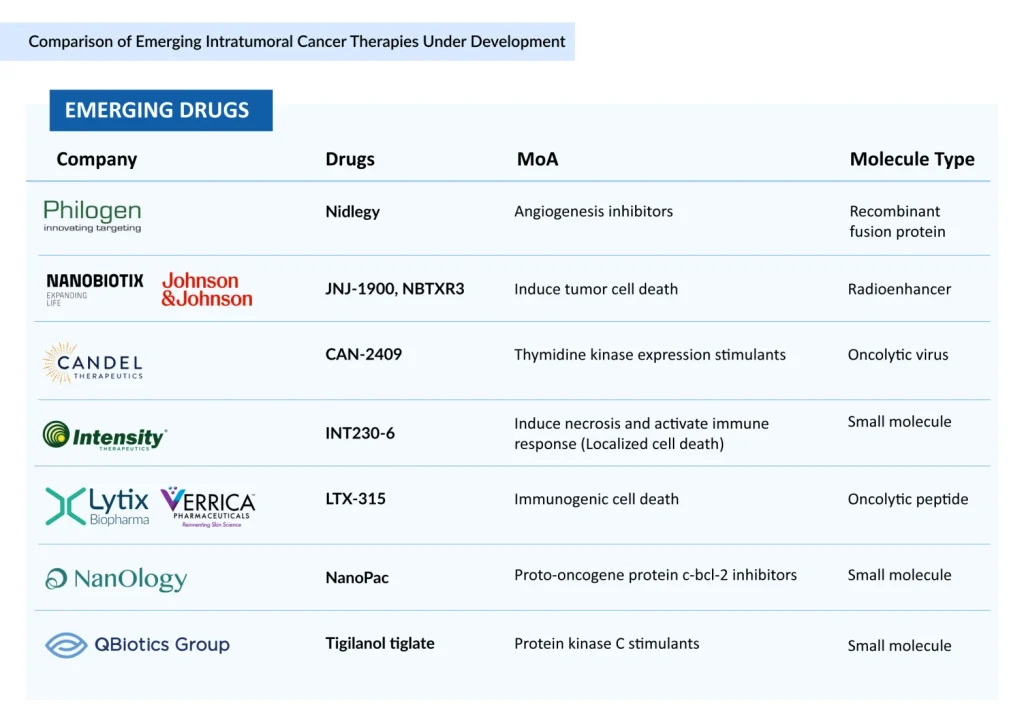
The anticipated launch of these emerging intratumoral cancer therapies are poised to transform the treatment landscape in the coming years. As these cutting-edge therapies continue to mature and gain regulatory approval, they are expected to reshape the intratumoral cancer therapy market landscape, offering new standards of care and unlocking opportunities for medical innovation and economic growth.
The Market Opportunity for Intratumoral Cancer Therapy
The commercial case for intratumoral therapy is still developing, but it is trending upward. The intratumoral cancer therapies market across the seven major markets has been estimated at roughly USD 115 million in 2025, and is projected to grow at a CAGR of 49% by 2034, a trajectory driven almost entirely by the anticipated launch and uptake of emerging pipeline therapies rather than by the existing approved products alone.
The United States currently represents the largest single market, accounting for roughly 65% of the intratumoral cancer therapies market size relative to the EU4 and UK combined with Japan. IMLYGIC currently holds the largest share of overall ITCT revenue, though that share is expected to erode over time as later-stage pipeline candidates, HENSIFY (as JNJ-1900/NBTXR3), Nidlegy, CAN-2409, Bizaxofusp, and others, begin capturing meaningful portions of the market toward the end of the forecast period.
Underlying all of this is a substantial and, in some cases, still-growing patient burden. Basal cell carcinoma alone accounts for millions of incident cases annually across the 7MM, with prostate cancer representing the second-highest disease burden among the indications tracked for intratumoral therapy. That scale of unmet need, paired with the sheer number of programs in active development, is a large part of why market analysts and pharmaceutical strategists are paying closer attention to this space.
The Road Ahead
Intratumoral cancer therapy sits at an interesting inflection point. The scientific rationale, high local drug exposure, reduced systemic toxicity, and the tantalizing possibility of converting a cold, immune-invisible tumor into a hot one capable of driving a body-wide response, is compelling enough that a broad and mechanistically diverse pipeline has formed around it. At the same time, only three therapies have made it to approval in over a decade, and even those have faced slow, uneven commercial paths.
That tension is likely to define the next several years of the field. As more Phase III data reads out, from JNJ-1900/NBTXR3 in HNSCC and NSCLC, CAN-2409 in prostate cancer, INT230-6, and Nidlegy in melanoma, among others, the industry will get a clearer answer to the central question: can intratumoral therapy move from a niche, logistically demanding option into a mainstream pillar of oncology care, ideally in combination with existing checkpoint inhibitors and other next-generation immunotherapies rather than competing against them?
If the current pipeline delivers on even a fraction of its promise, intratumoral cancer therapy could become one of the more consequential tools in the next generation of precision oncology, not by replacing systemic treatment, but by giving physicians a way to strike directly where the disease lives, and in doing so, teach the rest of the immune system to fight back.

Downloads
Article in PDF
Recent Articles
- 8 Late and Mid Stages Adenovirus-associated Oncolytic Virus Therapies To Watch Out
- Oncolytic Virus Cancer Therapy: Transforming Cancer Treatment
- Immuno-Oncology (I-O) Therapeutics: The Key to Future Cancer Treatment
- 15 Prominent Indications for Oncolytic Virus Therapy
- Is Gene Therapy the Next Cancer Treatment Revolution?