The Digital Biomarkers Revolution: How Wearables Are Redefining Healthcare?
Aug 19, 2026
Table of Contents
A decade ago, a heart-rate spike at 2 a.m. would have gone unnoticed until a patient’s next check-up, if it was noticed at all. Today, that same spike can trigger an alert on a smartwatch, get flagged by an algorithm trained on millions of similar events, and land in a cardiologist’s dashboard before the patient even wakes up. This shift, from episodic, clinic-bound measurement to continuous, real-world data streams, is the essence of the digital biomarker revolution, and wearable devices are its primary engine.
Digital biomarkers are objective, quantifiable physiological and behavioral measurements collected through digital devices such as wearables, smartphones, implantables, and ingestibles, used to explain, predict, or influence health outcomes. What used to require a lab draw, a clinic visit, or an overnight sleep study can increasingly be inferred from a wristband, a chest patch, or a ring worn continuously in daily life. The market reflects the scale of this shift: the global digital biomarkers market is projected to grow from around $4.1 billion in 2025 to nearly $14.4 billion by 2034, expanding at almost 17% CAGR, fueled by decentralized clinical trials, AI-powered analytics, and demand for real-world evidence.
Downloads
Click Here To Get the Article in PDF

Recent Articles
- 8 Promising Technologies Powering a More Efficient Operating Room
- Wearables 2.0: The Next Wave of Clinical-Grade Wearable Medical Devices
- Will Wearable Devices be Streamlined in Healthcare?
- 7 Key Technologies Pioneering Cybersecurity in the Healthcare Sector
- Navigating the Emerging Trends and Technologies in the Spinal Cord Injury Rehabilitation Segment
From Episodic Care to Continuous Monitoring
Traditional medicine is built around snapshots: a blood pressure reading at a single office visit, a single ECG strip, a single sleep study night in an unfamiliar lab bed. These snapshots miss the variability that actually defines disease, the nocturnal blood pressure surge, the transient arrhythmia, the day-to-day glucose swing. Wearables replace the snapshot with a continuous signal. A smartwatch or fitness band can track heart rate, movement, and sleep every few seconds around the clock; a biosensor patch can stream ECG and respiratory data for weeks; a smart contact lens or subcutaneous sensor can track glucose trends every few minutes without a single finger prick.
The resulting data, sampled far more densely and in the patient’s natural environment, offers something clinic visits structurally cannot: a view of how a person’s physiology behaves during ordinary life, not just during the twenty minutes they spend in an exam room. This continuity is what elevates raw sensor output into a “digital biomarker”: a physiological or behavioral signal validated against clinical outcomes rigorously enough to guide diagnosis, monitoring, or treatment decisions.
Therapeutic Areas Where Digital Biomarkers Are Making an Impact
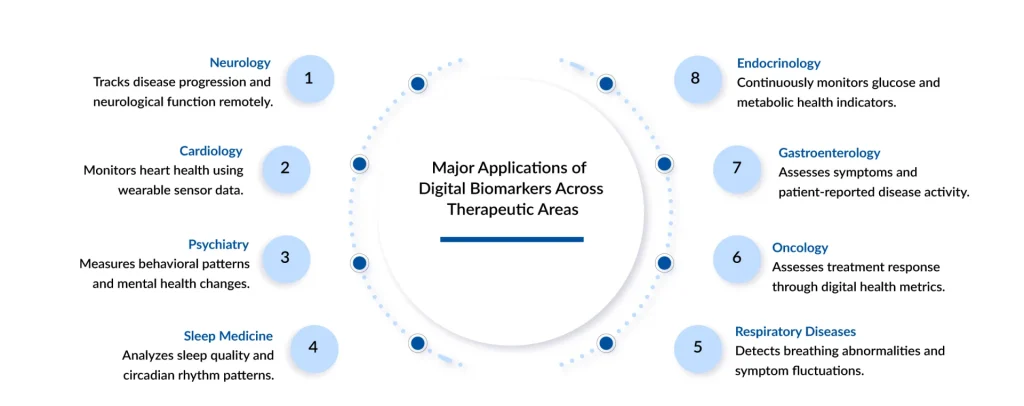
The clinical impact of wearable-derived digital biomarkers is not confined to any single specialty; it is showing up wherever disease produces a measurable physiological or behavioral signature between clinic visits. Cardiology and diabetes care were early beneficiaries simply because their key signals, heart rhythm and blood glucose, map naturally onto sensors that already existed. Neurology, sleep medicine, and psychiatry have followed as algorithms have grown sophisticated enough to extract meaning from subtler, noisier signals like gait, breathing patterns, and daily activity rhythms. Across all five areas below, the common thread is the same: continuous, real-world data is surfacing patterns that periodic clinical snapshots routinely miss.
Cardiology
Cardiology has become the most mature proving ground for wearable-derived digital biomarkers, largely because arrhythmias like atrial fibrillation (AFib) are intermittent and easy to miss in a single clinical ECG. Consumer smartwatches from Apple, Samsung, and Withings now carry FDA clearance for single-lead ECG and irregular rhythm notifications, using photoplethysmography (PPG) to flag pulse irregularities suggestive of AFib. For clinical-grade continuous monitoring, dedicated patches such as Zio achieve very high physician agreement on end-of-wear arrhythmia reports, and newer FDA-cleared biosensors, including VitalConnect’s VitalRhythm and Cardiosense’s CardioTag, extend continuous ECG, respiratory, and cardiac-timing monitoring into remote patient care and clinical trials. Even reimbursement codes have adapted: 2026 U.S. remote patient monitoring billing now includes a category specifically for AI-assisted cardiac diagnostics delivered via wearables.
Neurology
In neurodegenerative disease, wearables are helping surface symptoms long before they are visible to the naked eye. In Parkinson’s disease, wrist- and body-worn accelerometers and gyroscopes quantify tremor, bradykinesia, and gait abnormalities with enough precision to distinguish early-stage patients from healthy controls and to track subtle progression over months, insights that support studies like the multicenter WATCH-PD program. Because Parkinson’s has a “prodromal” phase where non-motor and subtle motor symptoms precede formal diagnosis, digital gait and movement biomarkers offer a rare diagnostic window that traditional clinical exams, conducted only periodically, simply cannot capture. Sleep-monitoring wearables and EEG headbands are also being explored to characterize the disrupted nocturnal patterns common in Parkinson’s and other neurological conditions.
Sleep Disorders
Sleep medicine has arguably benefited the most from moving monitoring out of the lab and into the bedroom. Wearable-based nocturnal breathing analysis, powered by machine learning, can flag sleep apnea risk and other breathing disturbances from data collected passively during normal sleep, reducing dependence on overnight polysomnography for initial screening. Devices like Withings’ ScanWatch combine ECG and SpO2 sensing to flag both AFib and possible sleep apnea from the same nightly dataset, illustrating how a single wearable can generate biomarkers across multiple organ systems simultaneously.
Diabetes
Continuous glucose monitors (CGMs) are perhaps the most clinically embedded digital biomarker technology in existence, having moved from a niche tool for type 1 diabetes to a mainstream aid for type 2 diabetes and even metabolic wellness in non-diabetic users. Modern systems measure interstitial glucose every few minutes and increasingly sync to smartwatches for at-a-glance readings during exercise or sleep. The frontier is now multi-analyte sensing, extending beyond glucose to ketones, lactate, cortisol, and other metabolites, combined with AI models that can predict glycemic trends, power closed-loop “artificial pancreas” insulin delivery, and identify metabolic subphenotypes that go beyond a simple diabetic/non-diabetic label.
Mental Health
Perhaps the most conceptually novel application is in psychiatry, where wearables enable “digital phenotyping”, inferring mental state from passively collected behavioral and physiological data rather than relying solely on subjective self-report. Wrist- and waist-worn accelerometers can capture sleep timing, activity intensity, and circadian rhythm disruption, all of which machine learning models have linked to depression and anxiety symptoms with moderate-to-good predictive accuracy. Heart rate variability, sleep duration variability, and rest-activity rhythm patterns have each emerged as candidate digital biomarkers for depression severity and relapse risk, offering the possibility of detecting deterioration between clinical visits rather than only during them.
Wearables in Clinical Trials and Real-World Evidence
Beyond individual patient care, wearables are restructuring how clinical research itself is conducted.
Remote and decentralized trials. By collecting physiological and behavioral endpoints continuously in participants’ everyday environments, wearables reduce the need for frequent site visits, a major source of trial dropout and cost. Analysis of interventional trial registrations shows wearable-derived data now supports several distinct purposes in drug development, measuring drug effects, optimizing dosing, tracking adherence, and refining delivery methods, reflecting a broadening role well beyond simple step-counting.
Smaller, faster, cheaper trials. Because digital measures can capture more sensitive and frequent signals than sparse clinic-based assessments, they can, in principle, allow smaller patient cohorts and shorter study durations while still detecting a treatment effect, directly changing trial economics.
Regulatory-grade digital endpoints. Some wearable-derived measures have earned formal regulatory recognition as trial tools; for instance, Apple Watch’s atrial fibrillation history feature achieved qualification as a Medical Device Development Tool, and companies are increasingly integrating medical-grade ECG hardware, such as AliveCor’s technology, into decentralized trial platforms to generate reliable cardiac endpoints outside traditional sites.
Real-world evidence (RWE). Once a therapy is approved, wearables continue generating value by capturing how it performs in everyday use across diverse populations, filling evidence gaps that traditional trials, with their narrow inclusion criteria and short follow-up, cannot address.
Personalized medicine. Digital biomarkers are pushing medicine toward genuinely individualized care by revealing patterns that are specific to a person rather than a population average. CGM-driven glycemic profiling, for example, is enabling researchers to move beyond static glucose thresholds and instead classify metabolic subphenotypes based on individual patterns of insulin resistance, beta-cell function, and incretin response, informing more precisely targeted lifestyle or pharmacological interventions. Similarly, multimodal digital phenotyping combining wearable, sensor, and even postpartum or life-stage-specific data is being used to individualize risk recognition for conditions like postpartum depression, rather than applying one-size-fits-all screening. The underlying premise is straightforward: a treatment plan built on a person’s own continuous physiological baseline is more precise than one built on population norms measured once a year.
The Technology Driving the Trend
Several converging technological advances explain why this transformation is happening now rather than a decade ago. Modern wearable technologies have advanced rapidly due to simultaneous progress in sensor engineering, artificial intelligence, cloud computing, and healthcare connectivity. Sensor miniaturization has enabled highly sophisticated PPG, ECG, accelerometer, and electrochemical sensors to be integrated into compact form factors such as smartwatches, rings, skin patches, and smart textiles without compromising comfort or performance. At the same time, improvements in sensing technologies, including electrochemical, optical, and plasmonic platforms, have expanded the range of measurable biomarkers by enabling non-invasive analysis of biofluids such as sweat, tears, interstitial fluid, and even breath. As a result, wearable devices are no longer limited to tracking basic physiological parameters like heart rate and physical activity but can monitor a much broader spectrum of health indicators.
The vast amount of data generated by these sensors is transformed into clinically meaningful insights through artificial intelligence (AI) and machine learning (ML). Advanced algorithms filter noisy sensor signals and identify subtle physiological patterns that may indicate disease or health deterioration. For example, machine learning models can detect cardiac arrhythmias from photoplethysmography (PPG) waveforms, recognize nocturnal breathing abnormalities using movement and oxygen saturation data, and identify behavioral indicators of mental health conditions such as depression by analyzing sleep and activity patterns. More recently, the emergence of large foundation models trained on extensive wearable datasets has enabled the extraction of digital biomarkers across multiple diseases simultaneously, reducing the need for disease-specific algorithms and improving the scalability of wearable health analytics.
Cloud computing and wireless connectivity further enhance the capabilities of wearable devices by enabling continuous collection, storage, and large-scale analysis of high-frequency physiological data. Cloud-based platforms aggregate information from millions of users, support real-time analytics, and deliver actionable insights or alerts directly to healthcare providers and patients. This infrastructure enables remote monitoring scenarios in which a wearable biosensor patch can detect clinically significant changes and automatically notify clinicians, facilitating timely intervention without requiring an in-person healthcare visit.
Equally important is the growing interoperability between wearable technologies and healthcare information systems. The clinical utility of digital biomarkers depends on their seamless integration into existing healthcare workflows. Increasingly, data from devices such as continuous glucose monitors (CGMs) and ECG-enabled smartwatches are being incorporated into electronic health records (EHRs) and remote patient monitoring platforms, supporting clinical decision-making, reimbursement, and longitudinal patient management. Although challenges related to data standardization and compatibility among device manufacturers, EHR vendors, and healthcare systems remain, ongoing interoperability initiatives are steadily bridging the gap between consumer wearable data and routine clinical practice. Together, these technological advances are transforming wearable devices into powerful tools for continuous, personalized, and proactive healthcare.
Key Challenges to Address
Despite their significant potential to transform healthcare, wearable devices face several critical challenges before digital biomarkers can be regarded as reliable clinical tools rather than merely promising indicators. One of the foremost concerns is data privacy. Wearable health data often exists within a regulatory gray area, as protections under the Health Insurance Portability and Accountability Act (HIPAA) generally apply only when data is managed by covered entities such as healthcare providers. Consequently, device manufacturers and mobile application developers may collect, share, or monetize sensitive physiological information with far fewer restrictions than hospitals or healthcare systems. Legal experts have identified this as a fundamental gap between the rapid evolution of wearable technologies and the comparatively static federal privacy framework, prompting several states to introduce broader consumer privacy laws.
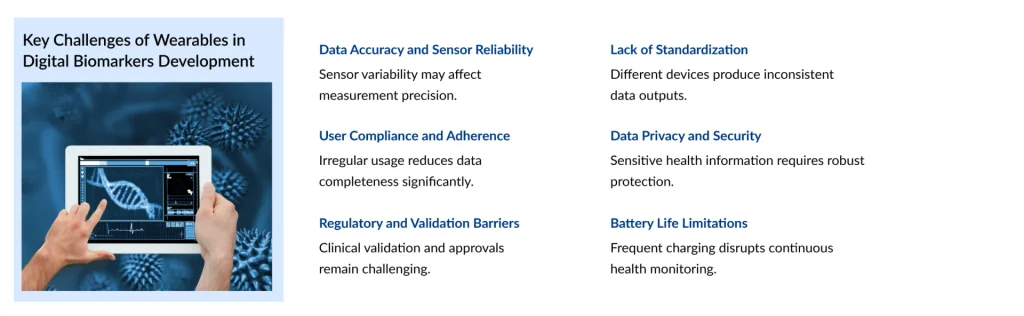
Another major challenge is ensuring the accuracy and clinical validation of wearable-derived data. Consumer-grade photoplethysmography (PPG) sensors are more susceptible to motion artifacts and measurement errors than clinical-grade electrocardiogram (ECG) systems, while single-lead wrist ECGs cannot substitute for comprehensive 12-lead clinical ECGs in definitive diagnosis. Moreover, establishing a digital biomarker requires far more than demonstrating statistical correlation; it demands robust clinical evidence linking the measured parameter to meaningful health outcomes through extensive validation studies. This evidence-generation process is both time-consuming and resource-intensive, and many promising biomarker candidates fail to progress to clinical adoption.
Regulatory uncertainty further complicates the pathway to widespread implementation. Regulatory agencies continue to refine the distinction between consumer wellness products and medical devices. In January 2026, the FDA updated its guidance to narrow oversight of low-risk wearable technologies and AI-enabled clinical decision support tools, aiming to reduce the regulatory burden for wellness-oriented products. However, critics argue that this approach creates ambiguity because metrics generated by devices marketed for wellness purposes are increasingly interpreted by both consumers and healthcare professionals as medically relevant data. This blurred boundary not only complicates regulatory oversight but may also leave certain categories of wearable-generated data outside established privacy protections.
Beyond regulatory clearance, additional barriers limit the integration of digital biomarkers into routine clinical practice. Successful adoption requires standardized qualification pathways, sustainable reimbursement models, interoperability across healthcare systems, and robust post-market evidence generation. Researchers emphasize that this supporting infrastructure remains fragmented and insufficiently developed compared with the rapid pace of wearable technology innovation, slowing the translation of promising digital biomarkers into everyday clinical care.
Finally, patient adherence and health equity remain significant concerns. The effectiveness of digital biomarkers depends on the quality and continuity of data generated by users, which can be affected by factors such as battery life, device comfort, usability, and long-term engagement. Adherence frequently declines after the initial period of enthusiasm, resulting in incomplete datasets that may reduce clinical utility. Additionally, much of the current evidence supporting wearable-based digital biomarkers has been generated from populations lacking adequate demographic diversity. This raises concerns that the underlying algorithms may perform less accurately for underrepresented populations, potentially exacerbating existing healthcare disparities and limiting equitable access to the benefits of digital health technologies.
The Road Ahead
The trajectory is unmistakable: wearables are shifting from consumer novelties into instruments of clinical evidence generation. Several developments suggest where this is heading next. Multi-condition, multi-sensor fusion will likely become standard, with a single wearable simultaneously screening for cardiac, respiratory, metabolic, and behavioral risk rather than one narrow measurement at a time. AI foundation models trained across huge, diverse wearable datasets promise to generalize better across populations and conditions than today’s narrowly trained algorithms, potentially compressing years of biomarker validation work.
Regulatory frameworks, even amid recent deregulatory moves for low-risk wellness devices, are likely to keep sharpening the distinction between general wellness and genuine medical-grade diagnostics, ideally paired with stronger privacy protections that close current HIPAA gaps. And as decentralized and hybrid clinical trials become the norm rather than the exception, wearable-derived digital endpoints are positioned to become a standard, not a novel, part of drug development.
None of this eliminates the fundamentals of good medicine, clinical judgment, careful validation, and trust between patient and provider. But it does mean that judgment will increasingly be informed by dense, continuous, real-world physiological data rather than sparse annual snapshots. The rise of wearables in digital biomarker development is not simply a story about better gadgets; it is a story about medicine slowly gaining the ability to see what has always been happening between office visits, and, in doing so, catching disease earlier, personalizing treatment more precisely, and generating evidence that better reflects how people actually live.

Downloads
Article in PDF
Recent Articles
- Top Home-Use Medical Devices Every Household Should Consider
- How Technology is Providing a New Dimension to the Clinical Trials?
- From Wrist to Wellness: The Evolving Landscape of Wearable Medical Devices Market
- iRhythm’s Zio® AT Device Improvements Receive FDA Clearance; Epitel Adds REMI AI Device to Portfo...
- MiniMed Secures FDA Clearance for MiniMed Flex; Spinal Elements Expands Portfolio with FDA-Cleare...