MIMRYLO Enters the Polycythemia Vera Arena: Can the First-in-Class Hepcidin Mimetic Challenge JAKAFI and BESREMi?
Sep 04, 2026
Table of Contents
Summary
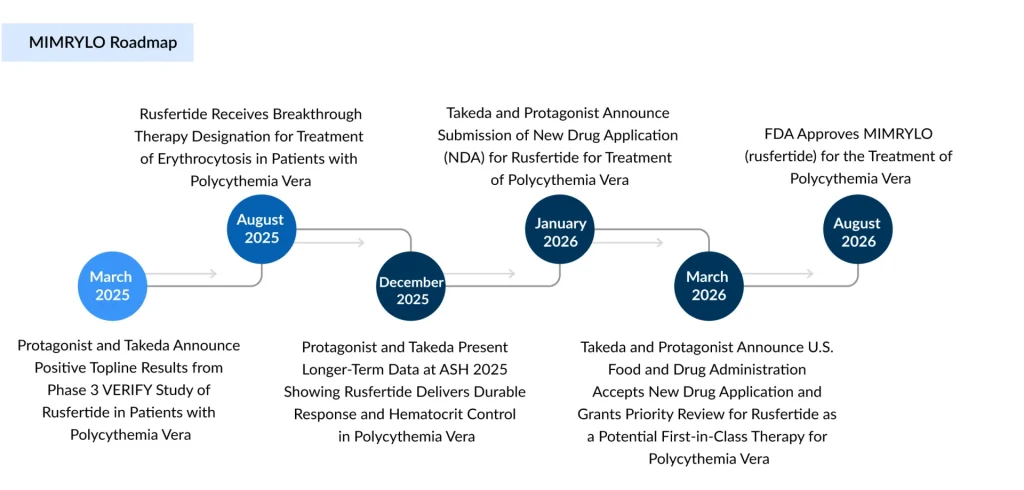
- On August 28, 2026, the FDA approved MIMRYLO (rusfertide), developed by Protagonist Therapeutics and commercialized by Takeda, for treating erythrocytosis in adults with polycythemia vera.
- MIMRYLO is the first approved hepcidin mimetic peptide for PV. It targets the iron-regulation pathway rather than directly inhibiting JAK-STAT signaling or modulating the immune system through interferon.
- The FDA approval was based on findings from the global, randomized Phase 3 VERIFY trial (NCT05210790), which enrolled 293 patients with PV.
- With its differentiated mechanism and broad label, it could challenge established treatment patterns while intensifying competition among JAKAFI, BESREMi, and emerging pipeline therapies such as Italfarmaco’s DUVYZAT, Merck’s Bomedemstat, Ionis and Ono’s Sapablursen, and Disc Medicine’s DISC-3405.
Big polycythemia vera news just landed. On August 28, 2026, the FDA approved MIMRYLO (rusfertide), developed by Protagonist Therapeutics and brought to market by Takeda, for the treatment of erythrocytosis in adults with polycythemia vera (PV). It’s a milestone moment for anyone tracking new treatments for polycythemia vera. MIMRYLO is the first hepcidin mimetic peptide ever approved for this rare blood cancer, and its arrival could meaningfully redraw the polycythemia vera treatment market that JAKAFI (ruxolitinib) and BESREMi (ropeginterferon alfa-2b) have dominated for years.
Downloads
Click Here To Get the Article in PDF

Recent Articles
- LEQEMBI Intravenous Infusion Approval; Novartis’ Presented Updates on Lutathera; FDA Accept...
- Madrigal Wins EU Approval for REZDIFFRA in MASH With Liver Fibrosis; Valneva Faces FDA License Su...
- 5 Emerging Polycythemia Vera Therapies Eyeing Market Dominance
- Polycythemia Vera: Growing Competition and the Changing Treatment Landscape in 2025
- Assessment of Key Products that Got FDA Approval in Second Half (H2) of 2021
What makes this approval especially notable isn’t just the novel mechanism. Unlike JAKAFI, whose PV indication is explicitly confined to patients who have had an inadequate response to or are intolerant of hydroxyurea, MIMRYLO’s label is not boxed into strict second-line use. That distinction alone could reshape how physicians sequence medications for polycythemia vera and where each drug fits across the treatment journey, from newly diagnosed patients to those cycling through multiple lines of therapy.
Inside the FDA Approval: What MIMRYLO Actually Does
MIMRYLO works by mimicking hepcidin, the hormone that naturally regulates how much iron is available for red blood cell production. In PV, the bone marrow overproduces red blood cells, thickening the blood and driving up the risk of stroke, blood clots, and other thrombotic events. By binding to the iron exporter ferroportin, rusfertide reduces the iron available for erythropoiesis, which lowers hematocrit levels. That’s a fundamentally different approach than what’s currently available among drugs for polycythemia vera; it doesn’t suppress the JAK-STAT pathway like JAKAFI, and it doesn’t work through immune modulation like BESREMi’s interferon mechanism.
MIMRYLO, a once-weekly, self-administered subcutaneous injection, is a first-in-class peptide that mimics hepcidin to regulate iron homeostasis and reduce red blood cell production. The FDA granted the application priority review, underscoring how much unmet need still exists in this space despite decades of hydroxyurea, phlebotomy, and interferon use.
The VERIFY Trial: The Efficacy Data Behind the Headlines
Regulators leaned heavily on the Phase 3 VERIFY trial, one of the most closely watched polycythemia vera clinical trials of the past several years. The multicenter, randomized, double-blind, placebo-controlled study enrolled 293 adults with PV whose disease remained inadequately controlled on standard-of-care therapy and who required frequent phlebotomies, randomizing them 1:1 to rusfertide or placebo over a 32-week period, with rusfertide dosed at 19 mg subcutaneously and titrated to keep hematocrit below 45%.
The topline number that’s generating buzz across polycythemia vera news outlets: Phase 3 VERIFY results showed 76.9% of patients achieved a clinical response during weeks 20–32. Beyond hematocrit control, patients receiving MIMRYLO plus current standard of care showed a higher response rate than placebo plus standard of care, including hematocrit control, reduced need for phlebotomy, and improved fatigue. For a patient population that has often had to accept regular blood draws just to stay ahead of dangerously rising red cell counts, phlebotomy-free status is a genuinely meaningful endpoint, and one that’s likely to become a new benchmark in future polycythemia vera clinical trials.
On cost, list pricing has already surfaced: MIMRYLO carries a list price of $4,200 per vial. Expect payer coverage discussions, prior authorization criteria, and rusfertide cost comparisons against JAKAFI and BESREMi to shape adoption just as much as the clinical data will.
JAKAFI’s Turf: Can the JAK Inhibitor Hold Its Ground?
For years, JAKAFI has been the default second-line cytoreductive therapy in PV, the go-to option once hydroxyurea stops working or becomes intolerable. Its strengths are real: strong brand recognition among hematologists, a well-established safety record, and broad benefits for splenomegaly and constitutional symptoms like night sweats, itching, and bone pain that go beyond simple hematocrit control. For patients with prominent splenomegaly or systemic MPN-related symptoms, JAKAFI’s ability to dampen the underlying JAK-STAT signaling driving the disease is something a purely iron-regulating therapy like MIMRYLO simply isn’t designed to replicate.
But JAKAFI’s position isn’t as secure as it once looked, for two reasons.
First, the label restriction itself is a vulnerability. JAKAFI’s PV indication is narrowly written for patients with an inadequate response to or intolerance of hydroxyurea, meaning it was never positioned to compete for first-line or treatment-naive patients. MIMRYLO’s unrestricted label opens the door to a broader swath of the polycythemia vera treatment options landscape, including patients who are phlebotomy-dependent but not ideal candidates for JAK inhibition, whether due to cytopenia risk, infection concerns, or simply not yet meeting hydroxyurea-failure criteria.
Second, Incyte’s exclusivity clock is ticking. Ruxolitinib’s core patents are widely expected to expire around 2028, opening the door to generic and biosimilar competition. That looming JAKAFI patent expiration is already shaping how analysts think about Incyte Corporation competitors in polycythemia vera; a genericized ruxolitinib market could pressure pricing and margins right around the same window that MIMRYLO, sapablursen, and other newer agents are gaining traction.
Where does JAKAFI likely remain the preferred choice? Scenarios involving prominent splenomegaly, severe constitutional symptoms, or a clinical need for broader myeloproliferative disease control, not just hematocrit management, still favor a JAK inhibitor’s mechanism. MIMRYLO’s job is narrower and more targeted: control erythrocytosis and reduce phlebotomy burden. For patients whose PV symptoms extend well beyond red cell overproduction, that narrower scope may be a real limitation rather than an advantage.
|
How MIMRYLO, JAKAFI, and BESREMi Approach Polycythemia Vera |
|||
|
Attribute |
MIMRYLO |
JAKAFI |
BESREMi |
|
Active ingredient/Company |
rusfertide · Takeda |
ruxolitinib · Incyte |
ropeginterferon alfa-2b · PharmaEssentia |
|
Mechanism |
Hepcidin mimic, limits iron for red cell production |
JAK1/JAK2 inhibitor, blocks underlying MPN signaling |
Long-acting interferon, immune-modulating, disease-modifying potential |
|
Line of Therapy |
Not restricted to second-line |
Second-line only (post-HU) |
First- and second-line |
|
Core Strength |
Reduces phlebotomy burden, targeted hematocrit control |
Broad symptom and spleen control, established track record |
May reduce mutant allele burden over time |
|
Watch For |
Limited effect on spleen size or systemic MPN symptoms |
Patent exclusivity ends around 2028 |
Flu-like and mood side effects limit tolerability |
|
Dosing |
Once-weekly subcutaneous |
Twice-daily oral tablet |
Injection every 2–4 weeks |
|
Status |
FDA approved · Aug 28, 2026 |
Established standard of care |
Gaining first-line traction |
BESREMi’s First-Line Foothold: Friend, Rival, or Both?
BESREMi occupies a different competitive lane entirely. As a long-acting interferon, it’s increasingly positioned early in PV treatment algorithms, sometimes as a genuine first-line option, thanks to its disease-modifying potential, including reductions in mutant allele burden that hydroxyurea and JAKAFI don’t reliably deliver. BESREMi was the first interferon specifically approved for polycythemia vera and is now used in both first- and second-line settings. Its upstream placement in treatment algorithms could delay or reduce how many patients ever progress to second-line agents like JAKAFI in the first place, a dynamic that matters enormously for anyone modeling the future polycythemia vera treatment market.
So how does MIMRYLO interact with a therapy that’s already trying to own the front end of the treatment journey? A few plausible scenarios are emerging, including its potential use as a complementary add-on therapy, an alternative for interferon-intolerant patients, or even a new first-line contender in its own right. Patients established on BESREMi who still require frequent phlebotomy despite interferon therapy could add MIMRYLO to close the gap on hematocrit control without escalating to a JAK inhibitor.
Alternatively, not everyone tolerates interferon’s flu-like symptoms, mood effects, or injection-site reactions, and for patients unwilling to accept those trade-offs, MIMRYLO’s mechanism and tolerability profile could make it a viable substitute rather than an add-on. Finally, if MIMRYLO’s phlebotomy-reduction data holds up in longer-term follow-up, some clinicians may begin favoring it earlier in the treatment algorithm purely for erythrocytosis control, especially in patients without prominent splenomegaly or elevated symptom burden, where BESREMi’s broader disease-modifying case is less compelling.
This sets up one of the more interesting head-to-head debates in the space: BESREMi vs JAKAFI for polycythemia vera has been the dominant comparison for years, but BESREMi vs JAKAFI for polycythemia vera long-term control discussions may soon need a third column for rusfertide vs BESREMi, particularly as maturing VERIFY data addresses durability beyond the initial 32-week window.
There are payer and guideline implications here too. If MIMRYLO gains traction as a first-line erythrocytosis-control option, insurers will need to decide whether it competes with BESREMi for first-line formulary placement or is treated as an adjunct, a distinction that will shape prior authorization criteria and, ultimately, real-world uptake as much as any efficacy data will.
Beyond the Big Three: The Rest of the Polycythemia Vera Pipeline
MIMRYLO’s approval doesn’t happen in a vacuum. It lands amid one of the most active pipelines PV has seen in decades, and staying current on polycythemia vera latest research means tracking several other mechanisms working their way toward the clinic. Merck’s bomedemstat, an oral LSD1 inhibitor originally developed by Imago BioSciences, is being evaluated head-to-head against usual PV treatments in an ongoing Merck-sponsored trial.
Sadaf Javed, Functional Head of Forecasting and Analytics at DelveInsight, said that we view it as a later-line, second-wave entrant, with regulatory submission unlikely before 2029, positioning it as a longer-term threat rather than an immediate one.
Ionis and Ono’s sapablursen takes a genetic approach, using an antisense oligonucleotide to target TMPRSS6 and boost the body’s own hepcidin production, conceptually adjacent to what MIMRYLO does pharmacologically, but through gene expression rather than direct receptor mimicry. It’s now advancing through a Phase 3 global trial in PV, alongside earlier-stage data in phlebotomy-dependent patients. Disc Medicine’s DISC-3405 is another entrant targeting the iron-hepcidin axis, currently in Phase 2 development for PV. Italfarmaco’s DUVYZAT rounds out the list of companies with pipeline interest in the PV space, one more sign of how crowded this therapeutic area is becoming.
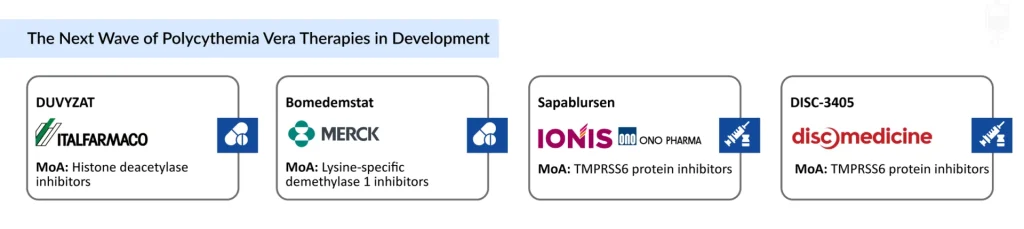
Taken together, these emerging polycythemia vera drugs suggest that MIMRYLO’s approval is less an endpoint and more an opening move. The hepcidin-iron axis, in particular, is emerging as a genuine new pillar of treatment alongside JAK inhibition and interferon therapy, a third mechanistic pathway that didn’t meaningfully exist in PV medications a few years ago.
Future Outlook: Where PV Treatment Goes From Here
Zooming out, the next three to five years look poised to reshape polycythemia vera treatment options more than any comparable stretch since JAKAFI’s original approval. A few forces are converging at once: JAKAFI’s patent cliff around 2028, BESREMi’s push to entrench itself as a first-line, disease-modifying option, MIMRYLO’s unrestricted label giving it room to expand across lines of therapy, and a deep pipeline of iron-axis and epigenetic agents following behind it.
Several open questions will ultimately determine how MIMRYLO’s role in polycythemia vera treatment evolves. One of the most important is whether its early benefits in hematocrit control and phlebotomy reduction will translate into meaningful long-term improvements in thrombotic events and survival. While VERIFY’s initial findings focus on outcomes over roughly 32 weeks, extension data are still maturing. The critical question is whether hepcidin mimicry can deliver durable reductions in stroke, thrombosis, and mortality risk over years rather than months, which will ultimately determine MIMRYLO’s position in treatment guidelines.
Another key consideration will be how MIMRYLO fits into existing treatment pathways. Clinicians will need to determine whether it should be layered onto polycythemia vera therapies such as hydroxyurea, BESREMi, or JAKAFI, used as monotherapy in patients with erythrocytosis-predominant disease, or reserved primarily for patients who remain dependent on phlebotomy. Because VERIFY was designed as a placebo-controlled add-on study, it was not intended to fully answer these sequencing questions, leaving real-world evidence and future head-to-head trials to clarify where MIMRYLO delivers the greatest clinical value.
The potential expansion of the hepcidin-based approach beyond established PV is another area to watch. If the iron-hepcidin mechanism demonstrates durable efficacy and an acceptable safety profile, rusfertide and similar agents could potentially be explored in other myeloproliferative neoplasms, including essential thrombocythemia, as well as in secondary erythrocytosis. There may also be an opportunity to intervene earlier in the PV treatment journey, before patients accumulate years of phlebotomy dependence or extensive exposure to therapies such as hydroxyurea.
For now, one thing is clear: the PV treatment market has gained a genuinely differentiated mechanism of action, and MIMRYLO’s broad label means its role is unlikely to remain confined to a narrowly defined second-line niche. With the VERIFY dataset continuing to mature, JAKAFI approaching patent expiration, BESREMi pursuing a stronger first-line position, and a growing pipeline of therapies targeting the iron axis and epigenetic pathways, PV is entering one of its most competitively dynamic periods in years. Ultimately, this intensifying competition could translate into more treatment options, greater therapeutic flexibility, and potentially better outcomes for patients.

Downloads
Article in PDF
Recent Articles
- Polycythemia Vera: Growing Competition and the Changing Treatment Landscape in 2025
- Assessment of Key Products that Got FDA Approval in Second Half (H2) of 2021
- Takeda’s MIMRYLO Wins U.S. FDA Approval for Polycythemia Vera; Lilly’s Mounjaro Gains FDA Approva...
- FDA Approves Eisai & Biogen’s LEQEMBI IQLIK for Maintenance Treatment of Early Alzheimer’s; T...
- JAK Inhibitors: New Lifeline for Hair Loss Treatment