BeOne Enters the BCL-2 Arena: Can BEQALZI Disrupt VENCLEXTA’s Longstanding Dominance?
May 25, 2026
Summary
- BeOne Medicines received accelerated approval for sonrotoclax (BEQALZI) to treat adults with relapsed or refractory mantle cell lymphoma (MCL) who have failed at least two prior therapies, including a BTK inhibitor.
- Backed by Phase 1/2 trial data in 103 heavily pre-treated patients, the drug distinguishes itself from the existing standard, AbbVie/Roche’s venetoclax (VENCLEXTA), through claimed 14x greater potency, higher BCL2 selectivity, and a shorter half-life that simplifies dosing and reduces tumor lysis syndrome monitoring burdens.
A decade after the last BCL2 inhibitor won FDA approval, a next-generation challenger has arrived. In May 2026, the FDA made history, quietly but profoundly, for thousands of patients battling one of the more aggressive and treatment-resistant blood cancers. The agency granted accelerated approval to sonrotoclax (BEQALZI), a next-generation BCL2 inhibitor developed by BeOne Medicines, for adults with relapsed or refractory (R/R) mantle cell lymphoma (MCL) who have received at least two prior lines of systemic therapy, including a BTK inhibitor. The approval, issued to BeOne Medicines, is more than just a regulatory milestone. It is the opening shot in what could become one of oncology’s most closely watched competitive battles: a next-generation BCL2 inhibitor going head-to-head with AbbVie and Roche’s blockbuster VENCLEXTA (venetoclax), a drug that has ruled this class of therapy for a decade.
In a landscape where treatment options for relapsed MCL have remained frustratingly limited, this approval is more than a regulatory milestone. It opens an entirely new class of therapy for a disease that desperately needed it. Mantle cell lymphoma is a rare but aggressive subtype of non-Hodgkin lymphoma, accounting for roughly 3,300 new MCL cases diagnosed in the United States each year. It tends to affect older adults and is notorious for its tendency to relapse. While initial treatments, particularly BTK inhibitors, have transformed outcomes in recent years, patients who progress after these therapies face a grim prognosis with few viable next steps.
Downloads
Click Here To Get the Article in PDF

Recent Articles
- Good news for Kite’s KTE-X19, and Aquestive’s Libervant; and a commercialization deal between ReF...
- BAXFENDY Receives US Approval for Adult Hypertension as a First-in-Class Aldosterone Synthase Inh...
- Sanofi’s Qfitlia Becomes First FDA-Approved Therapy for Hemophilia A or B; FDA Approves AstraZene...
- Analyzing the Most Promising Drugs That Will Lose Patent in the US & EU in 2022
- Phase 1 data of CYC065; Lysogene delays phase 3 study; Genetic disorders Diagnosis; PD-1 resistan...
BEQALZI is a next-generation, small-molecule BCL2 inhibitor, a drug that works by blocking a protein cancer cells use to evade death. In B-cell malignancies like MCL, the BCL2 protein is frequently overexpressed, allowing tumor cells to survive and resist chemotherapy. Sonrotoclax disrupts this survival mechanism, essentially forcing cancer cells to self-destruct through the body’s intrinsic apoptotic pathway.
The FDA’s approval covers adult patients with relapsed or refractory MCL who have received at least two prior lines of systemic therapy, including a BTK inhibitor. This is a patient population where treatment options are limited, and outcomes after progression are historically poor. BEQALZI becomes BeOne’s third commercial oncology product, joining BTK inhibitor BRUKINSA (zanubrutinib) and PD-1 inhibitor TEVIMBRA (tislelizumab) in the company’s growing portfolio.
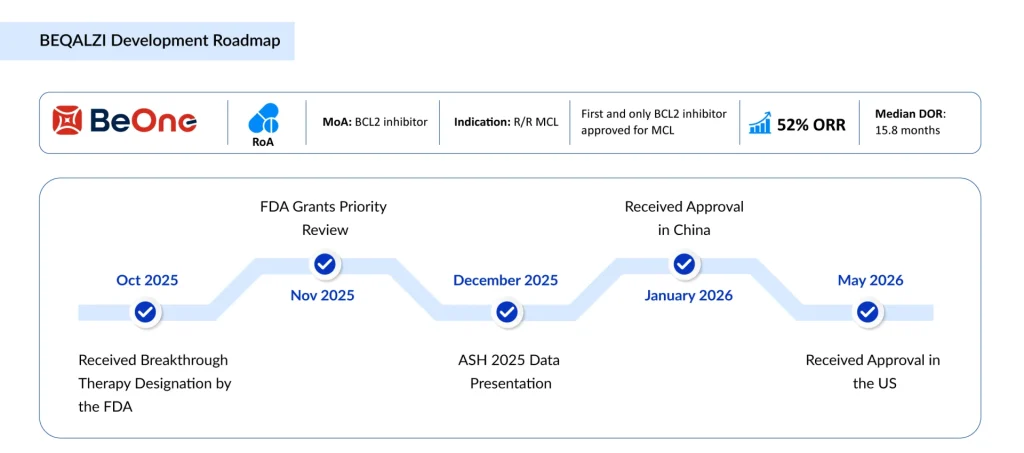
The FDA’s decision was supported by data from the BGB-11417-201 trial (NCT05471843), a single-arm, open-label, multicenter Phase 1/2 study that enrolled 103 adults with relapsed or refractory MCL who had previously received both anti-CD20–based therapy and a BTK inhibitor, a heavily pre-treated population with limited alternatives.
Treatment was generally well tolerated as a monotherapy, with a safety profile that may offer advantages over first-generation BCL2 inhibitors in a heavily pre-treated population. These results were previously presented at the 67th American Society of Hematology (ASH) Annual Meeting, helping establish early clinical credibility before the FDA’s green light. BeOne is now running the Phase 3 CELESTIAL-RRMCL confirmatory trial (NCT06742996), which carries a primary completion date of August 2028 and will be required to maintain the accelerated approval.
Venetoclax (VENCLEXTA), co-marketed by AbbVie and Roche, has been the only BCL2 inhibitor on the market since it first received FDA approval in 2016 for chronic lymphocytic leukemia (CLL), and later for acute myeloid leukemia (AML). For 2025, AbbVie reported nearly $2.8 billion in VENCLEXTA revenue, with year-over-year growth, underscoring the commercial power of this franchise. VENCLEXTA has also been used off-label in MCL, but it has never carried a formal approval for the indication. That gap is where BeOne has strategically planted its flag.
BeOne and independent researchers have highlighted several potential advantages of BEQALZI:
Potency and Selectivity: In preclinical assays, BEQALZI is 14 times more potent than VENCLEXTA and 6 times more selective for BCL2, according to BeOne’s Chief Medical Officer for Hematology, Dr. Amit Agarwal. This enhanced selectivity may translate into greater tumor cell kill with potentially less off-target toxicity.
Shorter Half-Life — A Practical Advantage: One of VENCLEXTA’s most burdensome characteristics is its long half-life, which complicates the dose-escalation process. Patients on VENCLEXTA require monitoring for tumor lysis syndrome (TLS) six to eight hours and 24 hours after each new dose increase, sometimes requiring hospitalization during the ramp-up phase. Sonrotoclax clears the body significantly faster. This shorter half-life may reduce drug accumulation, simplify TLS risk management, and allow for tighter, more precise dosing titration — a real-world convenience benefit for both patients and their care teams.
First Approved in Its Indication: BEQALZI carries an on-label indication that VENCLEXTA simply does not have for MCL. In formulary decisions, prior authorization reviews, and prescriber confidence, this distinction is commercially and clinically significant.
VENCLEXTA is not walking away from this battle quietly. The drug carries two established FDA approvals (CLL and AML), a decade of real-world safety data, widespread physician familiarity, and a massive commercial infrastructure through AbbVie and Roche. The more consequential battleground, analysts believe, will be CLL, a far larger market where VENCLEXTA already dominates. Early results from the combination regimen are expected at ASCO 2026, and the pharmaceutical community is paying close attention.
MCL is the beachhead, not the destination. BeOne is actively studying BEQALZI in a fixed-duration combination regimen with zanubrutinib (BRUKINSA) for treatment-naive and relapsed CLL, arguably the largest prize in the BCL2 treatment landscape. Early Phase 1/2 data from that program have shown deep molecular responses and high rates of undetectable minimal residual disease (uMRD), signaling the potential for chemotherapy-free, time-limited treatment in a patient population that has historically required continuous therapy.
BEQALZI is also already approved in China for both R/R MCL and CLL/SLL, and is currently under review by the European Medicines Agency (EMA), suggesting BeOne’s ambitions stretch well beyond U.S. borders. The drug also carries prior Breakthrough Therapy, Fast Track, and Orphan Drug designations from the FDA, reflecting early regulatory acknowledgment of its potential across the BCL2 inhibitor class.
In conclusion, BEQALZI’s approval is a landmark moment, the first new BCL2 inhibitor in ten years, and the only one to carry an on-label indication for mantle cell lymphoma. For R/R MCL patients who have exhausted BTK inhibitor options and face limited alternatives, it represents genuine, evidence-backed hope.
For the broader industry, it marks the beginning of a next-generation BCL2 era that will force AbbVie and Roche to defend their VENCLEXTA franchise not just with volume and legacy, but with data. Whether BEQALZI’s preclinical potency advantage translates into a decisive clinical edge, particularly in CLL, is the question that will define this competition over the next several years.
The BCL2 wars are just beginning. And for the first time in a decade, there’s a credible challenger in the ring.

Downloads
Article in PDF
Recent Articles
- CAR-T Cell Therapy aka Miraculous Technology: Mapping the Market, Approved Therapies, Competitive...
- Sanofi’s Qfitlia Becomes First FDA-Approved Therapy for Hemophilia A or B; FDA Approves AstraZene...
- Phase 1 data of CYC065; Lysogene delays phase 3 study; Genetic disorders Diagnosis; PD-1 resistan...
- BAXFENDY Receives US Approval for Adult Hypertension as a First-in-Class Aldosterone Synthase Inh...
- Eli’s Jaypirca: A Beacon of Success in the BTK Inhibitor Market