The Role of Digital Twins in Medical Device Development and Testing
Aug 05, 2026
Table of Contents
Medical device innovation has always been a race against two unforgiving constraints: patient safety and time. Every implant, imaging system, and connected diagnostic tool must survive years of physical prototyping, bench testing, animal studies, and clinical trials before it ever reaches a patient. Digital twins in healthcare are rewriting that timeline. By creating living, data-driven virtual replicas of devices, organs, and even entire patients, digital twin technology is helping manufacturers design smarter, test faster, and bring safer products to market, all while giving regulators a new, credible category of evidence to evaluate.
What Are Digital Twins in Healthcare and Medical Devices?
A digital twin is a virtual, continuously updated representation of a physical object, process, or biological system, built from real-world data and connected to its physical counterpart throughout its lifecycle. In healthcare, digital twins healthcare applications span three broad categories:
Downloads
Click Here To Get the Article in PDF

- Device digital twins: Virtual models of a medical device (a pacemaker, a heart valve, an insulin pump) that mirror its mechanical, electrical, and software behavior.
- Patient or organ digital twins: Patient-specific or population-based simulations of anatomy and physiology, such as a virtual heart, lung, or spine, used to predict how a device will interact with real human tissue.
- Process and facility digital twins: Models of hospital operations, manufacturing lines, or clinical workflows used to optimize efficiency and resource planning.
Unlike a static CAD model or simulation run once during design, a true digital twin is dynamic. It ingests real-time data from sensors, wearables, electronic health records, or in-field device telemetry, and updates continuously, creating a feedback loop between the physical device and its digital counterpart. This distinction matters: research from the National Academies of Sciences, Engineering, and Medicine has formalized this definition, and a recent scoping review found that only a small fraction of published “digital twin” studies in healthcare actually meet this full, continuously-updating standard; most are closer to static digital models or “digital shadows.” Understanding this gap is essential context for anyone evaluating vendor claims in the digital twins healthcare market today.
How Digital Twins Are Transforming the Medical Device Development Lifecycle
The traditional device development pathway, concept, prototype, bench test, animal study, clinical trial, regulatory submission, is linear, expensive, and slow. Digital twins compress and parallelize much of this process.
Design and Early Concept Development
Engineers can now build and stress-test a device concept inside a physiologically realistic virtual environment before a single physical prototype exists. Instead of guessing how a stent or catheter will behave, teams simulate device–tissue interactions across thousands of virtual patient anatomies, catching design flaws when they are cheapest to fix.
Prototyping and Iteration
Digital twins allow engineers to run rapid “what-if” design iterations virtually, adjusting material properties, geometry, or electrical parameters, and observe simulated outcomes in hours rather than the weeks required to machine and test physical prototypes.
Simulation and Preclinical Testing
This is where digital twins deliver their most dramatic impact. In silico trials, simulated clinical studies run entirely on computational models, can now supplement or, in specific cases, partially replace animal studies and early-phase physical testing. Structural heart interventions offer a clear example: transcatheter aortic valve replacement (TAVR) planning increasingly relies on patient-specific digital twins to model how a valve will deploy against a specific patient’s calcified anatomy, helping predict complications like paravalvular leak before the procedure ever begins.
Validation and Regulatory Submission
Digital twins increasingly generate the computational modeling and simulation (CM&S) evidence that supports formal regulatory submissions, following standards such as ASME V&V 40 for verification, validation, and uncertainty quantification, a shift discussed in detail in the regulatory section below.
Post-Market Surveillance and Predictive Maintenance
The lifecycle doesn’t end at approval. Digital twins of deployed devices continue to ingest field performance data, allowing manufacturers to detect early signs of mechanical wear, software drift, or performance degradation in implanted or in-use devices, often before a physical failure would ever be detected through conventional means.
Key Benefits of Digital Twins in Medical Device Development
Reduced development costs, accelerated product development, enhanced reliability, improved patient safety, and stronger regulatory support are among the key benefits driving the adoption of digital twins in the medical device industry. By replacing a portion of physical prototyping, cadaver studies, and animal testing with virtual simulations, manufacturers can significantly reduce research and development expenses, particularly for complex cardiovascular and orthopedic devices where traditional testing is costly. Virtual design iterations and simulation-based validation also help shorten development timelines and facilitate faster regulatory clearance, as demonstrated by the FDA–industry collaboration applying the V&V 40 framework to a spinal pedicle screw system, which showcased the potential of computational evidence to complement physical testing.
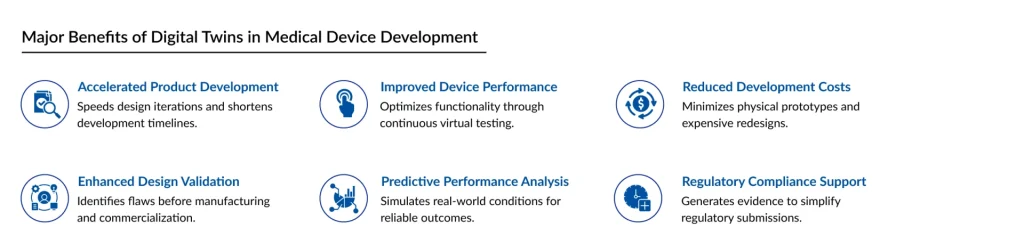
In addition, connected digital twins continuously monitor device performance in real-world settings, enabling predictive maintenance and early detection of anomalies to reduce the risk of failures and recalls. Patient-specific digital twins further enhance clinical outcomes by allowing physicians to simulate procedures and evaluate device fit using an individual’s anatomy before surgery. For example, Boston Children’s Hospital has leveraged patient-specific digital twins to plan complex congenital heart surgeries, with clinicians reporting more reliable outcome predictions than those obtained through animal models. Moreover, standards-based simulation frameworks such as V&V 40 provide manufacturers with a robust and auditable approach to demonstrating device safety and effectiveness, strengthening regulatory submissions while complementing conventional preclinical and clinical evidence.
Real-World Examples: Digital Twins Already at Work
Cardiac devices: The Living Heart Project
Dassault Systèmes’ SIMULIA Living Heart Model, developed in collaboration with the FDA, is arguably the most mature medical device digital twin in existence. It is a validated, multiphysics simulation of the human heart integrating structural mechanics, electrical activation, and physiological motion, used by device manufacturers to virtually evaluate pacemakers, stents, valves, and defibrillators under realistic cardiac conditions. Siemens Healthineers and Philips have joined the project as partners, and Dassault has since released the “ENRICHMENT Playbook”, a peer-reviewed guide, developed with the FDA and included in its Regulatory Science Tools Catalog, on using virtual twins to accelerate device trials.
Structural heart interventions
Beyond the Living Heart Model, tools such as AI-powered aortic root and valve reconstruction platforms and physics-based procedural simulation systems are being used to model TAVR device-anatomy interactions, helping predict implant depth, commissural alignment, and complication risk ahead of live procedures.
Orthopedic implants
Smart, sensor-embedded implants, such as Zimmer Biomet’s Persona IQ knee system, which pairs with a remote care management platform, generate continuous post-operative data that feeds into digital models of implant performance and patient recovery trajectories, extending the digital twin concept from the operating room into long-term patient monitoring.
Imaging and hospital operations
Siemens Healthineers has built digital heart and organ models using a database of hundreds of millions of annotated images and operational records, and has partnered with academic medical centers to simulate how equipment and workflow changes affect hospital efficiency, extending digital twin value beyond the device itself into the broader care environment.
The Role of AI, IoT, and Real-Time Data Integration
The advancement of digital twin technology is closely tied to the integration of artificial intelligence (AI) and the Internet of Things (IoT), as the accuracy and value of a digital twin depend entirely on the quality and continuity of the data it receives. AI and machine learning have significantly accelerated the development of patient-specific digital twins by analyzing multimodal healthcare data, including medical imaging, genomic information, wearable device outputs, and longitudinal electronic health records. Foundation models can now generate personalized organ or whole-body simulations far more efficiently than traditional manual calibration methods, while generative AI is being leveraged to create synthetic patient populations for virtual clinical testing and treatment optimization.
At the same time, IoT-enabled wearable devices and connected medical sensors provide the continuous stream of physiological data required to keep digital twins updated in real time. Data such as heart rhythm, physical activity, muscle strength, and other biometric parameters enable digital twins to dynamically reflect a patient’s changing health status. Research has shown that this continuous data integration supports disease prediction, simulated clinical trials, personalized treatment planning, and remote patient monitoring. Furthermore, connected implants and remote monitoring platforms continuously transmit real-world performance data back to manufacturers, creating a feedback loop that improves device design, enables predictive maintenance, and enhances long-term clinical outcomes.
The convergence of AI, machine learning, IoT, and real-time health data is driving the rapid expansion of digital twin applications in healthcare, transforming them from static, single-organ simulations into comprehensive, continuously evolving models capable of representing multiple body systems and, ultimately, entire patients.
Regulatory Considerations: How the FDA and EMA Are Responding
Regulators have moved from skepticism to structured engagement with simulation-based evidence, and this shift is central to why digital twins are gaining traction in device development rather than remaining a research curiosity. In the United States, the FDA finalized guidance in November 2023 establishing a risk-informed framework for including computational modeling and simulation evidence in medical device submissions, built on the ASME V&V 40 verification and validation standard. A collaborative FDA-industry exercise applying this framework to a spinal pedicle screw system served as a proof-of-concept, showing how computational evidence can substitute for a portion of physical testing in real submissions.
In January 2025, the FDA extended this trajectory with draft guidance on AI-enabled device software functions, further clarifying how simulation-based and digital twin evidence can support both device clearance and clinical trial design. The agency has also made clear that sponsors intending to use a digital twin or synthetic control arm must disclose this at the investigational stage, and that AI-driven synthetic arms will be held to a notably higher credibility bar than simpler external comparators like historical chart reviews.
In Europe, the EMA has signaled growing interest through its multi-year AI Action Plan, which includes dedicated technical reviews of digital twin technology, alongside a continued emphasis on real-world evidence in clinical decision-making. The throughline across both agencies is credibility, not novelty: regulators are not simply “allowing” digital twins; they are asking sponsors to prove, through structured verification and validation, that a given model is trustworthy for its specific intended use. That distinction matters enormously for how manufacturers should plan their simulation strategy.
Challenges Facing Digital Twin Adoption
Despite the strong momentum surrounding digital twin technology, several key challenges continue to limit its widespread adoption and must be carefully considered. One of the primary concerns is data accuracy and model credibility. The reliability of a digital twin depends on the quality of the underlying data, rigorous model validation, and uncertainty quantification. Recent analyses have shown that many published human digital twin models still fall short of established standards, indicating that further efforts are needed to distinguish true digital twins from basic simulations or digital shadows.
Cybersecurity also remains a significant challenge. As digital twins increasingly rely on connected medical devices and continuous real-time data exchange, they expand the potential attack surface for cyber threats. Protecting sensitive patient information while maintaining uninterrupted real-time data transmission is a critical technical and regulatory priority.
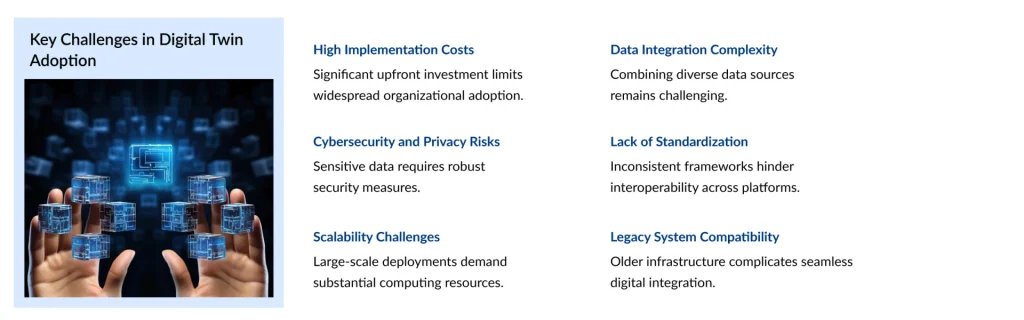
Another major barrier is the high cost of implementation. Developing physiologically accurate, high-fidelity digital twins requires advanced computational resources, specialized expertise across multiple disciplines, and substantial long-term investment. These requirements can be particularly burdensome for smaller medical device manufacturers and healthcare providers with limited resources.
In addition, integration with existing healthcare infrastructure presents ongoing difficulties. Fragmented electronic health records, legacy hospital information systems, and inconsistent data standards often hinder seamless data exchange, reducing the effectiveness and long-term accuracy of digital twin models.
Finally, regulatory inconsistencies and the lack of global harmonization continue to challenge broader adoption. While computational modeling evidence has gained increasing acceptance from agencies such as the FDA, regulatory recognition varies across regions. Greater international alignment will be essential for establishing simulation-based evidence as a globally accepted component of medical device development and regulatory decision-making.
Future Outlook: Personalized Medicine and Virtual Clinical Trials
The future of digital twins in healthcare is being shaped by two interconnected trends: personalized medicine and virtualized clinical development. As the technology matures, digital twins are evolving beyond research applications to become integral tools for precision care, medical device innovation, and regulatory decision-making.
Personalized medicine is expected to remain the primary driver of market growth in the near term. This segment currently represents the largest share of the digital twins in healthcare market, fueled by the increasing demand for patient-specific treatment planning and device optimization. Advances in artificial intelligence and computational modeling are enabling the creation of highly customizable virtual patient models. For example, next-generation platforms such as Dassault Systèmes’ AI-powered Living Heart model are designed to generate thousands of individualized cardiac digital twins, supporting personalized device design, therapy selection, and clinical decision-making.
Over the longer term, virtual and in silico clinical trials are poised to transform healthcare product development. Early clinical studies have demonstrated the potential of patient-specific digital twins to guide treatment decisions, with FDA-permitted trials reporting improved outcomes compared with conventional care in initial patient cohorts. As validation methodologies become more robust and regulatory confidence continues to grow, hybrid and fully virtual clinical trial models, where synthetic control arms complement or partially replace traditional comparator groups, are expected to become increasingly common for evaluating medical devices and therapeutics.
Market outlooks consistently indicate strong long-term expansion despite variations in individual forecasts. DelveInsight analysts project the global digital twins in healthcare market to grow from approximately USD 2 billion in 2025 to USD 15 billion by 2034. This growth is expected to be driven by continued advances in artificial intelligence, broader adoption of wearable and connected health technologies, increasing availability of real-world patient data, and greater regulatory acceptance of simulation-based evidence. Among the various application areas, organ- and body part-specific digital twins are anticipated to experience the fastest growth due to their comparatively straightforward clinical validation relative to whole-body digital twin models.
For medical device manufacturers, digital twins are rapidly transitioning from experimental research tools to strategic development capabilities. Companies that invest early in validated simulation platforms, integrate AI-driven modeling into product development workflows, and align with evolving regulatory frameworks established by agencies such as the FDA and EMA will be better positioned to accelerate development timelines, enhance regulatory submissions, reduce development costs, and deliver safer, more effective, and increasingly personalized medical technologies.

Downloads
Article in PDF