Neuroendocrine Carcinoma: After Four Decades of Chemo, the Treatment Playbook Is Changing
Nov 16, 2026
Table of Contents
Summary
- SCLC is the core of the NEC market. Small cell lung cancer makes up roughly 10-15% of lung cancers, with about 250,000 new cases worldwide each year, and most patients are diagnosed at the extensive stage.
- Extrapulmonary NEC is the biggest unmet need. With an incidence of about 1 per 100,000, it has no standard second-line therapy, and real-world first-line survival is only about 9 months.
- Approved options have grown fast. IMDELLTRA (full FDA approval Nov 2025), IMFINZI (limited-stage, Dec 2024), and ZEPZELCA plus atezolizumab (first-line maintenance, Oct 2025) have each added a new standard of care since 2024.
- The emerging NEC pipeline is increasingly focused on DLL3- and B7-H3-directed therapies, ADCs, bispecific T-cell engagers, and innovative immunotherapy combinations aimed at improving survival, overcoming treatment resistance, and expanding therapeutic options for patients with SCLC and epNEC.
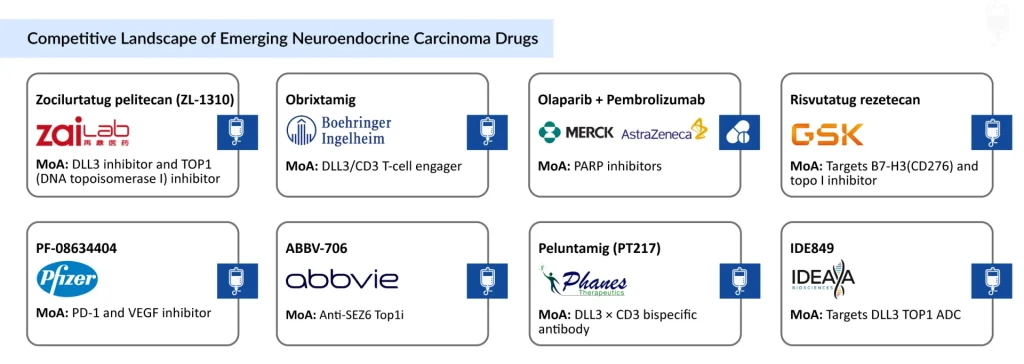
- Key candidates under clinical evaluation include Zai Lab’s Zocilurtatug Pelitecan (ZL-1310), GSK’s Risvutatug Rezetecan (GSK5764227), Pfizer’s PF-08634404, Boehringer Ingelheim’s Obrixtamig, Bristol Myers Squibb’s Pumitamig, AbbVie’s ABBV-706, Phanes Therapeutics’ Peluntamig (PT217), IDEAYA Biosciences’ IDE849, Merck/Daiichi Sankyo’s Gocatamig (MK-6070), and others.
For most of the last four decades, a diagnosis of neuroendocrine carcinoma meant the same thing: platinum-etoposide chemotherapy, a fast response, and a relapse that arrived faster than anyone hoped. That script is finally being rewritten. T-cell engagers, antibody-drug conjugates, and new maintenance strategies are pulling one of oncology’s most neglected cancers into the spotlight, and the pace of change since 2024 has been remarkable.
Downloads
Click Here To Get the Article in PDF

Recent Articles
Neuroendocrine Carcinoma: A Rare Cancer That Moves Fast
Neuroendocrine carcinoma (NEC) is the high-grade, poorly differentiated end of the neuroendocrine neoplasm spectrum. Under the microscope, it is defined by rapid cell division: a Ki-67 proliferation index above 20% and a high mitotic count are the classic hallmarks. Pathologists confirm the diagnosis with markers such as synaptophysin, chromogranin A, CD56, and INSM1, and NECs are typically split into small-cell and large-cell types. The biology explains the clinical picture. NECs grow quickly, spread early, and tend to respond well to chemotherapy at first, then recur, usually more resistant than before. That pattern holds whether the tumor starts in the lung or elsewhere in the body.
Pulmonary NEC/SCLC and Extrapulmonary NEC: Two Faces of One Aggressive Disease
In practice, NEC falls into two groups that share biology but differ sharply in size, evidence, and treatment options.
Pulmonary NEC, led by small cell lung cancer (SCLC)
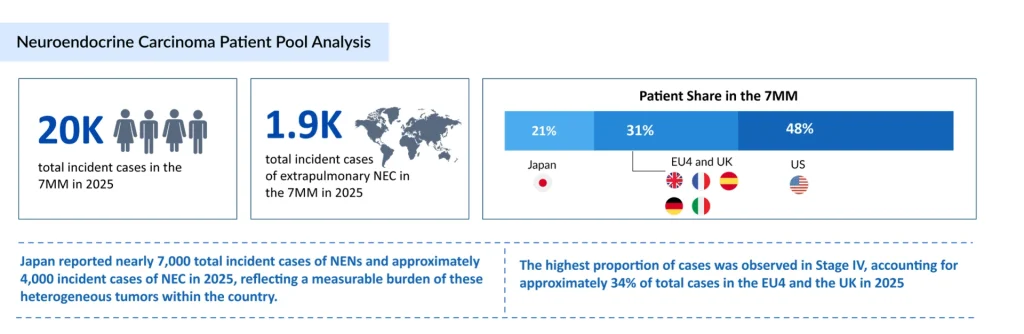
SCLC is itself a high-grade neuroendocrine carcinoma, and it is by far the largest NEC population. It accounts for roughly 10-15% of all lung cancers. DelveInsight estimates that about 250,000 people are diagnosed with SCLC worldwide each year, including roughly 27,000 in the US in 2025, or about 12% of US lung cancers. The burden is heavy because the disease is usually found late. Most patients present with extensive-stage disease (ES-SCLC), and Amgen has noted that fewer than 3% of ES-SCLC patients live beyond five years. Limited-stage disease makes up roughly 30% of diagnoses, and it too recurs often despite chemoradiation. Smoking is the dominant risk factor, which also means many patients arrive with other smoking-related illnesses that complicate treatment.
Extrapulmonary NEC (epNEC)
Extrapulmonary NEC can arise almost anywhere: the gastrointestinal tract (the most common site in several published series), the bladder, the cervix, the skin (as Merkel cell carcinoma), and more. It is much rarer than SCLC, with an incidence of about 1 per 100,000 people, according to a 2026 real-world analysis presented at ASCO. Rarity brings its own problem: very little high-quality evidence. Platinum-etoposide is borrowed from SCLC and remains the consensus first-line standard, while no second-line standard is agreed upon. In that ASCO 2026 US real-world dataset, first-line patients had a median overall survival of just 9.0 months, and only 7.0 months among those treated with platinum-etoposide alone. One widely cited retrospective review reports median survival of around five months once the disease reaches distant sites.
For patients and the companies serving them, the message is the same. Both groups face an aggressive cancer, a short window for treatment, and a long-standing shortage of options. That shortage is exactly what makes the current wave of innovation so significant.
Neuroendocrine Carcinoma Treatment Today: What’s Actually Approved?
The honest answer is that almost everything approved for neuroendocrine carcinoma is approved for small cell lung cancer. Extrapulmonary NEC patients borrow those regimens and the platinum-etoposide backbone, because dedicated labels for their disease barely exist.
Amgen’s IMDELLTRA: The T-Cell Engager That Changed the Conversation
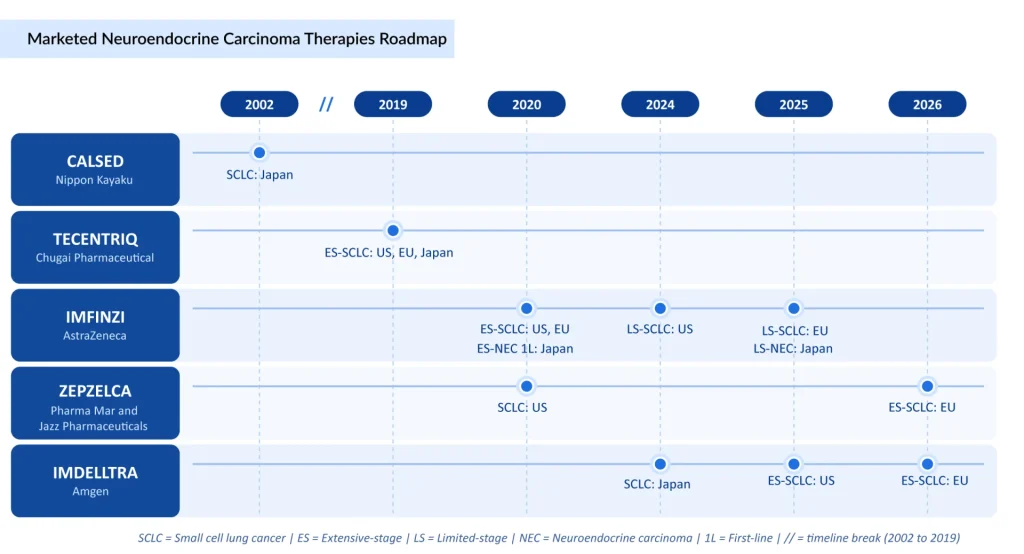
IMDELLTRA (tarlatamab-dlle) is a bispecific T-cell engager that links DLL3 on tumor cells to CD3 on T cells, steering the patient’s own immune system toward the cancer. The FDA first cleared it in May 2024 under accelerated approval, based on the phase 2 DeLLphi-301 study: a 40% objective response rate, a 9.7-month median duration of response and a 14.3-month median overall survival in heavily pretreated patients.
The confirmatory phase 3 DeLLphi-304 trial (509 patients) then showed that tarlatamab cut the risk of death by about 40% compared with standard chemotherapy, with fewer dose reductions or discontinuations for side effects. That earned full FDA approval on November 19, 2025, and European Commission approval followed on June 1, 2026. The label carries a boxed warning for cytokine release syndrome and neurologic toxicity, including ICANS, so monitoring logistics matter.
The bigger story is moving earlier. In the phase 3 DeLLphi-305 trial (563 patients), adding tarlatamab to durvalumab as first-line maintenance lifted median overall survival to 21.1 months from 12.7 months with durvalumab alone (hazard ratio 0.42). The data were presented at ESMO 2026 and published in the New England Journal of Medicine. This use is not yet approved, and Amgen has said it will share the results with regulators.
Chugai’s TECENTRIQ: The Immunotherapy That Opened the Door in Japan
When Chugai won Japanese approval for TECENTRIQ (atezolizumab) in extensive-stage SCL treatment on August 22, 2019, it became the first cancer immunotherapy cleared for the disease there and the first new option in 17 years. The approval, in combination with carboplatin and etoposide, rested on the IMpower133 study. TECENTRIQ remains central today, and not only in Japan. It is the partner drug in the ZEPZELCA maintenance combination, and a subcutaneous formulation (TECENTRIQ HYBREZA) is covered by the US label for that use.
Incyte’s ZYNYZ: A PD-1 Option for a Neuroendocrine Skin Cancer
ZYNYZ (retifanlimab-dlwr) is not an SCLC drug, which makes it easy to overlook. But Merkel cell carcinoma (MCC) is a neuroendocrine carcinoma of the skin, and in extrapulmonary NEC it is one of the few subtypes with a dedicated PD-1 label. The FDA approved ZYNYZ for metastatic or recurrent locally advanced MCC in March 2023, based on the single-arm PODIUM-201 study. The European Commission followed in April 2024 with a first-line monotherapy indication for patients not suited to curative surgery or radiation.
The FDA expanded the ZYNYZ label in May 2025 to include squamous cell carcinoma of the anal canal, but that is a separate tumor type. For NEC watchers, the takeaway is that checkpoint inhibition has a proven foothold outside the lung, and MCC patients have historically fared better than other extrapulmonary NEC groups.
AstraZeneca’s IMFINZI: Finally, Progress in Limited-Stage Disease
Limited-stage SCLC had seen little innovation for decades until the ADRIATIC trial. The FDA approved IMFINZI (durvalumab) on December 4, 2024, for adults whose LS-SCLC had not progressed after concurrent platinum chemotherapy and radiation. In 730 patients, durvalumab reduced the risk of death by 27% (median OS 55.9 vs 33.4 months) and extended median progression-free survival to 16.6 months from 9.2 months. The European Commission approved it in 2025.
IMFINZI is also approved with chemotherapy in extensive-stage disease based on the CASPIAN trial, which makes it the immunotherapy backbone across both stages. Pneumonitis, including radiation pneumonitis, is the main safety watch-out after chemoradiation. IMFINZI is also the foundation of the DeLLphi-305 regimen described above.
Pharma Mar and Jazz Pharmaceuticals’ ZEPZELCA: Rewriting First-Line Maintenance
ZEPZELCA (lurbinectedin) is an alkylating agent that binds DNA. The FDA first approved it in June 2020 for metastatic SCLC after platinum chemotherapy, and its second act has been bigger. On October 2, 2025, the FDA approved ZEPZELCA plus atezolizumab as first-line maintenance for ES-SCLC patients who had not progressed after atezolizumab, carboplatin, and etoposide induction.
In the phase 3 IMforte trial, the combination reduced the risk of progression or death by 46% (median PFS 5.4 vs 2.1 months) and the risk of death by 27% (median OS 13.2 vs 10.6 months) compared with atezolizumab alone. The NCCN added it as a preferred regimen. The European Commission approved it on June 1, 2026, after Swissmedic and the UK’s MHRA. Myelosuppression is the key toxicity: 84% of IMforte patients received primary G-CSF prophylaxis.
Nippon Kayaku’s CALSED: Japan’s Long-Standing Second-Line Workhorse
CALSED (amrubicin) is a synthetic anthracycline that inhibits topoisomerase II. It reached the Japanese market in 2002, and Nippon Kayaku has marketed it since January 2005 under license from Sumitomo. For years it was permitted for relapsed SCLC only in Japan, and a meta-analysis of 803 patients suggested it compares favorably with topotecan, though with heavy hematologic toxicity (about 70% grade 3-4 neutropenia and 12% febrile neutropenia). Amrubicin still matters globally as a reference point: it is one of the physician’s-choice chemotherapy comparators in the phase 3 IDeate-Lung02 trial. In Japan, a study of 150 patients found that its efficacy held up after prior chemoimmunotherapy, which keeps it relevant in the second-line setting.
The Neuroendocrine Carcinoma Pipeline: DLL3, B7-H3 and the Race for What’s Next
If the approved landscape is the present, the neuroendocrine carcinoma treatment pipeline is where the field is placing its bets. Two targets dominate: DLL3, reported on the surface of up to 85% of SCLC tumors, and B7-H3, an immune-regulating protein that is overexpressed in many cancers. Around them, developers are testing bispecific and trispecific T-cell engagers, antibody-drug conjugates (ADCs), CAR-T cells, and radionuclide conjugates. ADCs aimed at Trop2 and SEZ6 are also moving forward. A useful reality check comes from a 2026 MD Anderson preprint. In 138 SCLC patients, DLL3 expression by immunohistochemistry was heterogeneous, with a median of 70%, and higher expression tracked with better outcomes on tarlatamab. Biomarker selection is likely to matter as this class grows.
DLL3 Beyond IMDELLTRA: A Crowded and Fast-Moving Field
The DLL3-targeted therapeutic pipeline for small-cell lung cancer (SCLC) and extrapulmonary neuroendocrine carcinoma (epNEC) includes several promising candidates across different stages of development. Key candidates include Zocilurtatug pelitecan (ZL-1310; Zai Lab Limited), Obrixtamig (Boehringer Ingelheim), BL-M14D1 (SystImmune), Gocatamig (MK-6070; Merck/Daiichi Sankyo), Peluntamig (PT217; Phanes Therapeutics), IDE849 (IDEAYA Biosciences), Clesitamig (RO7616789; Roche/Chugai Pharmaceutical), and others. Among these, obrixtamig is the only candidate currently being evaluated in the first-line setting for epNEC, while the others primarily target relapsed or platinum-refractory disease, addressing a major unmet need.
Sadaf Javed, Functional Head of Forecasting & Analytics at DelveInsight, said that emerging DLL3-targeted agents, including zocilurtatug pelitecan, are expected to gain market share as biomarker-driven treatment options with the potential to improve outcomes in both pulmonary and extrapulmonary NEC.
B7-H3 and the Ifinatamab Deruxtecan Setback
Ifinatamab deruxtecan (I-DXd), from Daiichi Sankyo and Merck, targets B7-H3 and looked like the next approval. It showed a 48.2% response rate in the Phase 2 IDeate-Lung01 trial, and the FDA granted priority review in April 2026 with an October 10, 2026 decision date. Interstitial lung disease or pneumonitis occurred in 12.4% of patients, which is the main safety issue to manage.
Then, on September 25, 2026, the companies voluntarily withdrew the US application. After talks with the FDA, the phase 2 dataset was judged insufficient for accelerated approval in the post-platinum setting. Development continues: the phase 3 IDeate-Lung02 trial, comparing I-DXd with physician’s choice of amrubicin, lurbinectedin or topotecan, is still enrolling, and the companies say it is near completion.
The lesson is strategic. With tarlatamab now fully approved on survival data, the regulatory bar for new second-line SCLC agents has risen. Single-arm response rates may no longer be enough.
Neuroendocrine Carcinoma Market Outlook: Where the Growth Is Coming From
The Pulmonary NEC/SCLC and EP-NEC (excluding NEPC) markets are undergoing a gradual transformation, driven by growing disease awareness, improved diagnostic capabilities, expanding clinical research, and increasing adoption of immunotherapy and targeted treatment approaches. Historically, platinum-based chemotherapy has remained the cornerstone of treatment across these aggressive neuroendocrine malignancies.
However, the integration of immune checkpoint inhibitors and the emergence of novel targeted therapies are progressively reshaping the therapeutic landscape. Recent approvals, including durvalumab (IMFINZI) in limited-stage small cell lung cancer (LS-SCLC) and tarlatamab (IMDELLTRA) in relapsed extensive-stage SCLC (ES-SCLC), have expanded treatment options and addressed longstanding unmet medical needs. Similarly, immune checkpoint inhibitors are increasingly being incorporated into EP-NEC treatment strategies for selected patients, although outcomes remain poor, underscoring the substantial need for more effective therapies.
The treatment landscape across both markets is increasingly shifting toward biomarker-driven and targeted therapeutic approaches, with DLL3-targeted agents, antibody-drug conjugates (ADCs), bispecific T-cell engagers, and novel immunotherapy combinations demonstrating promising potential, particularly in relapsed or refractory disease. Ongoing clinical development, including the expansion of DLL3-targeted therapies into earlier treatment settings and the advancement of innovative therapeutic modalities, is expected to broaden treatment options and improve clinical outcomes.
Overall, increasing disease recognition, growing adoption of immunotherapy, advances in precision medicine, and continued pipeline innovation are anticipated to support sustained growth across the Pulmonary NEC/SCLC and EP-NEC (excluding NEPC) markets, creating significant opportunities for established pharmaceutical companies and emerging biotechnology developers.
Conclusion: From Few Options to a Field in Motion
Neuroendocrine carcinoma is still one of the hardest cancers to treat, but the story has changed. In under three years, SCLC has gained a T-cell engager with a confirmed survival benefit, an immunotherapy for limited-stage disease, and a new first-line maintenance combination. A second maintenance contender, tarlatamab plus durvalumab, has just posted a hazard ratio of 0.42 and is headed to regulators.
Three takeaways stand out. First, DLL3 has been validated as a target, and the race to build on it now spans bispecifics, trispecifics, ADCs, CAR-T, and radioligands. Second, the bar is rising: the I-DXd withdrawal is a reminder that response rates alone no longer win approval. Third, extrapulmonary NEC remains the largest gap, with first-line survival around nine months and no standard second-line option, but fast-track designations suggest that gap is starting to attract serious investment.
For clinicians, investors and strategists, the next 12 to 24 months will be decisive: regulatory decisions on first-line maintenance, the IDeate-Lung02 readout, and the first dedicated epNEC trials. Whoever tracks those milestones closely will understand where this market is going before it gets there.

Downloads
Article in PDF