Top 5 Late-Stage Intratumoral Cancer Therapies Redefining the Oncology Pipeline
Nov 09, 2026
Summary
- Intratumoral cancer therapies represent an emerging immunotherapy approach that directly targets the tumor microenvironment, enhances localized drug delivery, minimizes systemic toxicity, and potentially converts immunologically cold tumors into hot tumors responsive to immune-based treatment.
- Despite a rapidly expanding clinical pipeline, commercial penetration remains limited, with only three therapies reported as approved: Amgen’s IMLYGIC (2015, US/EU), Daiichi Sankyo’s DELYTACT (2021, Japan), and Oncolys BioPharma’s telomelysin (2026, Japan), Replimune’s TUDRIQEV (2026, US), and highlighting substantial regulatory and commercialization challenges.
- Promising late-stage candidates in the pipeline include JNJ-1900/NBTXR3 (NANOBIOTIX/Johnson & Johnson), CAN-2409 (Candel Therapeutics), Multikine (CEL-SCI), INT230-6 (Intensity Therapeutics), and NIDLEGY (Daromun; Philogen S.p.A.).
Intratumoral therapies are transforming cancer immunotherapy by directly modifying the tumor microenvironment (TME), enabling high drug concentrations at the tumor site while minimizing systemic toxicity and potentially converting immunologically “cold” tumors into “hot” tumors that are more responsive to immune-mediated treatment.
Despite substantial clinical development efforts, regulatory approvals for intratumoral therapies remain relatively scarce. To date, only a handful of agents have reached commercialization, including talimogene laherparepvec (IMLYGIC, Amgen), approved in the US and EU in 2015 for unresectable melanoma; teserpaturev/G47∆ (DELYTACT, Daiichi Sankyo), approved in Japan in 2021 for malignant glioma; and telomelysin (OBP-301; Oncolys BioPharma), approved in Japan in 2026 for locally advanced esophageal cancer.
Downloads
Click Here To Get the Article in PDF

Recent Articles
- 8 Late and Mid Stages Adenovirus-associated Oncolytic Virus Therapies To Watch Out
- Intratumoral Cancer Therapy: A Potential Weapon To Fight the Battle Against Cancer
- 15 Prominent Indications for Oncolytic Virus Therapy
- 7 HSV-associated Oncolytic Virus Therapies in Late and Mid-Stage
- Oncolytic Virus Cancer Therapy: Transforming Cancer Treatment
More recently, vusolimogene oderparepvec-wtpg (TUDRIQEV, Replimune) received FDA accelerated approval on August 6, 2026, in combination with nivolumab for adults with unresectable advanced cutaneous melanoma that has progressed following anti-PD-1 therapy.
Although talimogene laherparepvec (IMLYGIC) was the first approved intratumoral oncolytic viral therapy, its commercial performance has remained modest. Key challenges include the lack of a demonstrated overall survival benefit, stringent ultra-cold storage requirements of −70°C, and increasing competition from systemic immune checkpoint inhibitors with broader therapeutic applicability.
Commercial uptake is anticipated to be strongest in tumor types that are readily accessible for intratumoral administration and where resistance to immune checkpoint inhibitors represents a significant unmet clinical need. These characteristics position melanoma, head and neck squamous cell carcinoma (HNSCC), superficial skin malignancies, and selected accessible metastatic lesions as promising opportunities for intratumoral treatment adoption.
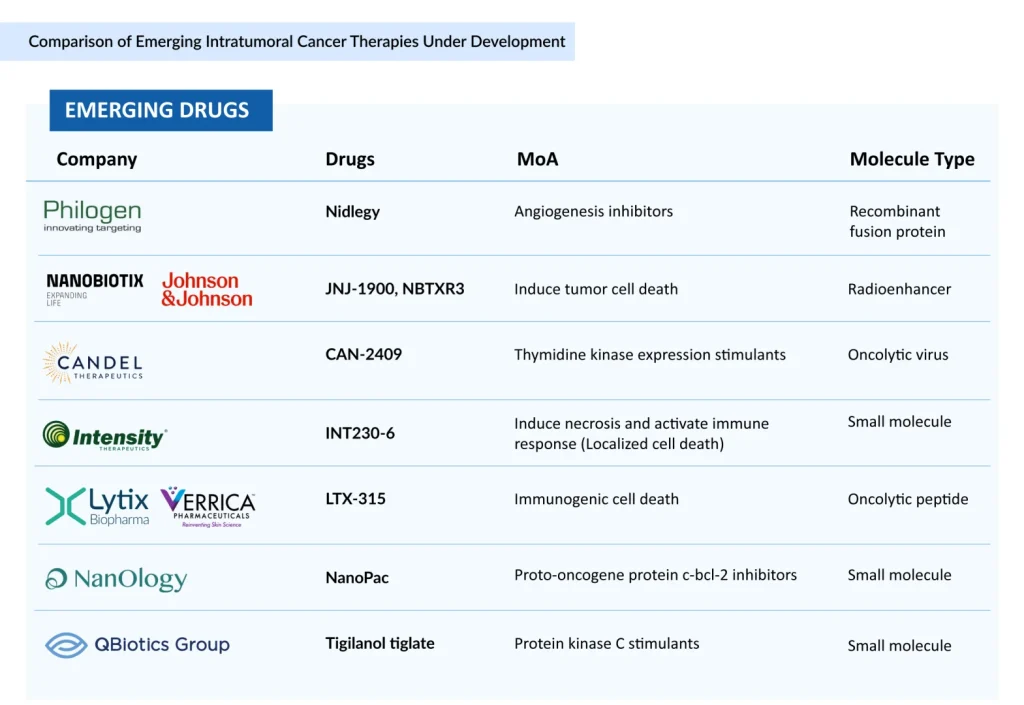
The intratumoral therapy pipeline is increasingly diversified, encompassing a broad spectrum of innovative and late-stage candidates, including JNJ-1900 (HENSIFY, NBTXR3; NANOBIOTIX/Johnson & Johnson), INT230-6 (Intensity Therapeutics), NIDLEGY (Daromun; Philogen S.p.A.), Aglatimagene besadenovec (CAN-2409) + valacyclovir (Candel Therapeutics), and MULTIKINE (CEL-SCI).
Sadaf Javed, Functional Head of Forecasting & Analytics at DelveInsight, said that the uptake of emerging ITCT therapies is expected to vary based on clinical efficacy, durability of response, safety, tumor type, administration route, combination potential, physician familiarity, and reimbursement. CY-101, JNJ-1900 (HENSIFY/NBTXR3), and BO-112 may achieve relatively faster or moderate adoption as clinical evidence matures, particularly where combination with checkpoint inhibitors demonstrates meaningful benefit. SP-002 (ASN-002), INT230-6, Hiltonol (Poly ICLC), Voyager V1, and VG161 are expected to see gradual uptake as efficacy, durability, safety, and long-term outcomes become established.
Below is a comprehensive review of five late-stage pipeline candidates expected to enter the intra-tumoral cancer therapies space in the coming years.
NANOBIOTIX/Johnson & Johnson’s JNJ-1900 (HENSIFY, NBTXR3)
Radioenhancer
NBTXR3 is engineered to amplify radiotherapy’s tumor-killing potential by enhancing radiation absorption and energy deposition within cancer cells while sparing surrounding healthy tissues. Beyond localized tumor destruction, the technology aims to trigger an immune response capable of targeting metastatic disease, potentially extending the benefits of radiation beyond the primary tumor. Building on this differentiated mechanism, NANOBIOTIX plans to explore additional indications in 2026, supported by a growing clinical data package, including updated Phase I results in NSCLC, new data from the expanded PDAC cohort, final results across multiple tumor types resistant to PD-1 inhibitors, updated esophageal cancer data, and determination of the recommended Phase II dose (RP2D) in the protein cohort.
As of May 2026, JNJ-1900 is advancing through a Phase III trial in patients with locally advanced head and neck squamous cell carcinoma (HNSCC), marking a pivotal step toward potential commercialization. NANOBIOTIX expects to complete patient enrollment, conduct the final analysis, and pursue global registration in H1 2027. Further strengthening its clinical pipeline, results from the second part of the randomized Phase II study evaluating NBTXR3 in Stage III NSCLC are anticipated in early 2027, providing additional evidence to support the technology’s broader therapeutic potential.
Intensity Therapeutics’ INT230-6
Small molecule
INT230-6 is an innovative intratumoral cancer therapy combining cisplatin and vinblastine with a proprietary amphiphilic cell-penetration enhancer, 8-(2-hydroxybenzoyl amino octanoate) (SHAO). Designed to optimize localized drug delivery, SHAO enhances the dispersion of both chemotherapeutic agents throughout injected tumors and facilitates their penetration into cancer cells, while nonclinical safety studies demonstrated no detectable drug penetration into healthy tissues. INT230-6 is currently advancing through multiple Phase II clinical cohorts across the US and Canada, evaluating its potential in various metastatic cancers. The therapy received FDA Fast Track designation for relapsed/metastatic triple-negative breast cancer (TNBC) in 2019 and Orphan Drug Designation (ODD) for soft tissue sarcoma (STS) in 2023, highlighting its potential in addressing high unmet medical needs.
Philogen S.p.A.’s NIDLEGY (Daromun)
Recombinant fusion protein
NIDLEGY is an innovative combination of two immunocytokines, L19IL2 and L19TNF, being developed as an intralesional therapy for advanced locoregional melanoma and non-melanoma skin cancers. The combination has demonstrated remarkable anti-tumor activity in preclinical melanoma models, achieving complete tumor eradication in all treated animals.
Clinical findings have further reinforced NIDLEGY’s therapeutic potential. In a Phase II study involving patients with Stage III/IVM1a melanoma, intralesional administration induced complete responses not only in injected lesions but also in the majority of non-injected tumors, highlighting its ability to trigger a systemic anti-tumor immune response.
Building on these encouraging results, a Phase III trial in patients with locally advanced melanoma demonstrated that intralesional NIDLEGY followed by surgery delivered statistically significant and clinically meaningful improvements in progression-free survival (PFS) compared with surgery alone. These findings were presented at ASCO 2024. Philogen has submitted a Marketing Authorization Application (MAA) to the European Medicines Agency (EMA), which has also approved a combination-pack request for NIDLEGY. A second Phase III study in locally advanced melanoma is currently underway across the United States and Europe.
Expanding its clinical potential, Philogen has initiated a U.S.-based Phase II trial evaluating intralesional NIDLEGY in combination with systemic anti-PD-1 therapy in patients whose disease has progressed following immune checkpoint inhibitor treatment. Encouraged by its promising melanoma performance, Philogen is also advancing two Phase II clinical programs investigating NIDLEGY in injectable, locally advanced basal cell carcinoma and other non-melanoma skin cancers, broadening its potential application across dermatological oncology.
The development program is partnered with SUN Pharmaceuticals for the treatment of skin cancers across Europe, Australia, and New Zealand.
Candel Therapeutics’ Aglatimagene besadenovec (CAN-2409) + valacyclovir
Oncolytic virus
Aglatimagene besadenovec is an investigational, off-the-shelf, replication-defective adenoviral gene therapy designed to transform tumors into personalized immune targets. By delivering the herpes simplex virus thymidine kinase (HSV-tk) gene directly into tumor cells, the therapy enables local conversion of orally administered valacyclovir into a cytotoxic metabolite, selectively killing cancer cells in the tumor microenvironment. Beyond direct tumor killing, this mechanism is designed to activate a potent, individualized CD8+ T-cell-mediated immune response against both injected tumors and distant, uninjected metastases. Functioning as an in situ cancer vaccine, aglatimagene besadenovec leverages a broad repertoire of tumor antigens to generate systemic anti-tumor activity, positioning it as a potentially versatile therapeutic platform across multiple solid tumor indications.
The therapy has secured several key FDA designations, including Fast Track Designation (FTD) for non-small cell lung cancer (NSCLC) and pancreatic ductal adenocarcinoma (PDAC) in 2023, Orphan Drug Designation (ODD) for pancreatic cancer in 2024, and Regenerative Medicine Advanced Therapy (RMAT) Designation for localized intermediate- to high-risk prostate cancer in 2025. In March 2025, Candel Therapeutics further strengthened its commercialization strategy through a collaboration with IDEA Pharma.
CEL-SCI’s MULTIKINE
Small molecule
Multikine is an investigational immunotherapy being developed to harness the body’s natural immune defenses against cancer. The therapy is being evaluated for multiple indications, including squamous cell carcinoma of the head and neck (SCCHN), cervical dysplasia, and peri-anal warts in patients co-infected with HIV and HPV. Its lead development program focuses on neoadjuvant treatment of SCCHN, with administration before surgery, radiation, or chemotherapy, at a stage when the immune system may be more capable of mounting a robust anti-tumor response.
Multikine represents a potentially differentiated approach to cancer immunotherapy, combining active and passive immune mechanisms within a single treatment. It is a defined, off-the-shelf formulation of naturally occurring immune-signaling molecules, including interleukins, interferons, chemokines, and colony-stimulating factors. These cytokines work collectively to stimulate and coordinate the body’s immune response, without requiring externally supplied tumor antigens.
Designed for scalable manufacturing and potentially cost-efficient production, Multikine aims to establish a new paradigm in immunotherapy by activating the immune system early, before conventional cancer treatments begin. If successfully developed and approved, it could offer a novel combination-immunotherapy strategy that leverages the body’s existing immune capabilities to target cancer.
Apart from these late-stage intra-tumoral cancer therapies, several other investigational treatments including RP2 (Replimune), Ruxotemitide (LTX-315/VP-315; Lytix Biopharma/Verrica Pharmaceuticals), LSAM-PTX (NanoPac; NanOlogy), LOAd703 (Delolimogene mupadenorepvec; Lokon Pharma), VG161 (Virogin Biotech), BO-112 (Highlight Therapeutics), Tigilanol Tiglate (QB46C-H07; QBiotics), SP-002 (ASN-002; Stamford Pharmaceuticals/Ascend Biopharmaceuticals), AdAPT-001 (EpicentRx), Bizaxofusp (MDNA55; Medicenna Therapeutics), SYNC-T SV-102 (Syncromune), Hiltonol (Poly ICLC; Oncovir), CY-101 (CyPep-1; Cytovation ASA), KB707 (Krystal Biotech), MVR-T3011 formerly called T-3011 (ImmVira Pharma), T3P-Y058-739 + Pembrolizumab (T3 Pharmaceuticals AG), STX-001 (Strand Therapeutics), TILT-123 (igrelimogene Iitadenorepvec; TILT Biotherapeutics), MEM-288 (Memgen), and others are currently in the mid and early stage of development.
These programs leverage diverse therapeutic modalities, including oncolytic viruses, immunotherapies, gene therapies, nanoparticle-based approaches, and radio-enhancer platforms, reflecting the growing technological breadth and therapeutic potential of this field.
In conclusion, the intratumoral cancer therapy landscape is poised for a significant transformation as emerging candidates progress toward regulatory approval and commercialization. The anticipated entry of therapies such as JNJ-1900, NIDLEGY, INT230-6, CAN-2409, and MULTIKINE could expand treatment options beyond conventional oncolytic viral approaches, introducing differentiated mechanisms of action, broader tumor applicability, and new opportunities for combination strategies with immune checkpoint inhibitors, radiotherapy, and other systemic treatments. Successful commercialization of these agents could reshape treatment paradigms by improving local tumor control, stimulating systemic anti-tumor immunity, and addressing resistance in immunologically cold tumors and checkpoint inhibitor-refractory malignancies.
Furthermore, increasing clinical validation and regulatory success are likely to strengthen physician confidence, accelerate market adoption, and attract further investment into the intratumoral therapy pipeline. While challenges related to clinical efficacy, durability of response, administration complexity, patient selection, and reimbursement will continue to influence uptake, the approval of these next-generation therapies could establish intratumoral immunotherapy as an increasingly important component of multimodal cancer treatment, ultimately driving a more diversified, personalized, and immune-driven oncology treatment landscape.

Downloads
Article in PDF
Recent Articles
- Oncolytic Virus Cancer Therapy: Transforming Cancer Treatment
- Intratumoral Cancer Therapy: A Potential Weapon To Fight the Battle Against Cancer
- 7 HSV-associated Oncolytic Virus Therapies in Late and Mid-Stage
- Top 7 Emerging Vaccinia Virus-associated Oncolytic Virus Therapies
- 15 Prominent Indications for Oncolytic Virus Therapy