Non-Surgical Body Contouring: What’s Fueling Its Growth in Aesthetic Medicine?
Jul 27, 2026
Table of Contents
The aesthetic medicine landscape has undergone a profound transformation over the past two decades, moving steadily away from procedures that require incisions, anesthesia, and extended recovery toward technologies that reshape the body with little to no downtime. Non-surgical body contouring sits at the center of this shift. It encompasses a family of energy-based and mechanical technologies designed to reduce localized fat deposits, tighten lax skin, tone underlying musculature, and improve the appearance of cellulite, all without cutting the skin.
Driven by rising patient demand for convenient, low-risk aesthetic solutions, an expanding population of patients recovering excess skin after significant weight loss, and continuous innovation from device manufacturers, non-surgical body contouring has become one of the fastest-growing categories in medical aesthetics. This document provides a comprehensive, structured overview of the field: the science behind it, the technologies that deliver it, its clinical applications, the role of artificial intelligence and digital innovation in modern platforms, the regulatory environment, the competitive landscape, and the trends likely to shape its future.
Downloads
Click Here To Get the Article in PDF

Recent Articles
- How Artificial Intelligence is adding value to the Healthcare sector
- Philips Secures FDA Nod for Image-Guided Platform in Prostate Cancer Treatment; Roche Gains CE Ma...
- Ventris Medical Secures Additional FDA Clearance for Backpack® Bone Graft in Intervertebral Disc ...
- Medtronic Launches Infusion Set for Insulin Pumps; Penumbra’s Virtual Reality-Based Rehabil...
- Exploring the Impact of AI in Mental Health: How it is Going to Revolutionize Diagnosis and Treat...
The material is intended for clinicians, medical spa operators, device evaluators, students of aesthetic medicine, and business stakeholders seeking a single reference point that connects the clinical, technical, and commercial dimensions of this fast-moving field.
What Is Non-Surgical Body Contouring?
Non-surgical body contouring refers to a category of aesthetic procedures that use controlled energy delivery, mechanical force, or a combination of modalities to alter the shape, volume, or firmness of a targeted body area without surgical incision, general anesthesia, or the tissue removal associated with liposuction. Treatments in this category work by triggering a natural biological process, such as programmed cell death in fat cells or collagen remodeling in the dermis, that unfolds gradually over the weeks following a session.
Purpose and Clinical Significance
The clinical purpose of non-surgical body contouring is threefold: to reduce the volume of stubborn, diet- and exercise-resistant subcutaneous fat in specific anatomical areas; to improve skin quality and elasticity, particularly in patients with mild to moderate laxity; and to enhance the tone and definition of underlying muscle groups. Unlike surgical liposuction, these treatments are not weight-loss solutions and are not designed to treat obesity; rather, they refine body contour in patients who are already close to a stable, healthy weight.
Evolution of Non-Surgical Body Contouring
Early aesthetic body treatments in the 1990s and early 2000s relied largely on mechanical massage and low-level RF for temporary circumferential reduction, with results that were modest and short-lived. A turning point came with the clinical development of cryolipolysis at Harvard’s Wellman Center for Photomedicine in the mid-2000s, which demonstrated that controlled cooling could selectively damage adipocytes while sparing the overlying skin. This research led to the first FDA clearance for a cryolipolysis-based device in 2010, establishing an evidence-based, cell-level mechanism that legitimized the entire non-surgical body contouring category.
Since then, the field has expanded rapidly. Radiofrequency and ultrasound-based fat reduction devices followed through the 2010s, and in 2018 and 2020, respectively, high-intensity focused electromagnetic (HIFEM) muscle-toning devices and combination RF/HIFEM platforms reached the market, extending non-surgical contouring beyond fat reduction into functional muscle enhancement. Today’s platforms increasingly combine multiple energy modalities in a single system and incorporate software-driven personalization, reflecting a maturing, technologically sophisticated category.
How Non-Surgical Body Contouring Works
Mechanism of Fat Reduction
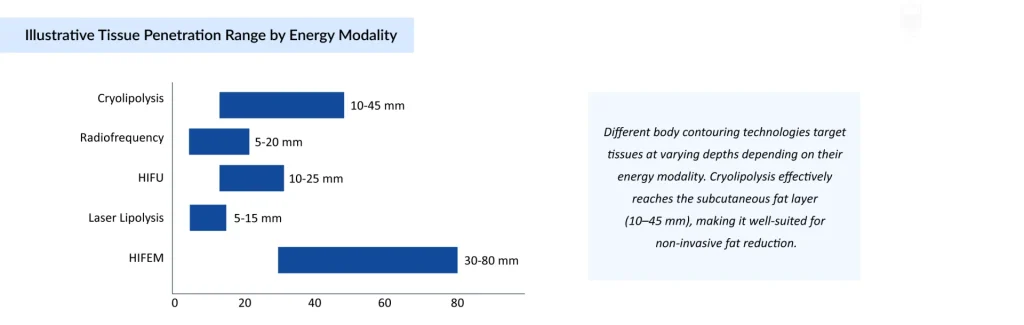
Although the energy source differs across technologies, most fat-reduction modalities share a common biological endpoint: selective adipocyte injury that triggers apoptosis, or programmed cell death, without significantly damaging the surrounding skin, nerves, or blood vessels. Cryolipolysis exploits the fact that fat cells are more susceptible to cold-induced crystallization than surrounding tissue. Thermal technologies such as RF, HIFU, and laser lipolysis instead raise adipocytes to a temperature threshold that denatures cellular structures, again triggering apoptosis or, at higher thresholds, direct thermal coagulation.
Skin Tightening Mechanism
Skin tightening technologies work primarily through controlled dermal heating. When collagen fibers are heated to approximately 60-70°C, they contract immediately, producing an early, modest tightening effect. More importantly, the controlled thermal injury stimulates fibroblast activity, triggering new collagen and elastin synthesis (neocollagenesis) over the following weeks to months, which produces the more durable improvement in skin firmness that patients typically notice several months after treatment.
Muscle Toning Mechanism
HIFEM and related electromagnetic technologies induce supramaximal muscle contractions, muscle contractions more intense than what can be achieved through voluntary exercise. These involuntary, high-frequency contractions place a significant workload on muscle fibers, promoting both hypertrophy (an increase in fiber size and density) and hyperplasia (formation of new protein strands within muscle fibers), which together contribute to visible improvements in muscle tone and definition.
Biological Clearance of Fat Cells
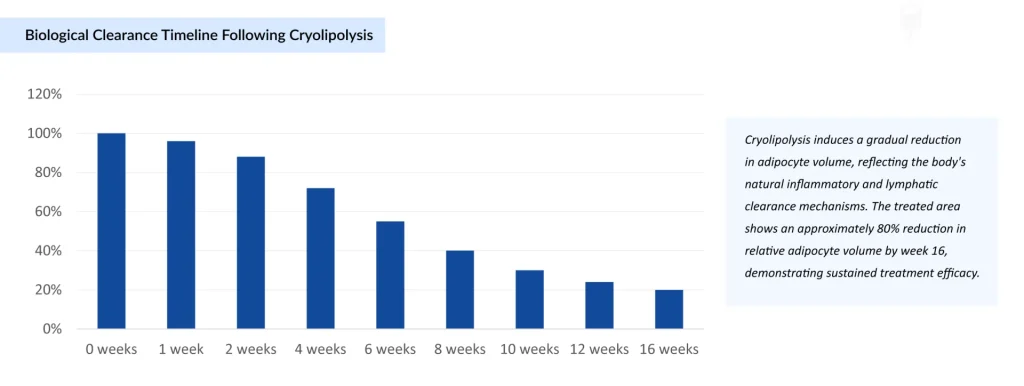
Following adipocyte injury, the body’s own immune and lymphatic systems are responsible for clearing the damaged fat cells. In the days following treatment, an inflammatory response begins, followed by macrophage infiltration into the treated area over roughly two to eight weeks. These macrophages engulf and metabolize the lipid content of injured adipocytes, which is then processed through normal lipid metabolism pathways and eliminated via the lymphatic system. Because this clearance process is gradual, visible results from fat-reduction treatments typically continue to develop for up to twelve to sixteen weeks after a session.
Common Non-Surgical Body Contouring Technologies
A wide range of devices and modalities now compete in this space, each using a distinct mechanism of action:
|
Technology |
Mechanism |
Common Devices/Brands |
Typical Target |
|---|---|---|---|
|
Cryolipolysis |
Controlled cooling crystallizes and destroys fat cells (apoptosis) |
CoolSculpting Elite |
Abdomen, flanks, thighs |
|
Radiofrequency (RF) |
Heat energy tightens collagen and can reduce localized fat |
BodyTite, Vanquish, Morpheus8 Body |
Skin laxity, mild fat, arms/abdomen |
|
High-Intensity Focused Ultrasound (HIFU) |
Focused ultrasound waves heat and disrupt fat/collagen at depth |
Ultherapy PRIME, Liposonix |
Skin tightening, fat layer |
|
High-Intensity Focused Electromagnetic (HIFEM) |
Induces supramaximal muscle contractions to build muscle and reduce fat |
Emsculpt Neo |
Abdomen, buttocks, muscle tone |
|
Injectable Lipolysis |
Deoxycholic acid dissolves fat cell membranes |
Kybella |
Submental (chin) fat |
|
Laser Lipolysis |
Laser energy liquefies fat for minimally invasive removal |
SculpSure, Vanquish ME |
Localized fat pockets |
Additionally, the advanced body contouring technologies have expanded beyond traditional fat reduction to include muscle toning, skin rejuvenation, and cellulite improvement. High-Intensity Focused Electromagnetic (HIFEM) technology uses focused electromagnetic energy to induce supramaximal muscle contractions, promoting muscle strengthening, enhanced muscle definition, and localized fat metabolism. Electrical Muscle Stimulation (EMS) delivers low-intensity electrical impulses to stimulate muscle contractions, improving muscle conditioning, strength, and recovery, primarily for muscle maintenance and toning. Acoustic Wave (Shockwave) Therapy employs mechanical shockwaves to enhance blood circulation, stimulate lymphatic drainage, promote collagen production, and reduce the appearance of cellulite while improving skin texture. Furthermore, modern combination energy-based platforms integrate multiple modalities, such as radiofrequency (RF), HIFEM, ultrasound, and laser technologies, within a single treatment system to simultaneously achieve fat reduction, skin tightening, and muscle toning, offering comprehensive body contouring outcomes with fewer treatment sessions.
|
Technology Comparison Summary |
||||
|
Technology |
Target Tissue |
Primary Mechanism |
Typical Sessions |
Downtime |
|
Cryolipolysis |
Subcutaneous fat |
Cold-induced adipocyte apoptosis |
1-2 per area |
Minimal to none |
|
Radiofrequency (RF) |
Dermis, subdermal fat |
Controlled thermal heating, collagen remodeling |
4-6 |
None |
|
HIFU |
Fat & fascial (SMAS) layer |
Focused thermal coagulation points |
1-3 |
Minimal, transient redness |
|
Laser Lipolysis |
Subcutaneous fat |
Photothermal adipocyte disruption |
6-8 |
None to minimal |
|
HIFEM |
Skeletal muscle |
Supramaximal muscle contractions |
4-6 |
Mild muscle soreness |
|
EMS (lower intensity) |
Skeletal muscle |
Electrically induced muscle contraction |
Ongoing/maintenance |
None |
|
Acoustic Wave Therapy |
Dermis, fibrous septae |
Mechanical shockwave disruption |
6-8 |
None |
Components of a Non-Surgical Body Contouring System
Energy Delivery Console: The console houses the generator responsible for producing the treatment energy, whether RF current, focused ultrasound, laser diodes, or electromagnetic pulses, along with the control electronics that regulate power output, pulse duration, and duty cycle throughout a session.
Treatment Applicators: Applicators are the handpieces that make contact with the patient’s skin and deliver energy to the target tissue. Modern systems typically offer a range of applicator sizes and shapes to accommodate different body areas, from small applicators for the chin and arms to large-format applicators for the abdomen, flanks, and back.
Cooling and Temperature Control Systems: Precise temperature control is essential both to achieve the intended tissue effect and to protect the epidermis from thermal or cold injury. Integrated cooling plates, contact sensors, and real-time thermal feedback loops allow the system to maintain applicator temperature within narrow, clinically validated ranges throughout treatment.
Smart Monitoring and Safety Features: Contemporary devices incorporate skin contact sensors, impedance monitoring, automatic shut-off mechanisms, and audible or visual alerts to flag suboptimal applicator placement, ensuring that energy is delivered only when proper tissue contact and safety thresholds are confirmed.
Software and User Interface: The user interface allows practitioners to select treatment protocols, customize energy parameters for individual patients, track session history, and, in increasingly common cases, connect to cloud-based practice management and outcome-tracking software.
Clinical Applications of Non-Surgical Body Contouring
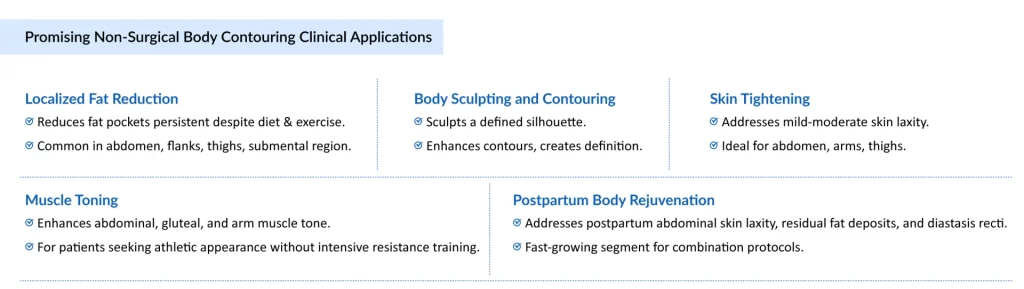
Non-surgical body contouring is widely used for a variety of aesthetic applications, including localized fat reduction, body sculpting, skin tightening, muscle toning, cellulite reduction, and postpartum body rejuvenation. These procedures effectively target stubborn fat deposits in areas such as the abdomen, flanks, thighs, and chin while enhancing overall body shape and definition. Technologies such as radiofrequency (RF) and high-intensity focused ultrasound (HIFU) improve skin firmness by stimulating collagen production, whereas High-Intensity Focused Electromagnetic (HIFEM) and Electrical Muscle Stimulation (EMS) strengthen and tone muscles for a more defined physique. Acoustic wave therapy and RF-based treatments help reduce the appearance of cellulite by improving circulation and skin texture. Additionally, combination treatment protocols are increasingly used for postpartum body rejuvenation, addressing abdominal fat, skin laxity, and weakened muscles to restore body contour with minimal downtime.
Common Treatment Areas
Non-surgical body contouring protocols are tailored to the anatomy, tissue characteristics, and aesthetic goals specific to each treatment area. The table below summarizes commonly treated regions.
|
Area |
Common Concerns |
Frequently Used Technologies |
Considerations |
|
Abdomen |
Central fat deposits, muscle laxity |
Cryolipolysis, HIFEM, RF |
Diastasis recti should be assessed pre-treatment |
|
Flanks |
“Love handles,” fat pinch thickness |
Cryolipolysis, laser lipolysis |
Bilateral symmetry planning is important |
|
Thighs |
Inner/outer thigh fat, cellulite |
RF, acoustic wave, cryolipolysis |
Skin laxity may require combination therapy |
|
Arms |
Upper arm fat, skin laxity |
RF, laser lipolysis |
Thinner skin requires careful energy titration |
|
Buttocks |
Volume, contour, cellulite |
HIFEM, acoustic wave, RF |
Often paired with gluteal toning goals |
|
Back |
Bra-line and lower back fat rolls |
Cryolipolysis, RF |
Larger applicator coverage needed |
|
Chin/Neck |
Submental fat, skin laxity |
Cryolipolysis (small applicator), RF microneedling |
Proximity to nerves requires precise placement |
|
Waist/Hips |
Contour definition, “hourglass” shaping |
Combination RF + HIFEM |
Often a multi-area treatment plan |
What’s Fueling the Growth?
The GLP-1 Weight-Loss Wave
Perhaps no single factor has reshaped demand for body contouring as quickly as the rise of GLP-1 receptor agonist medications such as semaglutide (Ozempic, Wegovy) and tirzepatide (Mounjaro). The Centers for Disease Control and Prevention (CDC) reported that 12.4% of U.S. adults had used a GLP-1 medication for weight loss by October 2025. These drugs can produce weight loss of 15% to 25% of total body weight, but rapid fat loss frequently outpaces the skin’s ability to contract, leaving patients with laxity, volume deflation, and contour irregularities in the abdomen, arms, thighs, and face.
This has created an entirely new patient population actively seeking solutions. ASPS survey data found that among GLP-1 patients under the care of its member surgeons, 20% had already undergone plastic surgery, 39% were considering a surgical procedure, and 41% were exploring non-surgical body contouring or skin-tightening options, positioning non-surgical treatments as a natural, lower-commitment entry point into aesthetic care for this population.
Device makers have responded directly. In November 2025, the FDA cleared Ultherapy PRIME, a focused-ultrasound platform previously used mainly on the face, specifically for treating skin laxity on the arms and abdomen, a clearance explicitly framed around the clinical needs of post-GLP-1 patients.
Minimal Downtime and Convenience
Modern patients, particularly working professionals, increasingly favor treatments that integrate into daily life. Non-surgical body contouring sessions typically take 30 to 90 minutes, require no anesthesia, and allow an immediate return to normal activity, a stark contrast to the days or weeks of recovery associated with liposuction, tummy tucks, or body lifts. This “lunchtime procedure” appeal has broadened the pool of eligible and willing patients well beyond those who would consider surgery.
Rapid Technological Advancement
Device innovation has meaningfully improved both efficacy and comfort. Newer-generation platforms combine multiple energy modalities in a single session, for example, radiofrequency paired with electromagnetic muscle stimulation, or ultrasound paired with skin-tightening protocols, allowing providers to simultaneously address fat, muscle tone, and skin laxity. This “combination therapy” trend improves outcomes without adding meaningful downtime, making treatments more competitive with surgical alternatives.
Lower Risk Profile and Broader Candidacy
Non-surgical treatments avoid the risks inherent to anesthesia, incisions, and surgical recovery, including infection, scarring, and prolonged healing. This makes them accessible to a wider range of patients, including those who are not medically eligible for elective surgery, and it lowers the psychological barrier to entry for first-time aesthetic patients who may later progress to surgical procedures.
Vision Platforms and De-stigmatization
Vision platforms, including advanced 3D body imaging, digital body mapping, and AI-powered visualization tools, are transforming non-surgical body contouring by enabling precise treatment planning and realistic outcome simulations. These technologies allow practitioners to assess body composition, identify target treatment areas, and visually demonstrate potential results, helping patients make informed decisions while improving treatment accuracy and satisfaction.
Simultaneously, the growing acceptance and de-stigmatization of aesthetic procedures have significantly contributed to the expansion of the non-surgical body contouring market. Increasing awareness through social media, celebrity endorsements, body positivity movements, and greater emphasis on personal wellness have shifted public perception, making body contouring procedures more socially acceptable among both women and men. As a result, more individuals are seeking minimally invasive treatments to enhance confidence and body image without the stigma traditionally associated with cosmetic procedures. This cultural shift, combined with technological advancements, continues to drive the adoption of non-surgical body contouring worldwide.
An Aging, Body-Conscious Population Seeking Prevention
Alongside corrective treatments, there is growing interest in “pre-juvenation” using non-surgical treatments proactively, earlier in life, to slow the visible progression of skin laxity and fat redistribution rather than waiting to address more advanced changes later. This preventive mindset is expanding the addressable patient base to younger age groups.
Expanding Use among Male Patients
Non-surgical body contouring has also benefited from growing acceptance among male patients, who often favor its discretion, minimal downtime, and lower barrier to entry compared with surgical alternatives, broadening the category’s demographic base beyond its traditionally female-dominated patient population.
Competitive Landscape of the Non-Surgical Body Contouring Market
The global non-surgical body contouring market is moderately consolidated, with competition led by a handful of established aesthetic device manufacturers that possess strong clinical evidence, broad product portfolios, extensive physician networks, and global distribution capabilities. Competition is primarily driven by technological innovation rather than pricing, as clinics and medical spas generally prefer devices with proven clinical outcomes, regulatory approvals, and high patient satisfaction.
|
Role of Artificial Intelligence in Non-Surgical Body Contouring |
||
|
AI Application |
Description |
Benefits |
|
AI-Powered Patient Assessment |
AI-driven imaging tools analyze body composition, fat distribution, skin laxity, and body proportions to objectively evaluate patient suitability for treatment. |
Improves patient selection, enhances assessment accuracy, and reduces operator variability. |
|
AI-Based Treatment Planning |
AI algorithms assist in determining optimal applicator placement, treatment parameters, and protocol selection based on patient-specific anatomical characteristics. |
Enables personalized treatments, improves contouring precision, and reduces treatment time. |
|
3D Body Imaging & Digital Body Mapping |
Three-dimensional imaging systems generate digital body models to quantify fat volume, monitor body contour changes, and create visual progress reports. |
Provides objective treatment measurements, tracks progress accurately, and improves patient communication. |
|
Intelligent Energy Optimization |
Machine learning algorithms continuously adjust energy delivery using tissue temperature, impedance, and patient-specific feedback during treatment. |
Enhances treatment safety, optimizes energy delivery, and improves clinical outcomes. |
|
Predictive Analytics & Outcome Simulation |
AI models predict treatment outcomes using baseline body measurements and historical patient data, allowing realistic expectation setting. |
Supports personalized treatment planning and improves patient satisfaction. |
|
AI-Enabled Patient Monitoring & Workflow Automation |
AI automates appointment scheduling, follow-up communication, treatment documentation, and long-term outcome tracking. |
Streamlines clinic operations, improves patient engagement, and enhances workflow efficiency. |
|
Future Potential of AI |
AI is expected to enable automated patient screening, adaptive treatment protocols, predictive device maintenance, and highly personalized body contouring solutions. |
Standardizes treatment delivery, improves efficiency, and supports next-generation aesthetic care. |
Regulatory Milestones and Recent Development Activities in the Non-Surgical Body Contouring Market
- January 2024: Cynosure completed the acquisition of Lutronic, creating one of the world’s largest medical aesthetics companies with an expanded portfolio of energy-based devices, including body contouring, skin rejuvenation, and laser technologies.
- March 2024: BioPhotas, Inc. launched the Celluma CONTOUR® system, an FDA-cleared LED light therapy device designed for non-invasive body contouring and temporary reduction in body circumference, expanding the company’s aesthetic treatment portfolio.
- April 2024: Cartessa Aesthetics introduced PHYSIQ 360™ through its partnership with DEKA, offering a next-generation non-invasive body contouring platform that combines electrical muscle stimulation with deep thermal technology for fat reduction and muscle toning.
- May, 2025: Apyx Medical Corporation received U.S. FDA 510(k) clearance for the AYON™ Body Contouring System, the company’s all-in-one body contouring platform integrating Renuvion® technology for skin tightening, electrosurgery, and contouring procedures.
- May 2025: SLIMUS launched its non-invasive lipolysis system, incorporating patented vibration technology to enhance fat cell metabolism and lymphatic drainage while treating areas such as the abdomen, thighs, arms, and back without downtime.
- September 2025: Apyx Medical commercially launched the AYON™ Body Contouring System in key markets following its FDA clearance, strengthening its presence in the aesthetic body contouring sector.
- October, 2025: Apyx Medical submitted a new FDA 510(k) application to expand the AYON™ Body Contouring System labeling to include power liposuction, aiming to establish the first fully integrated body contouring platform for surgeons.
- November, 2025: Venus Concept received U.S. FDA 510(k) clearance for Venus NOVA™, its next-generation multi-application platform combining Adaptive Electrical Muscle Stimulation (EMS), Multi-Polar Radio Frequency (RF), Pulsed Electromagnetic Fields (PEMF), and VariPulse™ technology for non-invasive body contouring, muscle conditioning, cellulite reduction, and skin treatments.
- December 2025: Venus Concept initiated the U.S. commercial launch of Venus NOVA™, with global expansion planned for 2026 to broaden access to its advanced body and skin treatment platform.
- During 2025: Dominion Aesthetic Technologies expanded FDA clearance for its EON® robotic laser body contouring system, adding treatment indications for the back and thighs in addition to the abdomen and flanks, thereby broadening the clinical applications of its robotic laser platform.
- May 2026: Alive Wellness Clinics launched CoolSculpting® Elite in India, marking one of the country’s largest deployments of the next-generation cryolipolysis platform with the simultaneous installation of four systems across its clinics.
Considerations and Limitations
- Non-surgical treatments typically produce visible but incremental improvement over weeks to months, and are not a substitute for surgical skin excision in cases of significant laxity.
- Many technologies require a series of treatments spaced weeks apart to achieve and maintain optimal results.
- Outcomes are highly dependent on proper patient selection, device calibration, and provider experience, making credentialing and training increasingly important as the category grows.
- These treatments contour existing tissue and are not designed or approved for significant weight reduction; professional guidance emphasizes they work best on patients who are already close to a stable, healthy weight.
Conclusion
Non-surgical body contouring’s growth is being driven by a convergence of forces: a historic wave of GLP-1-related weight loss creating new patient needs, continuous improvement in device technology, patients’ clear preference for low-downtime and lower-risk treatments, and a cultural shift that has normalized aesthetic care as routine self-maintenance. The data is unambiguous: non-surgical procedures now make up the majority of aesthetic treatments performed worldwide, and every major growth indicator suggests that trajectory will continue. For patients and practitioners alike, understanding the technologies and data behind this shift is essential to navigating where aesthetic medicine is headed next.

FAQs
Non-surgical body contouring procedures are minimally invasive treatments that reduce localized fat and improve body shape without surgery. They use technologies such as controlled cooling, heat, ultrasound, or laser energy to destroy fat cells, which are then naturally eliminated by the body over time.
Growing preference for minimally invasive cosmetic procedures, rising awareness of aesthetic treatments, and advancements in body contouring technologies are major growth drivers. Increasing disposable incomes, shorter recovery times, and expanding medical aesthetics clinics are also boosting market demand.
Cryolipolysis, radiofrequency (RF), high-intensity focused ultrasound (HIFU), and laser-based lipolysis are among the leading technologies transforming the market. These innovations provide targeted fat reduction, skin tightening, and improved body contouring with minimal discomfort and downtime.
Compared with liposuction, non-surgical body contouring offers greater safety, little to no downtime, and fewer procedure-related risks. While results are generally more gradual and better suited for mild to moderate fat reduction, these treatments deliver high patient satisfaction for appropriately selected candidates.
Emerging trends include AI-assisted treatment planning, combination therapies for simultaneous fat reduction and skin tightening, and next-generation energy-based devices with enhanced precision. Personalized treatment protocols and expanding applications for body sculpting are expected to further accelerate market growth.
Downloads
Article in PDF
Recent Articles
- Norlase’s LYNX Receives FDA and CE Approval for Clinical Use; FDA Approves Imperative Care’s Zoom...
- Allumiqs and Prolytix’s Partnership; Setpoint Medical’s Neuroimmune Modulation Platform get...
- LiviWell Receives FDA Clearance for Livi, Pioneering Post-Intercourse Vaginal Care; Medtronic Adv...
- Zimmer Biomet Secures FDA Clearance for Upgraded ROSA® Knee Robotic System; IceCure’s ProSense® C...
- SIBIONICS’s Ground-breaking GS1 Continuous Glucose Monitoring System; Abbott’s HPV Test to Run on...