Ventricular Assist Devices: The Mechanical Hearts Redefining Advanced Heart Failure Care
Oct 14, 2026
Table of Contents
Heart failure is one of the most pressing public health challenges of our time. An estimated 64 million people live with it worldwide, and in the United States the number of adults affected is projected to approach 9 million by 2030. For most patients, guideline-directed medications, implantable defibrillators, and cardiac resynchronization therapy can slow the disease for years. But for a meaningful minority, the heart keeps weakening despite the best treatment. This is advanced, or stage D, heart failure, marked by relentless fatigue, breathlessness at rest, repeated hospitalizations, and failing organs.
For decades, the only definitive answer was a heart transplant. The math, however, has never worked in patients’ favor. Roughly 4,500 heart transplants are performed each year in the United States, while many more patients could benefit. Donor hearts are scarce, and not every patient qualifies. This is where ventricular assist devices (VADs) come in. Once seen as a desperate last resort, VADs have become one of the most important tools in cardiovascular medicine. They buy time, restore function, and increasingly serve as a long-term therapy in their own right.
Downloads
Click Here To Get the Article in PDF

Recent Articles
- LEXICON’s INPEFA: Entry of Another Drug for Heart Failure Treatment
- ACC.25 Highlights: Groundbreaking Advances in Cardiovascular Medicine and Emerging Therapeutics
- Daiichi Sankyo’s Intravenous Iron Replacement Therapy; ANeuroTech’s Adjunctive Anti-depression Dr...
- Electrophysiology Devices: The Future of Cardiac Arrhythmia Management
- Major Drugs Decisions for Cardiovascular Diseases to Watch Through 2022
A ventricular assist device is a mechanical pump designed to support a weakened ventricle by helping move blood throughout the body. Unlike a total artificial heart, which replaces the native heart entirely, a VAD works alongside the patient’s own heart. It takes over a substantial portion of the heart’s pumping workload while the natural heart remains in place. A typical left ventricular assist device (LVAD) consists of four key components that work together to restore blood circulation. The inflow cannula is a small tube positioned in the left ventricle that draws blood into the pump. The pump itself is a compact implanted device containing a rotor that accelerates blood flow, with modern pumps being approximately the size of a small plum.
The outflow graft then carries blood from the pump to the aorta, the body’s main artery, allowing oxygen-rich blood to circulate to vital organs such as the brain and kidneys. The system also includes a driveline and external components, with a cable passing through the skin of the abdomen to connect the implanted pump to a wearable controller and power source, typically consisting of two batteries or a power module used at night.
Together, these components help restore the flow of oxygen-rich blood throughout the body and can significantly improve functional capacity and quality of life. Patients who may initially be so breathless that they struggle to walk to the bathroom can, with effective VAD support, regain the ability to climb stairs, return to hobbies, and spend more meaningful time with their families.
Four Reasons to Implant: VAD Clinical Indications Explained
Ventricular assist devices (VADs) are considered when the heart can no longer provide adequate circulation despite optimized medical therapy and other interventions. One of the most important indications is advanced or end-stage heart failure, particularly in patients with severe symptoms, recurrent hospitalizations, poor exercise capacity, or evidence of inadequate organ perfusion. In these patients, a VAD can provide mechanical circulatory support, improve cardiac output, and reduce the workload on the failing ventricle.
A second major indication is bridge to heart transplantation. For patients who are eligible for transplantation but are unlikely to survive the waiting period because of progressive heart failure, an LVAD can maintain circulation while a suitable donor heart becomes available. VADs may also be used as a bridge to recovery in selected patients whose cardiac function has the potential to improve after temporary mechanical support, such as in certain cases of acute myocarditis or reversible cardiac injury.
The fourth indication is destination therapy, in which long-term VAD support is used for patients with advanced heart failure who are not candidates for transplantation. Advances in pump design, driveline technology, anticoagulation management, and patient monitoring have made long-term mechanical support increasingly feasible. In practice, the decision to implant a VAD depends on factors such as ventricular function, comorbidities, transplant eligibility, frailty, right-heart function, bleeding and infection risks, and the patient’s goals and ability to manage the device.
Platform Spotlight: HeartMate 3, HeartWare, and the Race for the Best Pump
Abbott’s HeartMate 3: The Current Gold Standard
HeartMate 3 is the dominant durable LVAD worldwide. Its fully magnetically levitated centrifugal-flow rotor spins without mechanical contact, with no bearings to wear down and with wide blood-flow gaps that reduce blood damage and clotting. An “artificial pulse” feature briefly changes pump speed at regular intervals to help wash the pump and limit stasis. Its design was a major step toward fewer clotting events and strokes.
Medtronic’s HeartWare HVAD: A Cautionary Chapter
The HeartWare HVAD was once the other major durable platform, valued for its small size and intrapericardial placement. But in 2021, Medtronic stopped selling and distributing the device after reports of neurological events and pump-restart problems. Existing patients continue to receive support, but the withdrawal consolidated the market around fully magnetically levitated technology and underscored how heavily safety data now shapes device adoption.
Next-Generation Contenders
Newer pumps are in clinical evaluation, including BrioHealth’s BrioVAD. The industry is also exploring novel total artificial heart technologies such as SynCardia and BiVACOR for patients with biventricular failure. Short-term platforms from companies including Abiomed (Impella) and Abbott (CentriMag) remain central to acute care.
The common theme in new designs is simple: smaller, safer, quieter, and easier to live with.
Transplant Shortages and Rising Heart Failure: Why VADs Are Becoming Standard Care
The growing burden of advanced heart failure is occurring alongside a persistent shortage of donor hearts, creating a significant gap between the number of patients who could benefit from transplantation and the organs available for transplant. Heart transplantation remains the definitive treatment for selected patients with end-stage heart failure, but its use is constrained by donor availability, strict eligibility criteria, comorbidities, and the need for lifelong immunosuppression. As the heart-failure population expands and patients live longer with chronic cardiovascular disease, clinicians increasingly need treatment strategies that can stabilize patients who are not immediate transplant candidates or who may never become eligible for transplantation.
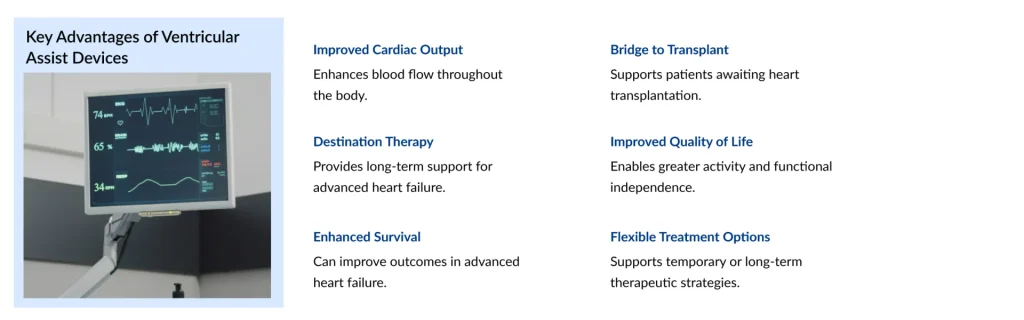
Ventricular assist devices, particularly left ventricular assist devices (LVADs), have emerged as an important solution to this unmet need. By mechanically supporting cardiac output, VADs can serve as a bridge to transplantation, maintaining a patient’s condition while they wait for a suitable donor heart. They can also be used as bridge-to-decision therapy when clinicians need time to determine a patient’s longer-term treatment pathway. For patients who are not eligible for transplantation, durable LVAD therapy can provide destination therapy, offering long-term circulatory support rather than simply serving as a temporary intervention.
Advances in VAD engineering have also helped expand their role in advanced heart-failure management. Earlier generations of ventricular assist devices were associated with substantial complications, including bleeding, thrombosis, infection, and device failure. Newer continuous-flow systems have become smaller, more durable, and more efficient, while improvements in pump design, driveline management, patient monitoring, and clinical management have contributed to better outcomes and quality of life for appropriately selected patients. These developments have shifted VAD therapy from being viewed primarily as a rescue strategy toward a more established component of advanced heart-failure care.
The convergence of increasing heart-failure prevalence, limited donor-organ availability, and improvements in mechanical circulatory support is therefore strengthening the clinical role of VADs. Rather than replacing transplantation, VADs increasingly complement it by providing a treatment pathway before, during, or instead of transplantation. As patient selection improves and device technology continues to evolve, VADs are becoming an increasingly important option within multidisciplinary advanced heart-failure programs, particularly for patients whose disease has progressed beyond the effectiveness of conventional pharmacological and device-based therapies.
The Business Side: A ~USD 2 Billion Market on the Rise
The global ventricular assist devices (VADs) market is projected to expand from USD 1.7 billion in 2025 to USD 3.2 billion by 2034, indicating strong and sustained market growth. The market is anticipated to register a CAGR of 8.39% during the forecast period from 2026 to 2034. By product type, left ventricular assist devices (LVADs) represented the largest share of the ventricular assist devices market in 2024, reflecting their widespread use in the management of advanced heart failure and their established role in long-term mechanical circulatory support.
The growth of the ventricular assist devices market is primarily driven by the rising prevalence of heart failure, the persistent shortage of donor hearts available for transplantation, ongoing technological advancements in VAD design and functionality, and increasing product development and innovation activities among leading market participants.
Key companies operating in the global ventricular assist devices market include Johnson & Johnson, Asahi Kasei Corporation, Abbott Laboratories, Berlin Heart GmbH, Jarvik Heart, Inc., Medtronic Plc., Terumo Corporation, Evaheart, Inc., Calon Cardio, SynCardia Systems LLC, Cardiobridge GmbH, LivaNova, Inc., Cirtec, CorWave SA, FineHeart, ReliantHeart Inc., and other industry participants.
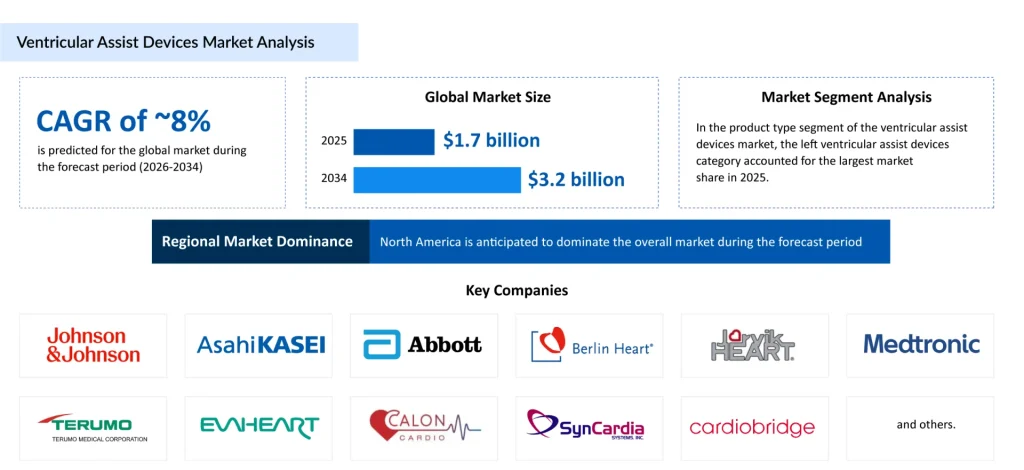
North America is expected to maintain its dominance in the global ventricular assist devices market, supported by the high prevalence of heart failure, a substantial patient population awaiting heart transplantation, and the increasing adoption of VADs for both bridge-to-transplant and destination therapy. The region also benefits from the presence of major medical device manufacturers, significant investments in research and development, and a well-established network of specialized cardiac care centers. Furthermore, increasing awareness among healthcare professionals and patients, coupled with supportive government initiatives, is expected to reinforce North America’s leading position in the global VAD market.
The Future Is Wireless: Innovations Reshaping VAD Therapy
The next generation of ventricular assist devices (VADs) is expected to move beyond simply improving pump performance toward creating a more seamless and patient-friendly form of mechanical circulatory support. One of the most important goals is eliminating the external driveline, which remains a major source of infection and a persistent limitation for patients. Fully implantable VAD systems could integrate the pump, controller, battery, and power-transfer components inside the body, potentially reducing driveline-related complications while allowing greater freedom in everyday activities.
Wireless power transfer is emerging as a key technology for making fully implantable systems possible. Instead of relying on a cable that passes through the skin, transcutaneous energy-transfer systems could deliver power across intact skin to an implanted battery or pump. Advances in inductive charging, energy storage, and power-management technologies could eventually allow patients to recharge their devices without physical connectors. This could reduce infection risk while making activities such as showering and swimming considerably easier and less restrictive.
Miniaturization and smarter device architecture are also expected to reshape VAD therapy. Smaller pumps, more efficient motors, improved biocompatible materials, and increasingly compact electronics could make implantation less invasive and expand mechanical support to a broader range of patients. At the same time, embedded sensors and artificial intelligence could enable VADs to continuously monitor parameters such as blood flow, pressure, pump performance, and patient activity. Future systems may automatically adjust pump support in response to changing physiological demands, providing more personalized circulatory assistance.
Ultimately, the long-term vision is a VAD that patients can live with rather than constantly manage. Wireless communication could allow clinicians to remotely monitor device performance and identify early signs of complications, while advanced algorithms could support predictive maintenance and individualized therapy. Combined with fully implantable power systems, smaller pumps, and intelligent control, these innovations could transform VADs from highly visible life-support technologies into largely autonomous, connected therapies that offer patients greater mobility, safety, and quality of life.

Downloads
Article in PDF
Recent Articles
- Understanding the Growth and the Evolving Market Dynamics of Cardiac Rhythm Management Devices
- Siemens Healthineers’s COVID-19 Antigen Self-Test; Paragon’s R3ACT Stabilization System; Pulnovo ...
- Major Drugs Decisions for Cardiovascular Diseases to Watch Through 2022
- Smith+Nephew’s Hip Arthroplasty System; Mammotome Launched the HydroMARK Plus Breast Biopsy Site ...
- Everything You Need to Know About Acute Kidney Injury