Electrophysiology Devices: The Future of Cardiac Arrhythmia Management
Feb 25, 2026
Table of Contents
Cardiac electrophysiology is a specialized branch of cardiology that focuses on the heart’s electrical system and the diagnosis and treatment of heart rhythm disorders, known as arrhythmias. The field has evolved from simple diagnostic recordings to a highly sophisticated discipline that utilizes robotics, advanced imaging, and microelectronics. At its core, electrophysiology involves the study of how electrical impulses travel through cardiac tissue to coordinate the heartbeat. When these signals malfunction, due to genetics, age, or disease, the results can range from benign palpitations to life-threatening cardiac arrest. Electrophysiology devices serve as the essential toolkit for clinicians to map, interpret, and correct these electrical disturbances, restoring the heart’s natural “metronome” and significantly improving patient outcomes.
The Clinical Imperative: Cardiovascular Disease Burden
The demand for electrophysiology devices is driven primarily by the rising global burden of cardiovascular disease (CVD). According to the World Health Organization (WHO), cardiovascular diseases remain the leading cause of death globally, taking an estimated 17.9 million lives each year.
Downloads
Click Here To Get the Article in PDF

Recent Articles
- Edwards’ SAPIEN M3 Becomes First Transfemoral TMVR System to Receive CE Mark; Terumo Neuro ...
- Enovis Acquires Novastep; Rockwell Medical Announced Collaboration with B. Braun; Dexcom G7 Recei...
- New Asundexian Phase III Study Result; Zibotentan/Dapagliflozin Combination Demonstrated Signific...
- Leadless Pacemakers: The Shift Toward Wire-Free Cardiac Pacing
- Ventricular Assist Devices: The Mechanical Hearts Redefining Advanced Heart Failure Care
A significant portion of this mortality and morbidity is attributed to arrhythmias. For instance, Atrial Fibrillation (AFib) is the most common sustained heart rhythm disorder. Recent data from the American Heart Association (AHA) and the National Institutes of Health (NIH) 2026 update indicate that the prevalence of AFib continues to rise alongside an aging population and increasing rates of hypertension and obesity. These statistics highlight a critical clinical imperative: as the number of patients with complex rhythm disorders grows, the medical community requires more precise and efficient devices to manage these conditions before they lead to stroke or heart failure.
The Taxonomy of Electrophysiology
The ecosystem of electrophysiology devices can be categorized based on their clinical function, forming a workflow that spans from initial discovery to permanent management. Diagnostic tools, such as mapping catheters and external monitors, are first employed to identify the specific type and anatomical origin of an arrhythmia. Once the “short circuit” is located, therapeutic tools like ablation catheters are used to treat the disorder by delivering targeted energy to modify the heart tissue responsible for the malfunction. For patients with chronic conditions that cannot be fully cured or those at high risk of sudden death, the arsenal shifts to implantable devices, such as pacemakers and defibrillators, which provide long-term, continuous monitoring and regulation of the heart rate. Understanding this taxonomy is essential for navigating the complex array of tools used in a modern EP lab.
Ablation Catheters: The Therapeutic Foundation
Ablation catheters are the “workhorses” of the EP lab. They are long, flexible tubes inserted through the blood vessels into the heart to deliver energy to specific areas of cardiac tissue. The goal is to create tiny scars (lesions) that block the irregular electrical signals causing the arrhythmia.
Types of Ablation Energy
Radiofrequency (RF) Ablation: The most common method, using thermal energy to cauterize tissue. Modern “irrigated” catheters circulate saline to cool the tip, allowing for deeper and safer lesions.
Cryoablation: This involves using extreme cold to freeze the problematic tissue. It is often preferred for isolating pulmonary veins in AFib patients due to its stability and safety profile.
Pulsed Field Ablation (PFA): A revolutionary non-thermal technology that uses high-voltage electrical pulses to create pores in cell membranes (electroporation). Because it is tissue-selective, it can destroy heart muscle cells while sparing surrounding structures like the esophagus or nerves.
Diagnostic Mapping: Uncovering the Cardiac “Short Circuit”
Before any therapeutic intervention, such as ablation, can be performed, a clinician must first locate the precise “short circuit” or source of the arrhythmia. This critical discovery phase relies on diagnostic mapping catheters, which are specialized tools equipped with multiple electrodes designed to record intracardiac electrograms. By interpreting these signals, electrophysiologists can translate raw electrical data into a spatial understanding of how a patient’s heart rhythm has malfunctioned.
Implantable Devices: The Chronic Management Arsenal
When arrhythmias cannot be fully cured via ablation or when the heart rate is chronically too slow (bradycardia), implantable devices provide a permanent safety net.
Pacemakers: Small, battery-powered devices implanted under the skin that send electrical pulses to keep the heart beating at a healthy rate.
Implantable Cardioverter Defibrillators (ICDs): These monitor for dangerously fast rhythms (ventricular tachycardia or fibrillation) and can deliver a life-saving shock to reset the heart’s rhythm.
Cardiac Resynchronization Therapy (CRT): Specialized pacemakers/defibrillators used for heart failure patients to ensure the left and right ventricles beat in harmony.
Implantable Loop Recorders (ILRs): Miniature monitors that can stay in the body for up to three years, capturing rare or elusive rhythm events that standard EKGs might miss.
Clinical Applications of Electrophysiology Devices
Electrophysiology devices play a critical role in diagnosing and managing a wide spectrum of cardiac arrhythmias, enhancing both patient outcomes and clinical efficiency. These devices, including intracardiac catheters, mapping systems, and implantable cardiac devices such as pacemakers and defibrillators, enable precise measurement of the heart’s electrical activity. By capturing real-time electrical signals, EP devices allow cardiologists to pinpoint arrhythmogenic foci, assess conduction pathways, and determine the origin and type of abnormal heart rhythms, which is essential for tailoring patient-specific therapeutic interventions.
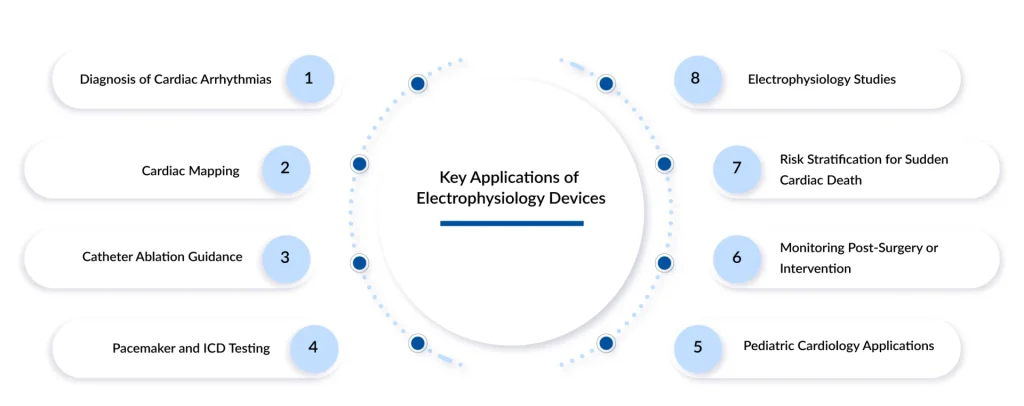
One of the primary clinical applications of EP devices is in the treatment of atrial fibrillation and other supraventricular tachycardias. Using advanced mapping systems, physicians can perform catheter ablation procedures with high precision, targeting abnormal electrical circuits and reducing the recurrence of arrhythmias. Implantable devices, such as pacemakers and implantable cardioverter-defibrillators (ICDs), further enhance patient management by providing continuous monitoring and timely correction of life-threatening arrhythmias, thus preventing sudden cardiac death.
Beyond arrhythmia management, EP devices are increasingly used in heart failure and syncope evaluation. Cardiac resynchronization therapy (CRT), delivered via specialized pacing devices, improves cardiac output in patients with left ventricular dysfunction by synchronizing ventricular contractions. Similarly, electrophysiological studies (EPS) can identify conduction abnormalities that may underlie unexplained fainting episodes, guiding appropriate interventions ranging from lifestyle modifications to device implantation.
Emerging applications of EP devices also extend into personalized medicine and remote patient monitoring. With the integration of AI-driven analysis and wireless telemetry, clinicians can continuously monitor patients, detect early signs of arrhythmia, and adjust therapy proactively. This evolution not only improves patient safety and quality of life but also reduces hospital admissions and healthcare costs. Overall, the clinical applications of electrophysiology devices underscore their transformative impact on modern cardiology, combining diagnostic precision with therapeutic efficacy.
Future Outlook of Electrophysiology Devices
The landscape of electrophysiology devices is poised for significant transformation as technological innovation converges with growing clinical demand. With the global burden of cardiac arrhythmias rising, particularly atrial fibrillation and ventricular tachycardia in aging populations, advanced EP devices are becoming essential tools for earlier diagnosis and more precise therapeutic interventions.
Traditional catheter-based ablation systems, electro-anatomical mapping tools, and implantable monitors are rapidly evolving, with improvements in miniaturization, sensing accuracy, and data integration. These enhancements not only improve procedural efficacy but also reduce complications, shorten procedure times, and expand applicability to more complex arrhythmias.
The global market for electrophysiology devices is projected to rise from USD 9.5 billion in 2024 to USD 19.6 billion by 2032, demonstrating robust and consistent growth. Over the forecast period from 2025 to 2032, the market is anticipated to expand at a CAGR of 9.51%.
A major driver of future progress is the integration of artificial intelligence (AI) and machine learning into both diagnostic and therapeutic platforms. AI-augmented mapping systems can analyze vast amounts of intracardiac electrical data in real time, helping clinicians more accurately identify arrhythmogenic substrates and tailor ablation strategies.
Predictive algorithms also hold promise for forecasting arrhythmia recurrence and optimizing individualized treatment plans. Furthermore, advances in signal processing and computational modeling are enabling devices to distinguish subtle electrical signatures that were previously difficult to interpret, enhancing both sensitivity and specificity in arrhythmia detection.
Another frontier is the development of wireless and leadless technologies, exemplified by emerging implantable devices that avoid transvenous leads altogether. These offer reduced infection risk, improved patient comfort, and extended device longevity. Coupled with remote monitoring capabilities and cloud-based data analytics, future EP devices will support continuous, real-world patient monitoring outside of clinical settings. This shift toward decentralized care can allow earlier intervention when arrhythmias are detected, potentially preventing hospitalizations and improving long-term outcomes.
Additionally, the involvement of leading players such as Boston Scientific Corporation, Lepu Medical Technology Co., Ltd., GENERAL ELECTRIC COMPANY, Medtronic, Abbott, BIOTRONIK, Microport Scientific Corporation, Acutus Medical Inc., Imricor, Johnson & Johnson Services, Inc., Baylis Medical Company Inc., Schwarzer Cardiotek GmbH, ATRICURE, INC., CardioFocus, Osypka AG, and others will further drive the electrophysiology devices market in the coming years.
Looking ahead, the integration of multimodal technologies, blending electrical mapping with imaging modalities such as MRI or high-resolution ultrasound, will further refine the precision of EP interventions. Innovations in energy delivery (e.g., pulsed-field ablation) and robotic catheter navigation are already enhancing safety profiles and procedural reproducibility.
Together, these advancements point toward a future where electrophysiology is not only more effective and patient-centric but also predictive and personalized, reshaping how cardiac rhythm disorders are diagnosed, treated, and managed across diverse healthcare settings.

Downloads
Article in PDF
Recent Articles
- Edwards’ SAPIEN M3 Becomes First Transfemoral TMVR System to Receive CE Mark; Terumo Neuro ...
- Understanding How Cardiac Devices are Aiding in Treatment and Prevention of Heart Disease
- A Glimpse of the Anticoagulants Therapy Market; Major Players
- Wearables 2.0: The Next Wave of Clinical-Grade Wearable Medical Devices
- FDA Clears Medtronic’s New Inpen™ App; Zimmer Biomet Gets FDA Approval for Oxford® Cementless Par...