
Autoimmune Disease Therapeutics Market Summary
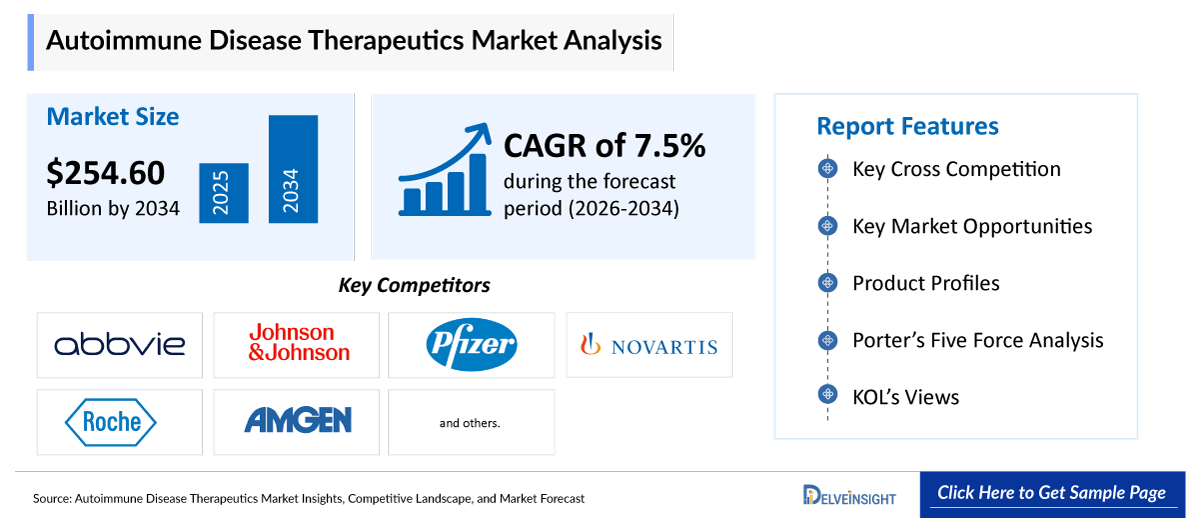
- The Autoimmune Disease Therapeutics Market Size is estimated at USD 132.75 billion in 2025 and is projected to reach USD 254.60 billion by 2034. Growth is anchored in the rising global prevalence of autoimmune disorders, the rapid expansion of biologic and targeted oral therapies, and sustained pharmaceutical investment in immunology pipelines spanning cell- and gene-based modalities.
- The Global Autoimmune Disease Therapeutics Market Size is growing at a CAGR of 7.5% during the forecast period from 2026 to 2034.
Autoimmune Disease Therapeutics Market Trends & Insights
- By drug modality, the biologics segment dominated the Autoimmune Disease Therapeutics Market with a 66% share in 2025.
- By drug class, the Tumor Necrosis Factor (TNF) Inhibitors segment dominated the Autoimmune Disease Therapeutics Market with a 29% share in 2025.
- By route of administration, the subcutaneous segment dominated the Autoimmune Disease Therapeutics Market with a 54% share in 2025.
- By disease type, the Rheumatoid Arthritis (RA) segment dominated the Autoimmune Disease Therapeutics Market with a 34% share in 2025.
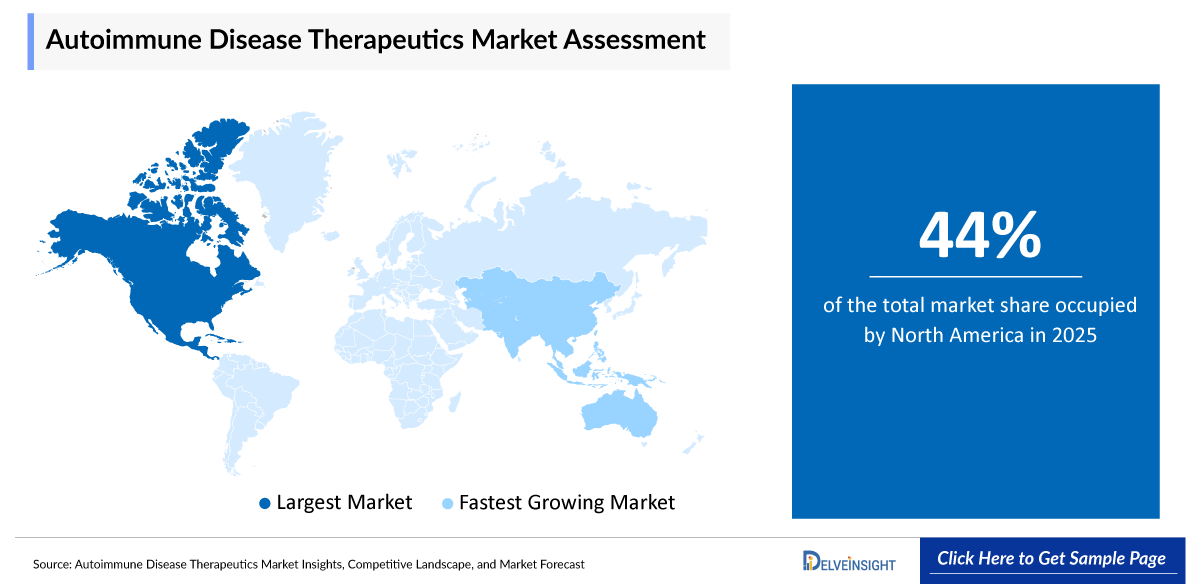
- North America dominated the global Autoimmune Disease Therapeutics market revenue with a 44% share in 2025, representing the highest regional market share globally.
Request to unlock the sample page of the "Autoimmune Disease Therapeutics Market"
Autoimmune Disease Therapeutics Market Size
The following snapshot summarizes the principal report metrics for the autoimmune disease therapeutics market.
|
Report Metrics |
Details |
|
2025 Market Size | |
|
2034 Projected Market Size | |
|
Growth Rate (2026-2034) | |
|
Largest Market |
North America |
|
Fastest Growing Market |
Asia-Pacific |
|
Market Structure |
Moderately Concentrated |
All market values are expressed in USD and represent DelveInsight estimates synthesized from primary and secondary research.
Factors Contributing to the Growth of the Autoimmune Disease Therapeutics Market
Autoimmune Disease Market Drivers
-
Rising Global Prevalence of Autoimmune Disorders
The most fundamental driver of the Autoimmune Disease Therapeutics market is the steadily rising global prevalence of autoimmune disease. More than 80 distinct autoimmune conditions are recognized, collectively affecting an estimated 5-9% of the world's population, and roughly a quarter of patients with one autoimmune disorder go on to develop a second. Rheumatoid arthritis, psoriatic arthritis, multiple sclerosis, and systemic lupus erythematosus remain the largest diagnosed populations, while genetic predisposition, environmental triggers, and improved diagnostic awareness continue to expand the identified patient base. As diagnosis rates improve and treatment-seeking behavior increases, the addressable population for biologic and targeted oral therapies grows in step, anchoring durable long-term demand across the forecast period.
-
Rapid Expansion of Biologic and Targeted Oral Therapies
The clinical and commercial rise of mechanism-specific biologics and oral small molecules is a central growth engine for the market. Interleukin inhibitors and Janus kinase inhibitors have moved rapidly from second-line to earlier use, and commercial performance is substantial: AbbVie's Skyrizi and Rinvoq together are expected to generate more than USD 30 billion in combined 2026 revenue, offsetting continued biosimilar erosion of legacy Humira. These agents deliver more precise immune-pathway targeting than older immunosuppressants, translating into better tolerability and durability of response. As pipelines mature and new mechanisms reach commercial scale, demand for advanced biologic and targeted oral treatment continues to expand across rheumatology, dermatology, gastroenterology, and neurology indications.
-
Accelerating Regulatory Approvals and Label Expansions
A steady wave of regulatory approvals and label expansions is broadening the addressable population for existing therapies. Pfizer's Litfulo (ritlecitinib) secured approval for severe alopecia areata, AbbVie has submitted regulatory applications for Rinvoq in vitiligo and alopecia areata, and Roche has advanced a supplemental application for Gazyva (obinutuzumab) in systemic lupus erythematosus. Diagnostic and therapeutic label expansions across IL-17, IL-23, JAK, and BAFF-inhibitor classes continue to extend approved indications across the United States, Europe, and Japan. Each approval and expansion creates durable, recurring demand for compliant manufacturing, clinical support, and commercial infrastructure, reinforcing market growth across the forecast period.
-
Emergence of Cell-Based and Gene-Based Therapies
A new wave of cell-based and gene-based approaches is opening treatment options for patients with refractory autoimmune disease. CAR-T and other B-cell-depleting cell therapies are advancing in systemic lupus erythematosus and multiple sclerosis, with programs from established immunology players and emerging biotech innovators reporting deep B-cell depletion and immune-reset outcomes in early clinical studies. China has emerged as the first jurisdiction to approve CAR-T therapies for lupus, while Western developers advance later-stage programs. As these modalities mature and regulatory pathways clarify, they are expected to expand the addressable market beyond conventional biologics and small molecules through the forecast period.
-
Intensifying Biosimilar Competition and Access Expansion
Biosimilar competition is reshaping the drug-class mix of the market while expanding patient access. Legacy TNF inhibitors such as adalimumab face erosion from multiple approved U.S. biosimilars, with newer entrants gaining meaningful share within a year of launch as payers and pharmacy benefit managers favor lower-cost options. While this pressures originator revenue in the TNF inhibitor class, it lowers the cost of biologic treatment overall, expanding the treated population and creating durable, high-volume demand across both originator and biosimilar manufacturers.
-
Rising Healthcare Expenditure and Improved Diagnosis
Growing healthcare expenditure, expanding diagnostic infrastructure, and increasing patient and physician awareness are shortening the historically long diagnostic delays associated with autoimmune disease. Improved access to specialty rheumatology, dermatology, and neurology care is translating into earlier treatment initiation and more consistent adherence, which together sustain long-term therapeutic demand and support the shift toward advanced biologic and targeted oral treatment across developed and emerging markets alike.
Autoimmune Disease Therapeutics Overview
Autoimmune disease therapeutics comprise the drugs and biologic agents used to manage conditions in which the immune system mistakenly attacks the body's own tissues, including Rheumatoid Arthritis, Psoriatic Arthritis, Multiple Sclerosis, Systemic Lupus Erythematosus, Psoriasis, and Inflammatory Bowel Disease. Because these disorders are chronic, relapsing, and only rarely curable, treatment is centered on long-term immune modulation rather than cure, and sponsors have progressively shifted from broad immunosuppressants toward mechanism-specific biologics and oral small molecules.
The Autoimmune Disease Therapeutics Market is organized by drug modality across small molecules, biologics, cell-based therapies, gene-based therapies, and others; by drug class, led by TNF inhibitors alongside a fast-growing base of Interleukin (IL) inhibitors, B-cell inhibitors, and JAK Inhibitors; by route of administration spanning oral, intravenous, and subcutaneous delivery; and by disease type, led by rheumatoid arthritis alongside psoriatic arthritis, multiple sclerosis, systemic lupus erythematosus, and other indications.
Driven by rising diagnosis rates, an expanding wave of label expansions for JAK and IL-class agents, and the emergence of CAR-T and other cell-based approaches for refractory autoimmune disease, the Autoimmune Disease Therapeutics market has become a core pillar of the global immunology and specialty pharmaceutical industry.
Autoimmune Disease Therapeutics Market Key Growth Drivers
- The rising global prevalence of autoimmune disorders is expanding the treated patient pool, with autoimmune diseases collectively affecting an estimated 5-9% of the world's population across more than 80 recognized conditions.
- Continued clinical and commercial expansion of biologic and targeted oral therapies is driving demand, with AbbVie's Skyrizi and Rinvoq together generating more than USD 30 billion in combined 2025 immunology revenue and both drugs receiving new regulatory submissions in vitiligo and alopecia areata.
- Accelerating label expansions and new approvals across JAK, IL-17, and IL-23 inhibitor classes, including Pfizer's Litfulo approval for severe alopecia areata, are broadening addressable patient populations.
- Growing pipeline activity in B-cell-depleting and CAR-T cell-based therapies for systemic lupus erythematosus and multiple sclerosis, led by programs from Roche, Novartis, and emerging biotech innovators, is opening new modalities of care for refractory disease.
- Intensifying biosimilar competition for legacy TNF inhibitors such as adalimumab is expanding patient access and price-based adoption while shifting originator strategy toward newer mechanisms.
- Rising healthcare expenditure, improved diagnostic capability, and growing patient awareness are shortening diagnosis timelines and increasing early-stage treatment initiation.
- The convergence of biologic innovation, label expansion, biosimilar penetration, and emerging cell- and gene-based modalities is expected to sustain steady, high-single-digit growth in the market through 2034.
Major Autoimmune Disease Therapeutics Companies
The Autoimmune Disease Therapeutics Competitive Landscape is led by the following active manufacturers:
- AbbVie
- Johnson & Johnson
- Pfizer
- Novartis
- Roche
- Amgen
- Eli Lilly and Company
- Bristol Myers Squibb
- UCB
- Sanofi, and others
For illustrative purposes, only the top 10 companies are listed in the Table of Contents. The report may include analysis and references to additional companies relevant to the market assessment.
Autoimmune Disease Market Restraints
Despite strong momentum, the Autoimmune Disease Therapeutics market faces material constraints. The high cost of biologic and targeted oral therapies, often exceeding tens of thousands of dollars annually per patient, creates significant reimbursement and access barriers, particularly in price-sensitive and emerging markets. Intensifying biosimilar and generic competition compresses originator pricing and revenue even as it expands access.
The chronic, relapsing nature of autoimmune disease means most available treatments manage symptoms and slow progression rather than cure the underlying condition, and heterogeneous patient response across mechanisms complicates treatment selection. Safety concerns associated with certain drug classes, including boxed warnings for JAK inhibitors, have prompted more conservative prescribing in some patient populations. Lengthy and complex regulatory pathways for novel mechanisms, particularly cell- and gene-based therapies, extend development timelines and raise costs, while diagnostic delays for complex conditions such as systemic lupus erythematosus continue to defer treatment initiation. Together, these cost, competitive, safety, and diagnostic barriers temper the pace of growth, even as the underlying drivers of rising prevalence, biologic innovation, and expanding treatment access remain firmly intact.
Autoimmune Disease Therapeutics Market Segment Analysis
The autoimmune disease therapeutics market by drug modality (small molecules, biologics, cell-based therapies, gene-based therapies, and others), drug class (tumor necrosis factor (tnf) inhibitors, interleukin (il) inhibitors, b-cell inhibitors, janus kinase (jak) inhibitors, and others), route of administration (oral, intravenous (iv), subcutaneous, and others), disease type (rheumatoid arthritis (ra), psoriatic arthritis (psa), multiple sclerosis (ms), systemic lupus erythematosus (sle), and others), end-users (hospitals, specialty clinics, and others), and geography (North America, Europe, Asia-Pacific, and Rest of World).
-
Autoimmune Disease Therapeutics By Segmentation By Drug Modality
Dominant Subsegment: Biologics.
The biologics segment accounted for 66% of the Autoimmune Disease Therapeutics market in 2025. Biologics are the leading drug modality because monoclonal antibodies and fusion proteins deliver precise, mechanism-specific immune modulation with a well-established efficacy and safety record across rheumatoid arthritis, psoriasis, psoriatic arthritis, and inflammatory bowel disease. Franchise biologics such as AbbVie's Skyrizi, Johnson & Johnson's Tremfya, and Novartis' Cosentyx continue to post double-digit growth as they capture share from older mechanisms and expand into new indications. The breadth of approved biologic classes, spanning TNF, IL-17, IL-23, and BAFF inhibitors, combined with an accelerating biosimilar pipeline that broadens access to lower-cost biologic treatment, sustains the segment's scale. While cell-based and gene-based therapies represent the fastest-growing modalities as CAR-T and B-cell-depleting approaches advance in lupus and multiple sclerosis, the depth of the approved biologic portfolio and its central role in first-line and second-line treatment secure the segment's leadership across the forecast period.
-
Autoimmune Disease Therapeutics By Segmentation By Drug Class
Dominant Subsegment: TNF Inhibitors.
The TNF inhibitors segment accounted for 29% of the Autoimmune Disease Therapeutics market in 2025. TNF inhibitors remain the leading drug class because agents such as adalimumab, etanercept, infliximab, and UCB's Cimzia carry decades of clinical validation across rheumatoid arthritis, psoriatic arthritis, ankylosing spondylitis, and inflammatory bowel disease, and continue to anchor first-line biologic treatment in many markets. The expanding availability of adalimumab biosimilars is broadening access and sustaining high treatment volumes even as originator revenue erodes. At the same time, IL inhibitors are the fastest-growing drug class, propelled by IL-17 and IL-23 agents such as Cosentyx, Tremfya, Skyrizi, and UCB's Bimzelx, while JAK inhibitors, led by Rinvoq and Pfizer's Litfulo, are expanding rapidly into new indications including alopecia areata and vitiligo, and B-cell inhibitors such as GSK's Benlysta anchor systemic lupus erythematosus treatment. Nonetheless, the breadth of approved indications and the sheer prescription volume of TNF inhibitors secure the class's leadership across the forecast period.
-
Autoimmune Disease Therapeutics By Segmentation By Route of Administration
Dominant Subsegment: Subcutaneous.
The subcutaneous segment accounted for 54% of the Autoimmune Disease Therapeutics market in 2025. Subcutaneous administration is the leading route because most modern biologics, including adalimumab, Skyrizi, Cosentyx, and Bimzelx, are formulated as self-administered pre-filled pens or syringes that allow patients to dose at home, improving convenience, adherence, and quality of life relative to infusion-based treatment. Manufacturers have increasingly prioritized subcutaneous formulations and autoinjector technology, including recent approvals of subcutaneous self-administration options for infused biologics, to reduce infusion-center burden and expand outpatient use. Intravenous administration remains essential for agents such as Roche's Actemra and Ocrevus and for induction therapy in severe disease, while oral small molecules, led by JAK inhibitors, are the fastest-growing route as patients and physicians favor pill-based regimens where efficacy is comparable. Nonetheless, the scale of the subcutaneous biologic franchise secures its leadership across the forecast period.
-
Autoimmune Disease Therapeutics By Segmentation By Disease Type
Dominant Subsegment: Rheumatoid Arthritis (RA).
The rheumatoid arthritis segment accounted for 34% of the Autoimmune Disease Therapeutics market in 2025. Rheumatoid arthritis is the leading disease type because it is among the most prevalent chronic autoimmune conditions worldwide, with a well-established biologic and targeted oral treatment paradigm spanning TNF, IL-6, JAK, and B-cell-targeted mechanisms such as Amgen's Enbrel and Bristol Myers Squibb's Orencia. Decades of clinical evidence, broad payer coverage, and established treat-to-target guidelines sustain high treatment rates and frequent therapy switching, both of which support recurring demand for advanced therapeutics. Psoriatic arthritis benefits from many of the same mechanisms and is expanding alongside dermatology-driven biologic use, while multiple sclerosis and systemic lupus erythematosus are the fastest-growing disease types as new B-cell-depleting, interferon-pathway, and emerging cell-based therapies reach patients with previously limited options. Nonetheless, the sheer size of the diagnosed rheumatoid arthritis population and the depth of its treatment paradigm secure the segment's leadership across the forecast period.
By End-Users
Dominant Subsegment: Hospitals.
The hospitals segment accounted for 52% of the Autoimmune Disease Therapeutics market in 2025. Hospitals are the leading end-user setting because they manage diagnosis, infusion-based biologic administration, and treatment of complex or severe autoimmune disease, including multiple sclerosis and systemic lupus erythematosus cases that require specialist oversight and access to intravenous therapies. Hospital-affiliated rheumatology, neurology, and dermatology departments also serve as the primary site for initiating biologic treatment and managing adverse events. Specialty clinics are the fastest-growing end-user segment as dedicated infusion centers and outpatient rheumatology and dermatology practices expand to handle rising patient volumes and increasingly self-administered subcutaneous therapies outside the hospital setting. Nonetheless, the central role of hospitals in diagnosis, complex-case management, and infusion therapy secures their leadership across the forecast period.
Autoimmune Disease Therapeutics Market Region Analysis
Dominant Region: North America
North America accounted for 44% of the global Autoimmune Disease Therapeutics market revenue in 2025, representing the highest regional market share globally. The region's dominance reflects a mature immunology treatment ecosystem, deep clinical-research infrastructure, broad payer coverage of biologics, and clear FDA regulatory pathways, particularly in the United States. North America hosts the largest concentration of biologic and targeted oral therapy prescribing and the deepest late-stage immunology pipeline, and sponsors benefit from proximity to leading immunology developers including AbbVie, Johnson & Johnson, Amgen, and Bristol Myers Squibb. The commercial success of franchises such as Skyrizi, Rinvoq, Tremfya, and Cosentyx, combined with rapid uptake of newly approved indications and a deep clinical pipeline in lupus and multiple sclerosis, drives substantial treatment demand. Strong reimbursement, regulatory clarity, and the concentration of major immunology manufacturers anchor the region's continued leadership across the forecast period.
Fastest Growing Region: Asia-Pacific
Asia-Pacific is the fastest-growing region in the Autoimmune Disease Therapeutics market. The region's elevated CAGR is driven by rising autoimmune disease diagnosis rates, expanding healthcare infrastructure, and growing biologic adoption across China, Japan, India, South Korea, and Australia. China is rapidly expanding access to biologics and advancing domestic CAR-T approvals for systemic lupus erythematosus, Japan continues to broaden reimbursement for advanced immunology therapies, and India benefits from growing biosimilar manufacturing capacity and increasing specialist access. Rising healthcare investment, expanding insurance coverage, and growing patient and physician awareness are accelerating adoption, while regional manufacturers scale biosimilar production and pursue global regulatory alignment. The combination of a large undertreated patient population, healthcare infrastructure build-out, and biosimilar manufacturing growth positions Asia-Pacific as the principal source of incremental growth over the forecast period.
Autoimmune Disease Market Regional Commentary
North America
North America accounted for 44% of the global Autoimmune Disease Therapeutics market revenue in 2025. The United States dominates on the strength of its immunology treatment infrastructure, deep clinical-research base, FDA regulatory clarity, and broad payer coverage of biologic therapies, while the commercial strength of Skyrizi, Rinvoq, Tremfya, and Cosentyx, alongside an active late-stage pipeline in lupus and multiple sclerosis, reinforces the region's leadership.
Europe
Europe is a large and advanced regional market, supported by established EMA regulatory frameworks, strong national health systems, and a deep base of immunology manufacturers including UCB, Sanofi, Novartis, and Roche. Growing biosimilar adoption, expanding reimbursement for IL-17 and IL-23 inhibitors, and active clinical development in multiple sclerosis and lupus reinforce the region's role in both innovator and biosimilar autoimmune therapeutics across Germany, France, the United Kingdom, Italy, and Spain.
Asia-Pacific
Asia-Pacific is the fastest-growing region, propelled by rising autoimmune disease diagnoses, expanding healthcare infrastructure, and growing biologic and biosimilar adoption across China, Japan, India, South Korea, and Australia. China's advancing CAR-T approvals for lupus, Japan's broadening biologic reimbursement, India's biosimilar manufacturing growth, and rising specialist access across the region are accelerating adoption and clinical-trial activity.
Rest of World
The Rest of World region, spanning Latin America, the Middle East, and Africa, is an emerging growth frontier. Expanding healthcare infrastructure, rising diagnosis of autoimmune disorders, and growing access to biosimilar therapies are gradually broadening treatment access, while international partnerships and local manufacturing investment support the build-out of regional biologic and biosimilar supply.
Autoimmune Disease Therapeutics Market Competitive Landscape
The Autoimmune Disease Therapeutics market is classified as Moderately Concentrated. A group of large, diversified immunology leaders with deep biologic and targeted oral portfolios, including AbbVie, Johnson & Johnson, Novartis, and Roche, secures large prescribing shares and anchors the top tier, while specialized and fast-scaling players such as UCB, Amgen, Sanofi, GSK, Biogen, Takeda, and Merck KGaA compete through mechanism differentiation, indication expansion, and dedicated cell- and gene-based therapy pipelines, increasing competition in the fastest-growing disease segments.
The competitive landscape can be evaluated across the following dimensions:
- Market concentration: Moderately concentrated, with large diversified immunology leaders anchoring the top tier and a growing field of specialized biologic and cell-therapy developers.
- Leading players: AbbVie, Johnson & Johnson, Novartis, and Roche anchor the top tier through breadth of approved biologic and oral portfolios and deep late-stage pipelines.
- Geographic reach: Leaders operate global commercial networks spanning North America, Europe, and Asia-Pacific, supported by regional manufacturing and biosimilar production capacity.
- Portfolio strength: Top players offer multi-mechanism portfolios spanning TNF, IL-17, IL-23, JAK, and B-cell-targeted agents across rheumatology, dermatology, gastroenterology, and neurology.
- Pipeline depth: Late-stage programs in cell-based and gene-based therapies for systemic lupus erythematosus and multiple sclerosis, alongside next-generation oral and biologic candidates, are a decisive advantage.
- Label expansion strategy: Continuous indication expansion, such as AbbVie's Rinvoq submissions in vitiligo and alopecia areata and Roche's Gazyva submission in lupus, extends commercial reach for existing molecules.
- M&A and licensing activity: Active licensing and pipeline in-licensing, alongside continued investment in emerging cell-therapy platforms, is expanding manufacturer access to next-generation mechanisms.
- Commercial capabilities: Deep specialist-physician relationships, patient-support programs, and autoinjector and self-administration technology are key competitive differentiators.
- Innovation focus: Cell-based and gene-based therapy scale-up, next-generation oral small molecules, biosimilar portfolio expansion, and precision biomarker-driven treatment selection.
Autoimmune Disease Therapeutics Market Recent Developmental Activities
- In 2026, AbbVie raised its full-year revenue outlook for Skyrizi and Rinvoq to approximately USD 21.6 billion and USD 10.2 billion, respectively, and submitted regulatory applications for Rinvoq in vitiligo and alopecia areata. Strategic significance: Reinforces AbbVie's position as the leading immunology franchise and extends its addressable dermatology-autoimmune population.
- In April 2026, Roche submitted a supplemental Biologics License Application for Gazyva (obinutuzumab) to expand its use into systemic lupus erythematosus, with an FDA decision expected in December 2026. Strategic significance: Repurposes an established immuno-oncology biologic to strengthen Roche's lupus and B-cell-depletion portfolio.
- In 2026, Johnson & Johnson continued to shift commercial focus toward Tremfya (guselkumab) across multiple immunology indications following loss of U.S. patent exclusivity for Stelara. Strategic significance: Sustains J&J's immunology leadership through label breadth and lifecycle management.
- In June 2025, Pfizer secured approval for Litfulo (ritlecitinib), a JAK inhibitor, for the treatment of severe alopecia areata. Strategic significance: Extends Pfizer's JAK inhibitor franchise into a new dermatology-autoimmune indication.
- In 2025-2026, Eli Lilly and Company continued to expand Omvoh (mirikizumab), an IL-23 inhibitor, following approval in ulcerative colitis and Crohn's disease. Strategic significance: Builds Eli Lilly's immunology presence and diversifies its inflammatory-disease portfolio.
- In 2025, UCB advanced commercial expansion of Bimzelx (bimekizumab), a dual IL-17A/F inhibitor, across psoriasis, psoriatic arthritis, and axial spondyloarthritis indications. Strategic significance: Strengthens UCB's position in the fast-growing IL-17 inhibitor class.
- In 2025, Novartis continued to expand Cosentyx (secukinumab) into new indications and geographies while advancing its immunology pipeline. Strategic significance: Reinforces Novartis' leadership in the IL-17 inhibitor drug class.
- In 2025, Bristol Myers Squibb continued commercial expansion of Sotyktu (deucravacitinib), a selective TYK2 inhibitor, in moderate-to-severe plaque psoriasis. Strategic significance: Extends BMS' oral immunology franchise with a differentiated, non-JAK1/2/3 mechanism.
- In 2025, GSK continued to expand access to Benlysta (belimumab), a BAFF inhibitor, for systemic lupus erythematosus and lupus nephritis across additional markets. Strategic significance: Reinforces GSK's leadership in B-cell-targeted lupus therapeutics.
- In 2025, Biogen and Merck KGaA continued to advance their respective multiple sclerosis portfolios, Tysabri and Mavenclad, amid growing competition from newer B-cell-depleting and oral mechanisms. Strategic significance: Sustains established neurology-autoimmune franchises while pipelines diversify toward next-generation MS therapies.
Autoimmune Disease Therapeutics Market Segmentation
- Autoimmune Disease Therapeutics Market by Drug Modality
- Small Molecules
- Biologics
- Cell-Based Therapies
- Gene-Based Therapies
- Others
- Autoimmune Disease Therapeutics Market by Drug Class
- Tumor Necrosis Factor (TNF) Inhibitors
- Interleukin (IL) Inhibitors
- B-cell Inhibitors
- Janus Kinase (JAK) Inhibitors
- Others
- Autoimmune Disease Therapeutics Market by Route of Administration
- Oral
- Intravenous (IV)
- Subcutaneous
- Others
- Autoimmune Disease Therapeutics Market by Disease Type
- Rheumatoid Arthritis (RA)
- Psoriatic Arthritis (PsA)
- Multiple Sclerosis (MS)
- Systemic Lupus Erythematosus (SLE)
- Others
- Autoimmune Disease Therapeutics Market by End-Users
- Hospitals
- Specialty Clinics
- Others
Autoimmune Disease Therapeutics Market by Geography
- North America Autoimmune Disease Therapeutics Market
- United States Autoimmune Disease Therapeutics Market Size in USD million (2023-2034)
- Canada Autoimmune Disease Therapeutics Market Size in USD million (2023-2034)
- Mexico Autoimmune Disease Therapeutics Market Size in USD million (2023-2034)
- Europe Autoimmune Disease Therapeutics Market
- Germany Autoimmune Disease Therapeutics Market Size in USD million (2023-2034)
- United Kingdom Autoimmune Disease Therapeutics Market Size in USD million (2023-2034)
- France Autoimmune Disease Therapeutics Market Size in USD million (2023-2034)
- Italy Autoimmune Disease Therapeutics Market Size in USD million (2023-2034)
- Spain Autoimmune Disease Therapeutics Market Size in USD million (2023-2034)
- Rest of Europe Autoimmune Disease Therapeutics Market Size in USD million (2023-2034)
- Asia-Pacific Autoimmune Disease Therapeutics Market
- China Autoimmune Disease Therapeutics Market Size in USD million (2023-2034)
- Japan Autoimmune Disease Therapeutics Market Size in USD million (2023-2034)
- India Autoimmune Disease Therapeutics Market Size in USD million (2023-2034)
- Australia Autoimmune Disease Therapeutics Market Size in USD million (2023-2034)
- South Korea Autoimmune Disease Therapeutics Market Size in USD million (2023-2034)
- Rest of Asia-Pacific Autoimmune Disease Therapeutics Market Size in USD million (2023-2034)
- Rest of the World (RoW) Autoimmune Disease Therapeutics Market
- Middle East Autoimmune Disease Therapeutics Market Size in USD million (2023-2034)
- Africa Autoimmune Disease Therapeutics Market Size in USD million (2023-2034)
- South America Autoimmune Disease Therapeutics Market Size in USD million (2023-2034)
Autoimmune Disease Therapeutics Market Recent Industry Trends and Milestones (2023-2026):
|
Category |
Key Developments |
|
Autoimmune Disease Therapeutics Market Product Approval |
Regulatory momentum continues to expand the addressable market. Pfizer's Litfulo (ritlecitinib) secured approval for severe alopecia areata, AbbVie submitted applications for Rinvoq in vitiligo and alopecia areata, and Roche advanced a supplemental application for Gazyva in systemic lupus erythematosus. Skyrizi, Rinvoq, Tremfya, and Cosentyx continue to anchor the biologic and targeted oral market, while newer B-cell and interferon-pathway agents expand approved indications in lupus. Each approval and label expansion creates durable demand for specialist prescribing, patient support, and commercial infrastructure. |
|
Autoimmune Disease Therapeutics Market Expansion |
Manufacturers broadened commercial and manufacturing capacity across the value chain. AbbVie and Johnson & Johnson expanded biologic manufacturing to support Skyrizi and Tremfya demand, UCB scaled commercial infrastructure for Bimzelx across additional markets, and multiple originators advanced subcutaneous autoinjector formulations to reduce reliance on infusion centers. Biosimilar manufacturers expanded adalimumab and other biosimilar production capacity to meet growing demand from cost-sensitive payers. |
|
Autoimmune Disease Therapeutics Market Investment |
Capital allocation accelerated toward next-generation mechanisms. Companies across the sector increased investment in cell-based and gene-based therapy platforms targeting systemic lupus erythematosus and multiple sclerosis, while established players such as AbbVie, Novartis, and Roche continued heavy R&D investment in late-stage immunology pipelines. Licensing and in-licensing activity for novel oral and biologic candidates increased as originators sought to diversify beyond legacy TNF inhibitor franchises. |
|
Company Strategy |
AbbVie: Immunology leadership through Skyrizi and Rinvoq, with continued label expansion. Johnson & Johnson: Lifecycle management through Tremfya following Stelara's loss of exclusivity. Novartis: IL-17 inhibitor leadership through Cosentyx. Roche: B-cell-depletion and lupus pipeline expansion through Gazyva and Ocrevus. Pfizer: JAK inhibitor franchise expansion through Litfulo. Amgen, Eli Lilly, Bristol Myers Squibb, UCB, Sanofi, GSK, Biogen, Takeda, and Merck KGaA: Differentiated mechanism-specific portfolios spanning TNF, IL, JAK, TYK2, and B-cell-targeted therapeutics. |
|
Emerging Technologies |
Cell-based and gene-based therapies are the leading edge of innovation, with CAR-T and other B-cell-depleting approaches advancing in systemic lupus erythematosus and multiple sclerosis, and China leading early regulatory approvals. Next-generation oral small molecules, including selective TYK2 and JAK inhibitors, are expanding treatment options with improved safety profiles. Biomarker-driven patient selection, AI-assisted drug discovery, and subcutaneous autoinjector technology are improving treatment precision and convenience, while biosimilar manufacturing scale-up continues to broaden global access. |
Autoimmune Disease Therapeutics Market Startup Funding and Investment Trends
Investment in the Autoimmune Disease Therapeutics ecosystem has concentrated on cell-based and gene-based therapy platforms, next-generation oral mechanisms, and biosimilar manufacturing capacity. The following companies illustrate recent funding and investment activity and technology focus.
|
Company |
Total Funding |
Funding Stage |
Main Offering |
Core Technology |
|
Adicet Bio, Inc. |
Venture and public financing |
Clinical stage |
Allogeneic cell therapy for autoimmune disease |
Gamma delta T cell therapy platform |
|
Request for unlocking the report of the @ Autoimmune Disease Therapeutics Market Insights | ||||
Capital is flowing toward developers advancing next-generation cell-based and oral mechanisms for refractory autoimmune disease. Emerging biotech companies are scaling CAR-T and B-cell-depleting platforms for systemic lupus erythematosus and multiple sclerosis, while established players continue heavy investment in late-stage biologic and oral pipelines. Collectively, these investments signal conviction that mechanism diversification, cell- and gene-based innovation, and biosimilar access expansion will define the next phase of competitive advantage in the global Autoimmune Disease Therapeutics market.
Key Takeaways from the Autoimmune Disease Therapeutics Market Report Study
- Market size analysis for the current autoimmune disease therapeutics market size (2025), and market forecast for 9 years (2026 to 2034).
- Top key product/technology developments, mergers, acquisitions, partnerships, and joint ventures that happened over the last 3 years.
- Key companies dominating the global autoimmune disease therapeutics market.
- Various opportunities available for competitors in the autoimmune disease therapeutics market space.
- What are the top-performing segments in 2025? How will these segments perform in 2034?
- Which are the top-performing regions and countries in the current autoimmune disease therapeutics market scenario?
- Which are the regions and countries where companies should concentrate their opportunities for autoimmune disease therapeutics market growth in the future?
Target audience who can benefit from this Autoimmune Disease Therapeutics market report study
- Autoimmune disease therapeutics product providers
- Research organizations and consulting companies
- Neurodegenerative disease therapeutics-related organizations, associations, forums, and other alliances
- Government and corporate offices
- Start-up companies, venture capitalists, and private equity firms
- Distributors and traders dealing in autoimmune disease therapeutics
- Various end-users who want to know more about the autoimmune disease therapeutics market and the latest technological developments in the autoimmune disease therapeutics market.

