How is Artificial Intelligence (AI) Playing a Constructive Role in Mental Health Management?
Aug 03, 2022
Table of Contents
Artificial Intelligence for Mental Health and Mental Illnesses: An Overview
As per the latest findings, the prevalence of Mental Health has grown significantly over the past two-three decades. The growth has been registered in almost every country worldwide. People of any age, race, religion or economic status can get mental illnesses. It can severely impact personal and professional life and personal relationships. Similarly, Schizophrenia, bipolar disorder, major depression, and anxiety disorders are some of the most common Mental Health worldwide. In the United States, nearly 43 million people struggle with mental illness. As per the U.S. Department of Health and Human Services, 1/2 of all mental illnesses show early signs before a person turns 14 years old, and 3/4 of mental illnesses begin before age 24. According to WHO, mental, neurological and substance use disorders comprise 10% of the global disease burden and 25.1% of the non-fatal disease burden. In the global economy, there is about $ 1 trillion yearly loss in productivity due to depression and anxiety.
A mental illness is a medical condition that disrupts a person’s thinking, feeling, mood, and ability to relate to others and daily functioning. Several factors can lead to the development of mental illness. Life experiences (such as trauma or a history of abuse), injury, use of alcohol or drugs, genetics (biological factors), physical illness, family history of mental illness, and chemical imbalances in the brain are some of the most common factors contributing to the development of the mental illness. Some of the most common signs of mental health issues include extreme mood swings, changes in eating habits, excessive worrying or fear, problems concentrating, and avoiding friends or social activities. The disorders increase the risk for several other diseases such as diabetes, heart disease, and stroke. The mental d
Downloads
Click Here To Get the Article in PDF

Recent Articles
- Miracor Medical’s Picso Pivotal Study; Medtronic’s Extravascular ICD; Galaxy Medical’s CENTAURI P...
- Sleep Aids Market: Examining Cutting-Edge Technologies and Major Breakthroughs
- We’re all in this together!
- Decoding DNA, Redefining Dosage: How Pharmacogenomic Testing Services Are Rewriting the Rules of ...
- How to Cure Treatment-resistant Depression?
It is observed that early diagnosis and treatment play a critical role in a better health outcome. Despite the continuous effort by the health agencies to raise awareness and immense development in the therapeutics segment, there is still a significant gap in mental illness diagnosis and treatment. Over half of the mental health remains undiagnosed. Even in developed countries like the US, most people often do not get adequate treatment for mental health. As per the study by Nguyen, Theresa et al. titled “State of Mental Health in America 2018,” 56% of American adults with mental illness did not receive care in the last year.
With the advent of digital approaches to mental health, modern Artificial Intelligence (AI) (machine learning in particular) can play a key role in predicting, detecting, and treating mental health care solutions. To provide an effective solution for better diagnosis and treatment, several global MedTech and health-tech companies are actively investing in Artificial Intelligence solutions for mental health illnesses.
Determining the Mental Illness Subtypes and Symptoms
It is observed that the direct observation of signs and symptoms of mental health issues is one of the key challenges for researchers and clinicians working in mental health management. At present, the mental illness diagnosis often relies on either self-reporting of specific feelings or actions or direct observation of a subject. Direct observation is a time-consuming and costly procedure. Additionally, accuracy is also one of the major challenges. Deploying Artificial Intelligence can provide better measurement, analysis, and diagnostics for various mental health issues. A recent study has concluded that Artificial Intelligence may detect anxiety symptoms with over 90% accuracy. Similarly, several other studies are going on to evaluate the potential of Artificial Intelligence in mental health diagnosis.
The development of Deep learning (DL) has emerged as a way to examine enormous data sets that can assess the probability of developing mental health conditions. With deep learning, today, we can analyze a large amount of data, including clinical files and personal medical history. It can help analyze data and identify patterns and potential warning signs, thereby guiding the physician to make quick decisions. Traumatic or stressful events or relatives with a history of mental disorders are some of the critical factors that may lead to mental health disorders. The data collection and recognition can allow physicians and clinical institutions to analyse the prediction for mental health issues in the person. The early assessment of the risk factors and symptoms can provide scope for the early treatment of mental health disorders. As technology like deep learning and its algorithms evolve, it will give more reliable and robust results. Overall, AI can make mental health diagnoses more quickly and accurately and provide a patient with the right course of treatment faster than the physician can manually.
Suggesting Optimum Treatment Plans and Patient Monitoring
Besides diagnosing and assessing symptoms, AI can play a key role in the treatment. Traditional treatment for mental health includes psychiatric counselling and medications. With the use of AI, physicians can monitor the treatment process and improve medication adherence over the duration of the treatments. More specifically, in the depressed, which leads to the mood and loss of interest or pleasure in day-to-day activity, the AI can play a significant role in the treatment journey. In fact, the patient can receive more tailored care to treat their mental illness.
AI technologies have great potential to support clinical treatments in many ways. Most importantly, AI can analyze the treatment response and bypass ineffective medication trials, expensive stimulation therapies, or time-consuming psychotherapies. AI can also help to predict serious side effects of treatments. If the person is going through medications for mental health, it can indicate the development of side effects in patients treated with similar products. In the longer term, the AI approaches can aid in building new theoretical models of mental disease pathophysiology. The pattern of past mental illnesses of different patients can accurately predict which individuals would develop the mental disorder in future. Alternatively, it will help predict the clinical action of drugs and manage future treatment plans. Overall, Artificial Intelligence (AI) can revolutionize the mental health treatment scenario to a much large extent than we can
Talk Therapy
Psychotherapeutic interventions, also known as talk therapy, can be applied for mental health management. AI as a conversational technology can deliver psychological interventions such as social, cognitive behavioural, and trauma therapy. The programme is designed to respond to the presented dialogue by the patients/user. It can be customized to a patient’s emotional state and clinical needs. Currently, some of the technologies are being incorporated into smartphones, most of which are in the early stage. Through the voice assistants or chatbots that use natural language processing, the AI can recognize and respond to users’ concerns who are going through some form of mental health issues. Some of the tech companies, such as Ginger.io, combine machine learning and a clinical network to provide patients with emotional support. Similarly, Woebot is a free therapy chatbot that converses about patients’ moods and thoughts, “listens” to them, learns their feelings, and offers evidence-based cognitive behaviour therapy. Several studies have demonstrated that Artificial Intelligence-based chatbots can make people feel more connected socially and overcome mental health challenges. In the coming years, chatbots or Talk Therapy will impact clinical practice significantly.
Key Benefits of Artificial Intelligence in Mental Health
Artificial intelligence is transforming mental healthcare by improving accessibility, personalization, and early intervention strategies. From AI-powered chatbots and virtual therapists to predictive analytics and mood-tracking applications, the technology is helping clinicians deliver faster and more accurate support to patients. The growing discussion around the 10 uses of artificial intelligence in mental health highlights how AI can assist in diagnosing mental health conditions, monitoring behavioral patterns, detecting emotional distress through speech and text analysis, and providing 24/7 support for individuals facing anxiety, depression, or stress-related disorders.
Additionally, AI-driven tools can streamline administrative tasks for healthcare providers, enhance treatment adherence, and enable data-driven decision-making, ultimately making mental healthcare more proactive, scalable, and patient-centric. Some of the benefits of AI among the 10 uses of artificial intelligence in mental health are given below:
Provides High Therapeutic Standards Through Quality Control
With rising demand for services and stretched workloads, some mental health facilities are looking into automated methods to check quality control among therapists. Technology companies have noticed and are providing clinics with tools to help therapists and clients better understand each other’s language. Lyssn, a software firm based in the United Kingdom and the United States, delivers technology to clinics and institutions to improve quality control and training.
Refinement of Diagnosis and Selection of an Appropriate Therapist
AI is assisting doctors in detecting mental illness early and making more accurate treatment plan decisions. Researchers believe they may utilise data insights to potentially match clients with the correct therapists and determine which style of therapy would work best for an individual to have more successful therapy sessions. Furthermore, Artificial Intelligence research can assist clinicians to personalise treatment by narrowing down patient diagnoses into different condition subgroups.
Using AI technology, therapists may filter through enormous quantities of data to uncover family histories, patient behaviours, and responses to earlier treatments, allowing them to establish more specific diagnoses and make more informed treatment and therapist selections.
Monitoring Patient Progress and Modifying Treatment
Once partnered with a therapist, tracking and monitoring patient development is necessary. AI can aid when it’s time for a therapy change or a new therapist. Lyssn’s, for example, analyses utterances between therapists and clients to determine how much time is spent on productive therapy vs ordinary chit-chat during a session to improve.
Justification for Cognitive Behavioural Therapy (Cbt) Above Medicine
The usage of medications to treat mental health conditions such as depression has increased. AI can aid in the validation of CBT as a treatment. CBT tries to discover negative thought patterns and develop strategies to break them, which can assist the therapists in utilising statements to explore techniques of change and future planning.
Drawbacks and Challenges of AI in Mental Health
AI has a huge potential in the healthcare space. However, it has several challenges associated with it. Some of the key challenges associated with AI in the mental Health segment include:
Data Security and Privacy
Artificial Intelligence in healthcare is increasingly being used in medical devices and other types of technologies and therapeutics. Privacy is one of the major concerns associated with AI. Companies collect, control, and utilise the data in many AI services. Similarly, private entities, clinics, and public bodies can also access the data. There is always a risk of data leakage to third parties or hackers. The data can be used for unethical purposes and have immediate repercussions.
Regulatory Issues
Countries worldwide follow different rules and regulations for implementing new technologies. In the case of healthcare, some countries have strict regulations to avoid mishappenings. Like in the US, companies must comply with the GDPR, HIPAA, and other industry-specific guidelines to roll out their product and services. Most of the Artificial Intelligence in mental health is delivered through mobile applications. The mobile apps must be validated through small-scale or short-term pilot studies for clinical usage. Similarly, healthcare agencies may monitor the tools and applications for potential benefits and harmful effects. The companies may have to invest heavily in terms of resources and time.
Biasness of the Designed Model
The data collected for the Artificial Intelligence applications can be very huge. The system or the model designed can have a business. Similarly, the model for a particular population cannot be applied to the out-of-sample population. The insufficient and poor-quality databases may also affect the validity of the Artificial Intelligence model for mental health. A simple model may greatly reduce the capacity of the observed data and may not provide a relevant conclusion. The model must provide optimum results with greater transparency using in-depth algorithms for wide acceptability among the people.
Prominent Companies in the AI in Mental Health Segment
Understanding the need and great demand, several well-established and prominent companies, over the years, have started working on developing Artificial Intelligence solutions for mental health management. Many startups have also entered in the segment and are working on different solutions that can diagnose and treat various mental health conditions.
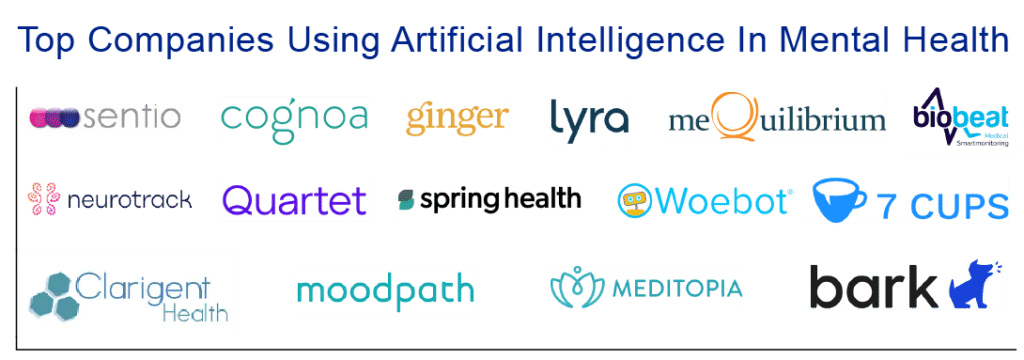
Some of the key companies in the Artificial Intelligence in the Mental Health Market include Sentio Solutions, Cognoa, Ginger.Io, Lyra Health, MeQuilibrium, Neurotrack, Quartet Health, Spring Health, Woebot Labs, BioBeats, Clarigent Health, 7Cups, MindDoc: Moodpath, Meditopia, Bark Technologies, and others.
AI in Mental Health: Future Perspective
Globally the mental health system is already overburdened with a larger number of cases and a low number of healthcare professionals to hand the cases. There is a significant gap in demand and supply. With the rising awareness, people are increasingly turning to digital solutions to address mental health issues. The adoption of Artificial Intelligence in mental health is relatively nascent. As technology is evolving and the awareness among the general population is increasing, AI is expected to contribute to mental health management significantly.
There are immense opportunities for the MedTech and HealthTech companies in Artificial Intelligence in mental healthcare segment. Across the mental-health industry, several startups and well-established companies are rapidly building solutions for monitoring and treating mental health issues. Companies are investing in smartphone-based Artificial Intelligence tech solutions for mental health. With the ongoing technological developments in the segment, AI is expected to contribute immensely to mental health management and overcome the crisis with optimum service delivery in the coming years.

Downloads
Article in PDF
Recent Articles
- Mobile Clinics: Bridging the Healthcare Gap
- Applications of AI in Healthcare: COVID-19 and Beyond
- Cloud Computing in the Healthcare Industry: Revolutionizing Patient Care
- The Question That Remains Unanswered: What Might Be Causing Alzheimer’s?
- Digital Twin Technology – Assessing the Growing Role and Its Evolving Applications in Healt...