Decoding DNA, Redefining Dosage: How Pharmacogenomic Testing Services Are Rewriting the Rules of Modern Medicine
Jul 08, 2026
Table of Contents
For decades, prescribing medicine has followed a “one-size-fits-all” playbook: a standard drug, a standard dose, and a hopeful wait to see how the patient responds. The pharmacogenomic testing service is quietly dismantling that model. By reading the genetic variants that govern how an individual absorbs, metabolizes, and reacts to a drug, this branch of precision diagnostics is helping clinicians answer a question that used to be guesswork: will this medicine actually work for this patient, at this dose, without causing harm? From oncology wards choosing the right targeted therapy to psychiatrists shortening the frustrating trial-and-error of antidepressant selection, pharmacogenomic testing services are becoming a foundational layer of modern, genetically-informed healthcare, and the ripple effects are being felt across drug development, clinical practice, and health economics alike.
Growing Demand for Pharmacogenomic Services
The appetite for pharmacogenomic testing is expanding rapidly, and the numbers tell a compelling story. Healthcare systems worldwide are grappling with the rising burden of adverse drug reactions, escalating costs of ineffective prescriptions, and a growing patient population living with chronic and complex diseases, all of which make genetically guided prescribing more attractive than ever. Physicians are increasingly turning to pharmacogenomic panels not as a niche research tool but as a practical, point-of-care decision-support system, particularly as electronic health record systems evolve to flag gene-drug interactions in real time. Insurers and health systems are also beginning to recognize the long-term cost savings of avoiding “trial-and-error prescribing,” which further accelerates institutional adoption. At the same time, direct-to-consumer genetic testing has normalized the idea of genetic self-knowledge among the general public, creating a more receptive market for clinically validated pharmacogenomic panels. This convergence of clinical necessity, technological readiness, and patient awareness is why demand for pharmacogenomic testing services is climbing across hospitals, diagnostic labs, and specialty pharmacies alike, with North America currently leading adoption and Asia Pacific emerging as the fastest-growing region on the back of expanding genomic infrastructure and rising healthcare investment.
Downloads
Click Here To Get the Article in PDF

Recent Articles
- The Evolution and Impact of Electronic Health Records (EHRs) in Modern Healthcare
- Edwards Lifesciences Receives FDA Approval for SAPIEN M3 Mitral Valve System; StimLabs Secures FD...
- Polymerase Chain Reaction (PCR) Market: Evaluating the Major Market Dynamics and Key Trends Drivi...
- Eko’s AI-powered Sensora Platform; SOPHiA GENETICS and QIAGEN Announced Partnership; Co-Diagnosti...
- Cancer Diagnostic Market: Evaluating the Major Growth Factors and the Key Developments in the Domain
Key Applications Across Therapeutic Areas
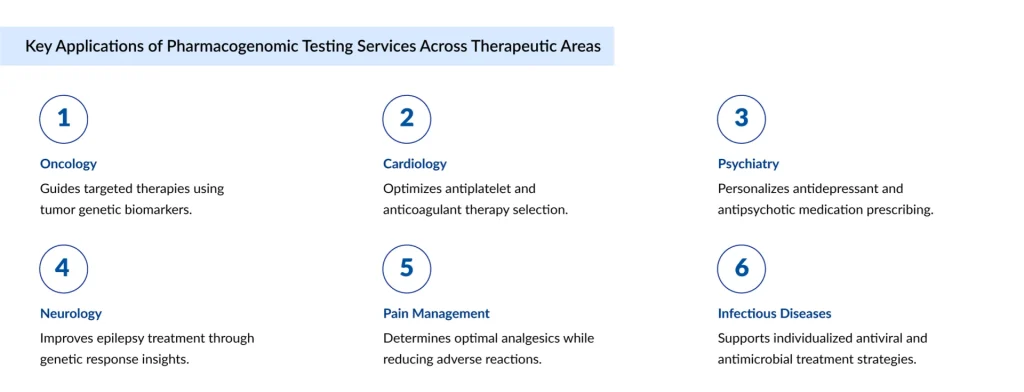
Pharmacogenomic testing services are transforming multiple therapeutic domains:
Oncology
Cancer care has emerged as the single largest application area for pharmacogenomic testing, and for good reason. Tumors and patients alike carry genetic variants that determine whether a targeted therapy will succeed or fail. Identifying mutations such as BRAF alterations in melanoma or HER2 amplification in breast cancer allows oncologists to match patients precisely to therapies designed for their tumor’s genetic profile, while also screening for variants like DPYD or UGT1A1 that predict severe toxicity to common chemotherapy agents. This precision reduces unnecessary exposure to ineffective or dangerous regimens and has measurably improved survival outcomes in genetically stratified patient groups.
Cardiology
In cardiovascular medicine, pharmacogenomic testing plays a critical role in guiding antiplatelet and anticoagulant therapy. Genetic variants in CYP2C19, for instance, influence how patients metabolize clopidogrel, directly affecting their risk of stent thrombosis after cardiac procedures. Similarly, warfarin dosing, long notorious for its narrow therapeutic window, has become significantly safer with genotype-guided algorithms that account for CYP2C9 and VKORC1 variants, helping clinicians avoid both under- and over-anticoagulation.
Psychiatry
Mental health treatment has historically relied on a slow, iterative process of trying one antidepressant or antipsychotic after another until something works. Pharmacogenomic testing is shortening this painful cycle by identifying how patients metabolize drugs through key liver enzymes such as CYP2D6 and CYP2C19, helping psychiatrists select medications and dosages more likely to be effective from the outset while minimizing side effects that often lead patients to abandon treatment altogether.
Neurology
In neurological care, pharmacogenomic insights are increasingly used to guide the selection of anti-epileptic drugs and to flag patients at risk of severe hypersensitivity reactions, most notably the link between the HLA-B*15:02 allele and life-threatening skin reactions to carbamazepine in certain populations. This has made pre-emptive genetic screening a near-standard practice in regions with a higher prevalence of the risk allele.
Others
Beyond these core areas, pharmacogenomic testing is expanding into pain management (optimizing opioid metabolism and reducing misuse risk), infectious disease (guiding antiretroviral and antimicrobial selection), transplant medicine (immunosuppressant dosing), and even preventive, wellness-oriented genetic panels offered through retail and telehealth platforms, signaling that the technology’s reach extends well beyond hospital walls.
AI Integration in Pharmacogenomic Testing Service
Artificial intelligence is fast becoming the engine that makes pharmacogenomic testing scalable and clinically actionable. Where traditional interpretation of genetic data required specialized genomic expertise and time-consuming manual review, machine learning algorithms can now process vast volumes of genotype-phenotype data to identify patterns, predict individual drug response, and flag clinically significant gene-drug interactions in seconds rather than days. AI-powered platforms are also accelerating the discovery of novel pharmacogenomic biomarkers, helping researchers uncover previously unrecognized genetic influences on drug metabolism. Perhaps most importantly, AI is enabling real-time clinical decision support, integrating genomic data directly into electronic health records so that physicians receive automatic alerts when a prescribed drug conflicts with a patient’s genetic profile. This fusion of genomics and computational intelligence is not just improving turnaround times; it is fundamentally reshaping how pharmacogenomic insights are delivered at the point of care, making precision prescribing a practical reality rather than an aspirational concept.
Artificial intelligence is also transforming pharmacogenomic testing by enabling the integration of multi-omics datasets, including genomics, transcriptomics, proteomics, and metabolomics, to generate a more comprehensive understanding of individual patient biology. Rather than evaluating genetic variants in isolation, advanced AI models can analyze complex biological interactions alongside clinical history, lifestyle factors, and real-world patient outcomes to produce increasingly accurate predictions of therapeutic efficacy and adverse drug reactions. This systems-level approach is expected to improve patient stratification in clinical trials, optimize drug selection, and support the development of highly personalized treatment strategies across oncology, cardiology, psychiatry, and other therapeutic areas where treatment response varies significantly among individuals.
Looking ahead, the convergence of artificial intelligence, cloud-based analytics, and expanding genomic databases is expected to accelerate the global adoption of pharmacogenomic testing services. As healthcare providers increasingly embrace precision medicine, AI-driven automation will help standardize test interpretation, reduce reporting variability, and make pharmacogenomic insights more accessible even in healthcare systems with limited genomics expertise. Continued advancements in explainable AI, regulatory frameworks, and data interoperability are likely to further strengthen clinician confidence and facilitate broader integration of pharmacogenomics into routine clinical practice. Together, these developments position AI not merely as a supporting technology but as a critical catalyst for the next generation of personalized healthcare, where treatment decisions are guided by predictive, data-driven insights tailored to each patient’s unique genetic profile.
Challenges in Pharmacogenomic Testing Service
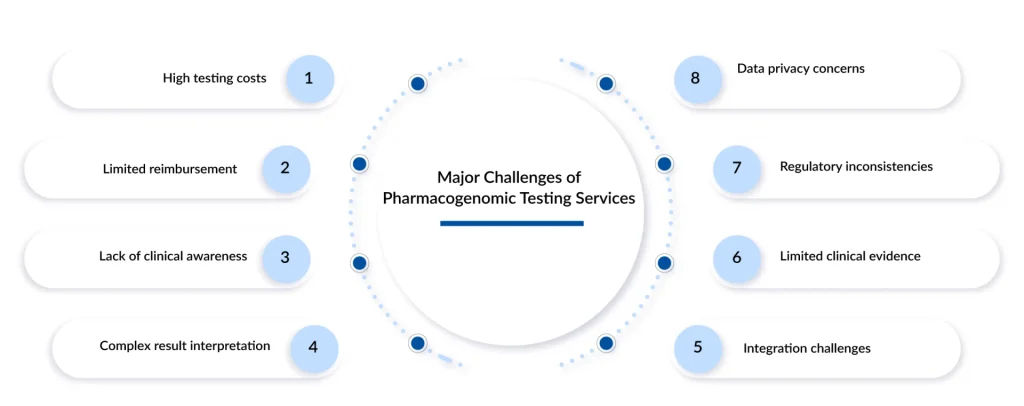
Despite its promise, pharmacogenomic testing faces a meaningful set of hurdles before it can achieve truly mainstream adoption. Cost remains a significant barrier; comprehensive panels and next-generation sequencing-based tests can be expensive, and reimbursement policies across insurers and health systems remain inconsistent, limiting equitable patient access. Interpretation of results is another persistent challenge; translating raw genetic data into clinically actionable guidance requires specialized expertise in genomics and pharmacology that many healthcare providers, particularly outside major academic centers, simply do not have readily available. Regulatory and ethical questions also loom large, spanning concerns around genetic privacy, informed consent, and the standardization of testing protocols across different laboratories and regions. Additionally, the lack of harmonized clinical guidelines across therapeutic areas can create inconsistency in how test results are applied to treatment decisions, while limited awareness among both patients and general practitioners continues to slow broader adoption outside specialty settings.
Future Outlook of Pharmacogenomic Testing Service
The trajectory for pharmacogenomic testing services points firmly upward. As per DelveInsight analysis, the global pharmacogenomic testing market was valued in the range of roughly USD 8.1 billion in 2025, growing at a compound annual growth rate of ~12%, pushing the market toward USD 22.4 billion by 2034. Oncology continues to be the dominant application segment, while North America holds the largest regional share thanks to established lab infrastructure and supportive regulatory frameworks, even as the Asia Pacific is widely expected to post the fastest growth on the back of expanding genomic research capacity and healthcare investment.
The competitive landscape features a mix of established diagnostics giants and specialized genomics players, including names such as Myriad Genetics, Inc., Genomind, LLC, OneOme, LLC, Quest Diagnostics Incorporated, Laboratory Corporation of America Holdings (Labcorp), Mayo Clinic Laboratories, ARUP Laboratories, Inc., Tempus AI, Inc., Invitae Corporation, Fulgent Genetics, Inc., Admera Health, LLC, Precision Medicine Group, LLC, Genelex Corporation (YouScript), Coriell Life Sciences, Sonic Healthcare Limited, Eurofins Scientific SE, Natera, Inc., Castle Biosciences, Inc., Personalis, Inc., Nebula Genomics, Inc., Color Health, Inc., Ambry Genetics Corporation, Blueprint Genetics Oy, CENTOGENE N.V., Molecular You Corporation, Genetic Technologies Limited, Dxcover Limited, Macrogen, Inc., BGI Genomics Co., Ltd., Novogene Co., Ltd., and others, alongside a growing wave of specialized precision-medicine and CI-adjacent companies developing multiplex panels and AI-augmented interpretation platforms.
Looking ahead, the convergence of falling sequencing costs, deeper EHR integration, expanding insurance coverage, and maturing AI-based interpretation tools is expected to push pharmacogenomic testing from a specialized diagnostic niche into a routine component of everyday prescribing, much like blood tests or imaging are today. For pharma and healthcare stakeholders, this signals not just a growing testing market, but a fundamental shift in how drugs will be developed, labeled, and prescribed in the years ahead.

Downloads
Article in PDF
Recent Articles
- Exploring the Impact of AI in Mental Health: How it is Going to Revolutionize Diagnosis and Treat...
- Eko’s AI-powered Sensora Platform; SOPHiA GENETICS and QIAGEN Announced Partnership; Co-Diagnosti...
- The Evolution and Impact of Electronic Health Records (EHRs) in Modern Healthcare
- How is Telepsychiatry Fulfilling the Evolving Mental Healthcare Demand?
- Companion Diagnostics in Healthcare: Powering the Era of Precision Medicine