Plasmid DNA Manufacturing: The Backbone of Next-Generation Therapies
May 20, 2026
Table of Contents
Plasmid DNA has moved from being a specialized laboratory tool to becoming one of the most strategic raw materials in modern biopharmaceutical manufacturing. In simple terms, a plasmid is a small, circular DNA molecule that exists separately from chromosomal DNA and can replicate independently inside microbial host cells such as bacteria. Because plasmids can be engineered to carry selected genetic sequences, they are widely used as delivery vehicles and templates in biotechnology, vaccine development, and advanced therapeutics.
Today, plasmid DNA is a foundational input for several high-growth healthcare segments, including gene therapy, cell therapy, DNA vaccines, mRNA manufacturing, genome editing platforms, and recombinant protein development. As the life sciences industry shifts toward precision medicine and curative therapies, plasmid DNA manufacturing has become an essential enabling capability rather than a supporting niche service.
Downloads
Click Here To Get the Article in PDF

Recent Articles
- The Regenerative Medicine Revolution: Opportunities Shaping the Next Decade
- BMS Sells NY Biologics Plant; FDA Approves Mitsubishi Tanabe’s Radicava, Love Pharma Acquires Mic...
- Molecular Modelling: The Silent Powerhouse Reshaping Drug Discovery, Development, and Competitive...
- New Osteoporosis Drug promises to rebuild Bone
- WASKYRA Wins FDA Approval, Marking a Historic Leap for Rare Disease Gene Therapies
According to DelveInsight, the plasmid DNA manufacturing market is expanding rapidly from USD 2.4 billion in 2025 to USD 10.8 billion by 2034 at a CAGR of ~18%, driven by technological innovation, strategic collaborations, and increasing commercial demand across therapeutic categories. The market is attracting significant investment as companies build new capacity, modernize production systems, and strengthen global supply networks.
Why Plasmid DNA Matters?
The importance of plasmid DNA lies in its versatility. In gene therapy, plasmids are frequently used to generate viral vectors such as AAV and lentiviral systems that transport corrective genes into patient cells. In cell therapy, plasmids are often used in ex vivo engineering workflows for CAR-T and other modified immune cell platforms. In mRNA production, plasmid DNA can serve as the template used for in vitro transcription.
From a business perspective, plasmid DNA has become a strategic bottleneck material. Without reliable access to high-quality plasmid DNA, many next-generation therapies cannot move from development into clinical or commercial production. This has elevated plasmid DNA manufacturers and CDMOs into critical positions within the global biotech value chain.
The increasing number of investigational gene therapies is also fueling demand. The U.S. Food and Drug Administration has repeatedly highlighted the growing pipeline of cell and gene therapy products, signaling sustained future manufacturing needs.
In addition, global public health organizations continue to emphasize the need for flexible vaccine technologies and resilient manufacturing ecosystems. The World Health Organization has supported expanded biologics and vaccine production capabilities worldwide, indirectly strengthening the case for nucleic-acid manufacturing infrastructure.
The Manufacturing Process: Step by Step
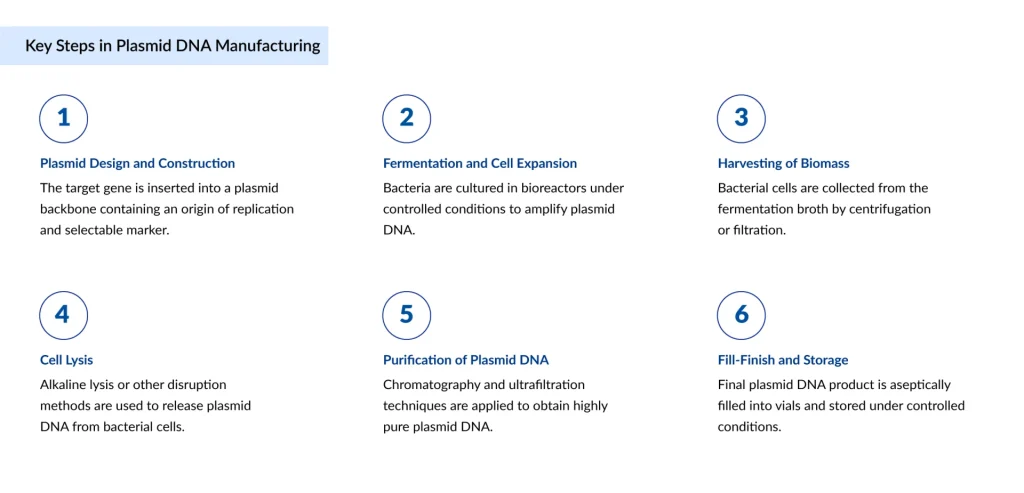
Producing plasmid DNA at research grade is relatively straightforward. Producing it at GMP-grade, clinical-quality, large commercial scale is highly complex. It requires process control, contamination management, reproducibility, regulatory compliance, and analytical precision. Below is the standard industrial workflow.
Plasmid Design and Cell Bank Preparation
Every successful manufacturing campaign begins with plasmid architecture. Scientists design the plasmid backbone to include:
- Origin of replication
- Selectable marker
- Therapeutic or functional gene insert
- Promoter and regulatory elements
- Stability-enhancing features
The design stage influences yield, structural stability, copy number, and downstream purification complexity. Poor construct design can reduce productivity or increase unwanted DNA forms such as multimers and nicked plasmids.
Once the construct is finalized, it is inserted into a bacterial host strain, commonly E. coli. A Master Cell Bank (MCB) and Working Cell Bank (WCB) are then created under controlled conditions. These banks ensure batch-to-batch consistency and traceability. From a regulatory standpoint, cell bank characterization is critical. Manufacturers typically confirm identity, plasmid retention, sterility, absence of adventitious agents, and genetic stability before production starts.
Fermentation (Upstream Processing)
Fermentation is where biomass and plasmid yield are generated. The engineered bacteria are grown in sterile bioreactors using nutrient-rich media under tightly controlled parameters such as:
- Temperature
- pH
- Dissolved oxygen
- Agitation rate
- Feed strategy
- Induction timing (if applicable)
The objective is not only to grow cells, but to maximize plasmid copy number while maintaining structural integrity. This stage has evolved substantially. Traditional batch systems are increasingly being replaced by fed-batch and intensified fermentation platforms that deliver higher cell densities and better productivity. Commercially, upstream efficiency is a major value driver. Even small improvements in fermentation yield can significantly lower the cost per gram of plasmid DNA, especially at large scale.
Cell Harvest
Once optimal growth is reached, the bacterial culture is harvested. This usually involves centrifugation, tangential flow filtration, or similar separation methods to isolate the cell biomass from spent media. Timing matters. If harvest occurs too late, cell viability may decline, and impurities can increase. If too early, the plasmid yield may be suboptimal. In modern facilities, automated harvest systems reduce operator variability and contamination risk while improving process reproducibility.
Cell Lysis and Clarification
After harvest, cells must be broken open to release intracellular plasmid DNA. This is typically achieved through alkaline lysis, a widely used method that disrupts cell membranes and denatures proteins and genomic DNA. Following lysis, clarification steps remove insoluble debris, precipitated contaminants, and large particulate matter. This may include:
- Depth filtration
- Centrifugation
- Microfiltration
This stage is highly sensitive because harsh handling can shear plasmid DNA or create unwanted topological changes. Operational excellence here directly impacts downstream purification load, making lysis and clarification one of the most underestimated stages in the manufacturing chain.
Purification and Polishing
Purification is where a crude plasmid extract becomes a pharmaceutical-grade product. It is also one of the most technically demanding and costly parts of production. Manufacturers must remove:
- Host cell proteins
- Endotoxins
- Residual RNA
- Genomic DNA
- Media residues
- Process chemicals
- Unwanted plasmid isoforms
Common technologies include chromatography, ultrafiltration/diafiltration, precipitation, and membrane-based purification systems. The FDA places strong emphasis on purity, identity, potency, and impurity control for biologic manufacturing systems, making robust purification analytics essential for regulatory readiness. Polishing steps are then used to refine concentration, buffer composition, and quality attributes. Final release testing often examines:
- Supercoiled percentage
- Residual endotoxin
- Residual host cell DNA
- Sterility
- Identity
- Concentration
- Stability
For many customers, purification capability is the deciding factor when selecting a CDMO partner.
Formulation, Sterile Filtration, and Fill-Finish
Once purified, plasmid DNA enters formulation. Buffers are selected to preserve molecular stability during storage, shipping, and use. The solution then passes through sterile filtration, usually using validated membrane systems. Finally, fill-finish operations place the material into sterile vials, bottles, or bags under aseptic conditions. This stage may appear routine, but it carries substantial compliance risk. Container closure integrity, particulate control, labeling accuracy, cold-chain logistics, and chain-of-custody systems are all vital. For commercial clients, fill-finish integration can shorten timelines and simplify vendor management.
Key Challenges in Scale-Up
Despite robust market demand, plasmid DNA manufacturing continues to face several structural challenges that can affect scalability, efficiency, and long-term profitability. One of the primary issues is yield and productivity constraints, as certain plasmid constructs naturally generate lower copy numbers or impose metabolic stress on host cells, making cost-effective scale-up difficult. Purity requirements also remain a major hurdle, since advanced therapies require exceptionally high-quality material, and removing endotoxins, host cell proteins, and other contaminants at a commercial scale without compromising yield is technically demanding.
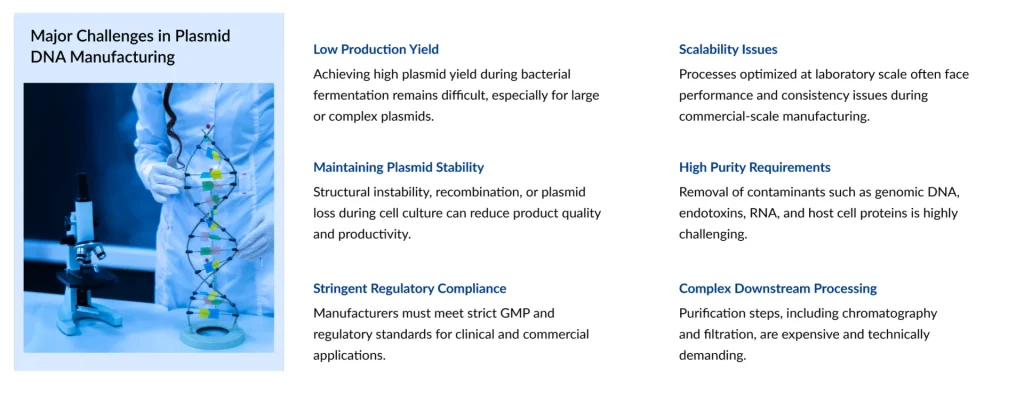
In addition, capacity shortages are emerging as gene therapy pipelines expand, leading to tighter availability of GMP manufacturing slots and driving long-term supply agreements as well as increased outsourcing to specialized partners. Regulatory complexity is another key concern, with evolving global standards requiring manufacturers to remain aligned with agencies such as the FDA and other international health authorities. Cost pressure is also intensifying, as many next-generation therapies already carry high treatment prices, prompting developers to seek lower cost-of-goods while maintaining stringent quality standards. Finally, supply chain resilience has become increasingly important, as critical raw materials, single-use technologies, and purification resins can create bottlenecks.
Future Market Outlook
The long-term outlook for plasmid DNA manufacturing remains highly favorable, supported by five major structural growth drivers that continue to reshape the biopharmaceutical landscape. First, the expansion of gene therapy pipelines across rare diseases, oncology, ophthalmology, and neurology is significantly increasing demand for plasmid DNA used in viral vector production.
Second, the commercialization of cell therapies such as CAR-T and other next-generation engineered cell platforms is creating a sustained need for scalable genetic engineering inputs. Third, the continued growth of DNA- and RNA-based platforms is broadening applications beyond infectious diseases, with vaccines and nucleic-acid therapeutics gaining traction across multiple therapeutic areas.
Fourth, outsourcing momentum is accelerating as biotech innovators increasingly partner with specialized contract development and manufacturing organizations (CDMOs) rather than investing heavily in internal production infrastructure.
Fifth, ongoing process innovation, including continuous manufacturing, automation, synthetic biology tools, and emerging non-bacterial DNA production technologies, is expected to improve efficiency and potentially transform future cost structures. According to DelveInsight, rising competitive activity through partnerships, acquisitions, facility expansions, and innovation-led strategies reflects a market steadily moving toward strategic maturity.
Conclusion
Plasmid DNA manufacturing is no longer a background technical service; it is the backbone of next-generation medicine. As healthcare transitions from symptom management to genetic correction and cellular reprogramming, plasmid DNA sits at the center of value creation.
Companies that can deliver scalable, compliant, high-purity plasmid DNA will play a decisive role in enabling tomorrow’s therapies. For investors, manufacturers, biotech developers, and policymakers alike, this is a market where scientific capability and commercial opportunity are increasingly inseparable.

Downloads
Article in PDF
Recent Articles
- Gene Therapy in Oncology: Innovation to Commercialization
- Nexalin Technology Secures Israeli Regulatory Clearance for Gen-2 SYNC 15 mA DIFS™ Neurostimulati...
- Nucleic Acids and Gene Therapies in Neuromuscular Disorders: Next-Generation Therapeutic Strategies
- Biogen buys Nightstar; Pacira acquires Myoscience; Horizon Pharma announces pricing; STAT with Sl...
- Break the Gene Therapy Barrier with DelveInsight’s Gene Therapy Reports