PROTACs: An Emerging Drug Modality with Multiple Oncology Approvals Expected in the Coming Years
Aug 03, 2026
Table of Contents
Summary
- PROTACs represent a new modality that eliminates target proteins by leveraging the cell’s ubiquitin-proteasome system.
- Vepdegestrant (VEPPANU) became the first FDA-approved PROTAC therapy in May 2026 for the treatment of ER+/HER2- ESR1-mutated breast cancer, representing a significant milestone for this emerging drug modality.
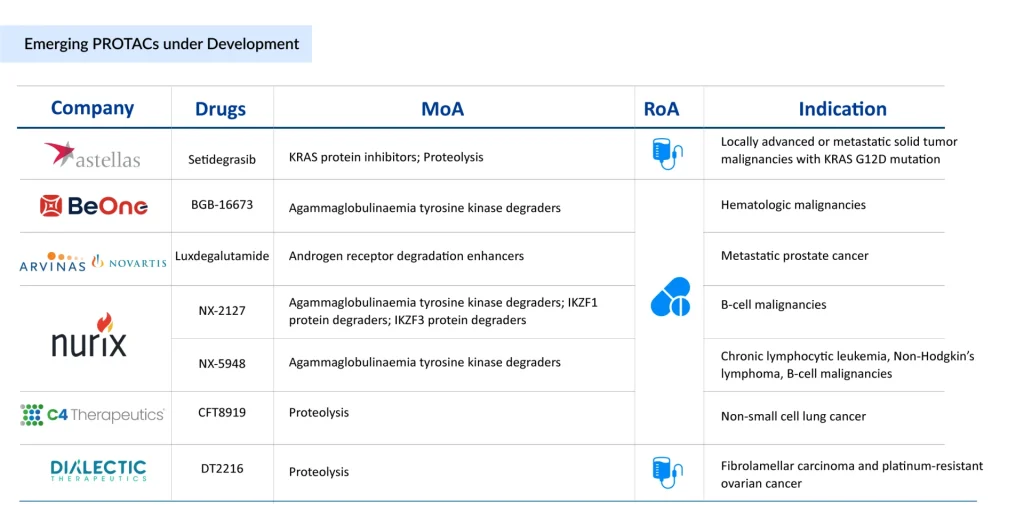
- Key assests set to challenge VEPPANU include Astellas Pharma’s Setidegrasib (ASP3082), BeOne Medicines’ BGB-16673, Arvinas and Novartis’ Luxdegalutamide, Nurix Therapeutics’ NX-2127 and NX-5948, C4 Therapeutics’ CFT8919, Dialectic Therapeutics’ DT2216, and others.
For decades, oncology drug development has followed one central doctrine: block the bad protein. Kinase inhibitors, receptor antagonists, and monoclonal antibodies all work by attaching to a disease-causing protein and silencing it. It’s a strategy that has transformed cancer care, but it’s not without its limits. Proteins mutate. They find workarounds. They become resistant. And some proteins, like transcription factors and scaffolding proteins, don’t even have a clean “off switch” to block in the first place.
Downloads
Click Here To Get the Article in PDF

Recent Articles
- Regeneron’s EVKEEZA Wins FDA Approval for HoFH in Children as Young as 1 Year; Eli Lilly’s INLURI...
- FDA Approves RINVOQ for Crohn’s Disease; FDA Approves Krystal Biotech’s Gene Therapy Vyjuve...
- Oral SERDs Defy the Odds Amid a History of Pipeline Setbacks
- How HR+/ HER2-Breast Cancer Emerging Drugs Will Transform The Market?
- Metastatic HER2-Positive Breast Cancer Landscape: What You Need to Know
Enter PROTACs: a revolutionary class of molecules that don’t just silence disease-driving proteins. They erase them. The acronym stands for Proteolysis Targeting Chimeras, and while the name sounds like something out of a science fiction novel, the biology behind it is elegantly grounded in the cell’s own natural machinery. PROTACs are rapidly transitioning from laboratory curiosity to clinical reality, with multiple pivotal trials ongoing and a string of oncology approvals anticipated in the near future.
Why PROTACs are a Genuine Paradigm Shift?
The excitement around PROTACs isn’t just about having a new chemical scaffold; it’s about a fundamentally different pharmacological logic. Four features set this modality apart from the small molecules and antibodies that have dominated oncology drug development for decades.
Targeting the “Undruggable” Proteome
An estimated 80% of disease-relevant proteins lack the deep, well-defined binding pockets that conventional small molecules need to act as effective inhibitors. Transcription factors, scaffolding proteins, and structurally disordered regulators have long been considered “undruggable” for this reason. PROTACs sidestep this constraint because they don’t need to inhibit a protein’s function at all; they only need to bind it somewhere, anywhere, with reasonable affinity, to drag it toward the degradation machinery. This has opened the door to targets like the androgen receptor splice variants, KRAS G12D, and mutant transcription factors that inhibitor-based chemistry had struggled to touch for years.
Overcoming Drug Resistance: A Major Clinical Advantage
Resistance to targeted therapy is one of oncology’s most persistent problems, and it very often arises from secondary mutations in the drug-binding site itself, the very pocket an inhibitor depends on. Because PROTACs frequently tolerate a broader footprint of binding-site mutations and destroy the entire protein rather than just blocking one function, they can remain active against many resistance mutations that render inhibitors useless. This is precisely the rationale behind luxdegalutamide’s activity against AR ligand-binding-domain mutations (L702H, H875Y, T878A) and CFT8919’s retained potency against EGFR L858R-T790M-C797S triple mutants that are resistant to approved EGFR inhibitors.
Event-Driven Pharmacology
Traditional inhibitors are “occupancy-driven”; their effect depends on continuously occupying the target, which usually means sustained, high systemic exposure to keep the pocket blocked. PROTACs are “event-driven”: once the ternary complex forms and ubiquitination occurs, the PROTAC dissociates and can go on to degrade additional protein copies. This catalytic, sub-stoichiometric mechanism means meaningful pharmacodynamic effects can potentially be achieved at lower and less frequent dosing, an advantage that shows up in the improved tolerability data reported across several second-generation degraders relative to their first-generation counterparts.
The Hook Effect: A Unique Challenge to Understand
Not every property of PROTACs is an advantage, and the “hook effect” is the clearest example of a challenge unique to this modality. Because PROTAC activity depends on forming a productive ternary complex between the target protein and the E3 ligase, very high drug concentrations can actually saturate the target and the ligase separately, preventing the three-way complex from forming and paradoxically reducing degradation efficiency at the top of the dose range. This bell-shaped dose-response curve complicates dose selection in ways conventional inhibitor pharmacology never has to contend with, and it is a central reason why PROTAC clinical pharmacology teams invest heavily in early, granular dose-ranging and paired pharmacodynamic biomarker sampling.
The Entry of First PROTAC: Arvinas and Pfizer’s VEPPANU
For nearly two decades, PROTACs lived almost entirely in journals, patent filings, and biotech pitch decks, a brilliant idea from Yale’s Craig Crews and Raymond Deshaies that chemists loved and regulators had never actually approved. That changed on May 1, 2026. On that day, the U.S. FDA cleared Arvinas and Pfizer’s vepdegestrant (VEPPANU) for ER+/HER2-, ESR1-mutated advanced or metastatic breast cancer, the first-ever FDA-approved Proteolysis Targeting Chimera. A technology platform that began as an academic curiosity in 2001 needed exactly 25 years to put a drug on a pharmacy shelf.
Vepdegestrant’s approval is the single most important event in the history of targeted protein degradation, and it’s worth understanding exactly why it worked. VEPPANU is an oral estrogen receptor (ER) degrader designed for a specific and stubborn problem: patients with ER+/HER2- breast cancer who develop ESR1 mutations after endocrine therapy. These mutations keep the estrogen receptor constitutively active even when estrogen itself is blocked, which is precisely the kind of resistance mechanism that inhibition alone struggles to overcome, but degradation handles well, because the receptor is gone entirely rather than just occupied.
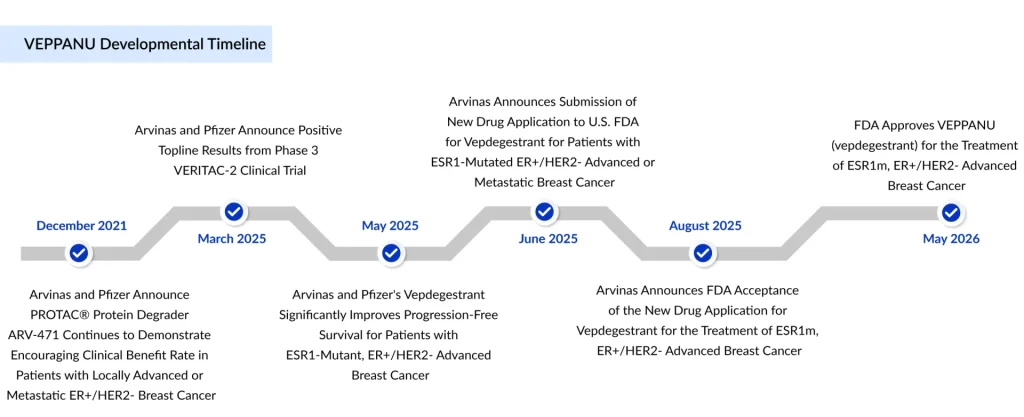
The pivotal Phase 3 VERITAC-2 trial randomized 624 adults with ER+/HER2- advanced or metastatic breast cancer, including 270 patients whose tumors carried an ESR1 mutation, to either vepdegestrant or fulvestrant. In the ESR1-mutated population, vepdegestrant cut the risk of progression or death by 43% relative to fulvestrant, with a median progression-free survival of 5.0 months versus 2.1 months. The FDA approved ahead of its own June 5, 2026, PDUFA date, alongside a companion diagnostic (Guardant360 CDx) to identify ESR1-mutated patients. Days later, the NCCN added vepdegestrant to its Breast Cancer treatment guidelines.
What makes this launch a genuine milestone for every PROTAC company, not just Arvinas, is the commercial architecture around it. Rather than build out their own salesforce, Arvinas and Pfizer opted to out-license global commercialization rights to Rigel Pharmaceuticals, a signal that even a first-of-kind, breakthrough approved PROTAC drugs can find a capital-efficient path to patients through partnership rather than a traditional big-pharma commercial buildout. For an industry that has spent a decade explaining PROTAC mechanism-of-action slides to skeptical investors, VEPPANU is proof: this modality can clear Phase 3, clear the FDA, and change practice guidelines within weeks. It stands, for now, as essentially the only entry on the very short list of FDA-approved PROTACs, and every other program described below is racing to join it.
The PROTAC Pipeline in Oncology
The numbers underline how fast this field has moved from bench to bedside. More than 40 molecules are currently PROTACs in clinical trials globally, spanning androgen receptor, estrogen receptor, BTK, IRAK4, and KRAS programs, and by PROTACs in clinical trials 2026, at least three degraders, Astellas Pharma’s Setidegrasib, Nurix Therapeutics’ NX-5948, and BeOne Medicines’ BGB-16673, have already reached Phase 3.
Below is a closer look at programs that illustrate just how far and how fast this pipeline has matured.
Astellas Pharma’s Setidegrasib (ASP3082): The First KRAS Degrader to Reach Phase 3
Setidegrasib (ASP3082) is arguably the most scientifically audacious program on this list: a first-in-class, intravenously administered protein degrader selectively targeting mutant KRAS G12D, a mutation found in roughly 40% of pancreatic ductal adenocarcinomas and about 5% of NSCLC cases, and one for which no targeted therapy had previously been approved. Published in the New England Journal of Medicine in March 2026, Phase 1 data showed encouraging antitumor activity and a manageable safety profile, with response rates of approximately 36% in KRAS G12D-mutant NSCLC and 24% in pancreatic cancer among heavily pretreated patients.
Astellas moved decisively on these results: in April 2026, the company dosed the first patient in a Phase 3 registrational trial evaluating setidegrasib combined with mFOLFIRINOX or NALIRIFOX as first-line treatment for KRAS G12D-mutated metastatic pancreatic cancer, and a second Phase 3 study comparing setidegrasib with docetaxel in previously treated KRAS G12D-mutant NSCLC began enrolling in April 2026 as well. Setidegrasib is the first protein degrader targeting a KRAS mutation to reach Phase 3, marking a significant late-stage milestone for PROTACs in clinical trials 2026 and reinforcing that degrader technology can tackle targets long considered intractable by conventional RAS inhibitor chemistry.
BeOne Medicines’ BGB-16673: An Oral BTK Degrader Engineered to Address BTK Inhibitor Resistance
BGB-16673 is an investigational, orally available Bruton tyrosine kinase (BTK)-targeting chimeric degradation activation compound (CDAC) designed to selectively degrade both wild-type and mutant forms of BTK, including resistance-associated variants that drive disease progression after BTK inhibitor therapy. The candidate is being evaluated across Phase II and Phase III clinical trials for relapsed/refractory chronic lymphocytic leukemia/small lymphocytic lymphoma (CLL/SLL), Waldenström macroglobulinemia (WM), and other B-cell malignancies.
Arvinas and Novartis’ Luxdegalutamide: The Next-Generation AR Degrader
Luxdegalutamide (ARV-766), out-licensed by Arvinas to Novartis in a transaction that closed in 2024, is a second-generation oral PROTAC androgen receptor (AR) degrader for metastatic castration-resistant and castration-sensitive prostate cancer. It has demonstrated the ability to degrade both wild-type AR and clinically important AR ligand-binding-domain mutations, including L702H, H875Y, and T878A, that commonly drive resistance to abiraterone and enzalutamide, while showing a materially improved tolerability profile compared with Arvinas’s first-generation AR degrader, bavdegalutamide (ARV-110). Novartis has since initiated Phase 2 combination trials pairing luxdegalutamide with androgen receptor pathway inhibitors in both mCRPC and metastatic hormone-sensitive prostate cancer settings, positioning the program to define recommended Phase 3 doses and setting up prostate cancer as the second major indication likely to see a PROTAC approved therapy.
Nurix Therapeutics’ NX-2127 and NX-5948: Dual-Mechanism and Brain-Penetrant BTK Degraders
Nurix’s BTK-degrader franchise is one of the more differentiated stories in the space. NX-2127 is an oral degrader that simultaneously eliminates BTK and the cereblon neosubstrates IKZF1 (Ikaros) and IKZF3 (Aiolos), combining targeted degradation with an immunomodulatory mechanism in a single molecule, and continues in Phase 1a/1b dose-escalation for relapsed/refractory B-cell malignancies, including DLBCL and mantle cell lymphoma. NX-5948, now carrying the INN bexobrutideg, is an orally bioavailable, brain-penetrant BTK degrader that has advanced furthest: it has received FDA Fast Track designation in CLL, generated encouraging updated efficacy and safety data from its Phase 1a/1b trial presented at EHA 2026, and, notably, has moved into DAYBreak CLL-201, a pivotal single-arm Phase 2 registrational study in relapsed/refractory CLL. Its brain penetrance also makes it one of the few degraders being explored in primary CNS lymphoma, a setting where covalent BTK inhibitors have limited utility.
C4 Therapeutics’ CFT8919: A Precision Degrader for EGFR L858R-Mutant Lung Cancer
CFT8919 is an orally bioavailable, allosteric BiDAC™ degrader engineered to selectively target EGFR harboring the oncogenic L858R mutation, the second most common EGFR driver mutation in non-small cell lung cancer, and one associated with historically less durable responses to EGFR tyrosine kinase inhibitors than exon 19 deletions. Its standout preclinical feature is retained potency against L858R-C797S, L858R-T790M, and L858R-T790M-C797S compound mutations that confer resistance to essentially all approved EGFR inhibitors, without inducing degradation of unrelated cereblon neosubstrates like SALL4 or GSPT1, an important selectivity signal for avoiding off-target toxicity. Developed in partnership with Betta Pharmaceuticals for Greater China (where roughly 40–50% of NSCLC diagnoses are EGFR-driven), CFT8919 is currently progressing through Phase 1 dose escalation, with data expected to shape its development path in the U.S., EU, and rest-of-world markets where C4 Therapeutics retains rights.
Dialectic Therapeutics’ DT2216: A First-in-Class Selective BCL-XL Degrader Built on the APTaD™ Platform
Dialectic’s lead candidate, DT2216, is a first-in-class Antiapoptotic Protein Targeted Degradation (APTaD™) therapy designed to selectively degrade BCL-XL in cancer cells. By eliminating this antiapoptotic protein, DT2216 promotes programmed cell death (apoptosis) and enhances tumor sensitivity to chemotherapy. The investigational therapy is currently being evaluated in Phase 1/2 clinical trials for Fibrolamellar Carcinoma (FLC) and Platinum-Resistant Ovarian Cancer (PROC).
Preclinical research has demonstrated that DT2216 exhibits potent antitumor activity across a broad range of hematologic malignancies and solid tumors, both as a standalone treatment and in combination with chemotherapy. The studies also suggest that tumors are less likely to develop resistance to DT2216 compared with conventional chemotherapeutic agents. Notably, DT2216 has shown a favorable safety profile with minimal toxicity, including limited effects on platelets.
A note on adjacent, earlier-stage degrader targets: Beyond these five headline programs, two areas frequently searched by pipeline trackers remain firmly in the discovery-to-preclinical stage rather than the clinic. HSP90, a molecular chaperone that stabilizes numerous oncoproteins, has attracted substantial academic and early biotech interest as a PROTAC target, since HSP90 inhibitors alone have historically been limited by hepatotoxicity and resistance; however, most published HSP90 degrader work (including CRBN-recruiting and geldanamycin-based degraders) currently sits in cell-based and animal-model studies, and no HSP90 PROTAC company clinical program has yet advanced to human dosing. Similarly, mutant p53, the most frequently mutated gene across human cancers and long considered undruggable due to its role as a nuclear transcription factor lacking a conventional binding pocket, has seen promising proof-of-concept work using aptamer-based and small-molecule PROTAC binders against hotspot mutants like p53-R175H and p53-R273H. But as of mid-2026, no protac mutant p53 company pipeline has yet produced a clinical-stage candidate; this remains one of the field’s most closely watched next frontiers precisely because of how difficult a target mutant p53 has been for every prior drug modality.
The Competitive Moat: What Makes a PROTAC Pipeline Defensible?
With one PROTAC now approved and several more nearing pivotal readouts, the strategic question for investors, biopharma business development teams, and market analysts is shifting from “does this modality work?” to “which PROTAC company has a truly defensible pipeline?” Several structural factors are emerging as genuine competitive moats rather than superficial differentiators.
Intellectual property depth around E3 ligase recruitment and linker chemistry matters enormously, because the pool of well-validated, drug-like E3 ligase ligands (chiefly cereblon and, to a lesser extent, VHL-based warheads) is still relatively narrow. Companies with proprietary, freedom-to-operate ligase-recruiter chemistry and dense linker-optimization patent estates, such as Arvinas’s DiscoveryEngine, C4 Therapeutics’ TORPEDO/Degronimid platforms, and Nurix’s DELigase platform, among them, are harder to design around than companies relying on more generic, off-the-shelf degrader chemistry.
Oral bioavailability expertise is a second differentiator that is easy to underestimate. PROTACs are inherently large, often exceeding traditional Lipinski “rule of five” molecular weight and polarity thresholds, which historically made oral dosing difficult. Vepdegestrant, luxdegalutamide, NX-2127, and NX-5948 are all orally dosed, a genuine engineering achievement, while setidegrasib remains intravenous, illustrating that oral formulation know-how is not evenly distributed even among leading protac companies and is a real point of clinical and commercial differentiation.
Clinical pharmacology and biomarker infrastructure built specifically for event-driven pharmacology is a third moat. Because of phenomena like the hook effect and the need to directly measure target degradation (not just target occupancy), companies need paired tumor biopsy programs, validated degradation assays, and sophisticated PK/PD modeling capabilities baked into early trial design, capabilities that take years to build and are not easily replicated by newer entrants running conventional inhibitor-style trials.
Finally, manufacturing and CMC complexity, evident in Nurix’s own experience with a partial clinical hold on NX-2127 tied to manufacturing-related issues before enrollment resumed with a newly manufactured, chirally controlled drug product, underscores that consistent, high-purity, stereochemically controlled synthesis of large bifunctional molecules at clinical and eventually commercial scale is itself a nontrivial barrier to entry.
PROTACs vs. Molecular Glues: Understanding the Nuance
No discussion of this pipeline is complete without addressing the modality most often confused with PROTACs: molecular glues. Both fall under the umbrella of targeted protein degradation and both hijack the ubiquitin-proteasome system, but the underlying chemistry and the resulting drug-like properties differ in important ways.
A PROTAC is explicitly bifunctional: a target-binding ligand and an E3-ligase-binding ligand are joined by a synthetic linker, and each piece can, in principle, be independently optimized, swapped, or re-engineered against a new target or a new ligase. This modularity is a major reason the PROTAC market has scaled as quickly as it has; the same E3-ligase-recruiting chemistry (cereblon-based warheads, for instance) can be reused across many different target-binding “warheads,” accelerating pipeline expansion once a platform is validated. The tradeoff is molecular size: PROTACs are typically large, bifunctional molecules, which historically complicated oral bioavailability, cell permeability, and manufacturing, challenges the field has only recently learned to engineer around.
Molecular glues, by contrast, are typically smaller, monovalent small molecules that bind at or near the natural interface between a target protein and an E3 ligase, stabilizing an interaction that either doesn’t otherwise occur or occurs too weakly to trigger degradation on its own, much as thalidomide-class immunomodulatory drugs glue IKZF1/3 to cereblon. Because there’s no linker to design, molecular glues can be more drug-like and easier to dose orally, but discovering a glue for a specific target-ligase pair is far less rational and modular than PROTAC design; it has historically depended more on serendipity or intensive screening than on structure-based engineering, though computational and screening advances are steadily closing that gap.
In practice, the two approaches are complementary rather than competitive. Many leading TPD-focused biotechs, including several of the PROTAC companies profiled above, run parallel molecular glue and PROTAC discovery efforts, choosing whichever chemistry best fits a given target’s structural biology, and analysts covering the proteolysis targeting chimera (PROTAC) market increasingly track both modalities together as part of the same broader degrader ecosystem.
The Future Horizon: The Dawn of the Degrader Era in Oncology
Vepdegestrant’s approval will be remembered as the moment PROTACs graduated from concept to clinic-validated modality, but it is unlikely to remain the only FDA-approved PROTAC for long. With and setidegrasib, NX-5948, and BGB-16673 in Phase 3, and luxdegalutamide in a pivotal registrational Phase 2 study, the industry is realistically positioned for two, three, or more additional degrader approvals within the next several years, a pace that would have seemed implausible even five years ago.
Market forecasts reflect this inflection. Sadaf Javed, Functional Head of Forecasting & Analytics at DelveInsight, now projects the global proteolysis targeting chimera (PROTAC) market to expand at a compound annual growth rate well into the double digits over the coming decade, with oncology continuing to account for the majority of active pipeline candidates given the field’s traditional strength in addressing drug resistance and previously undruggable oncology targets.
Looking beyond the current wave of PROTAC approvals and pivotal trials, three trends are likely to define the next phase of the degrader era. First, expect continued expansion into genuinely novel, previously intractable targets, KRAS mutant isoforms beyond G12D, transcription factors, and, eventually, mutant p53, as more PROTAC mutant p53 company programs and HSP90-targeted efforts mature from academic proof-of-concept toward IND-ready candidates. Second, expect the modality to broaden beyond oncology into autoimmune and inflammatory disease, neurodegeneration, and infectious disease, following the same induced-proximity logic that has proven itself in cancer. Third, expect the competitive landscape among protac companies to consolidate around platforms that have solved the hardest engineering problems, oral bioavailability, ligand diversity beyond cereblon, and manufacturing scalability, since these capabilities, more than any single molecule, will determine who leads the next decade of targeted protein degradation.

Downloads
Article in PDF
Recent Articles
- Roche Reveals Update from Phase III persevERA Study Targeting ER-Positive Advanced Breast Cancer;...
- Pancreatic Cancer Treatment to Stride Beyond Chemotherapy
- Bruton’s Tyrosine Kinase (BTK) Inhibitors An Emerging Therapeutic Target
- Bayer’s AskBio Initiates Phase II GenePHIT Trial; FDA Approves Merck’s KEYTRUDA Plus Chemoradioth...
- The Rise of Molecular Glues: Transforming Protein-Protein Interactions into Therapeutic Opportuni...