T-Cell Malignancies: The Evolving Treatment Landscape and the Race for Market Leadership
Aug 21, 2026
Table of Contents
Summary
- T-cell malignancies, including Peripheral T-cell Lymphomas (PTCL) and cutaneous entities such as Cutaneous T-cell Lymphoma (CTCL), comprise a diverse and often aggressive group of cancers that are generally associated with poorer clinical outcomes compared with B-cell malignancies.
- The current CTCL treatment landscape includes approved therapies such as VALCHLOR, TARGRETIN, ADCETRIS, POTELIGEO, and LYMPHIR, among others.
- For PTCL, the approved treatment landscape includes brentuximab vedotin (ADCETRIS; Takeda) for CD30-positive disease, romidepsin (ISTODAX; Bristol Myers Squibb), belinostat (BELEODAQ; Acrotech BioPharma), mogamulizumab (POTELIGEO; Kyowa Kirin), crizotinib (XALKORI; Pfizer), and valemetostat tosilate (EZHARMIA; Daiichi Sankyo) for selected subtypes.
- The treatment landscape for T-cell malignancies is poised to evolve significantly in the coming years, driven by a growing pipeline of emerging therapies. Promising candidates include HyBryte (Synthetic Hypericin/SGX301) (Soligenix and Sterling Pharma Solutions), PTX-100 (Prescient Therapeutics), lacutamab (IPH4102) (Innate Pharma), linperlisib (YY-20394/Linprixetine) (Shanghai Yingli Pharmaceutical), duvelisib (COPIKTRA) (Secura Bio), and several other novel therapies.
For decades, T-cell malignancies sat in the shadows of the broader lymphoma conversation, often lumped into generic non-Hodgkin lymphoma statistics and treated with one-size-fits-all chemotherapy regimens borrowed from other blood cancers. That era is ending. Cutaneous T-cell lymphoma (CTCL) and peripheral T-cell lymphoma (PTCL) are now recognized as biologically distinct, clinically demanding diseases, and the industry response has shifted accordingly: better diagnostics, biologic-driven therapies, and a fast-filling clinical pipeline are reshaping how these cancers are treated and commercialized. As diagnostic accuracy improves and incidence climbs across the seven major markets, the ctcl market and the peripheral t-cell lymphoma market are entering a genuinely competitive phase, one where clinical differentiation, not just approval, will decide who leads.
Downloads
Click Here To Get the Article in PDF

Recent Articles
- CAR T-Cell Therapies in Non-Hodgkin’s Lymphoma Treatment: A Revolutionary Approach
- Novo Nordisk’s Concizumab for Hemophilia; AbbVie Ends its Alliance with Alector; ADC Therapeutics...
- The Changing Landscape of Multiple Myeloma Therapies Market
- Insights Into The Cutaneous T-cell Lymphoma Treatment Market
- Nxera Pharma Confirms Positive Phase 3 Findings for Daridorexant in South Korea; AstraZeneca Stre...
The Growing Patient Burden Behind CTCL and PTCL
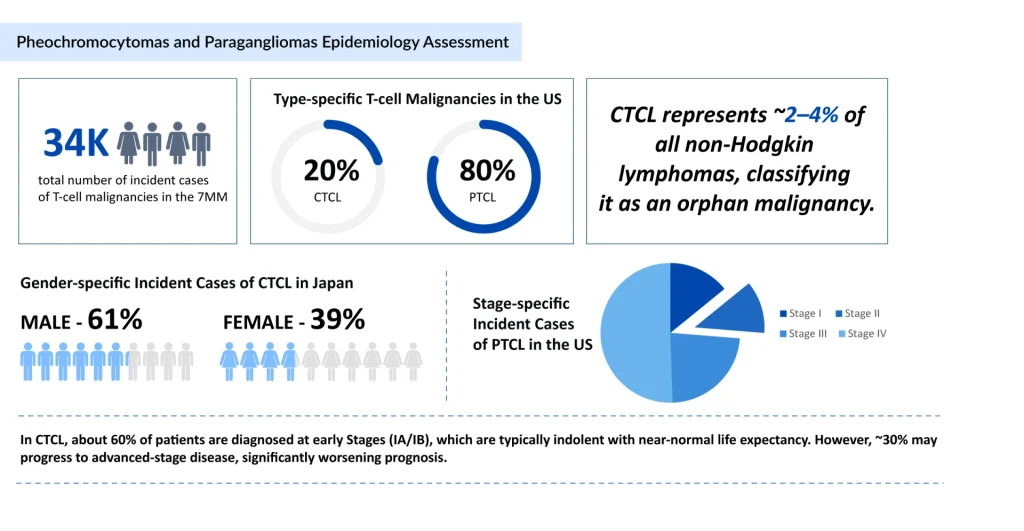
Understanding why the cutaneous T-cell lymphoma treatment market and PTCL space are drawing so much attention starts with the epidemiology, and the numbers tell a story of a quietly expanding disease burden. According to DelveInsight estimates, the total number of incident cases of T-cell malignancies across the 7MM was approximately 15,500 in 2025. In the US, PTCL represented the largest share among type-specific T-cell malignancies, with approximately 12,330 incident cases in 2025. In comparison, CTCL accounted for a smaller proportion, with around 3,100 cases during the same year.
CTCL is a rare hematologic malignancy, representing approximately 2–4% of all non-Hodgkin lymphomas and therefore falling within the orphan disease category. Mycosis fungoides is the most prevalent CTCL subtype, comprising nearly 55–65% of cases.
In CTCL, approximately 60% of patients are diagnosed with early-stage disease (IA/IB), which is generally indolent and associated with a near-normal life expectancy. Nevertheless, around 30% of patients may eventually progress to advanced-stage disease, resulting in a substantially poorer prognosis. CTCL primarily affects older adults, with the median age at diagnosis generally ranging from 55 to 65 years. Notably, approximately 60–70% of patients are diagnosed with early-stage disease.
PTCL represents approximately 10–15% of non-Hodgkin lymphoma cases in the US, 6.5% in Europe, and 25% in Japan. Its incidence varies across geographies and disease subtypes, with PTCL-NOS, AITL, and ALCL among the most frequently observed forms. Despite advances in treatment, patients often experience an unfavorable prognosis, high rates of relapse, and a lack of durable therapeutic options, placing a considerable clinical and quality-of-life burden on patients.
Even so, both CTCL and PTCL still lack reliable biomarkers to predict disease progression or long-term outcomes, a gap that continues to complicate treatment planning and contributes meaningfully to the overall patient and clinical burden, and one that plenty of companies chasing CTCL clinical trials and PTCL clinical trials are now racing to close.
The T-Cell Malignancies Treatment Landscape: Why It’s Changing Now
For years, T-cell lymphomas were managed with therapies designed for other cancers: skin-directed approaches for CTCL, and generic cytotoxic chemotherapy for PTCL. Both diseases remained largely incurable, with treatment goals centered on symptom control and prolonging survival rather than durable remission. That’s now shifting, and understanding why matters for anyone tracking the ctcl treatment market or peripheral t-cell lymphoma treatment market.
The core driver of change is biology. As researchers have gained a deeper understanding of immune dysregulation and the specific molecular pathways driving T-cell malignancies, treatment has shifted from broad cytotoxic approaches to mechanism-based, targeted therapies. This shift shows up clearly in how each disease is now staged and treated.
CTCL treatment is stage-dependent, with early-stage disease primarily managed through skin-directed therapies such as topical corticosteroids, retinoids, and phototherapy, which can effectively control symptoms and delay disease progression for years. As the disease advances or becomes refractory to skin-directed approaches, systemic therapies, including oral retinoids, interferons, extracorporeal photopheresis, and histone deacetylase (HDAC) inhibitors, are increasingly used. A more significant shift in the treatment landscape has been the emergence of targeted biologics, with approved CTCL treatment options including mogamulizumab (POTELIGEO), the first CCR4-targeting biologic approved in the US, supported by findings from the Phase III MAVORIC trial, which received FDA Priority Review and Breakthrough Therapy Designation.
Brentuximab vedotin (ADCETRIS), a CD30-directed antibody-drug conjugate, represents another important advancement, particularly for CD30-positive disease, and also plays a key role in the frontline treatment of peripheral T-cell lymphoma (PTCL). For early-stage CTCL, mechlorethamine (VALCHLOR/LEDAGA), a topical alkylating agent, remains an established treatment option. Additional approved therapies include crizotinib (XALKORI) and tucidinostat (HIYASTA), although their availability varies across the 7MM.
PTCL treatment for the frontline setting remains anchored to anthracycline-based chemotherapy regimens such as CHOP or CHOP-like combinations, often consolidated with stem cell transplantation in eligible patients. But a substantial share of patients relapse or become refractory to this approach, exposing the real limits of conventional chemotherapy. For relapsed or refractory PTCL, options now span HDAC inhibitors, antifolates such as pralatrexate (FOLOTYN), monoclonal antibodies, and other targeted agents, with brentuximab vedotin’s incorporation into frontline CD30-positive PTCL therapy standing out as one of the field’s few genuine advances in years. Emerging interest in JAK/STAT and PI3K pathway inhibition points to where the next wave of differentiation is likely to come from.
Despite this progress, the honest read on the current landscape is sobering: no first-line therapies are currently approved specifically for early-stage CTCL, and PTCL outcomes remain poor overall. That gap is precisely what’s fueling the current wave of investment and drug development.
Emerging Therapies Closing the Gaps
In recent years, the treatment landscape has increasingly incorporated antibody-drug conjugates (ADCs), monoclonal antibodies, and small-molecule targeted therapies, with agents such as duvelisib and crizotinib designed to disrupt key oncogenic signaling pathways that regulate T-cell proliferation and survival. This growing diversity of therapeutic mechanisms highlights the broader transition toward biology-driven treatment approaches, particularly for relapsed or refractory disease, where significant unmet medical needs persist.
At the same time, the T-cell malignancies clinical pipeline is advancing with next-generation immunotherapies and targeted agents, including checkpoint inhibitors, anti-KIR and anti-CD47 therapies, and epigenetic modulators, many of which are currently being investigated in early- and mid-stage clinical development. Researchers are also evaluating combination approaches, such as pairing ADCs with checkpoint inhibitors, to improve the durability of responses and address treatment resistance. Together, these developments underscore the growing emphasis on rationally designed combination regimens that could shape future treatment algorithms.
Several T-cell malignancy therapies for both CTCL and PTCL treatment currently in development include HyBryte (Synthetic Hypericin/SGX301), being developed by Soligenix and Sterling Pharma Solutions; PTX-100 from Prescient Therapeutics; Lacutamab (IPH4102) from Innate Pharma; Linperlisib (YY-20394/Linprixetine) from Shanghai Yingli Pharmaceutical; Duvelisib (COPIKTRA) from Secura Bio; Golidocitinib (AZD4205/DZD4205) from Dizal Pharmaceuticals; Sugemalimab (CEJEMLY/CS1001) from CStone Pharmaceuticals; Tolinapant (ASTX660), developed by Otsuka Pharmaceutical and Astex Pharmaceuticals; AUTO4 from Autolus Therapeutics; Soquelitinib (CPI-818) from Corvus Pharmaceuticals; Tambiciclib (GFH009/SLS009) from Genfleet Therapeutics and Sellas Life Sciences; and Bosmolisib (BR101801) from Boryung Pharmaceutical, among other emerging candidates.
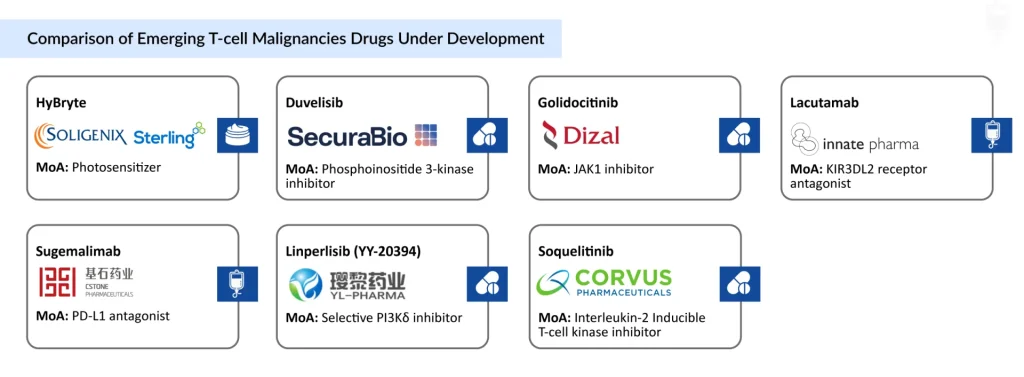
Aparna Thakur, Project Manager of Forecasting & Analytics at DelveInsight, said that emerging therapies, including Lacutamab (IPH4102), PTX-100, and AUTO4, are expected to experience moderate uptake as they progress through clinical development. Their adoption is likely to build gradually as additional clinical evidence becomes available and physicians gain greater confidence in their efficacy and safety profiles. In contrast, therapies such as Linperlisib are projected to demonstrate slow-to-moderate uptake. Their market adoption will largely depend on their ability to establish a differentiated position against existing treatment options, supported by compelling long-term efficacy and safety data.
The expected launch of these emerging CTCL therapies and PTCL drugs is set to significantly reshape the therapeutic landscape in the coming years. As these innovative treatments advance through development and secure regulatory approvals, they are likely to introduce new standards of care while driving further opportunities for therapeutic innovation and market growth.
The Future Outlook of T-Cell Malignancies Treatment Space
The commercial story here is one of a niche but structurally growing market. Currently, the market size for T-cell malignancies was found to be USD 1.8 billion in the 7MM in 2025, a figure expected to grow at a CAGR of 5.2%, as per DelveInsight. On a broader scale, the US represents roughly 69% of total market share across T-cell malignancies in 2025, underscoring that this remains a genuinely global commercial opportunity rather than a single-market story, even as it stays a comparatively small, specialty-driven segment overall. Several forces will shape the trajectory of the cutaneous t-cell lymphoma medication market and the broader PTCL space through 2036. According to DelveInsight’s analysis, the PTCL market across the seven major markets was valued at approximately USD 800 million in 2025. The market is projected to expand significantly, reaching around USD 1.6 billion by 2036.
Rising incidence, driven by both improving diagnostic capture and true disease-related increases, will steadily expand the treatable population. A maturing late-stage pipeline, spanning Phase III programs in JAK1 inhibition, PI3K inhibition, and novel topical photosensitizers, is positioned to introduce genuine first-line options where none currently exist, particularly for early-stage CTCL. And as biologics and targeted therapies continue displacing older chemotherapy-based regimens, average treatment costs and market value per patient are likely to climb, even as the addressable population itself stays modest by broader oncology standards.
For any CTCL company or PTCL-focused developer, the calculus is increasingly about being first, or best, in a well-defined biological niche rather than chasing broad-market scale. Winning commercial position in this space will depend on differentiated mechanisms of action, credible late-stage clinical data, and thoughtful market access and pricing strategy, particularly given the reimbursement complexity already emerging across major markets. With regulatory bodies actively supporting orphan and breakthrough designations, and pipeline diversity continuing to grow across both CTCL and PTCL, the treatment landscape for T-cell malignancies is set to look meaningfully different by 2036, with real implications for patients who have waited a long time for better options, and for the companies positioning themselves to deliver them.

Downloads
Article in PDF
Recent Articles
- Nxera Pharma Confirms Positive Phase 3 Findings for Daridorexant in South Korea; AstraZeneca Stre...
- Most Promising Oncological Drugs Expected to Launch in 2022
- Amgen to Acquire Horizon Therapeutics; Sanofi and Teva Announce Collaboration; Boehringer Obesity...
- The Next Wave in Peripheral T-Cell Lymphoma Treatment: 4 Late-Stage Drugs Making Their Mark
- CAR-T cell therapy market for Non-Hodgkin lymphoma: Future prospects, and untapped opportunities