Top 8 Extrapulmonary NEC Drugs That Could End Chemotherapy’s Decades-Long Grip
Nov 27, 2026
Table of Contents
Summary
- EP-NEC still has no approved therapy, and platinum chemotherapy offers only short-lived benefit.
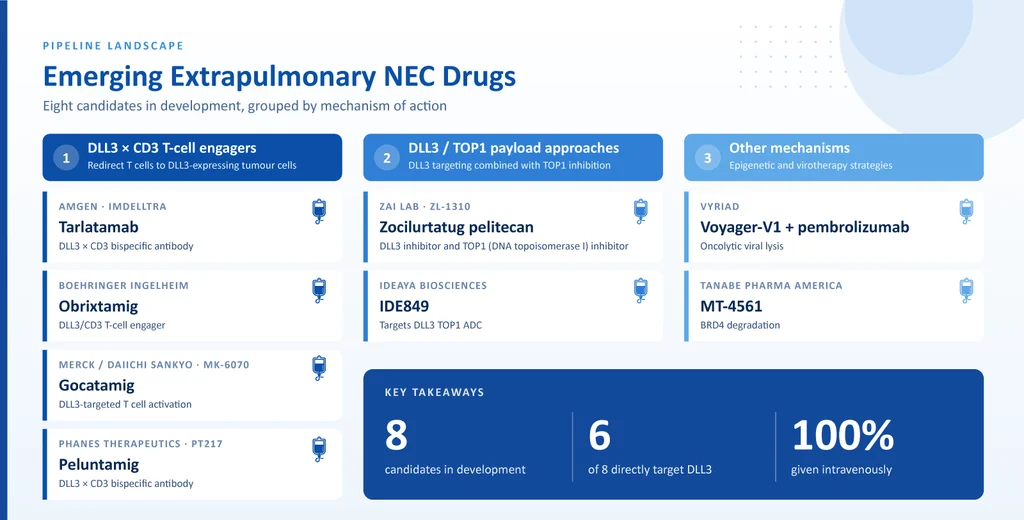
- The pipeline is now led by DLL3-targeted drugs including Zocilurtatug pelitecan (ZL-1310; Zai Lab), Obrixtamig (Boehringer Ingelheim), Tarlatamab (IMDELLTRA; Amgen), Gocatamig (MK-6070; Merck/Daiichi Sankyo), Peluntamig (PT217; Phanes Therapeutics), and IDE849 (IDEAYA Biosciences).
- Apart from DLL3, Oncolytic viruses (Voyager-V1 + pembrolizumab; Vyriad) and BRD4 degradation like MT-4561 (Tanabe Pharma America) give the field a backup plan.
- Obrixtamig is the only drug in a first-line Phase 3 trial, with a 77.3% response rate in DAREON-7 (a Phase 1b study).
For decades, extrapulmonary neuroendocrine carcinoma (EP-NEC) has played the same sad rerun. Platinum-based chemotherapy is still the front door to neuroendocrine carcinoma treatment, with irinotecan plus cisplatin or carboplatin, and etoposide plus cisplatin or carboplatin, doing most of the heavy lifting. These regimens can spark an early response, but the win rarely lasts. For most patients, the disease finds its way back within months. And when it does, the options thin out fast. Amrubicin is one of the most commonly used second-line choices, while everolimus, FOLFOX, S-1, and other fluoropyrimidine-based regimens may enter the picture for selected patients, depending on prior treatment, disease features, and clinical judgment. Here is the uncomfortable truth: no therapy is specifically approved for first- or second-line EP-NEC.
Downloads
Click Here To Get the Article in PDF

Top 8 Drugs Rewriting the EP-NEC Treatment Playbook
Management still leans on cytotoxic chemotherapy that delivers modest, short-lived benefit, while platinum resistance builds quickly and outcomes worsen with every subsequent line. That is exactly why the pipeline matters. Today’s EP-NEC landscape is led by DLL3-targeted therapies, including Zocilurtatug pelitecan (ZL-1310; Zai Lab), Obrixtamig (Boehringer Ingelheim), Tarlatamab (IMDELLTRA; Amgen), Gocatamig (MK-6070; Merck/Daiichi Sankyo), Peluntamig (PT217; Phanes Therapeutics), and IDE849 (IDEAYA Biosciences). Of these, obrixtamig is the only candidate currently being tested in the first-line setting, while the others mainly go after relapsed or platinum-refractory disease, where the unmet need is greatest. Apart from these, the other EP-NEC drugs under development include Voyager-V1 + pembrolizumab (Vyriad), MT-4561 (Tanabe Pharma America), and others.
So which programs will get a first-mover advantage in the extrapulmonary neuroendocrine carcinoma treatment landscape? Here are the top 8 emerging EP-NEC drugs to watch.
Zocilurtatug Pelitecan (ZL-1310): Zai Lab’s Fast-Tracked DLL3 ADC
If one drug is setting the pace in relapsed EP-NEC, it may be zocilurtatug pelitecan, or “zoci” for short. This antibody-drug conjugate pairs an anti-DLL3 antibody with a topoisomerase 1 inhibitor payload, delivering chemotherapy straight to DLL3-expressing tumor cells. At the 2026 AACR Annual Meeting, Zai Lab shared results from the Phase 1b/2 ZL-1310-002 trial (NCT06885281) in previously treated epNEC. Among 34 response-evaluable patients, the objective response rate (ORR) reached 38.2%, and the disease control rate hit 55.9%. The gastroenteropancreatic NEC cohort recorded a 33.3% ORR, while other NEC subtypes and DLL3-expressing solid tumors reached 43.8%. Dosing was 1.6 mg/kg every three weeks, and the only grade 3 or higher treatment-related adverse event seen in more than one patient was reduced neutrophil count.
In May 2026, the FDA granted zoci Fast Track designation for epNEC following progression on standard first-line therapy, marking its second Fast Track designation after the earlier recognition in extensive-stage SCLC. Subsequently, data presented at the NANETS Symposium in November 2026 demonstrated a 40.0% confirmed response rate, with responses observed even in tumors exhibiting low or no DLL3 expression, highlighting a notable therapeutic signal in a biomarker-driven treatment landscape. Looking ahead, Zai Lab is engaging with regulators to establish a registrational development strategy and aims to initiate registration-enabling studies across second-line SCLC, first-line SCLC, and epNEC by the end of 2026. Additionally, the company has announced a collaboration to evaluate zoci in combination with a bispecific T-cell engager.
Obrixtamig: Boehringer Ingelheim’s First-Line Game Changer
Every EP-NEC pipeline conversation eventually circles back to obrixtamig (BI 764532), and for good reason. This DLL3/CD3 IgG-like T-cell engager is the only agent in the lineup being pushed into first-line treatment. In the Phase 1 dose-escalation study published in the Journal of Clinical Oncology in 2025, patients dosed at 90 μg/kg or above showed confirmed ORRs of 17% in SCLC, 20% in extrapulmonary NEC, and 40% in large cell NEC of the lung. The real excitement, though, comes from combining it with chemotherapy up front. The Phase 1b DAREON-7 trial paired obrixtamig with platinum and etoposide in untreated DLL3-positive NEC. Early results in February 2026 showed a 72% response rate. At the 2026 NANETS Symposium, an updated analysis reported a 77.3% response rate in first-line DLL3-positive epNEC, rising to 87.5% in DLL3-high tumors, with a manageable safety profile and responses seen regardless of DLL3 expression level.
Boehringer Ingelheim has launched the Phase 3 DAREON-NEC-1 trial (NCT07544654), which began enrolling in July 2026. It randomizes patients with DLL3-positive epNEC to obrixtamig plus carboplatin and etoposide versus chemotherapy alone, with a target enrollment of about 390 participants. The trial also tests a DLL3 diagnostic assay. One of the DAREON investigators described it as likely the largest study ever run in epNEC. Meanwhile, the Phase 2 DAREON-5 study continues to evaluate obrixtamig monotherapy in relapsed or refractory DLL3-high epNEC.
Tarlatamab (IMDELLTRA): Amgen’s Approved DLL3 Trailblazer Eyes New Territory
Tarlatamab, the first DLL3-directed T-cell engager, has established its clinical potential through Amgen’s IMDELLTRA, which received accelerated approval for second-line small cell lung cancer (SCLC) following a 40% response rate in the DeLLphi-301 study. Building on this success, investigators are now exploring whether the same mechanism can deliver therapeutic benefits beyond lung cancer, particularly in extrapulmonary neuroendocrine carcinoma (EP-NEC). Several academic trials are evaluating tarlatamab in this setting, including DeLLight (NCT06893783), a Phase 2 single-arm study in South Korea enrolling approximately 60 patients with relapsed or refractory EP-NEC following one platinum-based regimen, with separate gastrointestinal/pancreaticobiliary and genitourinary cohorts and objective response rate (ORR) as the primary endpoint. The study administers an initial 1 mg step dose followed by 10 mg every two weeks.
Another Phase 2 study, TAURUS (NCT06816394), being conducted at National Taiwan University Hospital, is investigating tarlatamab in advanced extrapulmonary small cell carcinoma and neuroendocrine carcinoma (NEC). Additionally, a French cooperative group Phase 3 trial (NCT06937905), initiated in February 2026, is comparing tarlatamab with standard chemotherapy in previously treated patients with pulmonary or gastroenteropancreatic poorly differentiated NEC, with approximately 129 participants planned.
Sadaf Javed, Functional Head of Forecasting at DevleInsight, said that although efficacy readouts in EP-NEC remain pending, tarlatamab’s existing regulatory approval in SCLC and established clinical familiarity could facilitate broader adoption if forthcoming clinical results demonstrate meaningful therapeutic benefit.
Peluntamig (PT217): Phanes Therapeutics’ Two-Pronged Bispecific
Peluntamig takes a different road. Rather than recruiting T cells, this native IgG-like bispecific antibody binds both DLL3 and CD47. By blocking the CD47 “don’t eat me” signal, it aims to unleash macrophages to engulf DLL3-expressing tumor cells, and anchoring to DLL3 may limit binding to CD47 on healthy blood cells. The Phase 1/2 SKYBRIDGE study (NCT05652686) is the main vehicle, now planned for around 203 patients with an estimated completion in August 2028. It covers monotherapy, chemotherapy combinations (carboplatin-etoposide and paclitaxel), and a combination with atezolizumab, supported by a clinical supply agreement with Roche. In February 2025, Phanes dosed the first patient in the chemotherapy combination part. Regulatory signals are encouraging: the FDA has granted peluntamig orphan drug designations for SCLC and NEC, plus Fast Track designations for post-platinum extensive-stage SCLC and neuroendocrine prostate cancer. Phanes now describes peluntamig among its three Phase 2-stage programs. Clinical efficacy data have not been widely published yet.
IDE849: IDEAYA’s DLL3 ADC With Eye-Catching Early Numbers
IDE849, also known as SHR-4849, is a DLL3-targeting antibody-drug conjugate (ADC) carrying a TOP1 inhibitor payload, developed in collaboration with Jiangsu Hengrui. IDEAYA Biosciences oversees the global development program, while Hengrui leads development activities in China. The candidate is currently being evaluated in Phase I/II clinical development for small cell lung cancer and neuroendocrine carcinoma (NEC). In March 2026, IDEAYA announced plans to report clinical data from the ongoing global Phase I/II trial of IDE849 in SCLC and NEC by year-end 2026 and indicated that it was targeting initiation of a monotherapy registrational trial by the end of the same year.
In April 2026, the company entered into a clinical collaboration agreement with AstraZeneca to evaluate IDE849 in combination with IMFINZI (durvalumab) in extensive-stage SCLC (ES-SCLC), under which IDEAYA will sponsor the combination study, and AstraZeneca will provide Imfinzi. IDE849 is being developed as an investigational, potentially first-in-class DLL3-targeting TOP1 ADC. In May 2026, IDEAYA further announced that Phase I/II clinical updates for IDE849 and IDE034, its B7H3/PTK7 bispecific TOP1 ADC, were anticipated in the second half of 2026. Subsequently, at ESMO 2026 in October, updated long-term Phase I data from Hengrui’s IDE849 development program were reported, demonstrating a median overall survival of 17.4 months in patients with relapsed SCLC.
Additionally, preliminary results from a small cohort of 19 NEC patients reportedly showed an objective response rate (ORR) of 52.6% and a nine-month overall survival rate of 82.4%, according to an industry report. These China-based findings represent an encouraging early clinical signal, although their interpretation remains limited by the small patient population and preliminary nature of the data.
Gocatamig (MK-6070): Merck and Daiichi Sankyo’s Half-Life-Extended Engager
Gocatamig came to Merck through its acquisition of Harpoon Therapeutics. It is a TriTAC, a T-cell engager with a DLL3-binding domain, a CD3-binding domain, and an albumin-binding domain that extends its half-life. Merck and Daiichi Sankyo now co-develop and co-commercialize it worldwide, except in Japan, where Merck keeps exclusive rights. The ongoing Phase 1/2 trial (NCT04471727) enrolls patients with SCLC, neuroendocrine prostate cancer, and other high-grade neuroendocrine tumors. It is testing gocatamig alone, with atezolizumab, and with ifinatamab deruxtecan (I-DXd), a B7-H3 ADC from the Daiichi Sankyo and Merck alliance. Earlier data at ESMO 2023 showed an ORR of about 35% across tumor types in a mixed solid tumor population. In February 2026, investigators presented efficacy and safety results in neuroendocrine prostate cancer and other neuroendocrine neoplasms at ASCO GU, and a 2026 pharmacometrics analysis supported the dosing approach, including a 1 mg priming dose. Merck’s pipeline, updated in August 2026, lists gocatamig among its later-stage SCLC programs.
Voyager-V1 + Pembrolizumab: Vyriad’s Oncolytic Virus Bet
Not every contender is DLL3-driven. Voyager-V1 (VSV-IFNβ-NIS) is an oncolytic vesicular stomatitis virus engineered to express interferon-beta and the sodium iodide symporter. The thinking is straightforward: checkpoint inhibitors alone have disappointed in NEC, possibly because the tumor microenvironment is non-inflamed. An oncolytic virus may “heat up” these cold tumors and make them more sensitive to PD-1 blockade. The Phase 1/2 trial (NCT03647163), run by Vyriad with Mayo Clinic, gives the virus on day 1 and pembrolizumab on day 8, then every three weeks. The study included an NEC expansion cohort in patients who progressed on prior therapy, with a pre-specified bar: at least one objective response and confirmed safety would justify future study. A parallel cohort adds ipilimumab and nivolumab. The trial is now listed as active but not recruiting, with 33 patients enrolled. A full efficacy readout in NEC has not been widely reported, so a data update is the milestone to watch.
MT-4561: Tanabe Pharma America’s Early-Stage Dark Horse
Rounding out the list is the least mature candidate, but one worth tracking. MT-4561 is an investigational agent from Tanabe Pharma America. Public databases describe it as a BRD4 degrader (a PROTAC-type molecule), though the company has shared little mechanistic detail. The first-in-human Phase 1/2 study (NCT06943521) began in April 2025. It is dose-escalating weekly intravenous MT-4561 in 28-day cycles across a long list of advanced solid tumors, including neuroendocrine carcinoma and neuroendocrine tumors, alongside head and neck, lung, esophageal, gastric, biliary, pancreatic, and other cancers. Part 1 focuses on safety and maximum tolerated dose, with later parts planned for dose optimization and a drug-interaction substudy. Sites include centers in the United States and Japan, and completion is estimated for 2028. No clinical efficacy data have been released.
What These 8 Drugs Tell Us About the Future of EP-NEC
A closer look at the pipeline reveals several key themes. DLL3 has emerged as the leading therapeutic target, with six of the eight candidates either directly targeting DLL3 or being developed for DLL3-high disease, while early clinical findings suggest that DLL3 represents a meaningful therapeutic vulnerability in EP-NEC. Two major treatment modalities are competing for clinical advancement, including T-cell engagers such as obrixtamig, tarlatamab, and gocatamig, alongside ADCs such as zoci and IDE849, with potential opportunities for future combination strategies. Importantly, the treatment landscape is beginning to expand into the first-line setting, as obrixtamig’s Phase 3 trial represents the first substantial effort to move beyond chemotherapy-only frontline management. Biomarker-driven patient selection is also gaining importance, although DLL3 expression may not uniformly determine treatment response, given obrixtamig’s apparent greater activity in DLL3-high tumors and zoci’s demonstrated activity even at low DLL3 expression levels. Consequently, the evolving role of DLL3 testing could significantly influence patient selection and treatment strategies. Meanwhile, therapeutic approaches beyond DLL3 remain relevant, with oncolytic viruses and novel mechanisms such as MT-4561 offering alternative strategies to diversify the treatment landscape and address potential limitations of DLL3-directed therapies.
Final Word: The Chemotherapy Era in EP-NEC Is Being Challenged
For years, patients with EP-NEC and the clinicians treating them have had to make do with the same platinum-based playbook and a short list of second-line fallbacks. That finally looks set to change. With a Phase 3 trial in first-line, registrational plans taking shape in the relapsed setting, and a deep bench of ADCs, engagers, bispecifics and viral therapies behind them, the next few years could be the most consequential in the history of this rare cancer. Keep a close eye on upcoming readouts: DAREON-NEC-1 progress, Zai Lab’s registrational start, tarlatamab’s first EP-NEC results, and fresh data from IDE849 and gocatamig. Early-stage numbers can shift as cohorts grow, so every update deserves a careful read. But for the first time, EP-NEC has a pipeline worth watching.

Downloads
Article in PDF