Low-Grade Serous Ovarian Cancer Treatment Space: Targeted Drugs Arrive, and the Market Takes Off
Nov 23, 2026
Table of Contents
Summary
- LGSOC is only about 2% to 5% of epithelial ovarian cancers, yet roughly 80% of patients see recurrence, and chemotherapy offers limited benefit.
- More than half of tumors show MAPK-pathway activation (KRAS, BRAF, NRAS), which makes biomarker testing essential for choosing therapy.
- Verastem’s AVMAPKI FAKZYNJA Co-Pack won accelerated FDA approval on May 8, 2025, with a 44% response rate in KRAS-mutated recurrent disease and USD 74.5 million in cumulative net revenue by Q2 2026.
- Novartis’ TAFINLAR + MEKINIST is available through its 2022 tumor-agnostic approval, with an 80% response rate in a small LGSOC cohort.
- The LGSOC development landscape remains extremely limited, with few candidates in the pipeline (Ubamatamab [Regeneron Pharmaceuticals] and Letrozole [NRG-GY019; NRG Oncology]).
For most of modern oncology, low-grade serous ovarian cancer (LGSOC) lived in the shadow of its far bigger and more aggressive cousin, high-grade serous ovarian cancer (HGSOC). It is a small subtype; it grows slowly, and it rarely made headlines. Yet for the women who live with it, slow does not mean easy. The disease recurs again and again; it is largely indifferent to the chemotherapy that works in other ovarian cancers, and until recently there was almost nothing built specifically for it.
Downloads
Click Here To Get the Article in PDF

Recent Articles
- Sanofi Strengthens Amlitelimab’s Position in Atopic Dermatitis; Corcept Announces Statistically S...
- PARP Inhibitors making inroads into Ovarian Cancer
- Precigen’s PRGN-3006; Yescarta Approved as a First CAR T-cell Therapy for R/R LBCL; Biogen ...
- Ovarian Cancer Treatment Drugs and Unmet Needs
- Notizia
The Hidden Weight: Why LGSOC Is a Heavy Burden for Patients and Health Systems
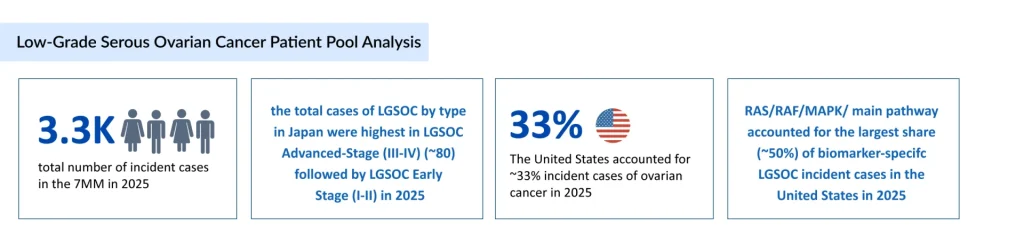
LGSOC is a rare and distinct subtype of epithelial ovarian cancer. Commonly cited estimates put it at roughly 2% to 5% of epithelial ovarian cancers. The total number of incident cases of LGSOC in the 7MM was ~3,300 in 2025, which is expected to increase by 2036, as per DelveInsight. The United States accounted for ~33% of incident cases of ovarian cancer in 2025. RAS/RAF/MAPK/ main pathway accounted for the largest share (~50%) of biomarker-specific LGSOC incident cases in the United States in 2025, followed by KRAS (~20%), and the smallest share was accounted by BRCA1/2.
Despite its indolent reputation, LGSOC is frequently diagnosed at an advanced stage. The defining feature of LGSOC is not how fast it grows, but how often it comes back. Recent literature reports recurrence rates of approximately 80%. Patients typically move through surgery, platinum-based chemotherapy, maintenance or hormone therapy, and then a cycle of recurrence, with supportive care or treatment continuing until unacceptable toxicity. Each relapse brings another decision about sequencing, and the evidence for the best order has historically been thin. For a disease that often strikes younger women than HGSOC, this can mean decades of living with a chronic, recurring cancer.
Here sits the core unmet need. Conventional platinum-based chemotherapy has limited activity in LGSOC, with response rates reported to be substantially lower than those seen in HGSOC. Patients take on the toxicity of treatment without the payoff clinicians hope for. At the same time, the disease has a more favorable overall survival than HGSOC in both early-stage and advanced-stage disease, according to the SEER analysis, which means patients live long enough to exhaust option after option. Acquired resistance to both targeted and endocrine therapies compounds the problem.
Targeted Breakthroughs: The Approved Drugs Redefining LGSOC Care
Two MAPK-directed regimens now anchor molecularly guided treatment. One was built for LGSOC. The other arrived through a tumor-agnostic approval and has become a trusted option for BRAF V600E-mutated disease.
Verastem Oncology’s AVMAPKI and FAKZYNJA Co-Pack: The First LGSOC-specific Approval
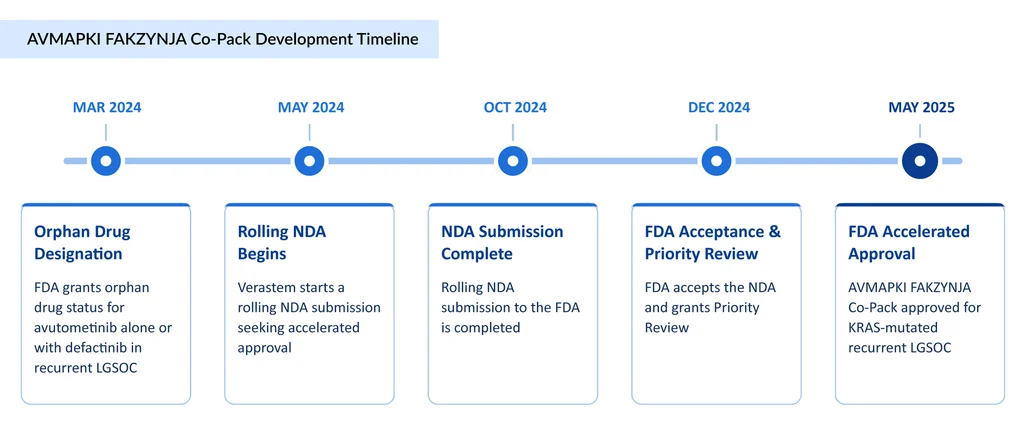
On May 8, 2025, the FDA granted accelerated approval to the AVMAPKI FAKZYNJA CO-PACK, combining avutometinib and defactinib, for adult patients with KRAS-mutated recurrent LGSOC who have received prior systemic therapy. It is the first and only FDA-approved medicine for LGSOC treatment, and the first treatment approved anywhere in the world specifically for KRAS-mutated recurrent LGSOC. The regimen had earlier received FDA Breakthrough Therapy Designation in May 2021 and Orphan Drug Designation, and in July 2025 the European Commission granted orphan designation for avutometinib plus defactinib in ovarian cancer.
The mechanism reflects the disease biology. Avutometinib inhibits MEK kinase activity while blocking the compensatory reactivation of MEK by upstream RAF. Defactinib inhibits focal adhesion kinase (FAK). Together, they aim for a more complete blockade of the signaling that drives growth and drug resistance in RAS/MAPK-dependent tumors.
The approval rested on the phase 2 RAMP 201 trial, which showed a 44% confirmed objective response rate in KRAS-mutated disease, versus 17% in KRAS-wild-type disease. Median duration of response reached 31.1 months in the KRAS-mutated group, and median progression-free survival was 22 months. Common side effects include elevated creatine phosphokinase, nausea, fatigue, abnormal liver tests and rash, and about 10% of patients discontinued because of adverse events. At Memorial Sloan Kettering, a key opinion leader quoted in the DelveInsight report praised the intermittent schedule of three weeks on and one week off, noting it improves long-term tolerability and has allowed patients to stay on therapy for a median of 18 months.
The commercial launch has been swift. Verastem launched the co-pack in the US within one week of approval at a monthly wholesale acquisition cost of USD 48,500 per 28-day cycle, built a specialty distribution network that includes Onco360, and reported broad payer coverage. The product is listed as a Category 2A recommendation in the NCCN guidelines. Net product revenue reached USD 30.9 million for full-year 2025, including USD 17.5 million in the fourth quarter, then USD 25.1 million in the second quarter of 2026, bringing cumulative net revenue to roughly USD 74.5 million since launch. Verastem has also projected that the franchise will be self-sustaining in the second half of 2026.
What comes next is critical. Because this is an accelerated approval, the ongoing Phase 3 RAMP 301 trial (NCT06072781) must verify clinical benefit. Notably, it enrolls both KRAS-mutated and KRAS-wild-type patients across Europe, Japan, Australia, and South Korea, so success could roughly double the addressable population. Topline data are expected in mid-2027, with potential filings in Japan in 2028 and Europe in 2029. Verastem also had a molecular profiling analysis and the Japanese RAMP 201J results selected for oral presentation at IGCS 2026. The company holds patent protection for avutometinib through 2039 (patent term extension) and for defactinib through 2034 (patent term adjustment).
Novartis’ TAFINLAR and MEKINIST: The BRAF V600E Workhorse
The second option is the dabrafenib (TAFINLAR) and trametinib (MEKINIST) combination from Novartis. In June 2022, the FDA granted accelerated, tumor-agnostic approval for patients with unresectable or metastatic solid tumors carrying a BRAF V600E mutation who have progressed after prior treatment and have no satisfactory alternatives. That approval supports use in BRAF V600E-positive LGSOC, and the NCCN ovarian cancer guidelines recognize the combination as a targeted option for eligible patients.
In the ROAR basket trial, the combination produced an 80% objective response rate in a small cohort of five LGSOC patients, with durations of response ranging from 12 to 42 months. Published case reports describe complete and durable responses as well. The limitation is reach: BRAF V600E is present in only a subset of LGSOC tumors, so the pool of eligible patients is small. Still, the commercial footprint is notable.
According to Sadaf Javed, oncology expert at DelveInsight, TAFINLAR plus MEKINIST generated approximately USD 1.1 million in 2022, rising to USD 21.4 million in 2025 across the 7MM and China, establishing it as the leading LGSOC therapy before the launch of AVMAPKI FAKZYNJA. Despite increasing competition, the regimen retained approximately 40% of the market in 2025, compared with around 51% captured by avutometinib plus defactinib. The evolving treatment landscape increasingly reflects complementary positioning, with dabrafenib and trametinib primarily serving patients with BRAF-mutated tumors, while avutometinib plus defactinib addresses the KRAS-mutated population.
Tomorrow’s Toolkit: Letrozole and Ubamatamab Chart the Next Chapter
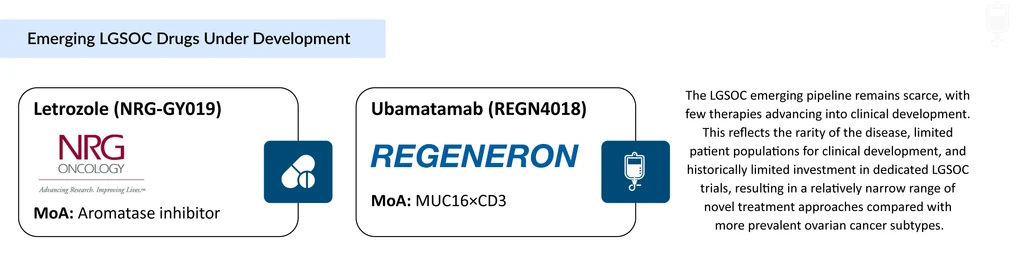
The LGSOC development landscape remains extremely limited, and the DelveInsight report names two programs shaping the near-term pipeline: letrozole in the NRG Oncology NRG-GY019 trial, and Regeneron’s ubamatamab. They tackle the problem from opposite ends. One redefines the foundation of first-line care. The other aims at a new target altogether.
NRG Oncology’s Letrozole (NRG-GY019): A Practice-defining Frontline Answer
Letrozole is an oral aromatase inhibitor that reduces estrogen synthesis. Hormone-directed therapy has been used in LGSOC for years because the disease expresses hormone receptors strongly, and the NCCN has included aromatase inhibitors for recurrent disease since 2017. What was missing was randomized evidence in the frontline setting. NRG-GY019 is the first phase 3 frontline trial completed in LGSOC, and the first phase 3 rare epithelial ovarian cancer study to complete enrollment.
The international, randomized noninferiority trial enrolled roughly 450 patients with newly diagnosed stage II to IV, p53 wild-type LGSOC after primary cytoreductive surgery, supported by National Cancer Institute grants through NRG Oncology. Patients received either letrozole alone or paclitaxel and carboplatin followed by maintenance letrozole. The question was simple: could chemotherapy be safely skipped?
Presented at the 2026 SGO Annual Meeting in April, the answer was no. Letrozole monotherapy did not demonstrate noninferiority, with a progression-free survival hazard ratio of 1.30 that crossed the prespecified margin of 1.213. At one year, progression-free survival was 80% with letrozole alone and 91% with chemotherapy plus letrozole. Overall survival was high in both arms, with 92% and 95%, respectively, a difference that was not statistically significant. The trade-off is tolerability: patients who received chemotherapy had about four times the odds of at least one grade 3 or 4 adverse event in the first six cycles. Lead investigator Amanda Fader called the results practice-defining, establishing chemotherapy plus letrozole as the standard of care for advanced LGSOC. Ongoing follow-up and tumor profiling may identify patients who can safely avoid chemotherapy, which keeps the door open for more personalized approaches. In market terms, this reinforces a stable, low-cost foundation of chemotherapy and hormonal therapy on top of which targeted drugs are layered.
Regeneron’s Ubamatamab (REGN4018): A Bispecific with Biomarker-free Appeal
If letrozole defines the foundation, ubamatamab hints at the future. It is a MUC16 by CD3 bispecific antibody that bridges MUC16-positive tumor cells and T cells through a mechanism independent of the major histocompatibility complex, promoting T-cell cytotoxicity. MUC16 is a cell surface glycoprotein highly expressed in ovarian cancers, and LGSOC in particular shows high MUC16 expression, which makes it an attractive target without requiring biomarker selection.
In the first-in-human phase 1/2 study (NCT03564340), ubamatamab showed an acceptable safety profile and durable clinical activity in recurrent ovarian cancer, including LGSOC. Results presented in a late-breaking plenary at the IGCS 2026 Annual Global Meeting showed a 73% objective response rate and an 11-month median progression-free survival in 11 patients with heavily pretreated recurrent LGSOC treated at the highest dose. Across 19 treated patients, cytokine release syndrome occurred in 90%, but all cases were grade 1 or 2, and grade 3 or higher serious events occurred in 21%. Regeneron has signaled plans to advance ubamatamab into a confirmatory phase 3 trial.
Caution is warranted, since 11 patients is a very small sample and longer follow-up is needed. But a biomarker-independent mechanism with durable responses speaks directly to the largest remaining gap: patients whose tumors are KRAS-wild-type, who have progressed through multiple therapies, or who have developed resistance to targeted and endocrine treatment. DelveInsight’s forecast already assumes a potential launch, with ubamatamab reaching about USD 41 million by 2036.
The Road Ahead: A Market Poised to Grow 14x
By any measure, LGSOC remains a small market, but it is no longer a stagnant one. DelveInsight’s analysis shows the LGSOC market growing from about USD 55 million in 2025 to roughly USD 770 million in 2036; that is a compound annual growth rate of around 25% between 2026 and 2036, and a roughly 14-fold expansion from the 2025 base. The composition of that market tells the real story. In 2025, avutometinib plus defactinib already accounted for about half of sales, with TAFINLAR plus MEKINIST at around 40% and chemotherapy and hormonal therapy making up the remainder.
By 2036, about 72% of the LGSOC market will go to avutometinib plus defactinib, roughly 14% to TAFINLAR plus MEKINIST, and about 12% to ubamatamab, while chemotherapy and hormonal therapy shrink to around 1% combined. Market drivers include the high recurrence rate and limited durability of current treatments, the spread of biomarker-driven care, growing recognition of LGSOC as a distinct disease, and the potential to broaden beyond KRAS-mutated patients. Barriers include the small patient population, the restricted label, unclear treatment sequencing, and the limited efficacy of chemotherapy.
Several milestones will shape the future trajectory of the LGSOC market. The topline results from RAMP 301, expected in mid-2027, will be particularly important, as confirmation of clinical benefit could support continued US accelerated approval and potentially expand the indication to KRAS-wild-type patients, followed by regulatory submissions in Japan in 2028 and Europe in 2029. Meanwhile, additional follow-up and molecular analyses from NRG-GY019 may help identify patients who can achieve favorable outcomes with endocrine therapy alone and those who require chemotherapy, potentially enabling more personalized treatment strategies.
The Phase 3 development of ubamatamab also represents a significant opportunity, as it could emerge as the first immunotherapy-based treatment option for LGSOC and provide a therapeutic alternative for patients without targetable mutations. Beyond clinical developments, evolving market access dynamics in 2026, including US Medicare drug price negotiations under the Inflation Reduction Act, most-favored-nation pricing pressures, and increasingly stringent European cost-containment measures, are expected to influence reimbursement decisions and commercial uptake of premium-priced orphan drugs.
The bottom line: LGSOC has moved from neglected to notable. With a first-in-class approved therapy, a tumor-agnostic option for BRAF V600E, a settled frontline standard of care, and a promising bispecific in the wings, patients finally have a pathway of options, and the industry has a clear picture of where the opportunity lies. For anyone investing in rare oncology, it is a reminder that a small disease with well-defined biology can deliver outsized impact.

Downloads
Article in PDF
Recent Articles
- AstraZeneca and Daiichi Sankyo’s Enhertu US Approval; Basilea’s ZEVTERA FDA Approval; Genmab’s Pr...
- World Ovarian Cancer Day | 2019
- Ofev’s expanded use; Arkin Bio-Ventures II launch; USD 125 M for COVID-19 treatment
- Eli Lilly’s ZEPBOUND Surpasses WEGOVY in SURMOUNT-5 Trial; Verastem Oncology Secures FDA Approval...
- Opdivo for carcinoma; Rucaparib receives designation; Sunovion buys; Insys marketed drug