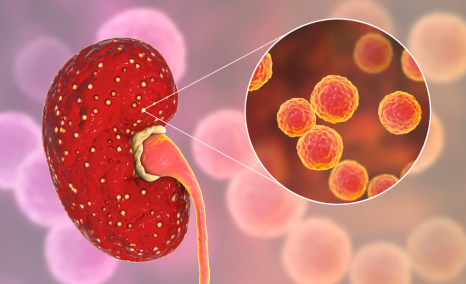
8 Applications of Cryoablation Devices in Healthcare
Apr 22, 2026
Table of Contents
Cryoablation, the use of extreme cold to destroy abnormal tissue, has rapidly evolved from a niche surgical technique into one of the most versatile minimally invasive tools in modern medicine. By precisely delivering temperatures as low as –40°C to –170°C through specialized probes, cryoablation devices destroy targeted cells while preserving surrounding healthy tissue. As the global cryoablation devices market continues to expand, driven by rising cancer incidence, growing demand for minimally invasive procedures, and technological innovation, it’s worth understanding exactly where this technology is making its biggest clinical impact.
Top 8 Uses of Cryoablation Devices in Healthcare
Cryoablation devices are widely used in healthcare to destroy abnormal or diseased tissue by applying extreme cold, typically using gases such as liquid nitrogen or argon. In oncology, they are commonly employed to treat tumors in organs like the kidney, liver, lung, prostate, and breast, offering a minimally invasive alternative to traditional surgery.
Downloads
Click Here To Get the Article in PDF

Recent Articles
- Aslan Pharma – IQVIA collaboration; Reata’s kidney drug bardoxolone; Alzheimer’s Dise...
- EU Approves Datroway for First-Line Metastatic TNBC; FDA Broadens Pluvicto’s Reach with App...
- Zimmer Biomet Secures FDA Clearance for Upgraded ROSA® Knee Robotic System; IceCure’s ProSense® C...
- SIO Urges NCCN to Add Cryoablation to Breast Cancer Guidelines Following ProSense® FDA Clearance;...
- Sana Biotechnology Reveals Long-Term Positive Data from Type 1 Diabetes Islet Cell Transplant Tri...
Beyond cancer and cardiovascular care, these devices are also used in dermatology for removing warts, skin tags, and precancerous lesions, as well as in pain management to target nerves causing chronic pain conditions. Their precision, reduced recovery time, and lower complication rates compared to conventional surgical approaches have made cryoablation an increasingly important tool across multiple clinical specialties.
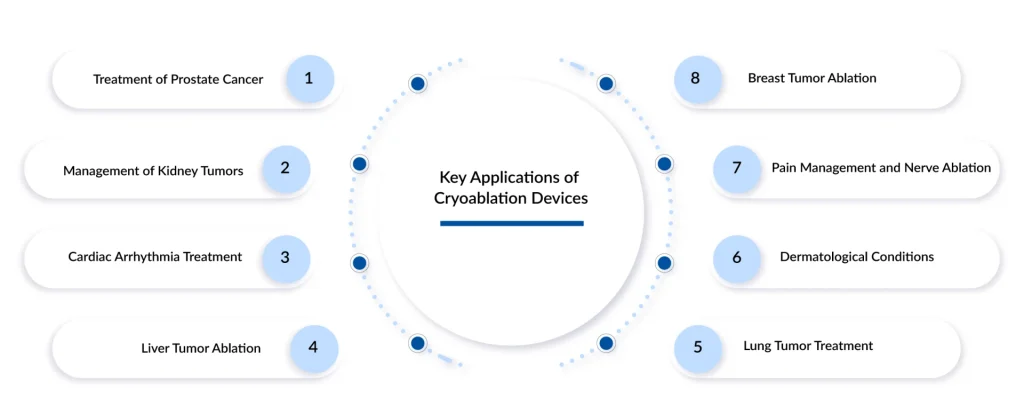
Here are the top eight applications shaping the future of cryoablation in healthcare.
Treatment of Prostate Cancer
Prostate cancer is one of the most common malignancies globally. For patients with localized prostate cancer or those who have experienced a recurrence after radiation therapy (salvage cryotherapy), cryoablation serves as a potent alternative to radical prostatectomy. During the procedure, several cryoprobes are inserted through the perineum into the prostate gland under transrectal ultrasound guidance. The goal is to freeze the entire gland or specific focal areas where tumors are located. The extreme cold disrupts cell membranes and causes vascular stasis, effectively “starving” the tumor. One of the primary benefits highlighted by clinical research is the reduced recovery time compared to open surgery. However, as noted by health monitoring agencies, the proximity of the prostate to the urethra and rectum requires the use of a warming catheter to protect the urethral lining from freezing damage.
Management of Kidney Tumors
For small renal masses (typically less than 4 cm), cryoablation has become a standard of care, particularly for patients who are not ideal candidates for traditional surgery due to age or comorbidities. The application in kidney health is vital because cryoablation is “nephron-sparing.” Instead of removing the entire kidney, the physician targets only the tumor. This preserves maximum renal function, which is a critical priority identified by the CDC in preventing chronic kidney disease (CKD). Because the ice ball is clearly visible on CT scans, surgeons can ensure a “kill zone” that encompasses the entire tumor margin plus a small safety buffer of healthy tissue.
Cardiac Arrhythmia Treatment
In the field of electrophysiology, cryoablation has revolutionized the treatment of Atrial Fibrillation (AFib). Unlike heat-based radiofrequency ablation, which uses friction to create scars, cryoablation uses a cryoballoon to freeze the tissue around the pulmonary veins. This process, known as Pulmonary Vein Isolation (PVI), creates a circular scar that blocks the irregular electrical signals causing the arrhythmia. The advantage of cold-based therapy in the heart is the reduced risk of “char” formation or esophageal injury, which can sometimes occur with heat. Patients undergoing cardiac cryoablation often report a significant improvement in quality of life and a reduction in the need for long-term anticoagulant or anti-arrhythmic medications.
Liver Tumor Ablation
The liver is a common site for both primary cancer and metastatic deposits from the colon or breast. When tumors are located near large blood vessels, traditional surgery can be risky. Cryoablation is utilized in the liver because the “cold” effect is less likely to damage the collagen framework of large vessels compared to heat. This allows for the treatment of tumors that were previously considered unresectable. WHO cancer management profiles suggest that local ablation techniques like cryotherapy are essential components of a comprehensive cancer care strategy, especially in regions where access to full organ transplantation is limited.
Lung Tumor Treatment
Primary and metastatic lung tumors present significant challenges due to the movement of the lungs during breathing. Cryoablation is increasingly used for patients with Stage I non-small cell lung cancer (NSCLC) who have poor pulmonary reserve. A unique benefit of lung cryoablation is the “cryo-analgesic” effect. Because cold naturally numbs nerve endings, patients often experience less post-operative pain compared to heat-based treatments like microwave ablation. Furthermore, the procedure carries a lower risk of damaging the pleura, which helps prevent complications like pneumothorax, a metric closely monitored in surgical safety databases.
Dermatological Conditions
The use of cryoablation in dermatology is perhaps its most “classic” application. From the removal of benign warts and seborrheic keratoses to the treatment of precancerous actinic keratosis and early-stage basal cell carcinomas, cryotherapy is a staple in outpatient clinics. In these cases, liquid nitrogen is often applied via a spray or a cotton-tipped applicator. The rapid freezing causes the lesion to blister and eventually fall off, allowing healthy skin to regenerate. Its low cost, speed, and minimal scarring make it a preferred first-line treatment in global health settings for skin disease management.
Pain Management and Nerve Ablation
Cryoneurolysis is the application of cryoablation to peripheral nerves to provide long-term pain relief. By freezing a nerve, the “axonotmesis” process occurs, the internal structure of the nerve is disrupted, blocking pain signals, but the outer sheath remains intact, allowing the nerve to eventually regenerate over several months.
This is widely used for:
- Intercostal neuralgia: Pain following chest surgery.
- Knee Osteoarthritis: Targeting the genicular nerves to reduce chronic pain.
- Phantom limb pain: Providing relief for amputees.
The CDC identifies the development of non-opioid pain management strategies as a top priority to combat the opioid crisis; cryoablation serves as a critical tool in this effort by providing localized, drug-free relief.
Breast Tumor Ablation
One of the most exciting emerging applications is the treatment of benign breast tumors (fibroadenomas) and, increasingly, small early-stage breast cancers. For many women, the prospect of surgery involves concerns about scarring and breast deformity. Cryoablation is performed through a tiny incision under local anesthesia. The ice ball engulfs the tumor, and over time, the body reabsorbs the dead tissue. Clinical trials monitored by regulatory bodies have shown high success rates in tumor destruction with excellent cosmetic outcomes, potentially shifting the paradigm of breast cancer care toward “office-based” procedures for low-risk patients.
Future Outlook of Cryoablation Devices
The cryoablation devices market is poised for sustained growth at a CAGR of ~9% by 2034, with the active participation of several companies such as Medtronic, CPSI BIOTECH, Coopersurgical Inc., Atricure, Inc., Galil Medical Inc., BVM Medical Limited, Healthtronics, Inc., SANARUS TECHNOLOGIES, METRUM CRYOFLEX SP, Boston Scientific Corporation, Varian Medical Systems, Inc., Biosense Webster, Adagio Medical, Icecure Medical, and others. The integration of robotic-assisted delivery systems and AI-powered imaging guidance promises to further enhance procedural precision and reproducibility. Miniaturization of cryoprobe technology is expanding access to anatomically challenging tumor locations, while combination therapies, pairing cryoablation with immunotherapy, are generating significant research interest due to cryoablation’s known ability to stimulate systemic anti-tumor immune responses (the “abscopal effect”).
Geographically, markets across North America, Europe, and the Asia-Pacific region continue to lead adoption, while the Middle East and Africa are emerging as high-growth markets driven by expanding oncology infrastructure and rising healthcare investment. As clinical evidence matures and reimbursement frameworks improve, cryoablation is expected to transition from a secondary option to a primary treatment modality across multiple specialties, fundamentally reshaping how clinicians approach localized tumor management and chronic disease treatment.

Downloads
Article in PDF
Recent Articles
- ACC.25 Highlights: Groundbreaking Advances in Cardiovascular Medicine and Emerging Therapeutics
- AstraZeneca’s Imfinzi Shows Positive Results; Novartis Announces Results of Tislelizumab; FDA Gra...
- Artivion and Endospan Agreement; Masimo and Cleveland Clinic Collaboration; Academic Medical Cent...
- Chronic Kidney Disease: Complex Debilitating Condition
- Aktis’s Novel Targeted Alpha Radiopharmaceuticals; Koye Partners with Sonde Health; Novartis to S...